
Rent vs Buy Calculator with Break-Even and Net Worth Analysis
Use this focused rent vs buy calculator, an advanced real estate decision-support utility. Renting and buying create different cash flows and different assets.
A monthly rent payment is not directly comparable with a mortgage payment because part of the mortgage payment reduces loan principal, while ownership also requires transaction costs, property tax, insurance, maintenance, and eventual selling costs. This online tool projects both renting and buying paths over a shared holding period. It presents a comprehensive annual cash-flow ledger, comparing cumulative housing costs and future net worth based on transparent scenarios.
Have a suggestion or found a calculation discrepancy? Let us know!
How to use this rent vs buy calculator
Enter the renting assumptions
Input your current or proposed monthly rent payment, security deposit, and estimated annual rent increase rate. Add other recurring costs such as renter's insurance and utility bills, plus their annual cost inflation rates. These values define the base cost line for renting.
Enter the home purchase and mortgage assumptions
Input the purchase price of the home, down payment amount, and closing costs. Specify the mortgage terms, including the annual interest rate and amortization period (e.g., 30 years). You can import these parameters from our mortgage tools or enter them manually.
Choose a shared analysis horizon
Select the holding period (number of years) for your analysis. The calculator uses this time frame to compare the total accumulated housing outlays and the ending net worth for both paths. Adjust the appreciation rates and alternative investment returns to see different outcomes.
Your rent versus buy comparison
Cumulative housing cost comparison
This lens shows the total cash outflow dedicated strictly to housing expenses under both paths. For renting, this includes rent payments and insurance. For buying, it comprises interest payments, maintenance, taxes, insurance, and closing/selling costs. Principal repayment is excluded here because it represents an equity transfer rather than a permanent loss.
Future net worth comparison
This lens compares your final liquid and illiquid wealth at the end of the analysis period. The renting side models a portfolio starting with the buyer's down payment and closing costs, augmented by investing the monthly cash-flow savings. The buying side comprises the appreciated home value minus the remaining mortgage balance and selling transaction fees.
Modeled crossover year
The crossover point (or break-even year) represents the moment when one path becomes economically superior to the other. There can be two different crossover years—one for cumulative cost and one for terminal net worth. The calculator displays both based on your specific financial inputs and growth assumptions.
Build the renting scenario
Initial rent and rent growth
The baseline rent is compounding annually. A 3% annual rent growth is typical in stable economic environments, but metropolitan areas can experience much higher volatility. Over a 10-year period, annual compounding significantly increases your total rental outflow.
Security deposit and renter costs
A renter must lock up a security deposit at month zero, which is refunded at the exit date. The renter path also models annual recurring renter's insurance to shelter personal property, plus any other secondary renter-paid utilities or services.
Renter investment account
To keep the comparison fair, the model assumes the renter starts with the same initial cash outlay as the buyer (down payment plus closing costs). The renter pays the security deposit, and the remaining funds are invested in a portfolio. Additionally, any monthly cash savings compared to the buying path are contributed to this portfolio.
Build the buying scenario
Purchase price and down payment
The purchase price establishes the asset base, while the down payment represents the initial equity injection. A larger down payment reduces the required loan size and monthly interest drag, but limits the liquidity available for alternative investments.
Mortgage principal and interest
The monthly mortgage payment is divided into principal reduction and interest costs. Interest is a pure cost paid to the lender, whereas principal represents equity conversion. Over time, the amortization schedule shifts to pay down more principal and less interest.
Purchase and selling transaction costs
Buying requires upfront closing fees (e.g., loan origination, title insurance, recording fees), and selling requires exit commissions (broker fees and transfer taxes). These transaction frictional costs represent permanent losses that increase the holding period required to break even.
Add recurring ownership costs
Property tax and insurance
Property taxes are assessed locally and typically range from 0.5% to 2.5% of assessed property value. Home insurance shelters the physical structure from loss. Both components are recurring costs that inflate over time, increasing your ongoing ownership liabilities.
Maintenance, HOA, and other costs
A physical structure requires ongoing maintenance (roof repair, plumbing, landscaping), which is often estimated at 1% of property value annually. Homeowners association (HOA) dues may also apply. Renters are shielded from these costs, which are borne entirely by the owner.
Ownership-cost growth assumptions
Operating expenses do not remain constant. Inflation pushes up the cost of labor, materials, and insurance premiums. The calculator applies an annual expense growth rate (e.g., 2.5%) to taxes, insurance, and maintenance, compounding these costs over the horizon.
Model home value and equity
Home appreciation assumption
Over long periods, real estate values tend to appreciate. The appreciation rate is a key lever in the model. A 3% or 4% appreciation rate can lead to significant equity accumulation over 10 years, representing the primary wealth-building engine of homeownership.
Remaining mortgage balance
As monthly principal payments are made, the outstanding mortgage balance decreases. The calculator models this amortization schedule, calculating the precise debt payoff and tracking your growing equity stake in the property.
Net sale proceeds and terminal equity
At the end of your holding period, the model assumes a hypothetical sale. The net sale proceeds are calculated as the appreciated home value minus the remaining mortgage balance and transaction fees (selling costs). This cash enters your terminal net worth.
Compare rent-versus-buy scenarios
Rent-favorable scenario
This scenario models conditions that favor renting: low rent inflation, poor housing price appreciation, and high owner operating costs. It illustrates how renting can build more wealth if the housing market stagnates or if ownership costs rise too quickly.
Base comparison scenario
The base scenario compiles your default assumptions, representing the most likely mid-range projection. It matches current local rent listings and standard mortgage parameters, serving as the primary benchmark for decision-making.
Buy-favorable scenario
This scenario models a strong housing market with high property appreciation, high rent inflation, and low ownership expense growth. Under these assumptions, buying quickly outpaces renting, accumulating substantial equity while sheltering the owner from rent hikes.
Rent versus buy variance profiling
Holding-period fluctuations
Frictional closing and selling costs make short-term homeownership expensive. This sensitivity test evaluates different holding periods (e.g., 3, 5, 7, 10, or 15 years) to show how the break-even dynamics improve the longer you plan to live in the home.
Rent-growth and appreciation variability
Rent growth and home appreciation are two dominant levers that are impossible to predict. The sensitivity matrix maps various rent inflation rates against housing appreciation rates, showing you the threshold where one option becomes superior to the other.
Investment-return fluctuations
If the renter's alternative investment portfolio yields high returns (e.g., 8% or 10%), renting can build more wealth than buying, even in a strong housing market. This analysis projects how different stock market returns impact the renter's wealth accumulations.
Rent versus buy formula and methodology
Net Worth Formula
Renter and buyer future assets are compared at the end of the selected horizon using standardized accounting formulas:
Annual cash-flow ledger
The engine runs a month-by-month cash flow loop, recording rent inflation, mortgage payments, property taxes, insurance, and maintenance. Rather than using simplified annual averages, the ledger compounds values monthly to reflect realistic timing.
Cumulative-cost method
Cumulative economic cost is derived as: Economic Cost = Total Outflows - Asset Recoveries. For buying, mortgage principal payments are recovered via equity, meaning only interest, fees, taxes, and selling commissions are counted as permanent economic losses.
Terminal-net-worth method
Terminal Net Worth measures total net asset values on the exit date. Renter net worth comprises the security deposit refund and the accumulated investment portfolio. Buyer net worth is the net proceeds from a home sale plus any buyer-side investment portfolio.
Rent versus buy calculation example
Example renting assumptions
Let's analyze a renter paying $2,500/month with a 3% annual rent growth and a $2,500 security deposit. Renter's insurance costs $300/year. Renter starts with $112,000 (buyer's down payment and closing costs minus renter deposit) in an investment account.
Example buying assumptions
A buyer purchases a home for $500,000, contributing a $100,000 down payment (20%), and $12,000 closing costs. The mortgage is a 30-year loan at 6.5% interest, with an annual property tax of $6,000 and maintenance of $5,000/year.
Example five-year comparison
Over 5 years, the home appreciates at 3.5% annually to $593,848. The buyer pays off $21,300 in loan principal, leaving a remaining balance of $378,700. After deducting a 6% selling commission ($35,630), the buyer's home equity is $179,518. If alternative investments returned 6%, the renter's portfolio grows to $183,400. In this case, renting builds slightly more wealth over a 5-year stay due to transaction costs.
Continue your housing analysis
Build the mortgage and down payment
An accurate rent vs. own analysis relies heavily on mortgage parameters. Navigate to our mortgage calculator to model different interest rates and down payment plans, and import the results back into your rent vs. buy sheet.
Open Mortgage Calculator →Estimate closing costs and property tax
Property taxes and transaction fees directly affect ownership cash flows. Use our Closing Cost and Property Tax tools to estimate local transaction fees, ensuring your underwriting is grounded in county-specific rules.
Open Closing Cost Calculator →Review the home-value scenario
Different property types (e.g., single-family homes vs. condos) experience different appreciation patterns. Underwrite your specific real estate asset class by analyzing historical appreciation indexes before finalizing your scenario assumptions.
Open LTV Calculator →Rent versus buy use cases
Short expected stay
If you plan to stay in a home for only 2 or 3 years, renting is almost always more financially advantageous. Transaction costs (closing costs when buying and commissions when selling) represent a significant cost barrier that requires several years of property appreciation to overcome.
Long-term homeownership planning
For individuals planning to settle in a region for 7 to 10 years or longer, buying is generally superior. Over a longer time frame, home appreciation builds substantial equity, and fixed-rate mortgage payments shelter the owner from the risk of compounding rent increases.
Relocation and uncertain timing
If you are relocating to a new city or have uncertain career plans, renting provides the flexibility to move without incurring transaction losses. The renter investment account ensures your capital continues to grow in alternative investments until you are ready to settle.
Common rent-versus-buy mistakes
Comparing rent only with mortgage payment
A common error is comparing monthly rent directly with the monthly mortgage payment. This comparison ignores the principal paydown portion of the mortgage (which builds equity) and omits homeownership operating costs (taxes, insurance, and maintenance) which can add hundreds of dollars to your monthly liability.
Treating principal as a pure expense
Mortgage principal reduction is an equity transfer, not a loss. Unlike rent, which is gone forever, principal payments increase your net home equity and are recovered when the property is eventually sold.
Hiding appreciation and investment assumptions
Some calculators mask the critical role that home appreciation and alternative investment returns play in the outcome. A small shift in either assumption can change the break-even year by a decade. Transparently modeling these parameters is essential for realistic planning.
Data sources and assumption quality
User-entered housing costs
The accuracy of this model depends on using realistic local parameters. Inputting actual rental listings and true property sales data ensures that the projection matches local market realities rather than generic national averages.
Mortgage, tax, and transaction imports
By importing closing fees and local property tax rates from official calculations, you eliminate guesswork, anchoring your homebuyer costs in documented, county-specific fee schedules.
Scenario assumptions versus observed data
Appreciation rates and stock returns are projections, not guarantees. The matrix panel lets you evaluate how the comparison shifts under bull and bear markets, providing a margin of safety against market downturns.
Real-world case study: U.S. Industrial Warehouse Sector Benchmark (FY 2024 (Industry Standard))
U.S. Industrial Warehouse Sector Benchmark metrics profile
Many businesses evaluate whether to lease or purchase their industrial facilities, a critical decision impacting long-term operational costs and asset building. This case study analyzes a hypothetical 75,000 square foot industrial warehouse in the U.S. market, comparing the financial implications of renting under a triple-net lease versus outright purchasing the property, based on current market benchmarks from FY 2024.
The decision to rent or buy an industrial warehouse involves a significant trade-off between initial capital outlay and long-term financial benefits. While renting a 75,000 sq ft facility under a triple-net lease requires a substantially lower upfront cash outlay of $137,500 (security deposit), purchasing the same property demands a considerable initial investment of approximately $2.66 million (down payment plus closing costs). However, ownership offers the advantage of building equity and benefiting from potential property appreciation, which averaged 0.5% in Q4 2023 for industrial properties, a factor absent in leasing. The annual owning costs, including a 6.00% commercial mortgage, property taxes averaging 1.85% of value, insurance, maintenance, and management fees, are initially higher than the first year's rent. Nevertheless, fixed-rate debt provides payment predictability against an average annual rent escalation rate of 3.0%, which can lead to cost savings over the long term. This analysis underscores the importance of evaluating both immediate liquidity and strategic long-term financial goals when making real estate decisions.
Related Calculators
Estimate real estate capitalization rate.
Open Tool →Occupancy Rate CalculatorCalculate occupancy and vacancy rate.
Open Tool →Cash-on-Cash ReturnMeasure levered cash return on equity.
Open Tool →NOI CalculatorCompute net operating income.
Open Tool →DSCR CalculatorSolve debt service coverage ratios.
Open Tool →Rental Property ROIEvaluate rental buy-and-hold returns.
Open Tool →Related Articles & Guides
 Real Estate
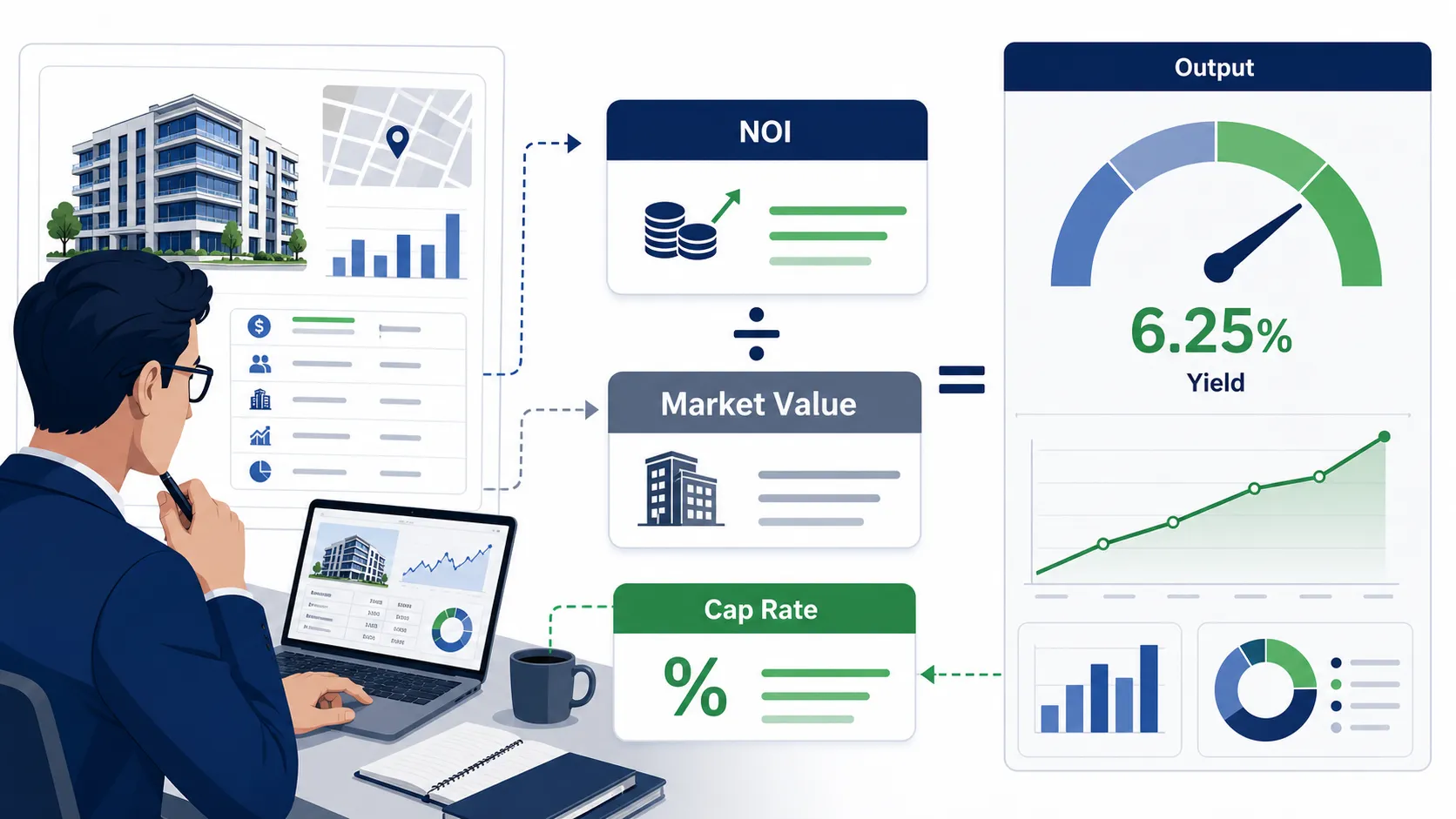
Cap Rate Calculator: Calculate Capitalization Rate Step by Step
Stop guessing property values. The cap rate formula delivers a single-year yield metric that strips out debt, letting you compare diverse assets instantly. Misjudge this rate, and you risk locking capital into an underperforming investment.
 Corporate Finance
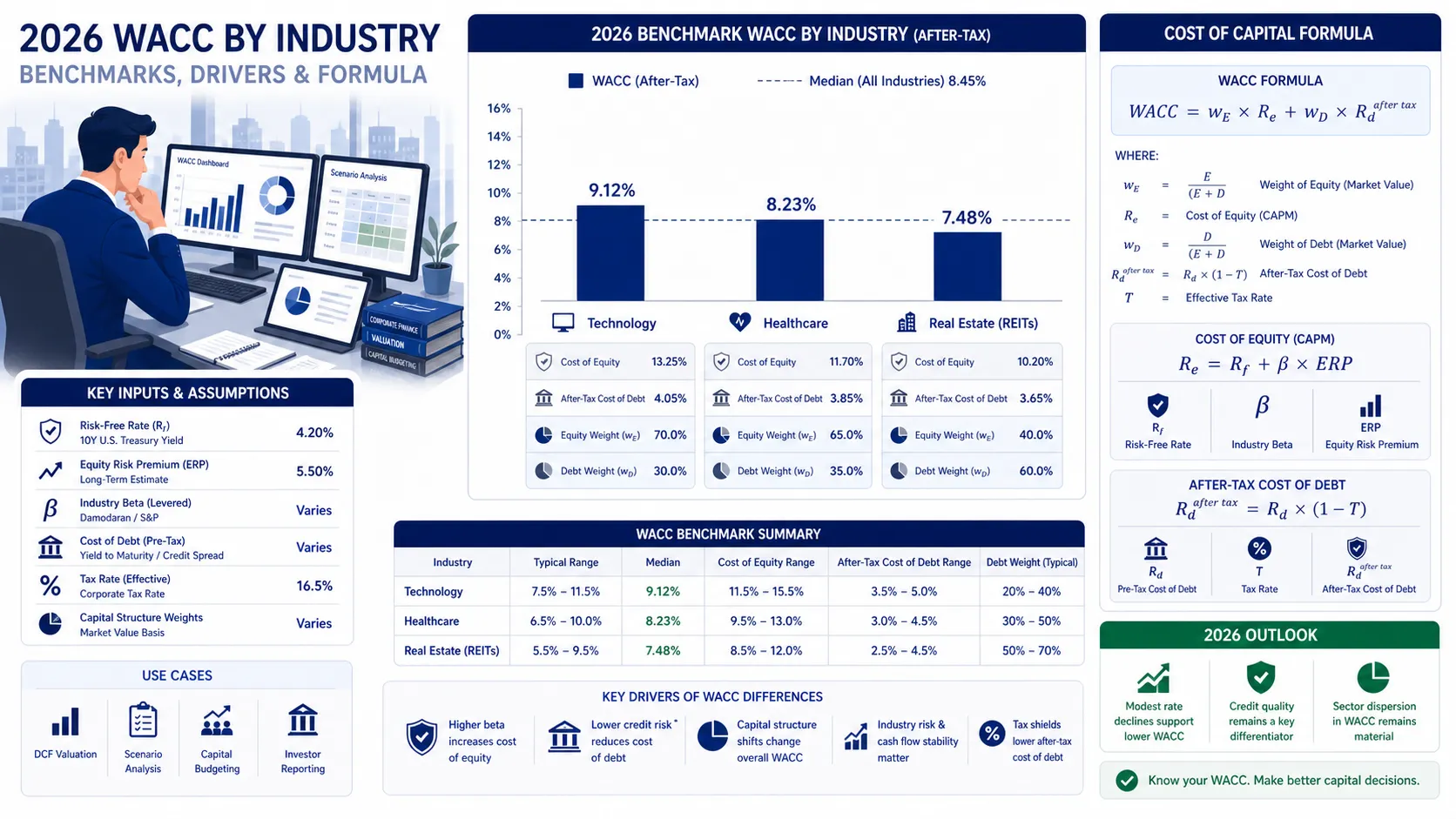
WACC by Industry: 2026 Benchmarks for Technology, Healthcare, and Real Estate
In 2026, industry WACC diverges sharply, from 5.5% for utilities to over 11.5% for software. CFOs must benchmark their discount rate against peers to ground valuations in market reality.
 Corporate Finance
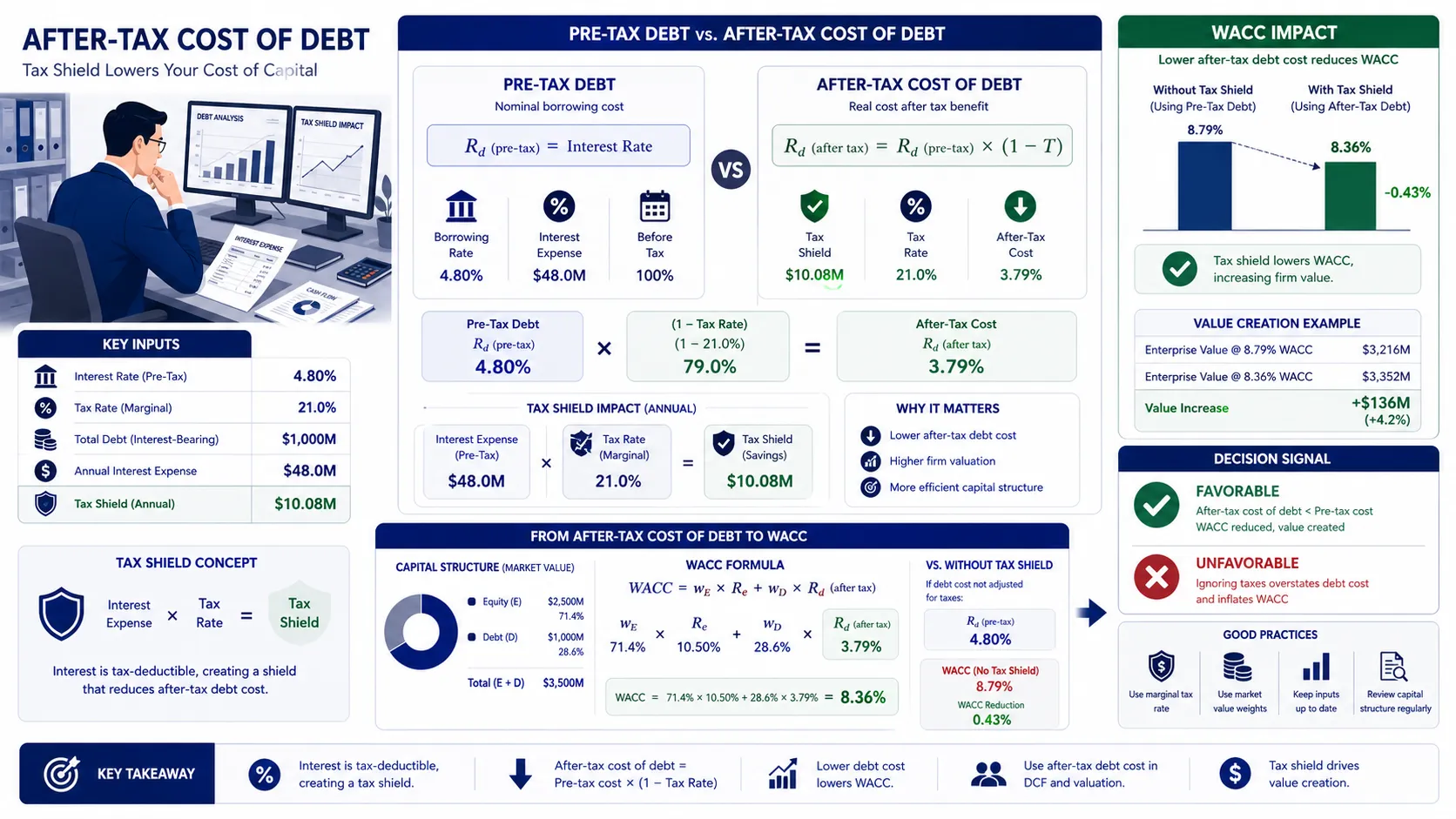
What Is After-Tax Cost of Debt and How Does It Lower WACC?
Interest payments are tax-deductible, making debt cheaper than equity and lowering your company's WACC. The after-tax cost of debt reveals this true, subsidized borrowing rate.
Frequently asked questions
How does rent versus buy break-even work?
Is mortgage principal a cost?
How is the down payment opportunity cost modeled?
Does the calculator include tax deductions?
Does this result tell me whether to rent or buy?
The real estate calculations, yield projections, and cash flow reports generated by BizToolkitPro are for educational and informational purposes only. They do not constitute formal real estate brokerage, lending underwriting, tax counsel, or legal advice.
Investment returns, debt coverage ratios, and capitalization metrics (including Cap Rate, DSCR, Cash-on-Cash, and Waterfall distributions) are simulated based on user-provided inputs and assumptions. Local housing laws, property taxes, market vacancies, and interest rates fluctuate dynamically; therefore, BizToolkitPro makes no warranties regarding the accuracy or real-world applicability of these projections.
Always perform your own independent physical and financial due diligence on properties, and consult with a licensed Real Estate Broker, Mortgage Underwriter, Tax Advisor, or real estate attorney before signing purchase agreements or securing loans.