
Cash-on-Cash Return Calculator for Real Estate Investment Yields
Use this focused Cash-on-Cash Return calculator, a premium real estate tool designed to measure out-of-pocket equity yield performance. While capitalization rates offer an unlevered benchmark of property performance, Cash-on-Cash (CoC) Return measures the actual cash yield realized by the investor relative to the cash they deployed.
This interactive tool tracks purchase prices, down payments, closing costs, rehab expenses, and financing payments to generate first-year return percentages, scenario comparisons, and risk profiles. Whether you are syndicating a deal or auditing a single-family rental, this calculator provides immediate sizing precision.
Have a suggestion or found a calculation discrepancy? Let us know!
How to use this Cash-on-Cash Return calculator
Identifying acquisition cash elements
To determine the true amount of equity tied up in the asset, look beyond the down payment. Input the following out-of-pocket cash requirements:
- Down Payment Cash: The actual equity paid to the seller, excluding lender loans.
- Closing Costs: Title fees, origination points, transfer taxes, and escrow setups.
- Rehab & Repair Budget: Initial capital expenditures required to make the property habitable or upgrade units.
- Initial Reserves: Operational cash set aside for vacancy buffers and sudden maintenance issues.
Operational revenues and financing inputs
Once your cash inputs are sized, model the annual operations and leverage payments of the property:
- Annual Gross Rent: Contract rental income generated under full occupancy.
- Other Income: Extra revenues from parking, storage, laundry, or pet fees.
- Vacancy Rate: Budgeted percentage to cover lease turnover gaps.
- Annual Debt Service: Total interest and principal paid to mortgage lenders annually.
Cash-on-Cash Return formula and methodology
The basic Cash-on-Cash equation
Cash-on-Cash Return measures the proportion of cash flow generated relative to the actual out-of-pocket cash invested. The formula is:
Understanding Total Cash Invested vs. Annual Pre-tax Cash Flow
Total Cash Invested (the denominator) represents the absolute liquidity an investor must tie up in the transaction. This is the sum of the purchase down payment, acquisition closing costs, immediate repair budgets, and any initial cash reserves required to secure bank financing. Neglecting to count non-down-payment acquisition costs is a major issue that leads to overstated return metrics.
Annual Pre-tax Cash Flow (the numerator) represents the remaining cash generated after operating costs and financing payments are fully covered. The calculation bridge resolves Potential Gross Income, deducts vacancy losses to find Effective Gross Income, subtracts operating expenses to determine Net Operating Income (NOI), and finally deducts the mortgage debt service (principal and interest) to solve for the pre-tax cash flow.
Cash-on-Cash Return example calculation
Baseline property acquisition parameters
Let's evaluate a rental property under acquisition with the following financial specifications:
- Purchase Price = $800,000
- Down Payment (25% Equity) = $200,000
- Closing Costs = $15,000 | Rehab Budget = $10,000
- Annual Gross Rental Income = $96,000 | Vacancy Rate = 5.00%
- Annual Operating Expenses = $32,000 | Annual Debt Service = $41,200
Step-by-step cash flow calculation breakdown
First, size the Total Cash Invested:Total Cash = $200,000 + $15,000 + $10,000 = $225,000.
Next, calculate the Effective Gross Income (EGI):EGI = $96,000 * (1 - 0.05) = $91,200.
Determine Net Operating Income (NOI):NOI = $91,200 - $32,000 = $59,200.
Subtract Annual Debt Service to find the Pre-tax Cash Flow:Cash Flow = $59,200 - $41,200 = $18,000.
Finally, divide pre-tax cash flow by the total cash invested to solve for the return percentage:CoC Return = ($18,000 / $225,000) * 100 = 8.00%. The property yields an 8.00% annual cash flow return on the deployed equity.
What a Cash-on-Cash Return result means for investors
Positive leverage vs. negative leverage
If your Cash-on-Cash Return is higher than the property's Cap Rate, you are experiencing "positive leverage." This happens when your borrowing interest rate is lower than the asset's overall cap rate yield, meaning lender funds amplify your equity return. If the borrowing rate is higher than the cap rate, "negative leverage" occurs, and debt obligations drag down your personal cash yield below the asset's base performance.
Risk profiling across asset classes
Target Cash-on-Cash Returns vary by asset location and class. Prime multifamily class-A units might yield a safe 4% to 6% CoC due to rapid appreciation prospects and low vacancy risks. Value-add commercial properties in secondary markets often target 8% to 12% CoC to offset lease rollover risks and physical upkeep liabilities.
Impact of holding period durations
First-year Cash-on-Cash Return only shows a snapshot of early performance. In properties undergoing renovations, the first-year return might be lower or negative due to heavy upfront rehab costs. As rents rise and units stabilize in subsequent years, the cash-on-cash yield should expand, changing the long-term yield profile of the asset.
Common underwriting mistakes and limitations
Confusing Cash-on-Cash Return with Cap Rate or IRR
Many investors confuse these three metrics. The Cap Rate is unlevered (ignores debt service) and measures asset efficiency. The Internal Rate of Return (IRR) is a multi-year metric that accounts for time-value of money, rental growth projections, and the eventual sale price of the asset. Cash-on-Cash Return is a single-year, levered metric measuring immediate cash yield. Confusing these leads to mismatched investment allocations.
Omitting hidden acquisition closing costs
Underwriters often divide cash flow by the down payment amount alone, forgetting that commercial deals carry title fees, loan origination points, transfer taxes, legal counsel bills, and upfront reserves. Omitting these costs from the capital denominator yields an artificially high CoC Return projection that will not match reality once capitalization occurs.
- Rehab inclusions: Always add upfront repair budgets to the total cash base.
- Hold-period scales: Adjust parameters if evaluating holding times under 12 months.
- Leverage cushions: Ensure your DSCR remains above 1.25x before maximizing debt.
Real-world case study: U.S. Multi-family Real Estate Investment (2024 Industry Standard)
U.S. Multi-family Real Estate Investment metrics profile
This case study examines a hypothetical investment in a 4-unit multi-family property in the U.S. during 2024, using realistic industry benchmarks for property acquisition costs, rental income, and operating expenses. It illustrates the calculation of Cash on Cash Return, a fundamental metric for evaluating the profitability of real estate investments.
A Cash on Cash Return of approximately 3.51% indicates that for every dollar of the initial cash investment, the investor receives about $0.035 back in pre-tax cash flow during the first year. In the current U.S. real estate market, characterized by elevated interest rates and stabilizing cap rates around 5.7-6.0% for multi-family properties, this return is modest but can be a realistic outcome. Investors typically weigh this metric against other investment opportunities and factors such as potential property appreciation, debt paydown, and tax benefits to assess the overall attractiveness of the real estate venture.
Related Calculators
Estimate real estate capitalization rate.
Open Tool →Occupancy Rate CalculatorCalculate occupancy and vacancy rate.
Open Tool →NOI CalculatorCompute net operating income.
Open Tool →DSCR CalculatorSolve debt service coverage ratios.
Open Tool →Rental Property ROIEvaluate rental buy-and-hold returns.
Open Tool →Gross Rent MultiplierBenchmark property pricing quickly.
Open Tool →Related Articles & Guides
 Real Estate
Cap Rate Calculator: Calculate Capitalization Rate Step by Step
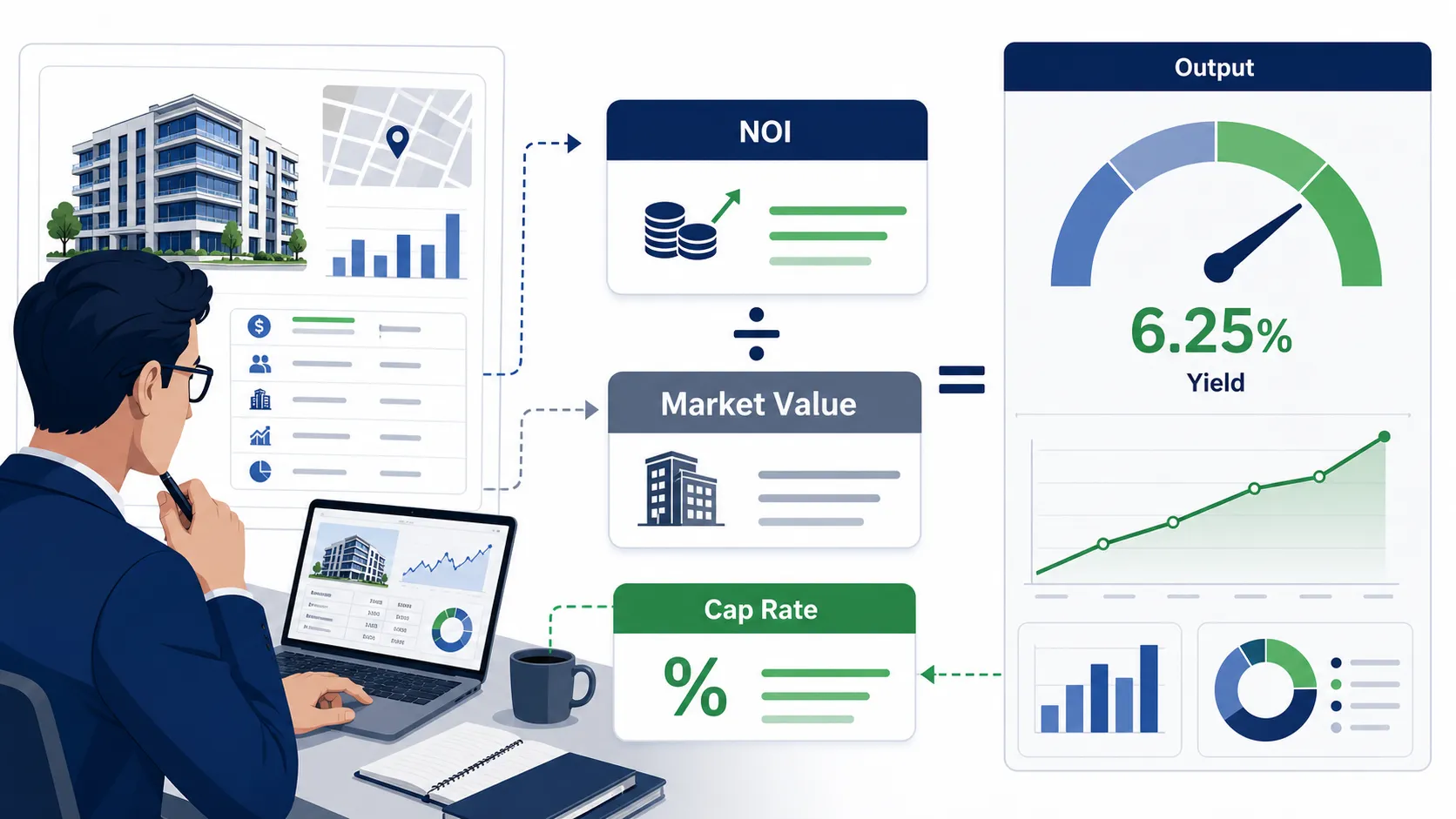
Stop guessing property values. The cap rate formula delivers a single-year yield metric that strips out debt, letting you compare diverse assets instantly. Misjudge this rate, and you risk locking capital into an underperforming investment.
 Corporate Finance
WACC by Industry: 2026 Benchmarks for Technology, Healthcare, and Real Estate
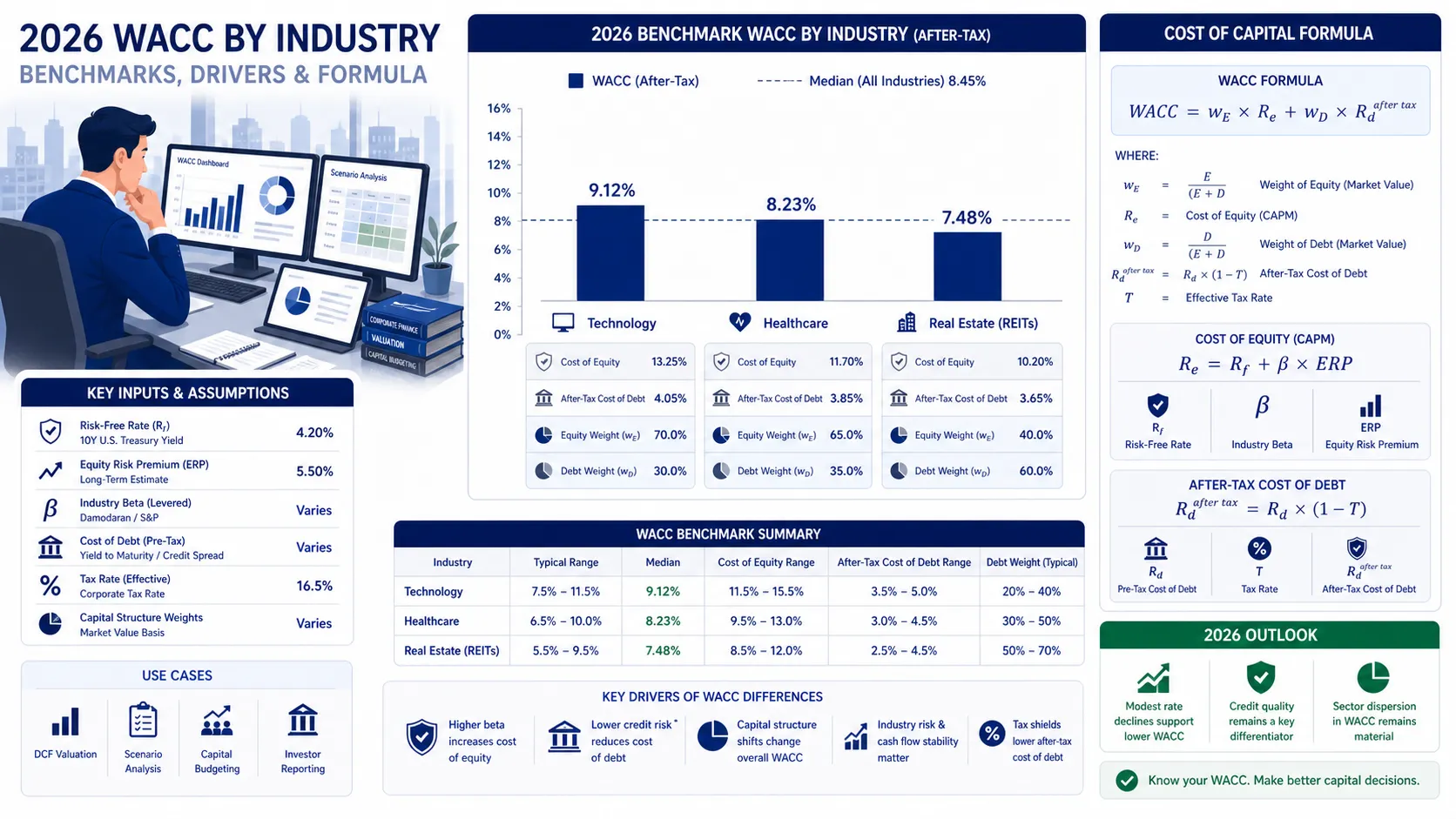
In 2026, industry WACC diverges sharply, from 5.5% for utilities to over 11.5% for software. CFOs must benchmark their discount rate against peers to ground valuations in market reality.
 Corporate Finance
What Is After-Tax Cost of Debt and How Does It Lower WACC?
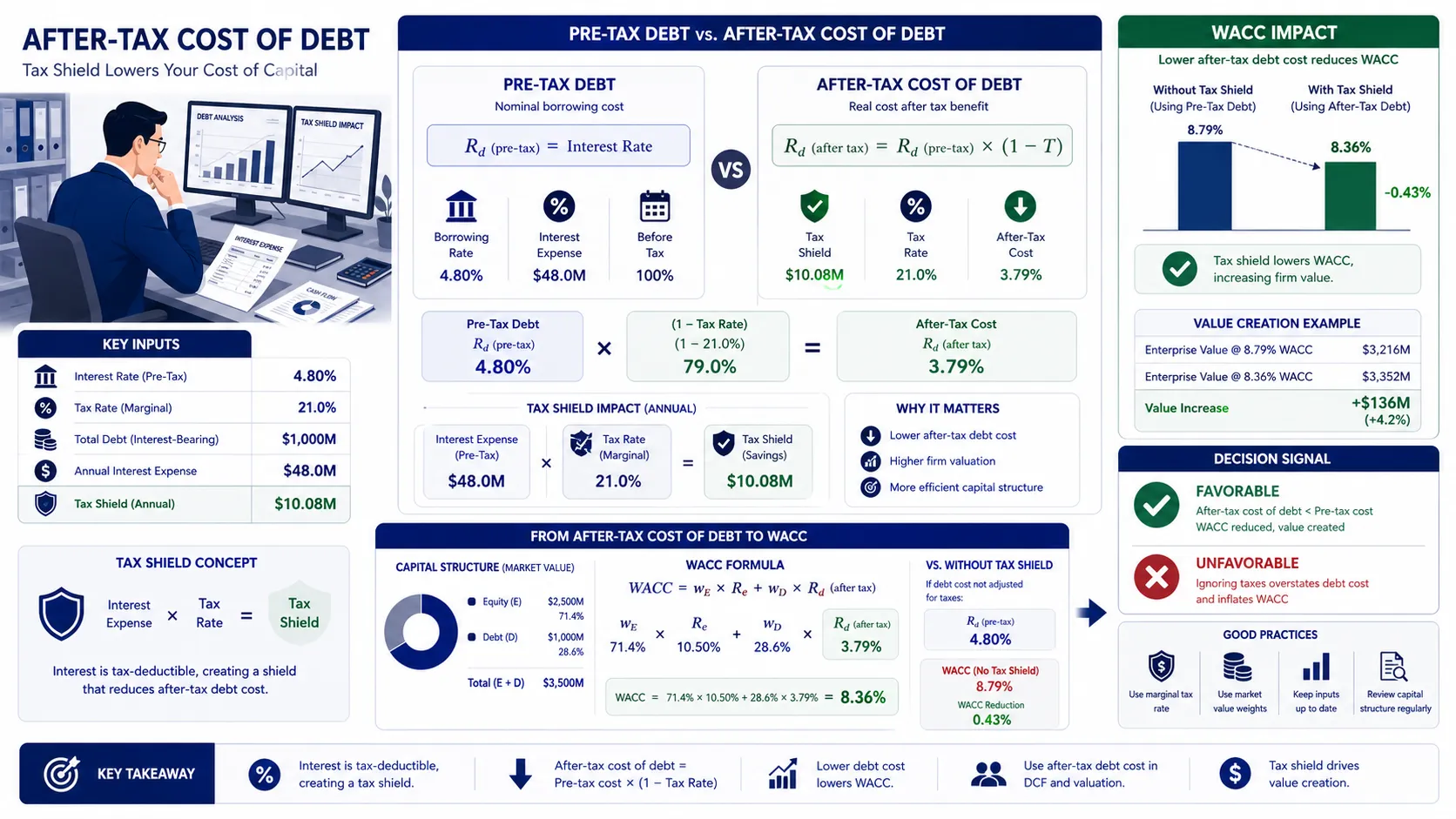
Interest payments are tax-deductible, making debt cheaper than equity and lowering your company's WACC. The after-tax cost of debt reveals this true, subsidized borrowing rate.
Frequently Asked Questions (FAQ)
What is a good Cash-on-Cash Return in real estate?
How does rehab spending impact Cash-on-Cash Return?
Should I use principal payments to calculate cash flow?
Why is Cash-on-Cash different from the Internal Rate of Return (IRR)?
How does vacancy affect the break-even occupancy?
The real estate calculations, yield projections, and cash flow reports generated by BizToolkitPro are for educational and informational purposes only. They do not constitute formal real estate brokerage, lending underwriting, tax counsel, or legal advice.
Investment returns, debt coverage ratios, and capitalization metrics (including Cap Rate, DSCR, Cash-on-Cash, and Waterfall distributions) are simulated based on user-provided inputs and assumptions. Local housing laws, property taxes, market vacancies, and interest rates fluctuate dynamically; therefore, BizToolkitPro makes no warranties regarding the accuracy or real-world applicability of these projections.
Always perform your own independent physical and financial due diligence on properties, and consult with a licensed Real Estate Broker, Mortgage Underwriter, Tax Advisor, or real estate attorney before signing purchase agreements or securing loans.