Cap Rate Calculator: Calculate Capitalization Rate Step by Step
Stop guessing property values. The cap rate formula delivers a single-year yield metric that strips out debt, letting you compare diverse assets instantly. Misjudge this rate, and you risk locking capital into an underperforming investment.
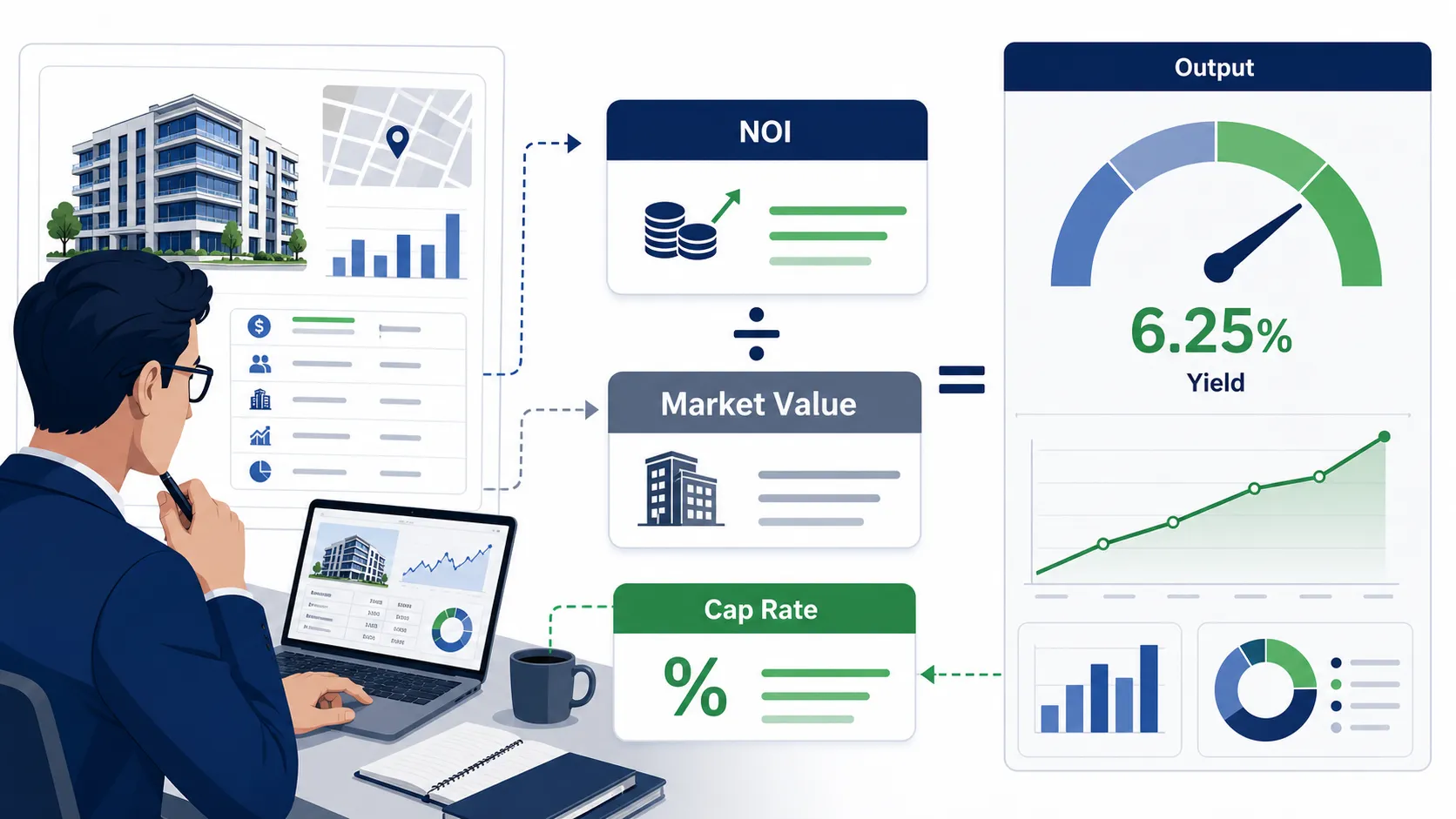
Featured Formula: Capitalization Rate (Cap Rate)
The core formula is:
`Cap Rate = Net Operating Income (NOI) / Current Market Value`It measures a real estate property's natural rate of return for a single year without accounting for debt financing or mortgage costs. This resulting percentage allows real estate investors and lenders to compare different yield profiles across diverse properties.
In the world of commercial and residential property investment, cash flow is the lifeline, but valuation is the scorecard. If you misvalue an asset by underestimating its capitalization rate, you risk locking up precious capital in an underperforming property.
The cap rate calculator simplifies this evaluation by providing a swift, standardized yield metric that filters out capital structure noise.
Put This Theory into Practice
Calculate Capitalization Rate, property value, and Net Operating Income. Enter your custom inputs and simulate scenarios in our math-verified Cap Rate Calculator.
1. The Capitalization Rate Formula: Understanding the Cap Rate Calculator
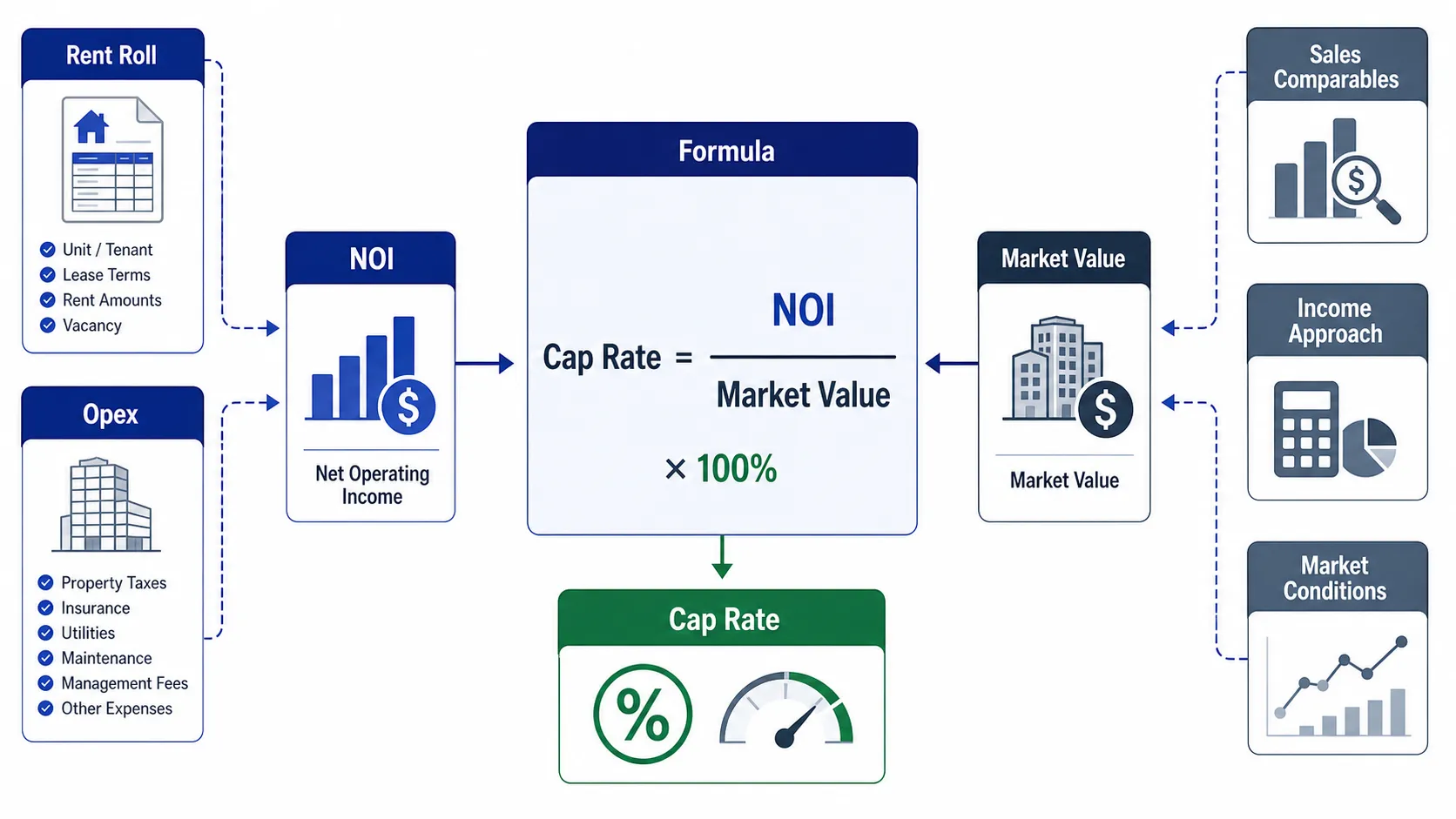
At its heart, the capitalization rate is a ratio of income to asset value. It represents the unlevered return an investor would expect if the property were purchased entirely with cash.
Formula Variables and Data Sources
To execute the formula Cap Rate = Net Operating Income (NOI) / Current Market Value, you need to aggregate key rental and financial data points using current 2026 market statistics:
Input | Source | Example (FY2026) |
|---|---|---|
Gross Scheduled Income | Current rent roll records | $120,000 |
Vacancy and Credit Loss | Historical property performance / market average | 5.0% |
Operating Expenses (Opex) | Property tax, insurance, utility bills, management | $39,000 |
Net Operating Income (NOI) | Calculated as Gross Operating Income minus Opex | $75,000 |
Current Market Value | Purchase price or formal appraisal value | $1,000,000 |
Common Real Estate Underwriting Mistakes
Even professional underwriters often introduce substantial errors into this formula. Make sure you sidestep these common pitfalls during real estate analysis:
Including Mortgage Costs in Opex: Debt service (principal and interest) is a financing expense, not an operating expense. Deducting mortgage payments from Net Operating Income will artificially suppress your NOI and yield calculations.
Neglecting Capital Expenditures (CapEx): Regular repairs go into Opex, but major structural changes (like a roof replacement) belong in a CapEx reserve. Omitting a normalized CapEx reserve leads to an unsustainably high cap rate calculation.
Ignoring Vacancy Rates: Underwriting a property with a 0% vacancy rate is unrealistic. Market conditions in 2026 dictate factoring in a localized vacancy allowance to ensure realistic yield assumptions.
Mismatched Property Valuation: Comparing a property’s historical purchase price from five years ago with today’s Net Operating Income generates an inaccurate cap rate. Always align NOI with current appraised market value.
The Limits and Errors of Manual Excel Modeling
Relying on manual Excel spreadsheets to evaluate real estate deals presents major operational challenges. Underwriters regularly break cellular formulas when adjusting operating expense categories or fail to account for variable vacancy rates dynamically.
When an investment committee requests a fast sensitivity review—such as "how does our cap rate change if property taxes jump by 15%?"—recalculating the spreadsheet inputs manually wastes time and risks critical investment oversights.
Skip the Spreadsheet: Use BizToolkitPro's Cap Rate Calculator to run this calculation instantly — no formula errors, no manual sensitivity tables, and instant professional reporting.
2. Step-by-Step Guide: Using the BizToolkitPro Cap Rate Calculator
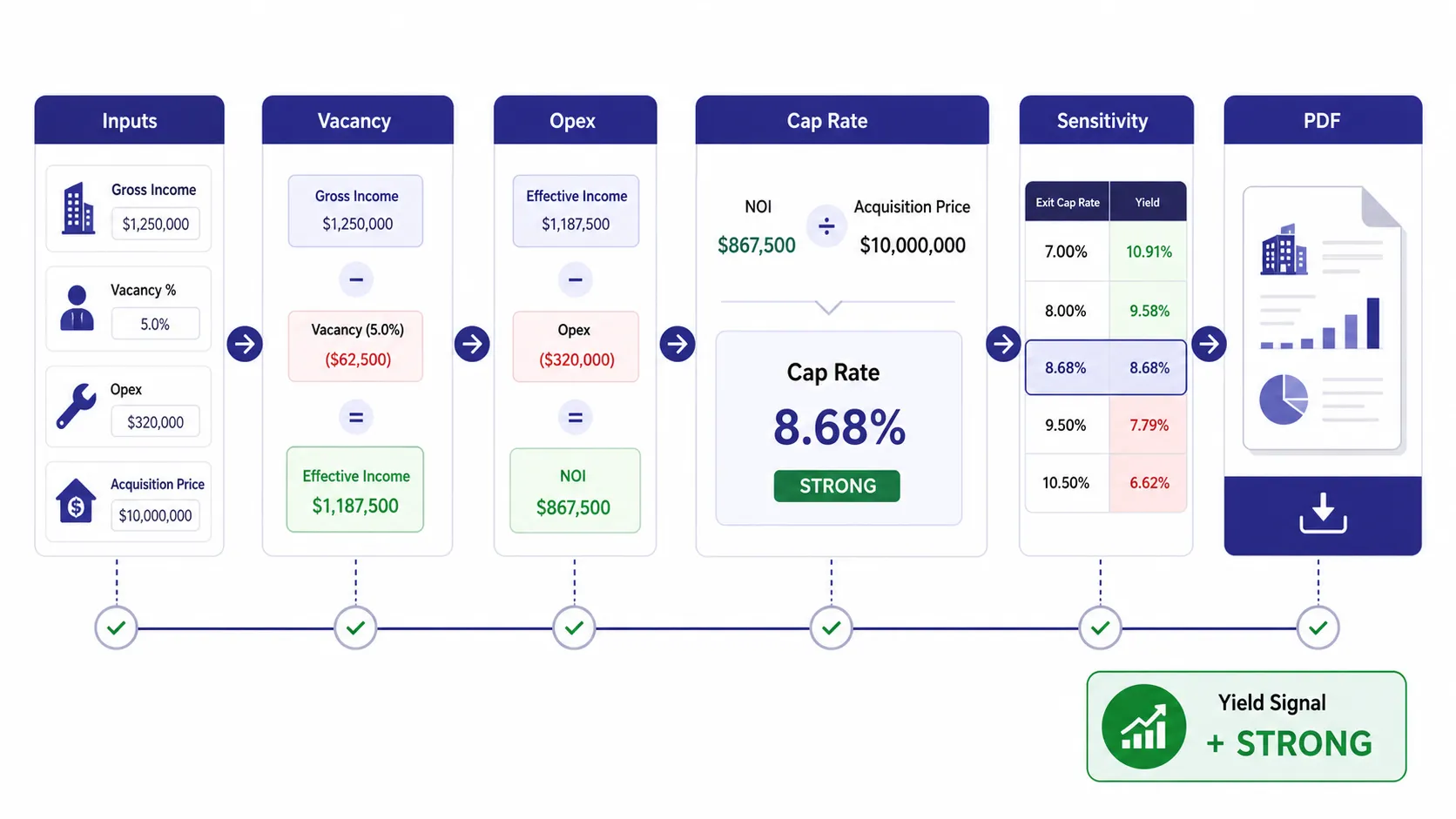
Our tool streamlines property underwriting by automating the math behind capitalization rates. Here is a walkthrough of an illustrative commercial deal in 2026.
Setting Inputs and Scenario Parameters
Let us evaluate a typical multi-family rental property to compute its capitalization rate:
Step 1: Determine Gross Operating Income (GOI)
Gross Scheduled Rent: $150,000 per year
Expected Vacancy Rate: 6.0% ($9,000 loss)
Calculated GOI = $150,000 - $9,000 = $141,000
Step 2: Calculate Operating Expenses (Opex)
Property Taxes: $15,000
Property Insurance: $4,500
Property Management Fee: $11,000
Maintenance & Utilities: $12,500
Total Opex = $15,000 + $4,500 + $11,000 + $12,500 = $43,000
Step 3: Define Net Operating Income (NOI)
NOI = GOI - Opex = $141,000 - $43,000 = $98,000
Step 4: Execute the Cap Rate Formula
Acquisition Price (Market Value): $1,400,000
Cap Rate = $98,000 / $1,400,000 = 7.00%
Interpreting the Output and Sensitivity Matrix
After entering the values, our calculator generates a detailed yield dashboard. Here is how to interpret the results:
Example Cap Rate Calculator Output | What It Shows |
|---|---|
Net Operating Income (NOI) | The annual cash flow generated after operating expenses ($98,000). |
Final Capitalization Rate | The unlevered annual rate of return (7.00%) for comparing this asset. |
Implied Property Value | The valuation if a different target market cap rate is applied. |
Sensitivity Table | Cross-references Cap Rate shifts based on changes in occupancy and purchase price. |
By utilizing this dashboard, you can instantly see if the asset aligns with your target return goals. If the transaction requires debt, you can easily pair this with our DSCR Calculator to check if the property generates enough cash flow to cover the mortgage.
Frequently Asked Questions
What is a good cap rate for a rental property in 2026?
A "good" capitalization rate is highly dependent on market location, asset class, and prevailing interest rates. In 2026, prime properties (Class A commercial assets in major metropolitan areas) typically trade at lower cap rates (4% to 5.5%) due to low risk.
Secondary markets or Class C properties often require higher cap rates (7% to 9%+) to compensate for higher vacancy risks and slower economic growth.
What is the difference between cap rate and cash-on-cash return?
While the capitalization rate measures the property’s performance ignoring leverage, cash-on-cash return evaluates the cash flow relative only to the actual cash invested. If you use a mortgage to buy a property, your cash-on-cash return will factor in debt service costs and your down payment, whereas the cap rate remains anchored strictly to unlevered Net Operating Income and overall market value.
Does the capitalization rate calculation include mortgage payments?
No. The cap rate formula specifically excludes mortgage payments and debt service. This intentional design allows investors to analyze the core earning power of the real estate asset itself, independent of the buyer's specific financing structure.
How does Net Operating Income (NOI) affect the cap rate calculator?
NOI is the direct numerator in the capitalization rate formula. Any operational adjustment that increases Net Operating Income—such as raising rents, lowering management costs, or minimizing vacancy rates—directly increases the capitalization rate, assuming the property value remains constant.
Can a property have a negative capitalization rate?
Yes, though it is highly undesirable. A negative cap rate occurs if a property’s operating expenses exceed its gross rental income, yielding a negative Net Operating Income. This indicates that the landlord is losing money simply running the property, even before paying a mortgage.
Why does a higher capitalization rate signal higher risk?
In financial theory, capitalization rates reflect risk premium. A high cap rate (e.g., 10%) means the property is priced low relative to its income, usually because investors perceive high risks—such as high tenant turnover, neighborhood decline, or looming major structural expenses.
Put This Theory Into Practice
Run your own scenario analysis with our math-verified calculators.