
NOI Calculator: Net Operating Income Yield Audit
Measure the rental yield potential of your real estate investments using our professional Net Operating Income (NOI) calculator. Net Operating Income represents the pure cash profitability of an income-producing property before factoring in debt payments or income taxes.
By deducting vacancy rates, credit losses, and total operating expenses from your gross rental revenues, NOI isolates the property's operational health. Use our builder to compute your NOI, run vacancy stress-tests, and prepare inputs for capitalization (Cap) rate calculations.
Have a suggestion or found a calculation discrepancy? Let us know!
Understanding Net Operating Income (NOI): Definition & Importance
Net Operating Income (NOI) is a fundamental metric used in commercial and residential real estate valuation. NOI measures the ability of an income-producing asset to generate cash flow from its regular operations. Lenders, appraisers, and investors focus heavily on NOI because it represents the raw earnings potential of the real estate, independent of how the property is financed or the owner's individual tax situation.
Why NOI is the foundation of real estate valuations
Because NOI isolates the property's direct operational performance, it serves as the key variable for other essential real estate metrics. For instance, dividing a property's NOI by its purchase price yields the Capitalization (Cap) Rate, representing the asset's unleveraged rate of return. Similarly, mortgage underwriters compare a property's NOI against its annual debt service obligations to calculate the Debt Service Coverage Ratio (DSCR), determining loan sizes and risk profiles.
How to Calculate Net Operating Income (Step-by-Step)
The NOI Walk
We apply standard real estate accounting sequences to isolate NOI:
Defining the operational variables
To execute a complete NOI audit, you must compile all operational data:
- Gross Rental Income: The total rent you would receive if the property was occupied 100% of the time at market rates.
- Other Income: All auxiliary revenues generated by the property, including laundry machines, parking spaces, pet fees, or utility chargebacks.
- Vacancy & Credit Loss: The estimated revenue lost due to unrented units or tenant non-payment. Standard models assume a 5% to 10% vacancy allowance.
- Operating Expenses: All recurring outlays required to run the property. This includes property taxes, structural insurance, maintenance utilities, property management fees, and landscaping.
Example Net Operating Income Calculation
Real-World Property Ledger
Consider a residential multi-family property with these financial metrics:
- Gross Rental Income: $120,000 per year
- Other Income (Parking & Laundry): $5,000 per year
- Vacancy Rate: 5%
- Credit Loss Rate: 1%
- Annual Expenses (Taxes, Ins, Mgmt, Maint): $35,000
Calculating the NOI
First, calculate Gross Potential Income:Gross Potential Income = $120,000 + $5,000 = $125,000.
Second, calculate Vacancy and Credit Loss:Vacancy & Credit Loss = $120,000 * (5% + 1%) = $7,200.
Third, determine Effective Gross Income (EGI):EGI = $125,000 - $7,200 = $117,800.
Finally, subtract operating expenses to find the Net Operating Income:NOI = $117,800 - $35,000 = $82,800.
In this scenario, the property delivers a clean Net Operating Income of $82,800, which is the baseline number used to determine property valuation or mortgage eligibility.
Expense Allocations: Operating Expenses vs CapEx
What is Excluded from NOI Expenses?
A major rule of NOI modeling is that you must distinguish between operational expenses and financing or equity charges. The following items must never be deducted when calculating NOI:
- Mortgage Payments (Debt Service): Principal and interest payments depend on the owner's loan structure and do not reflect the property's direct earning power.
- Depreciation: A non-cash tax deduction that does not affect operational cash flows.
- Income Taxes: Depend on the owner's personal tax bracket.
- Capital Expenditures (CapEx): Major structural improvements (such as replacing a roof or HVAC unit) are capitalized on the balance sheet and are not classified as day-to-day operating expenses.
The Operating Expense Ratio (OER)
OER measures the efficiency of property management by comparing expenses to revenues:
An OER between 35% and 50% is typical for well-managed multi-family properties. A higher OER suggests utility inefficiencies or deferred maintenance costs.
Common Mistakes in NOI Performance Reviews
Underestimating Maintenance & Reserves
Many property listings advertise an inflated NOI by omitting realistic maintenance expenses or property management fees (especially when self-managing). Always budget realistic reserves for repairs and management fees to understand the property's true cash flow.
Including Mortgage Interest in NOI
Since debt structures vary widely between cash buyers and highly-leveraged investors, mortgage interest must never be included in NOI. Omit debt service entirely when calculating NOI; it will be evaluated separately in the Debt Service Coverage Ratio (DSCR).
Real-world case study: American Tower Corporation (AMT, FY 2023)
American Tower Corporation metrics profile
American Tower Corporation, a prominent global Real Estate Investment Trust (REIT) specializing in communications infrastructure, reported robust financial performance for its fiscal year 2023. This case study utilizes their verifiable full-year data to illustrate key operational inputs and calculated net operating income metrics for a large-scale real estate company.
American Tower's significant property revenue of $11.001 billion in fiscal year 2023 underscores the strong global demand for its wireless and broadcast communications infrastructure. The calculated implied property-related operating expenses of $3.914 billion, derived from subtracting Adjusted EBITDA from property revenue, demonstrate the operational costs associated with managing its extensive portfolio. An Adjusted Net Operating Income (Adjusted EBITDA) of $7.087 billion reflects substantial profitability after core operational expenses, serving as a robust measure of cash flow generation for this REIT. The resulting operating expense ratio of 35.58% highlights American Tower's efficiency in managing its vast asset base, a critical factor for sustained investor value in the capital-intensive real estate sector.
Related Calculators
Estimate real estate capitalization rate.
Open Tool →Occupancy Rate CalculatorCalculate occupancy and vacancy rate.
Open Tool →Cash-on-Cash ReturnMeasure levered cash return on equity.
Open Tool →DSCR CalculatorSolve debt service coverage ratios.
Open Tool →Rental Property ROIEvaluate rental buy-and-hold returns.
Open Tool →Gross Rent MultiplierBenchmark property pricing quickly.
Open Tool →Related Articles & Guides
 Real Estate
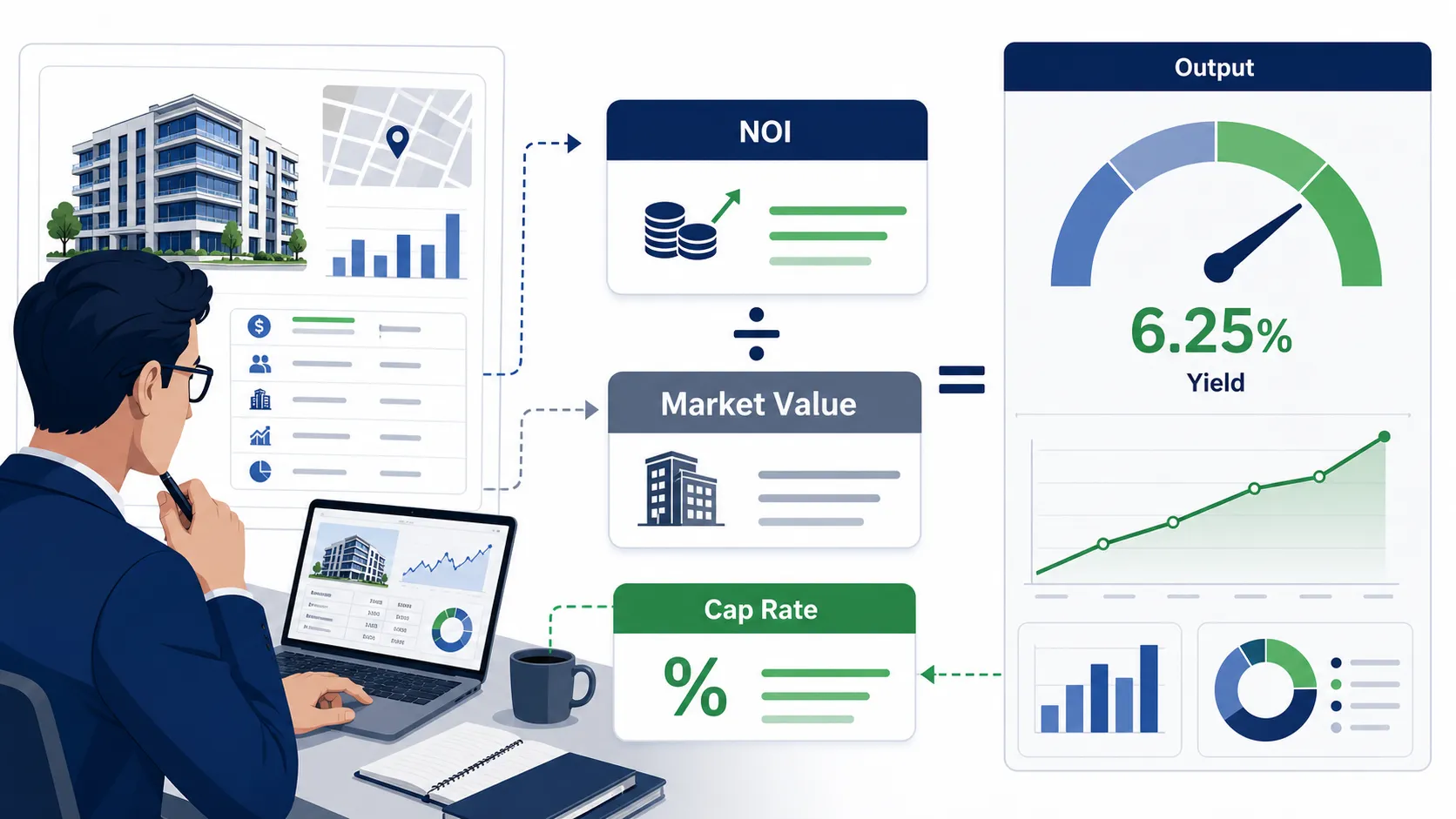
Cap Rate Calculator: Calculate Capitalization Rate Step by Step
Stop guessing property values. The cap rate formula delivers a single-year yield metric that strips out debt, letting you compare diverse assets instantly. Misjudge this rate, and you risk locking capital into an underperforming investment.
 Corporate Finance
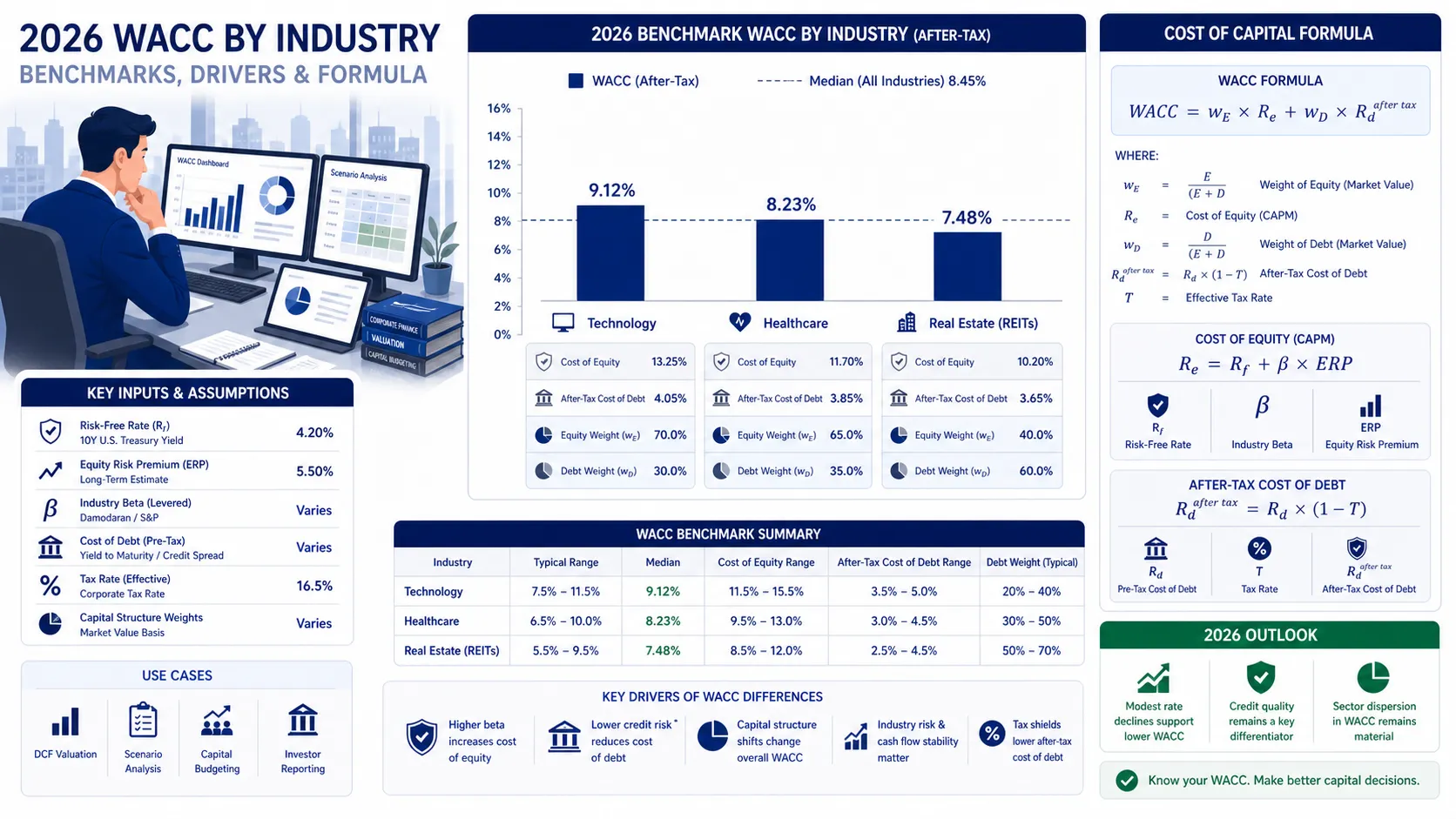
WACC by Industry: 2026 Benchmarks for Technology, Healthcare, and Real Estate
In 2026, industry WACC diverges sharply, from 5.5% for utilities to over 11.5% for software. CFOs must benchmark their discount rate against peers to ground valuations in market reality.
 Corporate Finance
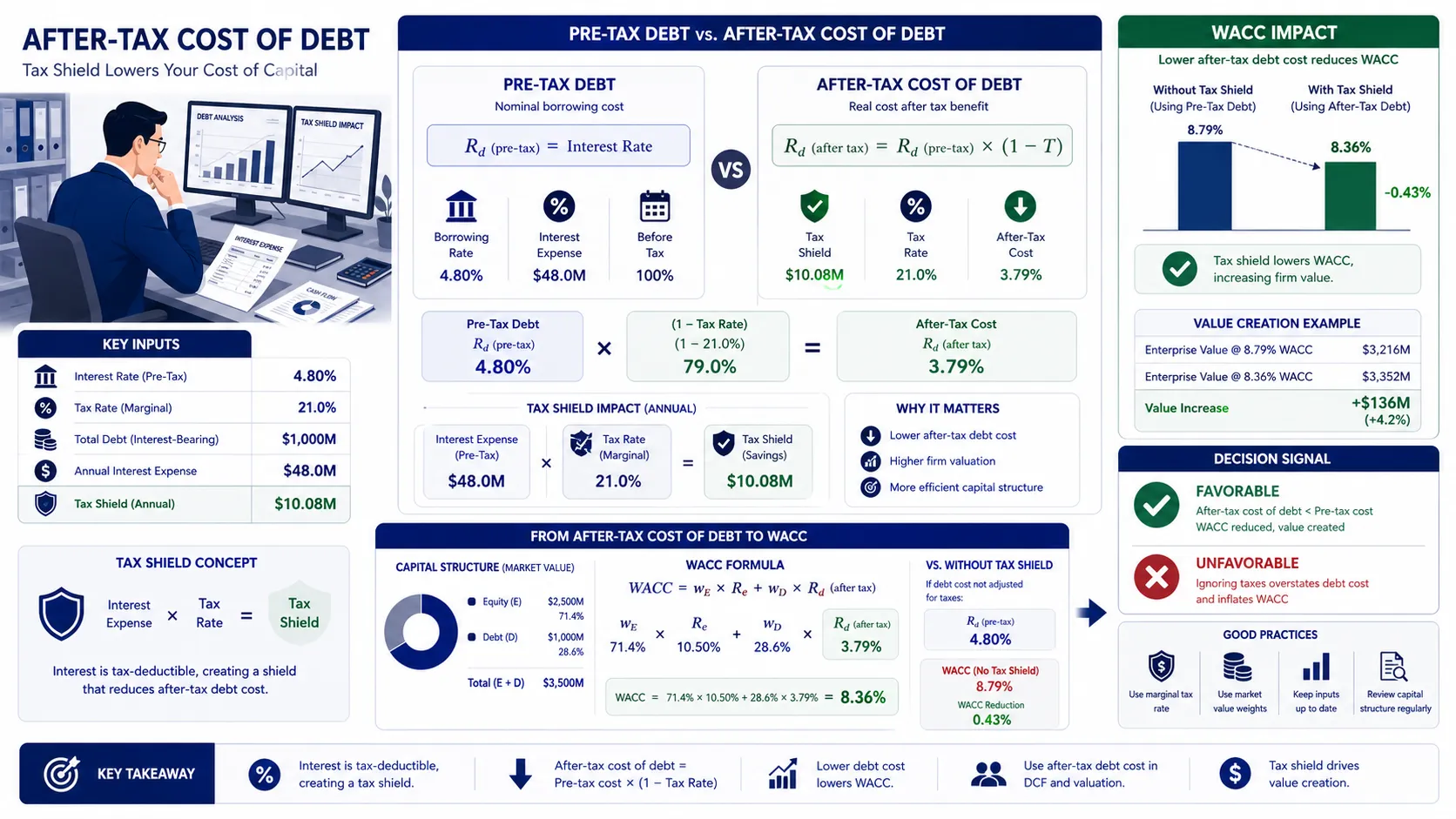
What Is After-Tax Cost of Debt and How Does It Lower WACC?
Interest payments are tax-deductible, making debt cheaper than equity and lowering your company's WACC. The after-tax cost of debt reveals this true, subsidized borrowing rate.
Methodology, Frequently Asked Questions (FAQ) & Disclaimers
FAQ: Frequently Asked Questions
Q: What is the difference between NOI and Cash Flow?
A: Net Operating Income (NOI) represents a property's income before deducting mortgage debt service and capital expenditures (CapEx). Cash Flow is the net amount of cash remaining after all expenses, including mortgage payments and CapEx reserves, are paid.
Q: How does management fee affect NOI?
A: Property management fees are direct operational expenses. Deducting a 7% to 10% management fee from EGI directly reduces the property's Net Operating Income (NOI), lower the valuation output under cap rate models.
Disclaimer: Informational Guidance Only
The financial calculations and Net Operating Income (NOI) figures generated by this calculator are intended solely for educational and high-level budgeting purposes.
Calculations are based on general accounting models and do not constitute formal real estate appraisals, underwriting approvals, or certified tax advice. Property taxation, utility bills, and insurance rates vary based on location, credit ratings, and property age. Consult certified public accountants (CPAs) and commercial underwriters prior to executing real estate transactions.
The real estate calculations, yield projections, and cash flow reports generated by BizToolkitPro are for educational and informational purposes only. They do not constitute formal real estate brokerage, lending underwriting, tax counsel, or legal advice.
Investment returns, debt coverage ratios, and capitalization metrics (including Cap Rate, DSCR, Cash-on-Cash, and Waterfall distributions) are simulated based on user-provided inputs and assumptions. Local housing laws, property taxes, market vacancies, and interest rates fluctuate dynamically; therefore, BizToolkitPro makes no warranties regarding the accuracy or real-world applicability of these projections.
Always perform your own independent physical and financial due diligence on properties, and consult with a licensed Real Estate Broker, Mortgage Underwriter, Tax Advisor, or real estate attorney before signing purchase agreements or securing loans.