
Capitalization Rate (Cap Rate) Calculator for Real Estate Deals
Use this cap rate calculator to calculate real estate capitalization rate from net operating income and property value. Cap rate is a core unlevered yield metric for commercial property, rental property, and income-producing real estate.
The calculator supports quick NOI-based inputs, detailed rental income and expense assumptions, and reverse valuation from a target cap rate. Use it to compare properties before moving into debt service, cash-on-cash return, and IRR analysis.
Have a suggestion or found a calculation discrepancy? Let us know!
How to Calculate Cap Rate in Real Estate
Select your preferred calculation mode
Depending on the metrics available for your transaction, you can toggle between three computational modes:
- Detailed NOI: The most precise approach. Input raw rental incomes, vacancy allowances, and operating expenses to construct a full Net Operating Income (NOI) bridge before solving for the yield.
- Direct NOI: A fast-track approach. If you already know the property's annual Net Operating Income from an offering memorandum, input it directly with the value basis to compute the rate.
- Solve Value: An acquisition pricing tool. Input your target capitalization rate and the net cash flows to calculate the implied buying price or valuation limit.
Input variables required for calculation
To extract maximum utility from this calculator, ensure you have gathered the following deal parameters:
- Property Valuation: The transaction purchase price, current appraised market value, or listing asking price.
- Annual Gross Rental Income: Total contract rents generated assuming 100% occupancy.
- Vacancy and Credit Loss: A percentage buffer to account for lease turnover gaps and uncollected rent debts.
- Annual Operating Expenses: The total cost to operate the asset, excluding financing debts and income taxes.
Cap Rate Formula
The fundamental Cap Rate formula
The Capitalization Rate represents the unlevered rate of return a real estate asset generates based on its operational net income. It is mathematically formulated as:
Understanding Net Operating Income (NOI)
Net Operating Income is the foundational cash flow metric in commercial real estate. It reflects the income generated by the property after deducting essential operating expenses but before accounting for financing costs (mortgage payments), depreciation allowances, amortization, and income tax liabilities. Because NOI is capital-structure neutral, it allows analysts to compare property yields objectively, regardless of whether a buyer uses 100% cash or high-leverage debt to acquire the property.
Operating expenses typically include property taxes, building insurance, third-party property management fees, routine maintenance and repairs, landscaping, trash collection, utilities paid by the landlord, and marketing costs. Capital expenditures (such as replacing a roof or HVAC system) are excluded from NOI under standard accounting, though prudent investors subtract a CapEx reserve to represent long-term amortization.
Property value basis definitions
Depending on the stage of your analysis, the denominator of the Cap Rate equation can shift. Underwriting a new deal utilizes the purchase price to calculate the acquisition yield. Valuing an asset currently held in a portfolio relies on the current market value or appraisal. Marketing a listing for sale uses the asking price to calculate the offered market cap rate. Ensuring consistency in the value basis is crucial to preventing misleading comparison results across peer transactions.
Cap Rate Calculation Example
Baseline property example metrics
Consider a commercial office building under evaluation with the following annual income and physical parameters:
- Purchase Price / Valuation = $2,500,000
- Annual Gross Rental Income = $300,000
- Other Operating Income (parking, storage) = $15,000
- Vacancy & Credit Loss Rate = 8.00%
- Annual Operating Expenses = $110,000
Step-by-step Cap Rate calculation process
First, calculate the Potential Gross Income (PGI): PGI = $300,000 + $15,000 = $315,000.
Next, calculate the Vacancy and Credit Loss: Vacancy Loss = $315,000 * 8% = $25,200.
Compute the Effective Gross Income (EGI): EGI = $315,000 - $25,200 = $289,800.
Subtract Operating Expenses to determine Net Operating Income (NOI): NOI = $289,800 - $110,000 = $179,800.
Finally, divide NOI by the purchase price to solve for the Cap Rate: Cap Rate = ($179,800 / $2,500,000) * 100 = 7.19%. The acquisition yield is solved at 7.19%.
What your Cap Rate result means
High Cap Rate vs. low Cap Rate properties
A higher Capitalization Rate implies that a property has higher risk but offers potential for greater cash flow yields. For example, older properties in tertiary markets or neighborhood retail strip centers often trade at 8% to 10% cap rates. Conversely, a lower cap rate suggests a safer, more stable asset, such as a class-A apartment complex in a prime metropolitan center, which might trade at 4% to 5% cap rates due to robust occupancy and stable demographic drivers.
The inverse relationship between Cap Rate and property value
Cap rates are inversely proportional to property values. If the market capitalization rates in a submarket compress (go down) due to high investor demand or falling interest rates, property values will rise, even if the NOI remains identical. Conversely, if interest rates rise or market demand weakens, cap rates will expand (go up), resulting in a direct drop in commercial property valuations.
Analyzing market yield spreads
Real estate professional underwriters evaluate cap rates relative to risk-free treasury yields. The difference between a property's cap rate and the 10-year Treasury rate is known as the "risk premium" or yield spread. A narrow spread (e.g., less than 1.5%) suggests that investors are not being adequately compensated for the liquidity risks of owning real estate compared to holding government bonds.
What Is a Good Cap Rate?
Market quality
Prime assets in stronger markets often trade at lower cap rates because buyers accept lower current yield in exchange for perceived stability, liquidity, and rent growth.
Asset risk
Higher cap rates can reflect leasing risk, older building quality, weaker tenants, deferred maintenance, or lower market growth expectations.
Interest-rate environment
Cap rates are often compared with financing costs and Treasury yields. When debt becomes more expensive, buyers may require higher property yields.
Cap Rate vs Cash-on-Cash Return
Cap rate is unlevered
Cap rate compares NOI with property value before debt service. It helps compare properties independent of the buyer's financing structure.
Cash-on-cash return is levered
Cash-on-cash return compares annual pre-tax cash flow after debt service with the actual equity invested. It changes when loan terms, down payment, or interest rates change.
Common Cap Rate Mistakes
Overlooking capital expenditure reserves (CapEx)
One of the most frequent underwriting errors is using a property's Net Operating Income without accounting for capital expenditures or reserves. While regular maintenance belongs in operational expenses, replacing major structural components (roofs, parking lots, HVAC units) requires capital reserves. Neglecting to set aside a realistic replacement reserve leads to an artificially inflated NOI, causing buyers to overpay.
Miscalculating vacancy and credit loss rates
Pro-forma calculations often assume unrealistically low vacancy rates (e.g., 2% or 3%) to make a listing look attractive. However, structural submarket vacancy rates could be 7% or 10%. Furthermore, credit losses due to non-paying tenants must be accounted for. Artificially low vacancy buffers lead to overstated effective gross income projections and distorted cap rate conclusions.
Ignoring local property tax reassessment rules
In many jurisdictions, a property sale triggers a tax reassessment based on the new transaction value. If the previous owner held the property for a long time, the current tax bill might be significantly lower than the post-sale tax bill. Underwriting a transaction using historical property taxes rather than projected reassessed taxes will result in a gross overestimation of future NOI and actual yields.
- CapEx reserves: Deduct $250 - $400 per unit annually for residential assets.
- Tax adjustments: Always check local appraisal district tax multiplier guidelines.
- Utility allocations: Verify owner-paid utilities vs. tenant utility billbacks (RUBS).
Real-world case study: Prologis, Inc. (PLD, FY 2023)
Prologis, Inc. metrics profile
Prologis, Inc. is a global leader in logistics real estate. As a Real Estate Investment Trust (REIT), its financial performance is often evaluated using metrics like Net Operating Income (NOI) and Capitalization Rate (Cap Rate) to assess the profitability of its extensive property portfolio. This case study analyzes Prologis's overall portfolio performance based on its reported annual NOI and total assets under management.
For FY 2023, Prologis reported an annual Net Operating Income (NOI) of $6.9 billion and total Assets Under Management (AUM) of $235 billion as of September 30, 2023. Dividing the annual NOI by the total AUM yields a calculated capitalization rate of approximately 2.94%. This metric indicates the unlevered rate of return on the company's total portfolio. It's important to note that Prologis also reported a weighted average stabilized cap rate of 4.5% for its operating portfolio (excluding land and other real estate) for the full year 2023. The difference between the calculated overall cap rate and the reported stabilized cap rate can be attributed to the inclusion of non-stabilized assets, development projects, and land within the broader AUM figure, while the stabilized cap rate focuses specifically on income-generating, fully operational properties. This suggests that while their stabilized properties generate a higher return, the overall portfolio, including assets in various stages of development or acquisition, presents a lower immediate yield.
Related Calculators
Calculate occupancy and vacancy rate.
Open Tool →Cash-on-Cash ReturnMeasure levered cash return on equity.
Open Tool →NOI CalculatorCompute net operating income.
Open Tool →DSCR CalculatorSolve debt service coverage ratios.
Open Tool →Rental Property ROIEvaluate rental buy-and-hold returns.
Open Tool →Gross Rent MultiplierBenchmark property pricing quickly.
Open Tool →Related Articles & Guides
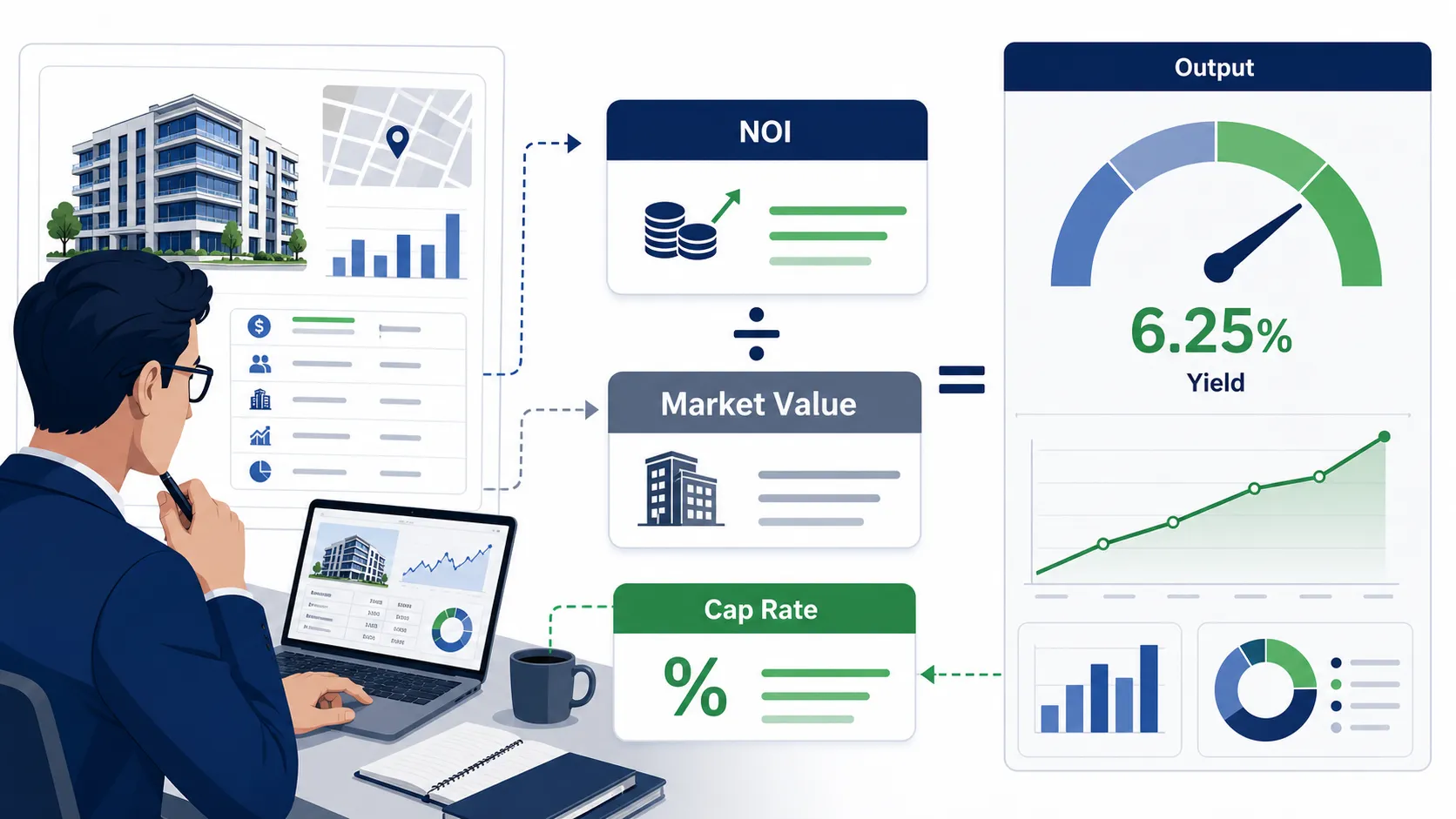 Real Estate
Cap Rate Calculator: Calculate Capitalization Rate Step by Step
Stop guessing property values. The cap rate formula delivers a single-year yield metric that strips out debt, letting you compare diverse assets instantly. Misjudge this rate, and you risk locking capital into an underperforming investment.
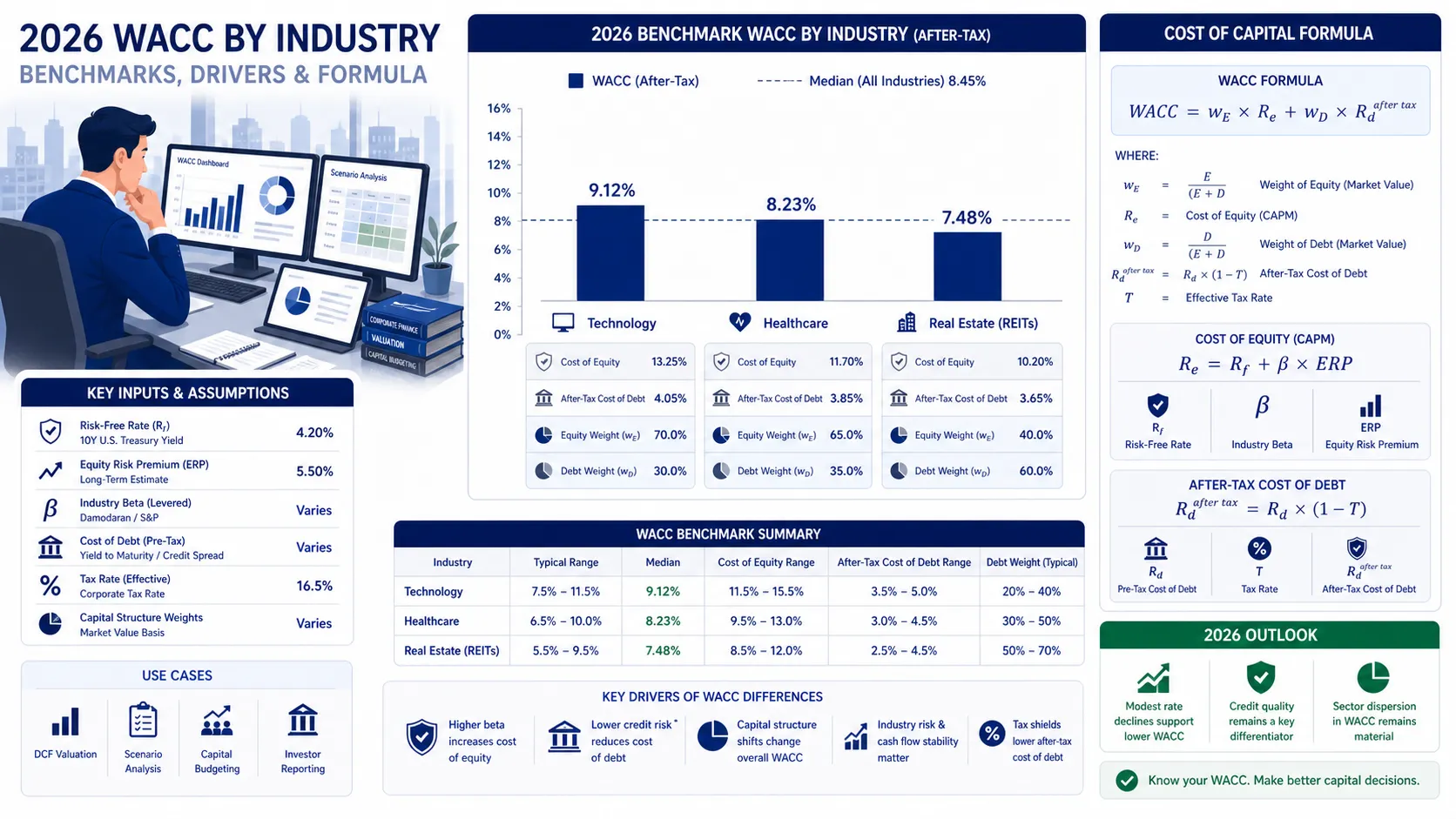 Corporate Finance
WACC by Industry: 2026 Benchmarks for Technology, Healthcare, and Real Estate
In 2026, industry WACC diverges sharply, from 5.5% for utilities to over 11.5% for software. CFOs must benchmark their discount rate against peers to ground valuations in market reality.
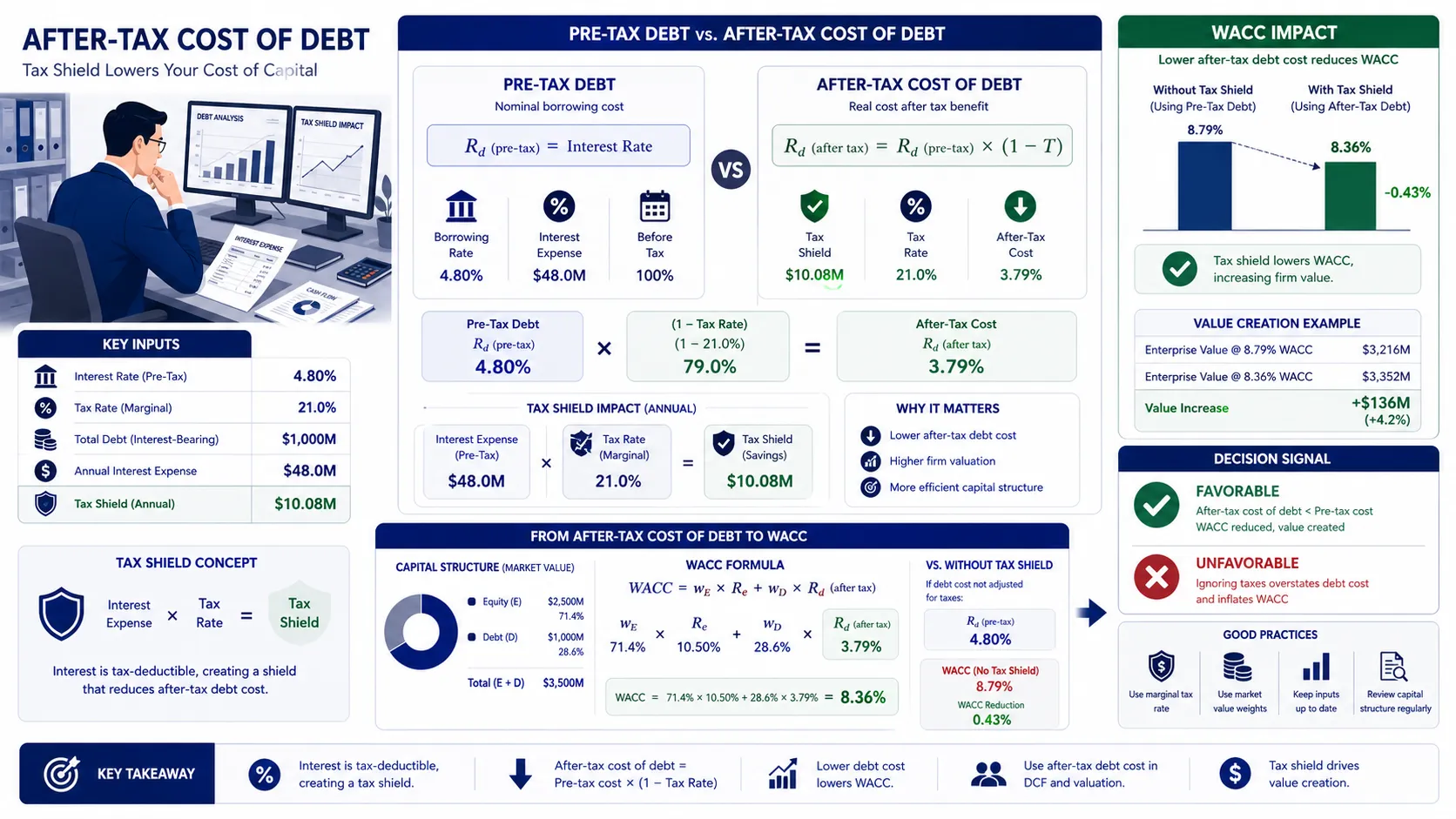 Corporate Finance
What Is After-Tax Cost of Debt and How Does It Lower WACC?
Interest payments are tax-deductible, making debt cheaper than equity and lowering your company's WACC. The after-tax cost of debt reveals this true, subsidized borrowing rate.
Frequently Asked Questions (FAQ)
What is a good Cap Rate for rental properties?
Why is the Cap Rate calculated without mortgage details?
What is the difference between Cap Rate and Cash-on-Cash Return?
Does Cap Rate include capital expenditures?
How do interest rates affect Cap Rates?
The real estate calculations, yield projections, and cash flow reports generated by BizToolkitPro are for educational and informational purposes only. They do not constitute formal real estate brokerage, lending underwriting, tax counsel, or legal advice.
Investment returns, debt coverage ratios, and capitalization metrics (including Cap Rate, DSCR, Cash-on-Cash, and Waterfall distributions) are simulated based on user-provided inputs and assumptions. Local housing laws, property taxes, market vacancies, and interest rates fluctuate dynamically; therefore, BizToolkitPro makes no warranties regarding the accuracy or real-world applicability of these projections.
Always perform your own independent physical and financial due diligence on properties, and consult with a licensed Real Estate Broker, Mortgage Underwriter, Tax Advisor, or real estate attorney before signing purchase agreements or securing loans.