
DSCR Calculator: Debt Service Coverage Ratio for Real Estate Loans
Use this DSCR calculator to estimate debt service coverage ratio, loan sizing capacity, and lender coverage cushion for income-producing real estate.
This web application calculates the safety margin of property rental yields relative to financing payments, generating dynamic sensitivity tables and scenario comparisons. Whether you are analyzing a commercial property acquisition, evaluating agency loan guidelines, or optimizing debt service coverage, this utility delivers immediate institutional sizing insights.
Have a suggestion or found a calculation discrepancy? Let us know!
How to use this DSCR calculator
Selecting your dscr calculation mode
This underwriting program supports three distinct modes of operation depending on your current target parameters:
- Loan Terms: Enter a specific loan amount, interest rate, and amortization schedule to solve for the solved DSCR against your current Net Operating Income (NOI).
- Direct Debt Service: If you already have the total annual debt payment amount from a mortgage statement, input it directly to find the raw coverage ratio.
- Solve Capacity: Solve for the maximum mortgage loan amount a property's NOI can support based on your bank's minimum DSCR requirements (e.g. 1.25x).
Gathering parameters for loan underwriting
To check financing eligibility, compile the following operational and financial metrics:
- Annual NOI: The net earnings of the property before paying debt obligations or income taxes.
- Loan Principal: The target debt amount you wish to borrow.
- Annual Interest Rate: The loan interest rate (support for fixed rate parameters).
- Amortization Period: The number of years over which the loan principal is paid off (typically 25 or 30 years).
DSCR formula and underwriting methodology
The primary DSCR equation
The Debt Service Coverage Ratio (DSCR) measures the proportion of cash flow available to pay current debt obligations. The core formula is:
Defining Net Operating Income vs. Debt Service
Net Operating Income (NOI) represents a property's capability to generate free cash flows. Lenders will perform a strict audit of the property's income ledger, adjusting vacancy assumptions to at least a 5% standard minimum, and ensuring local tax reassessments are factored. Maintenance costs, utility bills, management fees, and structural CapEx reserves are subtracted from gross revenues to determine a conservative NOI basis.
Annual Debt Service (ADS) includes all principal and interest payments due to lenders within a 12-month period. Under standard fully-amortizing structures, the mortgage payment remains fixed, and a portion goes toward reducing the principal balance. In an interest-only structure, only the interest payments are counted during the initial period, yielding a lower debt service and higher solved DSCR, though introducing refinancing risks when the interest-only period expires.
DSCR example calculation
Sample deal underwriting inputs
To illustrate, let's look at a commercial multifamily asset with the following underwriting parameters:
- Annual Net Operating Income (NOI) = $150,000
- Requested Mortgage Amount = $1,500,000
- Annual Interest Rate = 6.00%
- Amortization Period = 30 Years
- Payment Frequency = Monthly
Step-by-step DSCR valuation breakdown
First, calculate the monthly payment using standard amortization formulas. With a 6% annual rate (0.5% monthly rate) over 360 payments:Monthly P+I Payment = $8,993.26.
Next, calculate the Annual Debt Service:ADS = $8,993.26 * 12 = $107,919.12.
Finally, divide Net Operating Income by the annual debt payments:DSCR = $150,000 / $107,919.12 = 1.39x.
Since 1.39x exceeds typical lender targets (such as 1.25x), this property demonstrates strong coverage, leaving an annual cash cushion of $42,080.88 for the property owner.
What a DSCR score means for commercial financing
Understanding minimum lender ratios
A DSCR of 1.00x is the absolute break-even mark, where operating profits match the loan payment exactly. Any ratio below 1.00x represents an operating loss, meaning the sponsor must invest additional capital to avoid default. Lenders enforce a strict DSCR safety buffer to absorb market fluctuations, requiring a minimum of 1.20x for apartment buildings, 1.25x for multi-tenant retail/industrial, and up to 1.35x or 1.40x for riskier assets like hotels.
Leverage limits and borrowing capacities
DSCR functions alongside Loan-to-Value (LTV) ratios to limit maximum loan sizing. Even if a property qualifies under LTV guidelines (e.g. 75% LTV), the lender will check if the cash flow is sufficient to maintain the target DSCR. If rising interest rates increase debt payments, the borrowing capacity compresses, requiring a larger equity down payment to meet debt coverage covenants.
Impact on DSCR rental loan products
In residential real estate investing, "DSCR loans" allow buyers to acquire 1-4 unit rental properties based on the rental cash flow rather than their personal tax returns or debt-to-income (DTI) metrics. A property DSCR above 1.00x (preferably 1.20x+) allows faster loan underwriting approvals and better interest rate terms, unlocking scalable financing for independent real estate portfolios.
Common underwriting mistakes and risks
Underestimating annual operating expenses
Property sellers often display pro-forma calculations with operating expense ratios as low as 30% or 35% of gross revenues. However, historical data across commercial assets shows that real operating expense ratios range from 45% to 55% once leasing commissions, property management fees, administrative overheads, and realistic maintenance costs are accounted for. Understating expenses leads to an overstated NOI, yielding an artificially high solved DSCR that will fail commercial audits.
Using pre-tax gross income instead of net operating income
A catastrophic mistake made by novice investors is dividing gross rental incomes by debt service. Lenders will never base debt sizing on gross income, as it does not account for the property's operational costs. Always resolve Effective Gross Income and subtract actual operating costs first to verify the true net cash flow supporting interest payments.
- Statutory tax rates: Verify local assessment reassessment ratios post-transaction.
- Management buffers: Factoring 4% to 8% property management cost even if self-managing.
- CapEx reserves: Setting structural capital reserves separate from maintenance costs.
Real-world case study: Large Commercial Real Estate Owner (Benchmark) (2024 Industry Standard)
Large Commercial Real Estate Owner (Benchmark) metrics profile
This case study examines a hypothetical large commercial real estate owner, representative of a Real Estate Investment Trust (REIT) or a substantial property holding company. It illustrates the application of the Debt Service Coverage Ratio (DSCR) to assess the company's ability to meet its debt obligations from its operating income. The figures used are realistic industry benchmarks for a well-managed entity in the commercial real estate sector.
A DSCR of 1.67x indicates a healthy financial position for this hypothetical commercial real estate owner. It signifies that the company's Net Operating Income is 1.67 times its total annual debt service obligations, providing a comfortable buffer against potential fluctuations in income or unexpected expenses. For investors, this strong DSCR suggests lower risk, as the company is generating sufficient cash flow to cover its debt payments. Operationally, it implies efficient property management and stable rental income, allowing for potential reinvestment, dividend distributions, or further strategic debt financing opportunities.
Related Calculators
Estimate real estate capitalization rate.
Open Tool →Occupancy Rate CalculatorCalculate occupancy and vacancy rate.
Open Tool →Cash-on-Cash ReturnMeasure levered cash return on equity.
Open Tool →NOI CalculatorCompute net operating income.
Open Tool →Rental Property ROIEvaluate rental buy-and-hold returns.
Open Tool →Gross Rent MultiplierBenchmark property pricing quickly.
Open Tool →Related Articles & Guides
 Real Estate
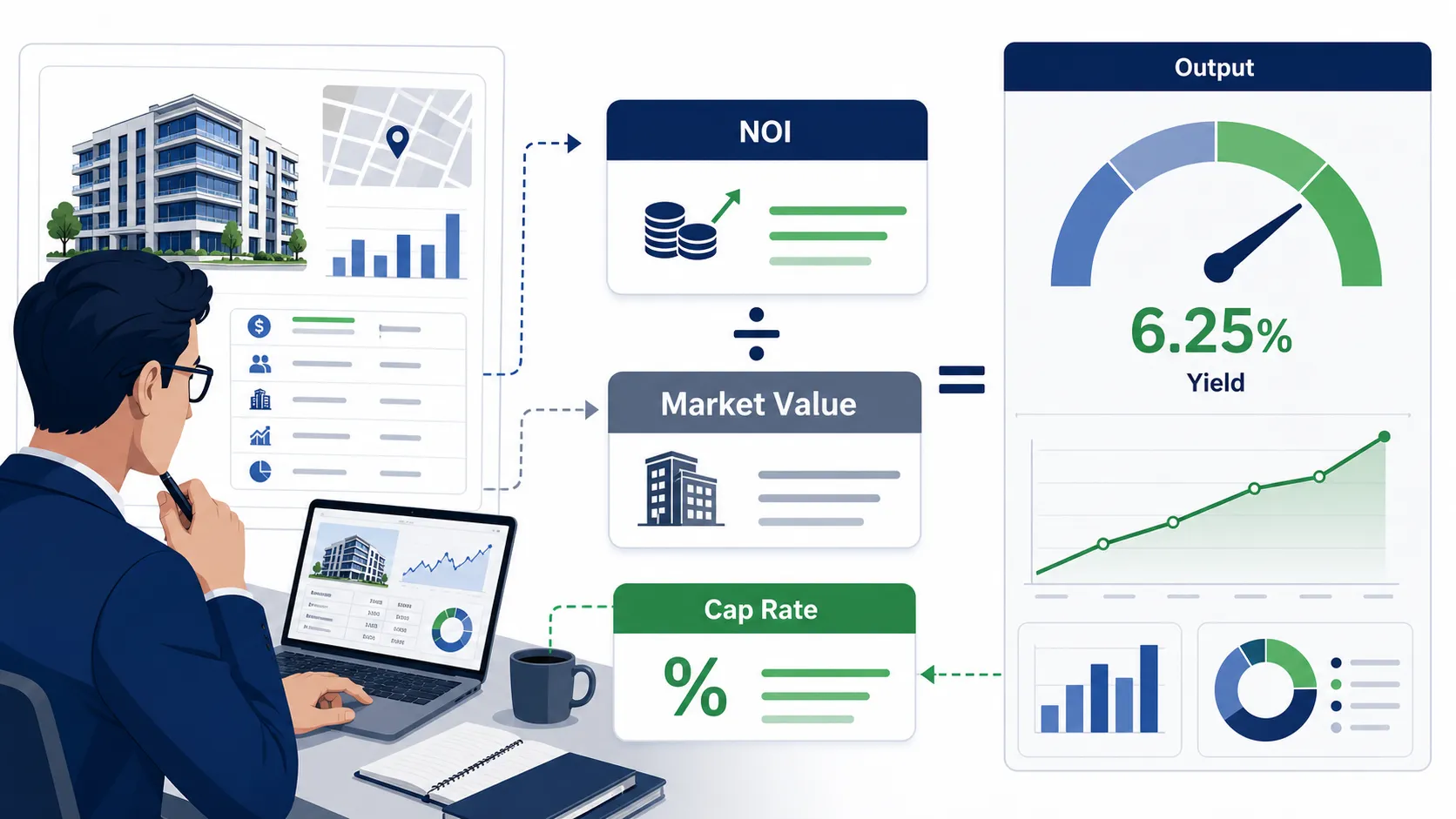
Cap Rate Calculator: Calculate Capitalization Rate Step by Step
Stop guessing property values. The cap rate formula delivers a single-year yield metric that strips out debt, letting you compare diverse assets instantly. Misjudge this rate, and you risk locking capital into an underperforming investment.
 Corporate Finance
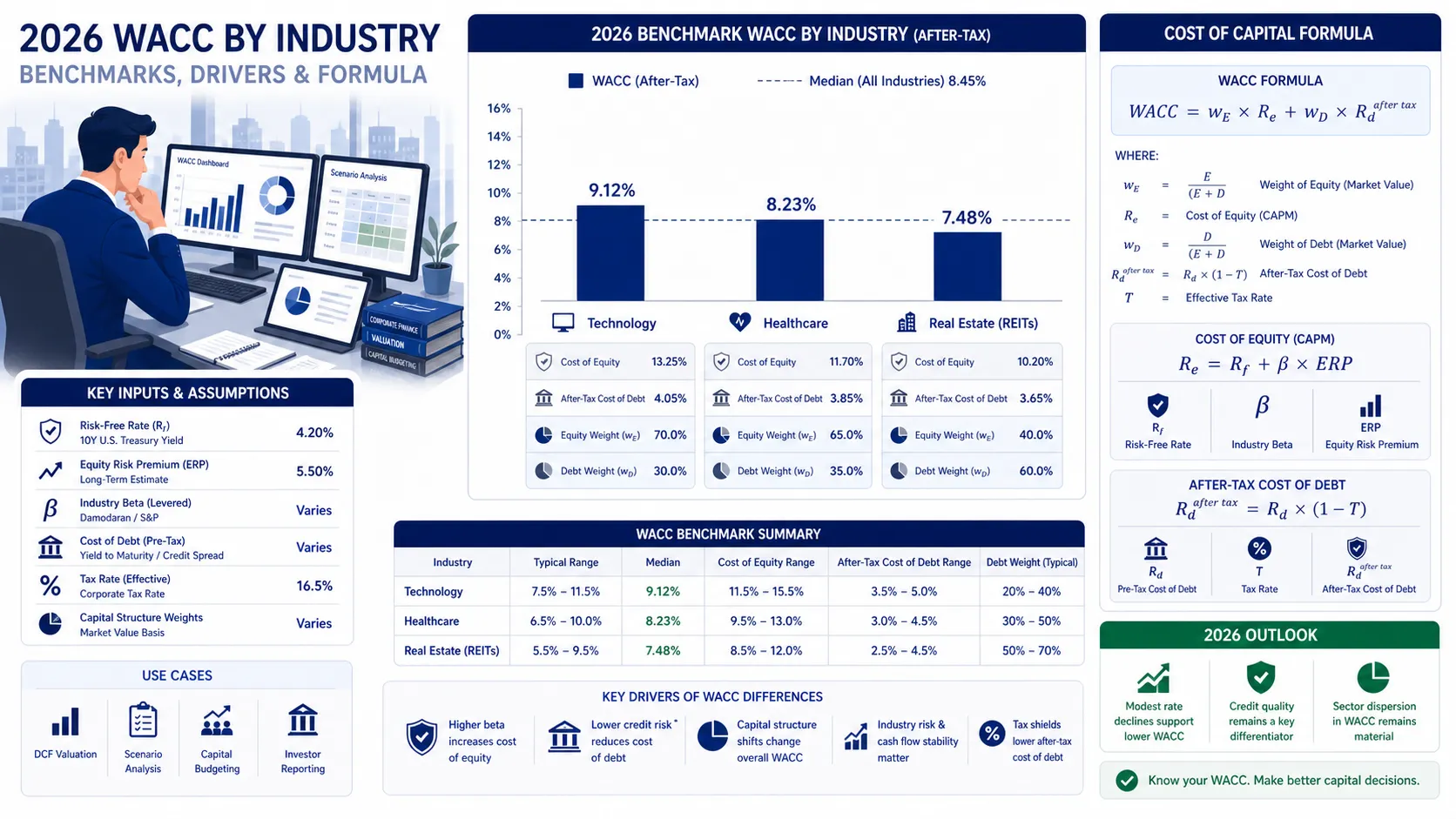
WACC by Industry: 2026 Benchmarks for Technology, Healthcare, and Real Estate
In 2026, industry WACC diverges sharply, from 5.5% for utilities to over 11.5% for software. CFOs must benchmark their discount rate against peers to ground valuations in market reality.
 Corporate Finance
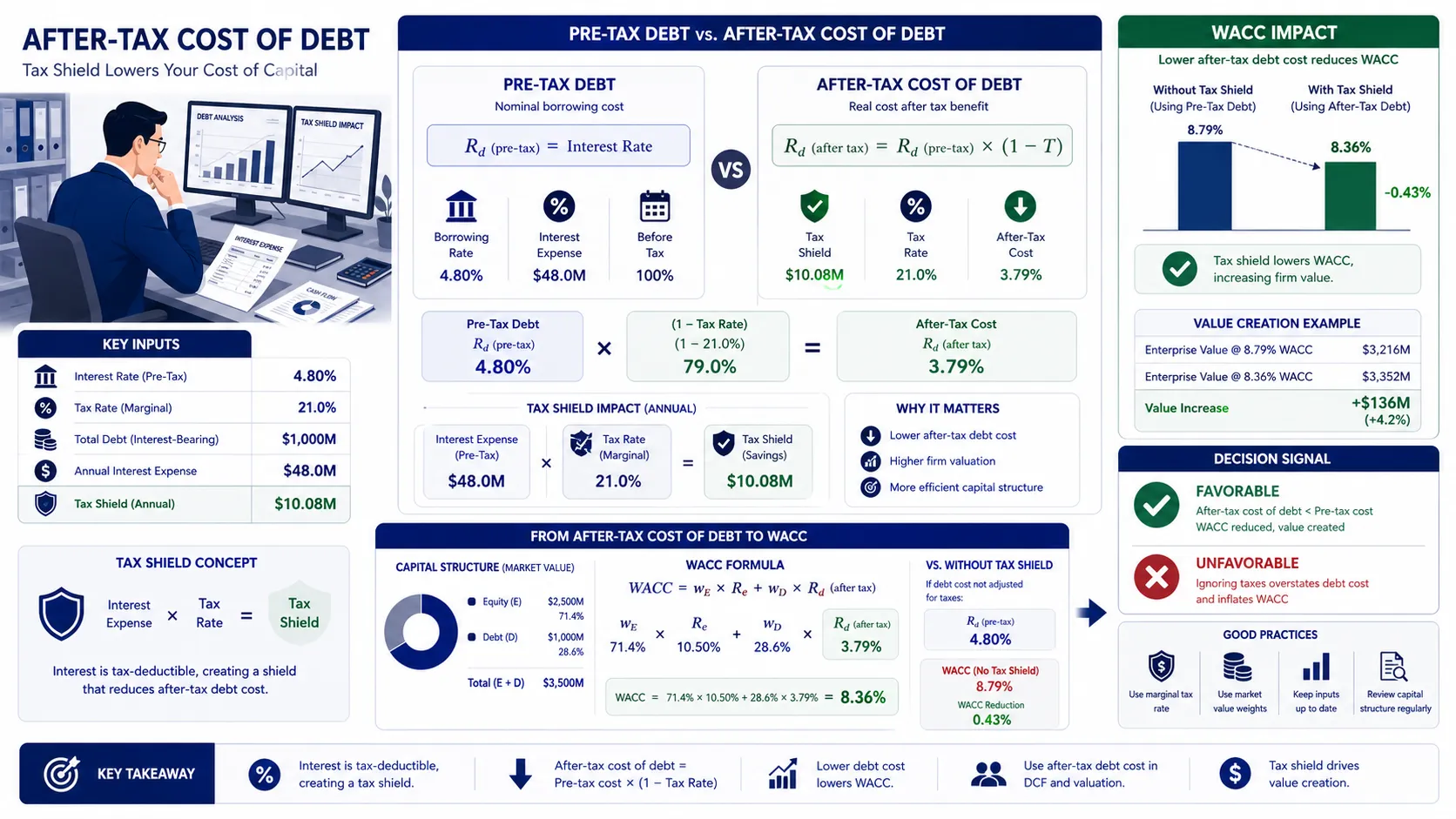
What Is After-Tax Cost of Debt and How Does It Lower WACC?
Interest payments are tax-deductible, making debt cheaper than equity and lowering your company's WACC. The after-tax cost of debt reveals this true, subsidized borrowing rate.
Frequently Asked Questions (FAQ)
What is a good DSCR ratio for a commercial property loan?
Can you borrow on a property with a DSCR below 1.00x?
Does DSCR factor in personal DTI or income tax?
How is DSCR calculated for an interest-only loan?
What is the difference between DSCR and LTV?
The real estate calculations, yield projections, and cash flow reports generated by BizToolkitPro are for educational and informational purposes only. They do not constitute formal real estate brokerage, lending underwriting, tax counsel, or legal advice.
Investment returns, debt coverage ratios, and capitalization metrics (including Cap Rate, DSCR, Cash-on-Cash, and Waterfall distributions) are simulated based on user-provided inputs and assumptions. Local housing laws, property taxes, market vacancies, and interest rates fluctuate dynamically; therefore, BizToolkitPro makes no warranties regarding the accuracy or real-world applicability of these projections.
Always perform your own independent physical and financial due diligence on properties, and consult with a licensed Real Estate Broker, Mortgage Underwriter, Tax Advisor, or real estate attorney before signing purchase agreements or securing loans.