
Mortgage Calculator: Principal, Interest, Taxes & PMI
Analyze your home purchase options using our professional Mortgage calculator. While basic mortgage tools only compute your core Principal & Interest (P&I) payments, buying a property involves complex recurring expenses.
Property taxes, homeowners insurance, private mortgage insurance (PMI), and homeowners association (HOA) fees can increase your true out-of-pocket costs significantly. Use our interactive builder to analyze your full Monthly PITI breakdown, run interest-rate stress-tests, and plan strategic downpayment options.
Have a suggestion or found a calculation discrepancy? Let us know!
Understanding Mortgage Payments: Defining PITI Components
When purchasing residential real estate, understanding your true monthly commitment is critical to avoiding financial distress. Lenders evaluate borrowers based on a comprehensive housing expense ratio known as PITI. PITI stands for Principal, Interest, Taxes, and Insurance. Together with HOA fees, this figure represents your complete monthly cash outflow for housing, establishing the baseline for debt-to-income (DTI) qualification checks.
Breaking down Principal & Interest vs holding expenses
The core of any mortgage is the Principal and Interest (P&I) payment. Principal is the portion of the cash payment that goes directly toward reducing the outstanding balance of your loan, building your home equity over time. Interest is the fee charged by lenders for borrowing the capital. Property taxes and homeowners insurance are holding costs that do not build equity but are required to protect the property asset. Property taxes are levied by local governments, while insurance protects the structure against hazard losses.
How to Calculate Mortgage Payments (Step-by-Step)
The Standard Formulas
We apply standard amortization formulas to isolate each PITI expense:
Defining the amortization parameters
To run the equation, you need to establish these variables:
- Home Value (Purchase Price): The total dollar value negotiated to purchase the house.
- Downpayment: The upfront cash equity paid by the buyer. If the downpayment is less than 20% of the home value, lenders require Private Mortgage Insurance (PMI) to offset the risk of defaults.
- Interest Rate: The annual rate charged by the lender. This is converted to a monthly rate by dividing by 12.
- Loan Term: The length of the loan. The standard term is 30 years (360 months), though 15-year options are common for borrowers seeking lower lifetime interest costs.
Example Mortgage Calculation
Real-World Purchase Case
Consider a home buyer purchasing a property with these details:
- Home Value: $400,000
- Downpayment: $40,000 (10% downpayment)
- Interest Rate: 6.50%
- Loan Term: 30 Years
- Property Tax Rate: 1.2%
- Home Insurance: $1,200 per year
- PMI Rate: 0.70%
Calculating the Breakdown
First, calculate the Loan Amount: $400,000 - $40,000 = $360,000.
Second, calculate Monthly Principal & Interest:
Using the amortization formula with a monthly rate of 0.5417% (6.5%/12) and 360 months:Monthly P&I = $360,000 * [0.005417 * (1.005417)^360] / [(1.005417)^360 - 1] = $2,275.44.
Third, calculate monthly holding expenses:Monthly Tax = ($400,000 * 1.2%) / 12 = $400.00.Monthly Insurance = $1,200 / 12 = $100.00.Monthly PMI = ($360,000 * 0.7%) / 12 = $210.00(Required because downpayment is < 20%).
Finally, add all items together:Total Monthly Payment = $2,275.44 + $400 + $100 + $210 = $2,985.44.
Strategic Mortgage Decisions: Rates & Terms
Comparing 30-Year vs 15-Year Terms
Choosing a loan term is a balance between monthly cash flow and total interest expenses:
- 30-Year Mortgages: Offer lower monthly payments, maximizing your purchasing power and preserving monthly cash flow. However, because the amortization rate is slower, you pay significantly more in cumulative interest over the life of the loan.
- 15-Year Mortgages: Command higher monthly payments, but benefit from lower interest rates and a rapid principal reduction schedule, saving tens of thousands of dollars in lifetime interest.
Avoiding PMI
PMI is required on conventional loans when you put down less than 20% of the purchase price. PMI protects the lender, not you.
- Make a 20% downpayment to eliminate PMI entirely.
- PMI can typically be canceled once your outstanding loan balance drops to 80% of the original home value.
Common Mistakes in Budgeting Mortgage Loans
Budgeting Solely Based on P&I Payments
Focusing only on Principal and Interest is a major financial risk. Taxes, insurance, and HOA fees often make up 20% to 40% of your total housing payment. Always evaluate your budget using the full PITI payment to avoid buying a home you cannot afford to maintain.
Underestimating Local Tax Changes
Property tax rates are not static. Purchasing a home in an expanding school district or experiencing a county revaluation can trigger massive increases in your property tax bill, raising your escrow requirements and monthly payments unexpectedly.
Real-world case study: U.S. Commercial Industrial Property Benchmark (FY 2023 / Q1 2024)
U.S. Commercial Industrial Property Benchmark metrics profile
This case study examines a hypothetical but realistic commercial real estate transaction for an industrial property in the U.S., reflecting typical market conditions for late 2023 and early 2024. The analysis focuses on the financing of an industrial warehouse, a sector that has demonstrated strong performance and investment activity during this period. The mortgage calculation illustrates the financial commitment required for such an acquisition.
The calculated monthly mortgage payment of approximately $37,902 for a $4.55 million loan on a $6.5 million industrial property highlights the significant capital outlay involved in commercial real estate. An interest rate of 7.0% reflects the higher borrowing costs seen in FY 2023 and Q1 2024 due to the Federal Reserve's monetary tightening. The 70% loan-to-value ratio is a common benchmark, indicating a substantial equity contribution from the buyer, which reduces lender risk. For companies, understanding these metrics is crucial for cash flow planning, capital allocation, and assessing the overall financial viability of real estate investments. Investors closely monitor such financing terms as they directly impact property yields and the return on equity for real estate portfolios.
Related Calculators
Estimate real estate capitalization rate.
Open Tool →Occupancy Rate CalculatorCalculate occupancy and vacancy rate.
Open Tool →Cash-on-Cash ReturnMeasure levered cash return on equity.
Open Tool →NOI CalculatorCompute net operating income.
Open Tool →DSCR CalculatorSolve debt service coverage ratios.
Open Tool →Rental Property ROIEvaluate rental buy-and-hold returns.
Open Tool →Related Articles & Guides
 Real Estate
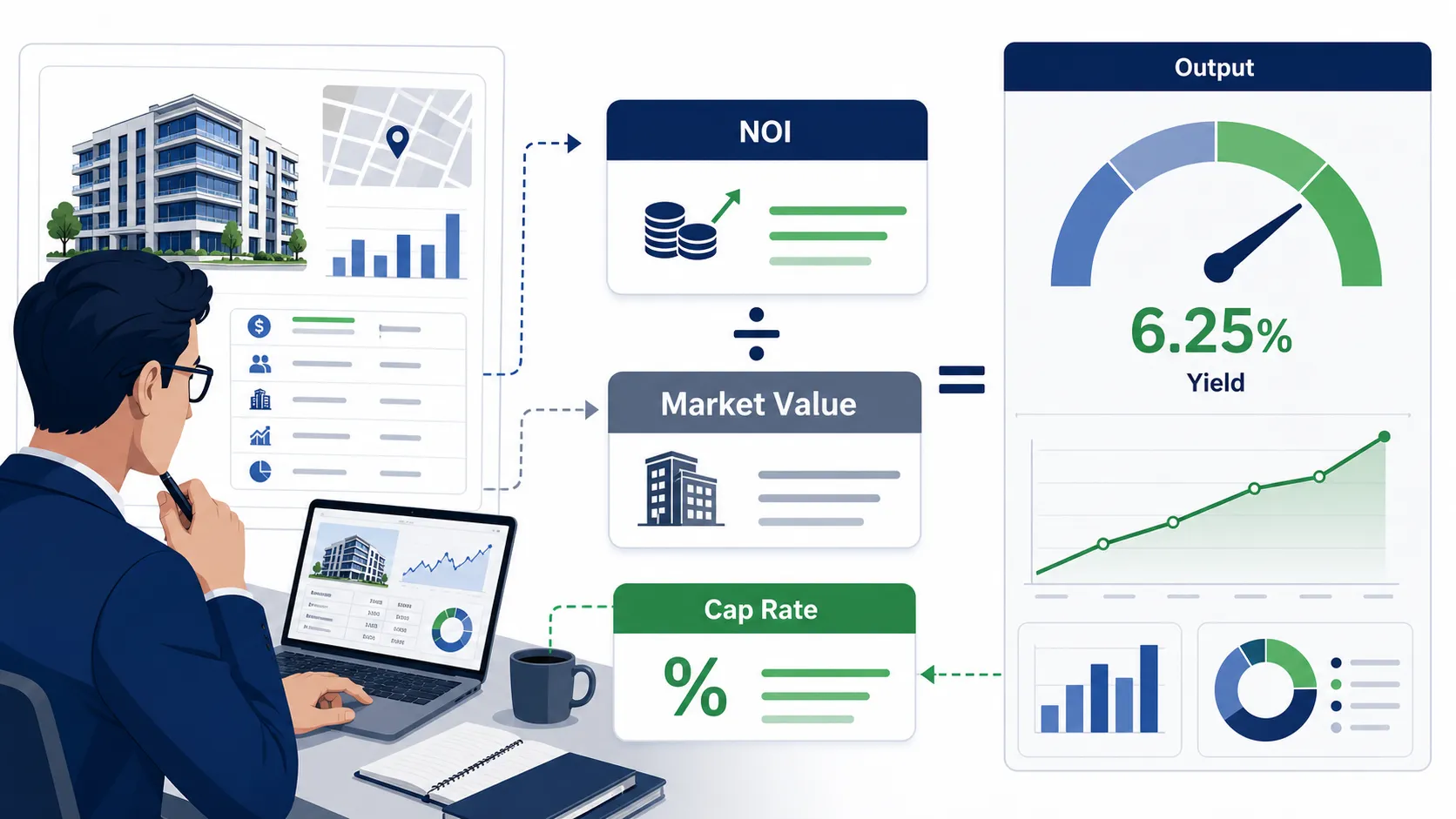
Cap Rate Calculator: Calculate Capitalization Rate Step by Step
Stop guessing property values. The cap rate formula delivers a single-year yield metric that strips out debt, letting you compare diverse assets instantly. Misjudge this rate, and you risk locking capital into an underperforming investment.
 Corporate Finance
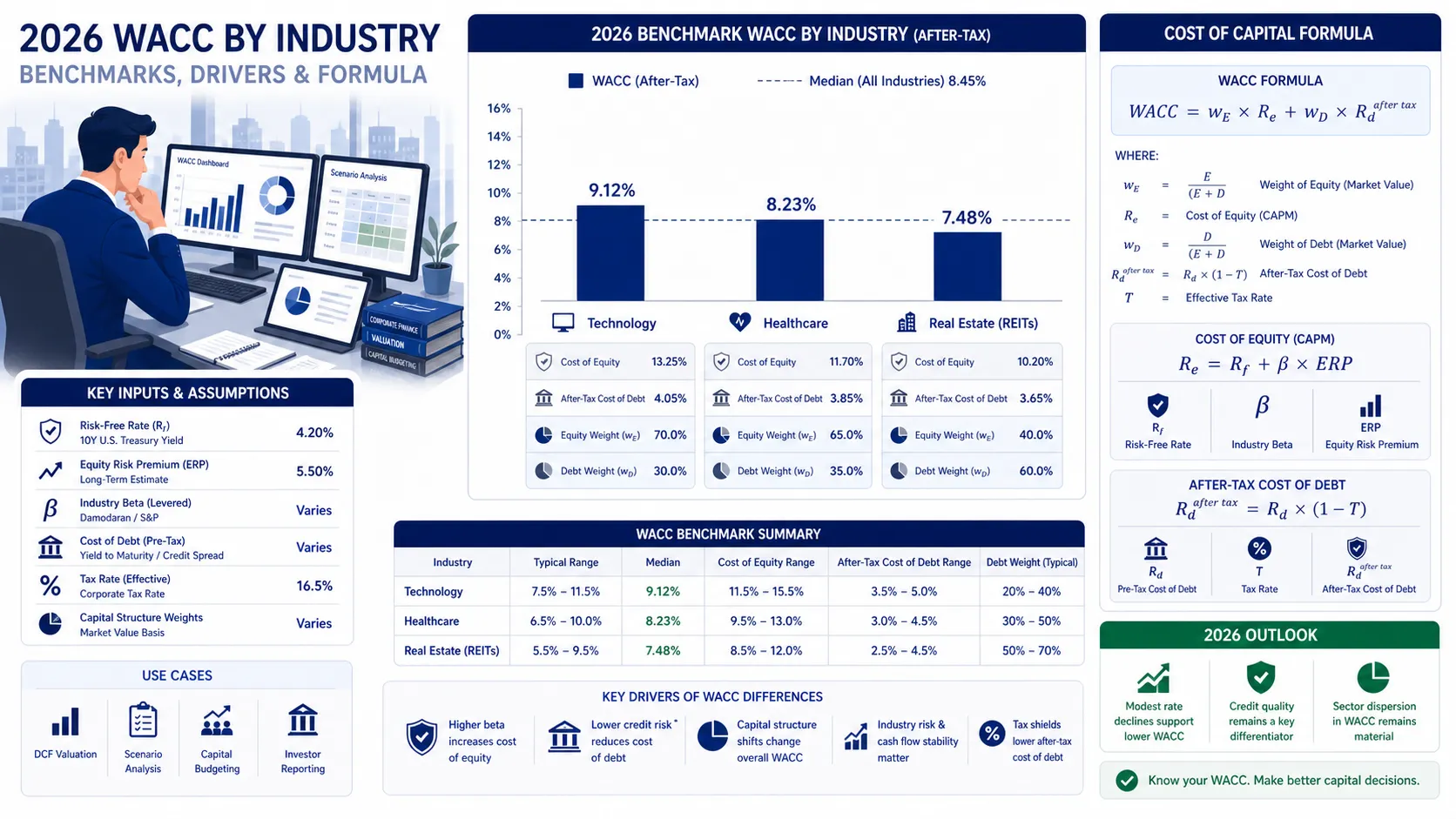
WACC by Industry: 2026 Benchmarks for Technology, Healthcare, and Real Estate
In 2026, industry WACC diverges sharply, from 5.5% for utilities to over 11.5% for software. CFOs must benchmark their discount rate against peers to ground valuations in market reality.
 Corporate Finance
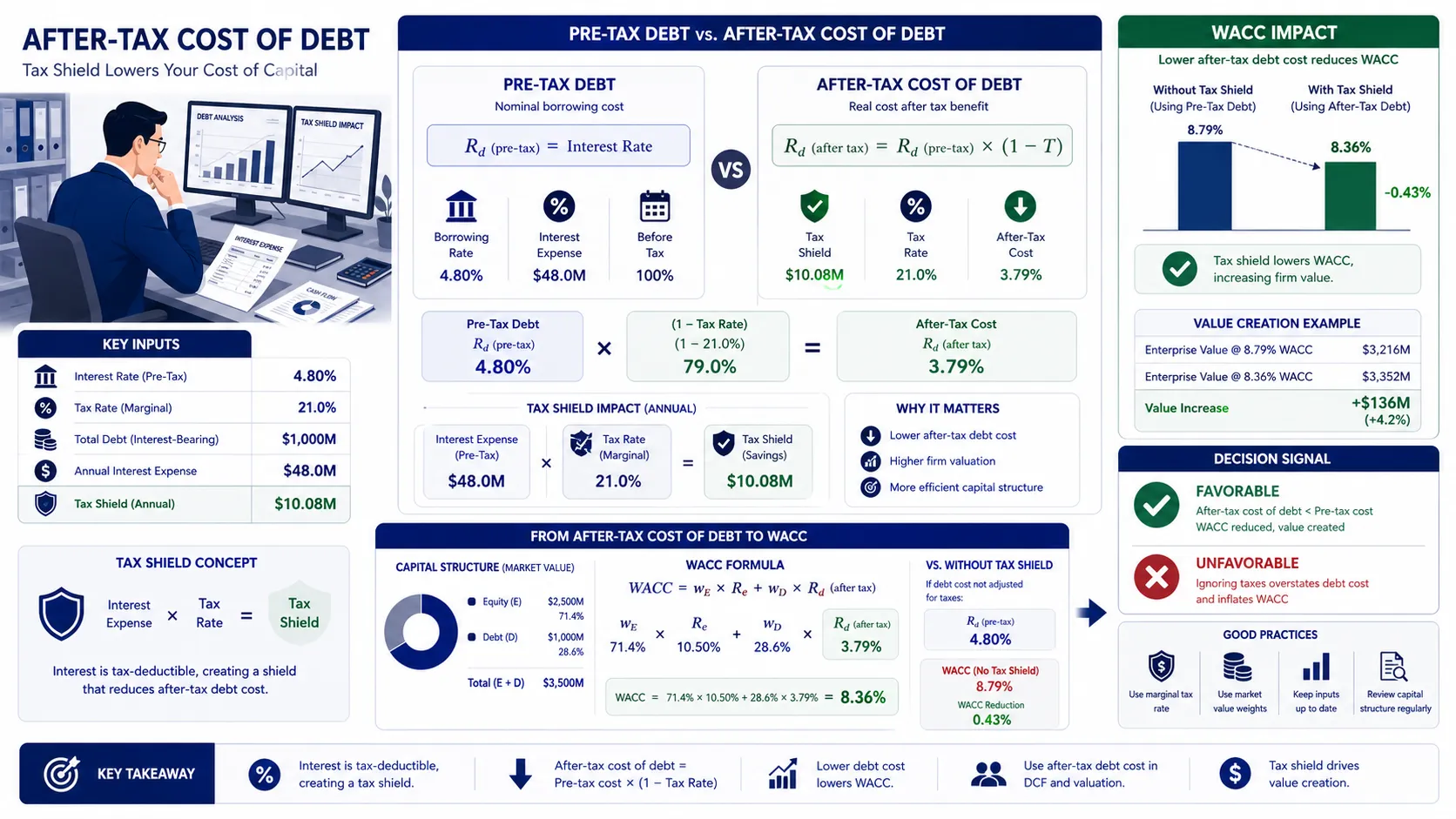
What Is After-Tax Cost of Debt and How Does It Lower WACC?
Interest payments are tax-deductible, making debt cheaper than equity and lowering your company's WACC. The after-tax cost of debt reveals this true, subsidized borrowing rate.
Methodology, Frequently Asked Questions (FAQ) & Disclaimers
FAQ: Frequently Asked Questions
Q: What is included in escrow accounts?
A: Lenders use escrow accounts to collect and pay property taxes and homeowners insurance on your behalf. Lenders divide your annual tax and insurance bills by 12, adding that amount to your monthly mortgage payment.
Q: How does a higher downpayment affect monthly payments?
A: A larger downpayment directly reduces the size of your mortgage loan, decreasing your monthly Principal and Interest payments. It can also eliminate the need for monthly Private Mortgage Insurance (PMI) fees if you put down 20% or more.
Disclaimer: Informational Guidance Only
The financial calculations and payment projections provided by the Mortgage Calculator are intended solely for educational and high-level budgeting purposes.
Calculations are based on general pricing models and do not constitute a commitment to lend, credit approval, or formal financial advice. Mortgage rates, property values, and insurance costs vary based on individual credit histories, localized underwriting guidelines, and macroeconomic factors. Consult certified mortgage brokers and professional financial advisors prior to executing property purchases.
The real estate calculations, yield projections, and cash flow reports generated by BizToolkitPro are for educational and informational purposes only. They do not constitute formal real estate brokerage, lending underwriting, tax counsel, or legal advice.
Investment returns, debt coverage ratios, and capitalization metrics (including Cap Rate, DSCR, Cash-on-Cash, and Waterfall distributions) are simulated based on user-provided inputs and assumptions. Local housing laws, property taxes, market vacancies, and interest rates fluctuate dynamically; therefore, BizToolkitPro makes no warranties regarding the accuracy or real-world applicability of these projections.
Always perform your own independent physical and financial due diligence on properties, and consult with a licensed Real Estate Broker, Mortgage Underwriter, Tax Advisor, or real estate attorney before signing purchase agreements or securing loans.