
Property Tax Calculator with Assessed Value and Exemptions
Use this focused property tax calculator, a premium real estate valuation utility designed to model property tax liabilities across jurisdictions. Property tax is generally based on a taxable value and one or more local tax rates, but the definitions and calculation rules vary widely by jurisdiction.
This online utility supports a direct effective-rate estimate, an assessed-value and percentage rate method, and a detailed millage or levy component model. It independently processes exemptions, credits, special assessments, prorations, and purchase-reassessment scenarios. Whether you are conducting property underwriting, estimating escrow budgets for home loans, or preparing investment memos, this tool delivers the necessary analytical precision.
Have a suggestion or found a calculation discrepancy? Let us know!
How to use this property tax calculator
Select a calculation method
Choose from three calculation methods depending on the data available to you. Use Assessed Value / Percentage Rate if you have an assessed value and a single combined percentage tax rate. Use Millage / Levy Components to build a multi-layered tax rate using millage (mills) or separate percentage levies (such as school, county, and city taxes). Choose Direct Effective Rate for a quick estimate based on market value and a single effective tax rate.
Enter value, tax year, and jurisdiction
Input the property's appraised or market value. Set the assessment ratio (percentage of market value that is taxable) to derive the assessed value. Define the tax year and enter your local jurisdiction label (e.g., Orange County). You can override derived assessed or taxable values directly if you have your official tax bill in hand.
Add exemptions, credits, and assessments
Use our interactive builders to add exemptions (which reduce the taxable value, such as homestead exemptions) and tax credits (which directly reduce the calculated annual tax liability). You can also append flat special assessments (such as solid waste or sewer fees) that do not depend on the property's value. Click Estimate Property Tax to compile the report.
Your property tax estimate
Estimated annual property tax
This is the final estimated ad valorem tax liability for the year, plus flat special assessments, minus any qualifying tax credits. It represents your total annual recurring cash outflow for property tax purposes. Keep in mind that tax rates and assessment ratios change annually during local referendum and budget cycles.
Monthly escrow equivalent
The monthly property tax equivalent is calculated simply as the estimated annual tax liability divided by twelve. This is a budgeting benchmark representing the average monthly accrual needed to fund your annual bill. A mortgage lender's actual escrow account requirement may differ due to cushion rules, payment timing, and reserves.
Effective tax rate
The effective tax rate represents the true tax rate you pay relative to the property's appraised market value (Annual Tax divided by Market Value). This rate is often significantly lower than the nominal millage or statutory tax rate because of assessment ratios, homestead caps, and exemptions that shelter a portion of the value.
Build taxable property value
Market or appraised value
Market value is the estimated amount for which a property should exchange on the date of valuation between a willing buyer and a willing seller in an arm's-length transaction. An appraisal is an opinion of value by a licensed professional. In many states, the tax assessor estimates market value using mass appraisal techniques, which may lag behind actual market sales prices.
Assessment ratio and assessed value
The assessment ratio is the percentage of a property's appraised value that is subject to tax. For example, if a property has a market value of $500,000 and the local assessment ratio is 80%, the assessed value is $400,000. Assessment ratios are set by state or local law and often vary by property class (e.g., residential vs. commercial).
Exemptions and taxable value
Exemptions are statutory reductions in value that shelter home values from property taxes. A common example is the homestead exemption, which reduces the assessed value for primary residences. Subtracted from the assessed value, exemptions yield the final Taxable Value. Taxable value is the actual base multiplied by the tax rate to determine the tax due.
Build the property tax rate
Direct effective tax rate
An effective tax rate expresses the total property tax as a direct percentage of the property's market value. This is useful when comparing tax burdens across different regions without getting bogged down in local assessment ratios and complex millage calculations. It reflects the real-world tax drag on your real estate assets.
Millage and levy components
A millage rate is expressed in mills, where one mill represents $1 of tax per $1,000 of taxable value. A property tax bill is typically a aggregate of separate levy components from multiple taxing authorities, such as the county government, the city municipality, the school district, and special water or emergency service districts.
Special assessments and flat charges
Special assessments are non-ad valorem fees levied on property owners to fund specific local infrastructure projects or public services (e.g., street paving, lighting, solid waste management). Unlike ad valorem taxes, special assessments are flat dollar amounts and do not vary based on the property's assessed value.
Compare property tax scenarios
Current bill scenario
The current bill scenario models your tax liability under the existing market valuation and local tax structures. This is a baseline projection for current owners who do not expect immediate assessment adjustments or purchase triggers. It serves as a benchmark for ongoing holding costs.
Purchase reassessment scenario
When a property is sold, the transaction price often triggers a reassessment by the county tax assessor. The purchase reassessment scenario models this transition by adjusting the market value (typically by a default assumption of +10%) and recalculating the tax base, ensuring that prospective buyers prepare for potential post-closing tax increases.
Higher-value or higher-rate stress scenario
This stress test models a dual increase in both property market value (+15%) and local tax rate components (+5%). Strategic underwriters utilize this scenario to analyze high-inflation environments or municipal budget shortfalls, stress-testing whether property operating cash flows can support elevated tax drag.
Property tax variance profiling
Taxable-value fluctuations
Understanding how shifts in valuation affect your bottom line is crucial. This analysis measures how increments or decrements in the property's taxable base translate into actual dollar tax increases, isolating value shifts while keeping the statutory millage or percentage rates constant.
Rate and millage variability
Local voters and municipal boards frequently propose new bond initiatives or school levies. Rate sensitivity analysis models how changes in millage rates affect your property tax obligation, allowing you to gauge the financial impact of local tax hikes or rollback measures.
Exemption shielding impact
Exemptions act as a shield against the full brunt of ad valorem rates. By modeling alternative exemption amounts, you can analyze the savings generated by new eligibility qualifications, such as adding a senior citizen status, disability status, or veteran program to your baseline homestead allowance.
Property tax proration
Annual tax period and paid status
At real estate closings, property taxes must be divided between the buyer and the seller. This division depends on the county's fiscal tax period and the status of the current annual tax bill (paid in advance, unpaid, or paid in arrears). Proper documentation is required to avoid escrow discrepancies.
Buyer and seller day allocation
Proration calculates the exact number of calendar days each party owns the property during the tax year. For example, if a transaction closes on day 150 of the fiscal year, the seller is responsible for the first 150 days of tax, and the buyer assumes responsibility for the remaining days.
Estimated closing credit or debit
Based on the day count and paid status, a financial credit is generated at closing. If taxes have been prepaid by the seller, the buyer credits the seller for the post-closing portion. If taxes are unpaid and will be billed later, the seller credits the buyer for the pre-closing portion.
Property tax formula and methodology
Millage formula
When millage rate components are used, the property tax computation follows structured algebraic sequences to convert mills into tax dollars:
Direct-rate formula
In direct-rate mode, the formula acts as a simple ratio multiplication. The base tax is derived as: Annual Tax = Taxable Value * (Direct Rate / 100). This model is commonly used for rapid high-level estimates or when local municipalities quote single comprehensive rates.
Assessment-ratio and millage formulas
When building a detailed millage model, we first compute: Assessed Value = Market Value * (Assessment Ratio / 100). Exemptions are then subtracted: Taxable Value = max(0, Assessed Value - Value Exemptions). Each rate component is calculated and aggregated: Base Ad Valorem Tax = Sum(Taxable Value * Rate).
Credits, assessments, and rounding
Finally, special assessments and credits are integrated into the total: Estimated Annual Tax = max(0, Base Tax + Special Assessments - Tax Credits). All calculations are rounded to two decimal places for currency fields, while effective rates preserve four decimal places. Credits reduce tax dollar-for-dollar, while exemptions reduce value dollar-for-value.
Property tax calculation example
Example assessed value
Let's look at an illustrative property with a market value of $500,000. The county applies a residential assessment ratio of 80%. First, we find the assessed value:$500,000 * 0.80 = $400,000 Assessed Value
Example exemption and millage
The owner qualifies for a homestead exemption of $25,000. This shelters value, resulting in:$400,000 - $25,000 = $375,000 Taxable ValueThe local taxing district has an aggregate rate of 25 mills (25 per $1,000).
Example annual and monthly calculations
We apply the millage rate to the taxable base to find the ad valorem tax:($375,000 * 25) / 1,000 = $9,375 Base TaxWith a flat school fee of $500, the total annual bill is $9,875, translating into a monthly equivalent of $822.92.
Continue your property analysis
Add tax to a mortgage budget
Once you have estimated your monthly property tax, you can import this value directly into our mortgage calculator. Including property tax is essential for calculating a realistic monthly PITI (Principal, Interest, Taxes, and Insurance) payment.
Go to Mortgage Calculator →Add tax to closing costs
Property tax prorations play a significant role in transaction fees. Pass your estimated daily tax liabilities to our closing costs sheet to analyze buyer/seller credits, helping you verify bank quotes and reserve requirements.
Go to Closing Cost Calculator →Add tax to NOI and rent-versus-buy analysis
Taxes represent a substantial operating expense. In rental property underwriting, taxes directly reduce Net Operating Income (NOI). Rent vs. Buy models also rely on accurate tax estimations to compare the long-term wealth returns of ownership against rental alternatives.
Go to Rent vs Buy Calculator →Property tax calculator use cases
Current homeowner budgeting
Existing homeowners use this calculator to estimate the impact of recent tax rate changes, referendum results, or property exemptions. By modeling local adjustments, owners can anticipate adjustments to their mortgage escrow payments, avoiding unexpected shortages or monthly payment spikes.
Home purchase planning
Prospective home buyers must look beyond the current seller's tax bill. In many states, the home's value is reassessed upon sale, which can lead to a significant tax increase. Modeling these reassessments prevents buyers from being blindsided by new tax bills after closing.
Rental property underwriting
Real estate investors use tax estimations to model property holding costs, calculate tax shields, and evaluate potential cash flows. Because taxes represent a large operating expense, accurate projections are critical for calculating realistic cap rates and IRR metrics.
Common property tax mistakes
Using market value as taxable value without checking
A common error is multiplying market value directly by the nominal tax rate. This method ignores state-specific assessment ratios and homestead caps, which can lead to overestimating tax liabilities. Always check if an assessment ratio is applied in your local jurisdiction.
Mixing mills and percentage rates
Millage rates are expressed as mills per dollar of value (or dollars per thousand), while standard tax rates are percentages. Confusing the two can lead to massive calculation errors (e.g., treating 20 mills as a 20% tax rate instead of 2.0%). Be sure to clarify your units before calculating.
Treating an exemption or credit as guaranteed
Property tax exemptions (such as senior citizen, veteran, or homestead programs) have strict qualification requirements and application deadlines. Assuming you qualify without verification can leave you with an unexpectedly high tax bill. Always confirm eligibility with your local tax assessor.
Data sources and jurisdiction rules
Assessor and tax collector sources
The primary authority for property tax values is the county or city tax assessor. Assessor databases compile parcel values, historical transactions, and building characteristics. The tax collector or county treasurer is responsible for issuing tax bills and tracking payment history.
Official levy and exemption references
Local millage rates and levy schedules are approved annually by school boards, city councils, and county commissions. Exemption qualification limits are governed by state statutes and local ordinance, and are updated periodically based on legislative changes.
User-entered and scenario values
This calculator runs calculations using user-entered data or illustrative values. When official records are unavailable or outdated, the manual input panel provides a fallback for custom calculations, avoiding reliance on stale average tax data.
Real-world case study: Public Storage (PSA, FY 2023)
Public Storage metrics profile
Public Storage, a prominent self-storage Real Estate Investment Trust (REIT), incurred substantial property tax expenses in fiscal year 2023, reflecting the significant property holdings essential to its business model. These taxes represent a key operational cost influencing the company's financial performance.
Public Storage's considerable property tax expense of $812.2 million in FY 2023, calculated against its approximately $53.9 billion in net real estate assets, results in an effective property tax rate of about 1.51%. This figure is a critical indicator for investors and management, showcasing the substantial impact of local property taxation on the REIT's operational efficiency and net operating income. Proactive management of these tax obligations, including potential appeals and strategic asset allocation, is vital for Public Storage to maintain competitive advantage and optimize shareholder returns in the dynamic real estate market.
Related Calculators
Estimate real estate capitalization rate.
Open Tool →Occupancy Rate CalculatorCalculate occupancy and vacancy rate.
Open Tool →Cash-on-Cash ReturnMeasure levered cash return on equity.
Open Tool →NOI CalculatorCompute net operating income.
Open Tool →DSCR CalculatorSolve debt service coverage ratios.
Open Tool →Rental Property ROIEvaluate rental buy-and-hold returns.
Open Tool →Related Articles & Guides
 Real Estate
Cap Rate Calculator: Calculate Capitalization Rate Step by Step
Stop guessing property values. The cap rate formula delivers a single-year yield metric that strips out debt, letting you compare diverse assets instantly. Misjudge this rate, and you risk locking capital into an underperforming investment.
 Corporate Finance
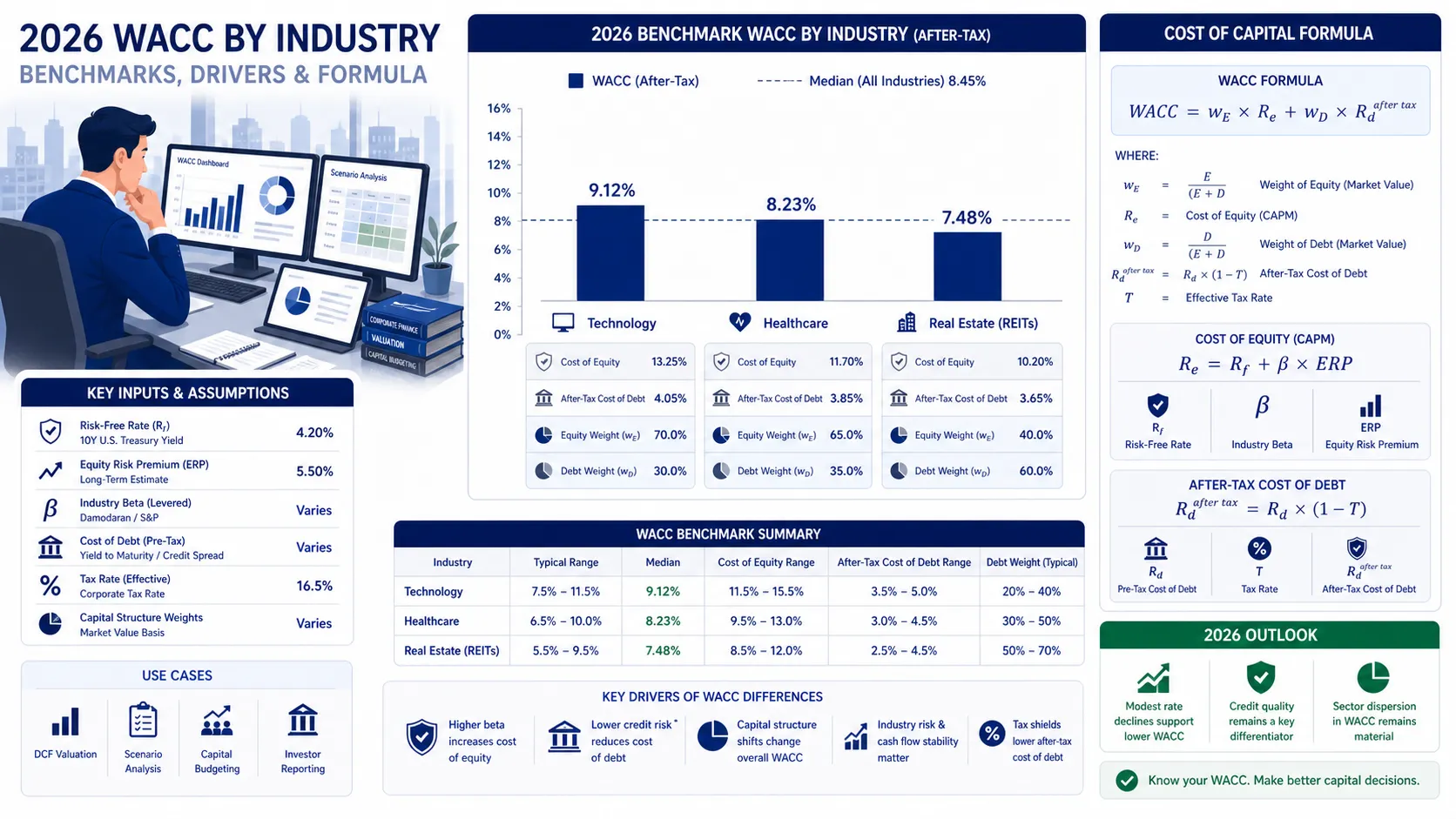
WACC by Industry: 2026 Benchmarks for Technology, Healthcare, and Real Estate
In 2026, industry WACC diverges sharply, from 5.5% for utilities to over 11.5% for software. CFOs must benchmark their discount rate against peers to ground valuations in market reality.
 Corporate Finance
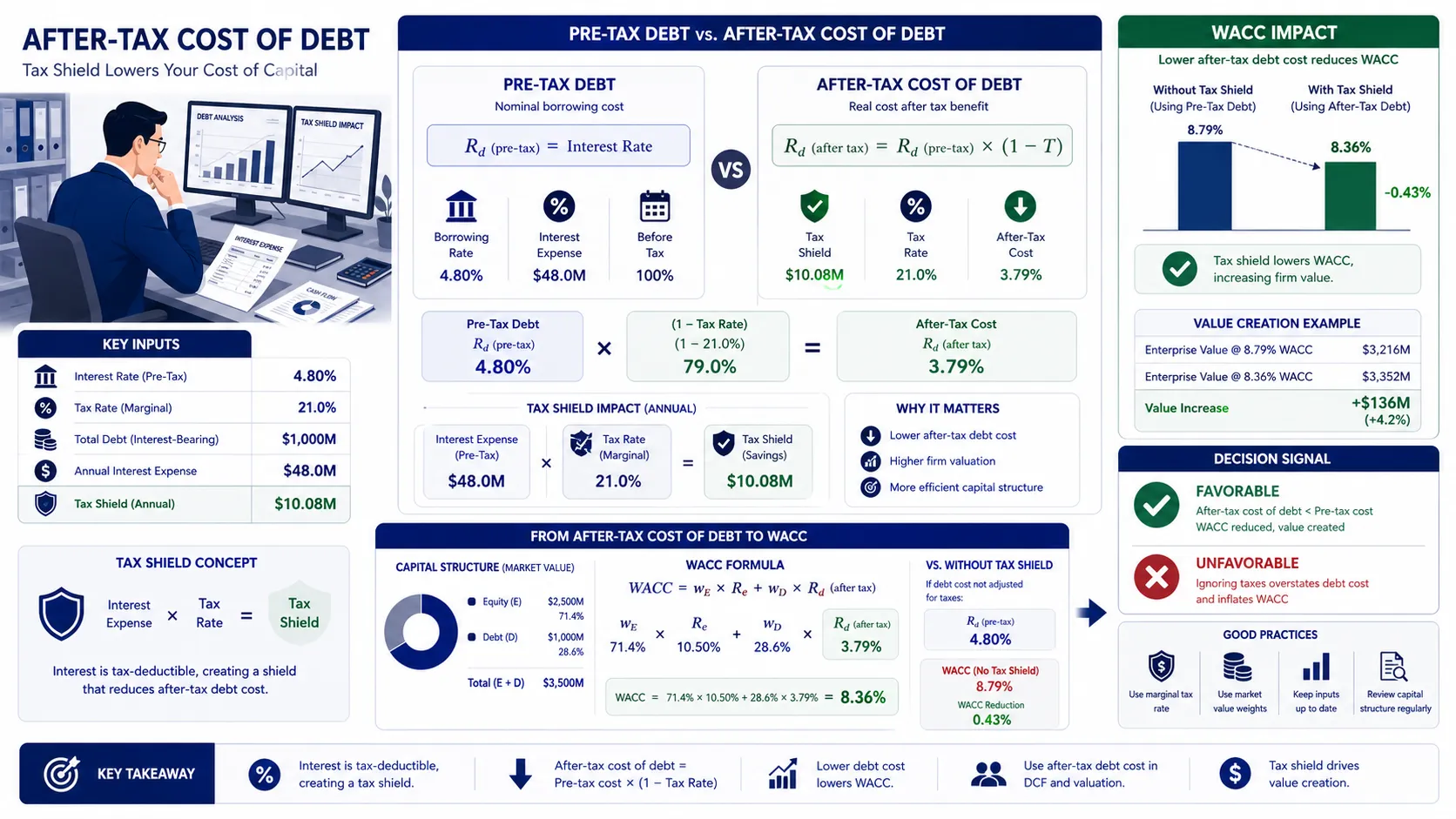
What Is After-Tax Cost of Debt and How Does It Lower WACC?
Interest payments are tax-deductible, making debt cheaper than equity and lowering your company's WACC. The after-tax cost of debt reveals this true, subsidized borrowing rate.
Frequently asked questions
How is property tax calculated?
What is the difference between assessed and market value?
What does a millage rate mean?
Is the monthly amount an escrow quote?
Can this calculator determine an exemption?
The real estate calculations, yield projections, and cash flow reports generated by BizToolkitPro are for educational and informational purposes only. They do not constitute formal real estate brokerage, lending underwriting, tax counsel, or legal advice.
Investment returns, debt coverage ratios, and capitalization metrics (including Cap Rate, DSCR, Cash-on-Cash, and Waterfall distributions) are simulated based on user-provided inputs and assumptions. Local housing laws, property taxes, market vacancies, and interest rates fluctuate dynamically; therefore, BizToolkitPro makes no warranties regarding the accuracy or real-world applicability of these projections.
Always perform your own independent physical and financial due diligence on properties, and consult with a licensed Real Estate Broker, Mortgage Underwriter, Tax Advisor, or real estate attorney before signing purchase agreements or securing loans.