
Vacancy Rate Calculator for Rental Property Performance
Use this focused vacancy rate calculator, a key real estate analysis tool for landlords, asset managers, and acquisition teams. Vacancy rate measures unused rental capacity, but the correct denominator depends on the question.
This online tool calculates physical Point-in-Time Unit Snapshot, Period Unit-Days Exposure, Area-Weighted Rentable Area, and Economic Vacancy (revenue leakage). It highlights the critical difference between space availability and cash flow loss, providing the precise inputs needed for commercial underwriting and multifamily property management.
Have a suggestion or found a calculation discrepancy? Let us know!
How to use this vacancy rate calculator
Select a vacancy definition
Choose the basis that matches your analysis goals. Select Point-in-Time Unit Snapshot for residential portfolios, Period Unit-Days Exposure to count vacant days over a time frame, Area-Weighted for commercial buildings with varying unit sizes, or Economic Vacancy to capture concessions and credit losses.
Enter the property and analysis period
Input the property class and define how offline units (e.g., units undergoing major renovation or set aside for model use) should be treated. You can exclude them from the denominator or count them as vacant, depending on local reporting conventions.
Add simple totals or a detailed schedule
Enter the total units, vacant units, area metrics, or gross potential rent in the input fields. The calculator dynamically solves the equations, generating a physical occupancy complement, a physical-economic gap diagnostics panel, and downside/upside operating scenarios.
Your vacancy and occupancy metrics
Physical vacancy rate
This represents the percentage of physical rental inventory that is vacant and available for lease. Depending on the mode, this rate is calculated using unit count, rentable square feet, or calendar unit-days, keeping your physical asset utilization visible.
Occupancy rate
The occupancy rate is the mathematical complement to the vacancy rate (Occupied Inventory / Total Included Inventory). Under the same reporting criteria and period definitions, your occupancy and vacancy rates always sum to exactly 100%.
Economic vacancy and revenue loss
Economic vacancy measures cash flow leakage rather than physical space. It divides total rent loss (due to vacancy, concessions, discounts, write-offs, and bad debts) by the property's potential gross rent. If concessions are high, economic vacancy can be significantly higher than physical vacancy.
Calculate unit vacancy
Point-in-time vacant units
Point-in-time unit vacancy counts vacant units on a specific date (such as month-end or quarter-end). This snapshot is useful for rapid residential underwriting when units are broadly similar in size, layout, and target market rent.
Included and excluded units
A major source of reporting discrepancies is the treatment of offline inventory. Non-rentable units (such as models, employee apartments, or units offline for major fire damage restoration) must be handled consistently. Excluding them from available inventory increases the calculated vacancy rate for the remaining units.
Unit occupancy complement
The unit occupancy rate measures active leases on your roll. It is a critical operational KPI for leasing agents, who use the occupancy complement to schedule advertising spend, track move-in dates, and plan tenant turnovers.
Calculate unit-day vacancy
Available unit-days
Unit-day vacancy accounts for the passage of time over a period. In a 31-day month, a 100-unit property has 3,100 available unit-days. This provides a more accurate representation of operational performance than point-in-time snapshots, capturing partial-month availability.
Vacant unit-days
Every calendar day a unit sits empty adds to the vacant unit-day accumulator. For instance, if one unit is vacant for 15 days and another is vacant for 10 days, the property has 25 vacant unit-days in that month, reflecting turnover downtime and lease-up speeds.
Partial-period and offline-unit treatment
When a unit is taken offline for renovations or repairs, it does not contribute to the leasing inventory. The calculator adjusts available unit-days based on offline days, ensuring that capital improvement programs do not artificially penalize leasing staff performance metrics.
Calculate area-weighted vacancy
Total rentable area
In office buildings, shopping centers, and warehouses, suite counts can be highly misleading. A single anchor tenant might occupy 50,000 square feet, while a small boutique occupies only 1,000 square feet. Using total rentable area establishes the correct mathematical base.
Vacant rentable area
This counts the exact square footage of suites that are empty and available for lease. The area-weighted vacancy is the vacant rentable area divided by the total rentable area. This is the standard reporting metric for commercial property markets.
Commercial suite weighting
Area-weighting ensures that larger tenant vacancies have a proportionally larger impact on the property's vacancy rate, preventing small suite turnovers from distorting the overall performance picture.
Calculate economic vacancy
Potential gross rent
Potential Gross Rent (or Gross Potential Income) is the total rental revenue the property would generate if it were 100% occupied at market rents. It serves as the economic baseline for evaluating revenue leakage.
Vacancy, concessions, and credit loss
Economic vacancy can include rent lost to empty units, lease concessions (e.g., "one month free" promotions), bad debt write-offs, and loss-to-lease (the difference between market rents and historical lease agreement rates).
Collected rent and economic occupancy
Economic occupancy is the percentage of potential gross rent that is actually collected in cash. A property can be 95% physically occupied but have an economic occupancy of only 85% due to high tenant concessions or collection issues.
Compare vacancy scenarios
Downside vacancy scenario
This downside scenario models a weak leasing market: high physical vacancy, long lease-up delays, and high tenant concessions. It helps underwriters stress-test debt service coverages under severe market downturns.
Base operating scenario
This base scenario maps the property's expected, stabilized performance. It reflects typical turnover levels and standard local lease concessions, serving as the benchmark for regular budgeting and operations.
Upside lease-up scenario
This upside scenario models a strong market with rapid lease-up times and minimal concessions. It illustrates the property's maximum revenue potential under ideal market conditions.
Vacancy variance profiling
Physical vacancy adjustments
This analysis measures how changes in the number of vacant units affect total dollar losses and net operating income, keeping other operating assumptions (such as rental rates and maintenance expenses) constant.
Average-rent adjustments
This test analyzes how variations in average rental rates impact economic vacancy and EGI, showing whether raising rents offset the risk of increased physical vacancy.
Lease-up timing impact
For new acquisitions or renovations, this models the cash flow impact of leasing delays. A delay of just 30 days in stabilized occupancy can significantly affect first-year investment yields.
Vacancy trend and diagnostics
Period-over-period vacancy trend
Tracking vacancy trends over consecutive quarters shows whether occupancy is stabilizing or deteriorating. It is a key metric for evaluating the effectiveness of local leasing staff and property managers.
Turnover and downtime diagnostics
Turnover rate measures the percentage of tenants who do not renew their leases. Downtime (the number of days a unit sits empty between leases) directly impacts your annual unit-days vacancy. Keeping turn times low is critical for maintaining cash flow.
Physical-to-economic vacancy bridge
This diagnostics bridge traces the steps between space vacancy and cash collection, identifying whether revenue losses are driven by physical vacancy, high tenant concessions, or bad debt collection issues.
Vacancy formula and methodology
Unit snapshot formula
Point-in-time snapshot vacancy uses direct division:
Unit and unit-day formulas
In unit-days mode, the formula accounts for elapsed days: Unit-Day Vacancy = Vacant Days / Available Days * 100. This captures turnover lag and lease gaps over a period.
Area-weighted formula
For commercial properties, rentable square feet is used: Area Vacancy = Vacant Square Feet / Total Square Feet * 100, ensuring larger vacant spaces carry appropriate weight.
Economic vacancy formula
The revenue loss ratio is derived as: Economic Vacancy = Total Revenue Losses / Potential Gross Rent * 100, highlighting cash leakage.
Vacancy rate calculation example
Example unit schedule
A 100-unit multifamily building has 8 empty units on the last day of the month, with 5 units offline for renovations. If offline units are excluded from the available inventory, the physical vacancy is:8 / (100 - 5) = 8 / 95 = 8.42% point-in-time vacancy
Example unit-day exposure
Over a 30-day month, the same 95 available units contribute 2,850 available unit-days. If turnovers caused units to sit empty for a combined 200 calendar days, the unit-day vacancy is:200 / 2,850 = 7.02% period unit-days vacancy
Example economic vacancy loss
The property has a potential gross monthly rent of $150,000. Vacancies caused $10,500 in lost rent, while leasing promotions added $2,500 in concessions. The economic vacancy rate is:($10,500 + $2,500) / $150,000 = $13,000 / $150,000 = 8.67% economic vacancy
Continue your property analysis
Apply vacancy to NOI
Vacancy directly reduces gross potential income. Export your estimated vacancy rate and dollar losses into our Net Operating Income (NOI) calculator to construct a realistic cash flow projection.
Open NOI Calculator →Recalculate rental yield
Vacancy losses affect net operating yields. Import your adjusted EGI (Effective Gross Income) into our rental yield sheet to see how vacancy drag impacts your capitalization and cash-on-cash returns.
Open Rental Yield Calculator →Stress-test DSCR
Lenders require a minimum DSCR (Debt Service Coverage Ratio) to fund mortgages. Stress-test your loan compliance by modeling downside vacancy scenarios to see if NOI remains sufficient to cover debt payments.
Open DSCR Calculator →Vacancy calculator use cases
Residential rental and multifamily
Property managers track Point-in-Time unit vacancy to audit leasing performance. Unit-day calculations are used to measure lease gaps and turnover turn-times, ensuring units are readied and re-leased quickly to minimize revenue drag.
Office, retail, and industrial property
Commercial assets with varying suite sizes require area-weighted calculations. A large tenant lease expiration has a massive impact on available square footage, making area vacancy the primary metric for tracking commercial lease exposures.
Lease-up and renovation periods
For new acquisitions or renovation programs, properties experience high temporary vacancy. Managers utilize separate offline treatments to isolate units undergoing capital improvement, tracking normalized vacancy separately.
Common vacancy calculation mistakes
Mixing point-in-time and period rates
A common error is comparing a month-end vacancy snapshot with a year-long period rate. Snaphots reflect single-date availability, while period rates capture seasonal lease gaps and turn-time delays, providing a more reliable performance baseline.
Counting offline units inconsistently
Including units undergoing major renovation in available inventory can artificially inflate vacancy metrics, penalizing leasing staff. Conversely, omitting offline units entirely can mask construction delays, hiding capital improvement inefficiencies.
Treating physical and economic vacancy as identical
Assuming high physical occupancy translates to high revenue collection is a costly mistake. If concessions are high or bad debt write-offs are extensive, economic vacancy can be significantly higher than physical vacancy, creating unexpected cash flow shortages.
Data sources and benchmark quality
Rent roll and property-management data
The most reliable source for vacancy modeling is the property's rent roll. Rent rolls track lease status, move-in/move-out dates, and active contract rents, providing the raw data needed for point-in-time and period vacancy calculations.
Budget, underwriting, and scenario data
Operating budgets and acquisition models use stabilized vacancy assumptions (typically 5% for multifamily and 7-10% for commercial assets) to project cash flows. Modeling alternative scenarios helps verify whether actual operational data aligns with these underwriting targets.
Market vacancy references
Market benchmarks are published periodically by brokerage firms and data portals. To be useful, these references must specify the geographic scope, property class, period, and definition basis used.
Real-world case study: Prologis, Inc. (PLD, FY 2023)
Prologis, Inc. metrics profile
Prologis, Inc. is a global leader in logistics real estate, owning and managing a vast portfolio of industrial properties worldwide. This analysis examines their vacancy rate for the fiscal year 2023, offering insights into the utilization of their extensive real estate assets. Their business model focuses on high-barrier, high-growth markets, catering to approximately 6,700 customers across various industries.
Prologis's low vacancy rate of 2.9% for Q4 2023, derived from an impressive 97.1% occupancy across its 1.2 billion square feet portfolio, underscores the strong demand for modern logistics facilities in their targeted high-growth markets. This low vacancy indicates efficient asset management and a robust market position, which is favorable for both operational efficiency and investor confidence. For investors, a low vacancy rate suggests stable rental income and potential for continued rent growth, reflecting the company's ability to retain tenants and attract new ones in a competitive real estate landscape. The ability to maintain such high occupancy rates reflects positively on their strategic location choices and their focus on essential logistics infrastructure.
Related Calculators
Estimate real estate capitalization rate.
Open Tool →Occupancy Rate CalculatorCalculate occupancy and vacancy rate.
Open Tool →Cash-on-Cash ReturnMeasure levered cash return on equity.
Open Tool →NOI CalculatorCompute net operating income.
Open Tool →DSCR CalculatorSolve debt service coverage ratios.
Open Tool →Rental Property ROIEvaluate rental buy-and-hold returns.
Open Tool →Related Articles & Guides
 Real Estate
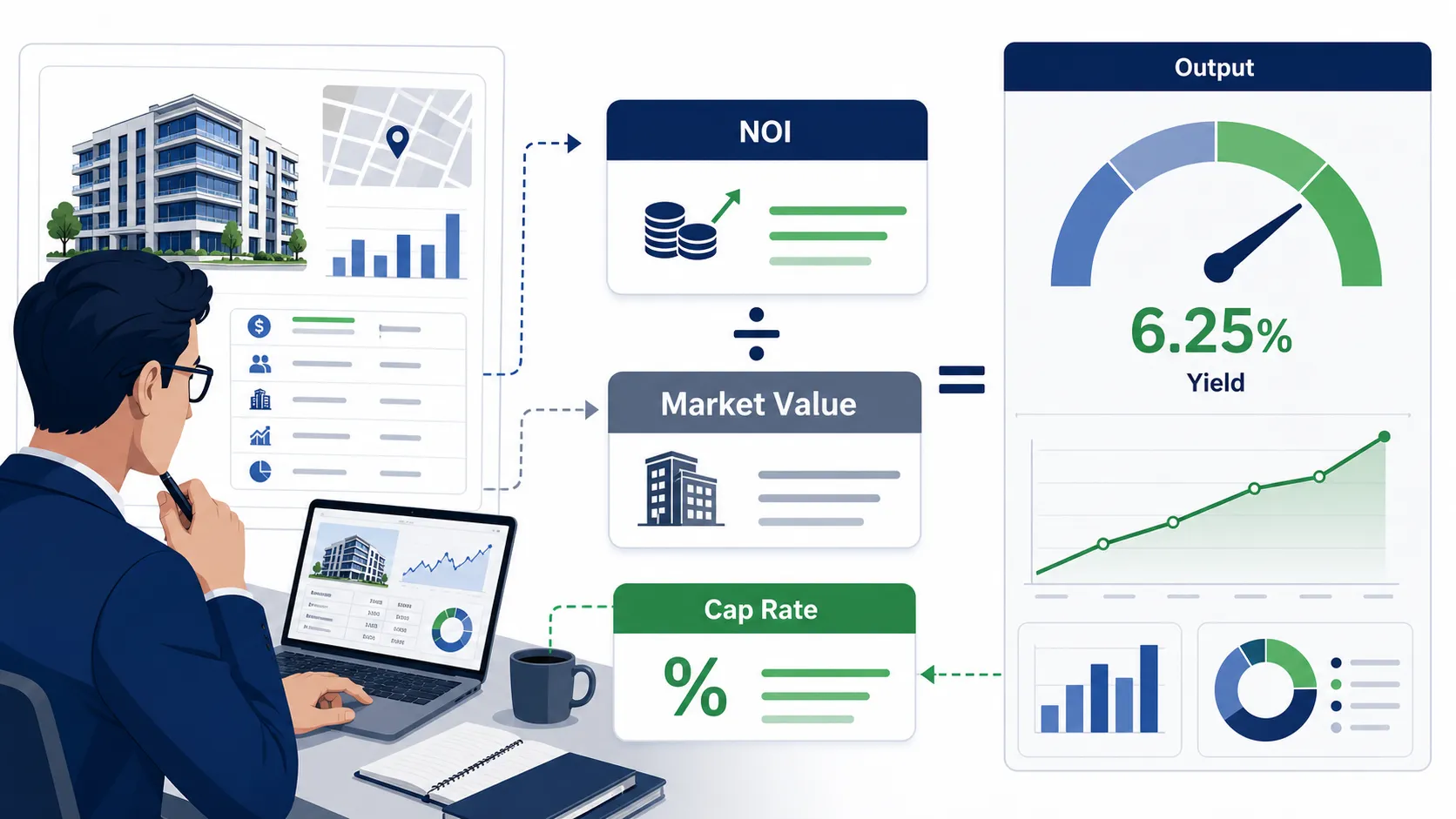
Cap Rate Calculator: Calculate Capitalization Rate Step by Step
Stop guessing property values. The cap rate formula delivers a single-year yield metric that strips out debt, letting you compare diverse assets instantly. Misjudge this rate, and you risk locking capital into an underperforming investment.
 Corporate Finance
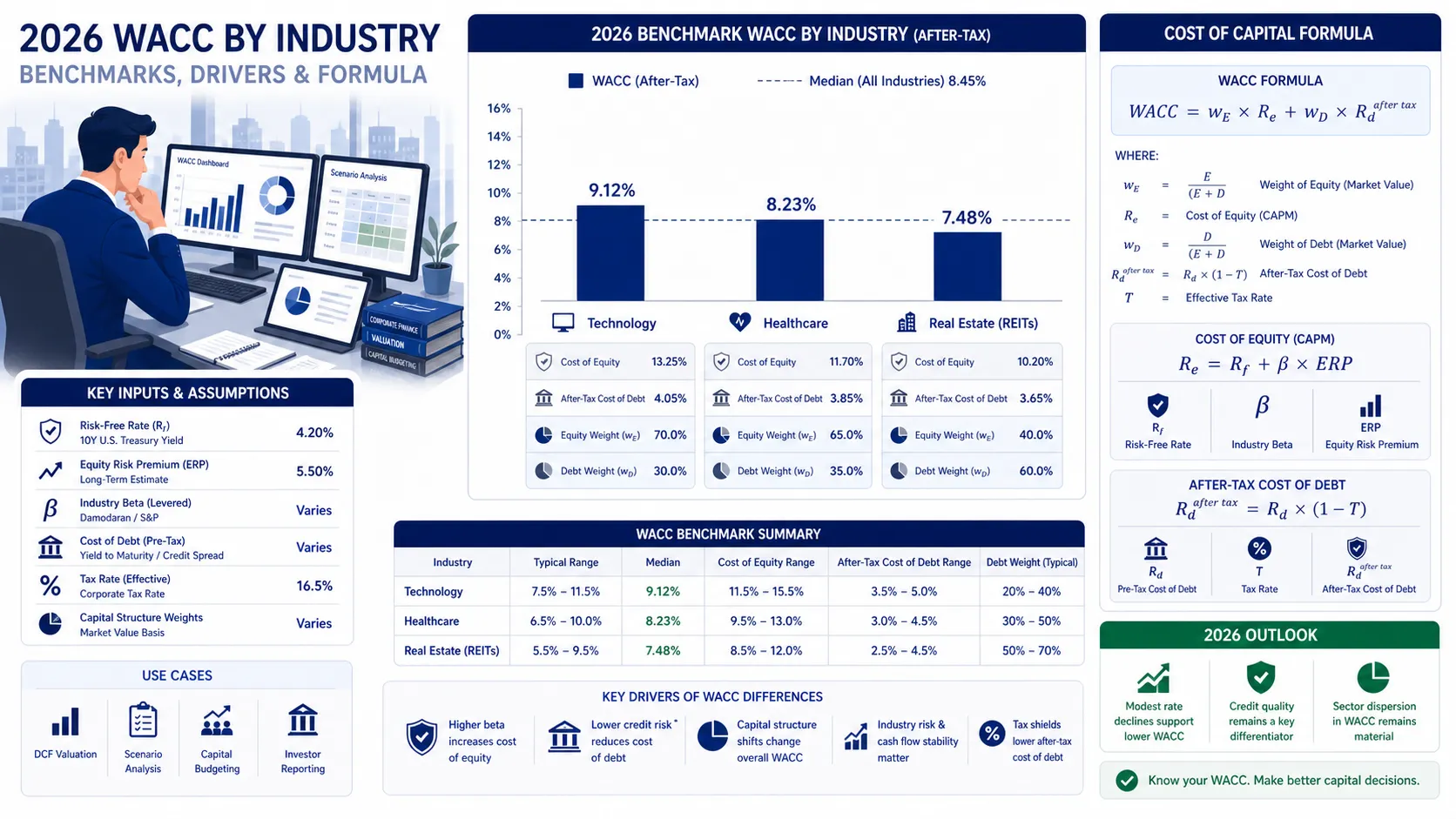
WACC by Industry: 2026 Benchmarks for Technology, Healthcare, and Real Estate
In 2026, industry WACC diverges sharply, from 5.5% for utilities to over 11.5% for software. CFOs must benchmark their discount rate against peers to ground valuations in market reality.
 Corporate Finance
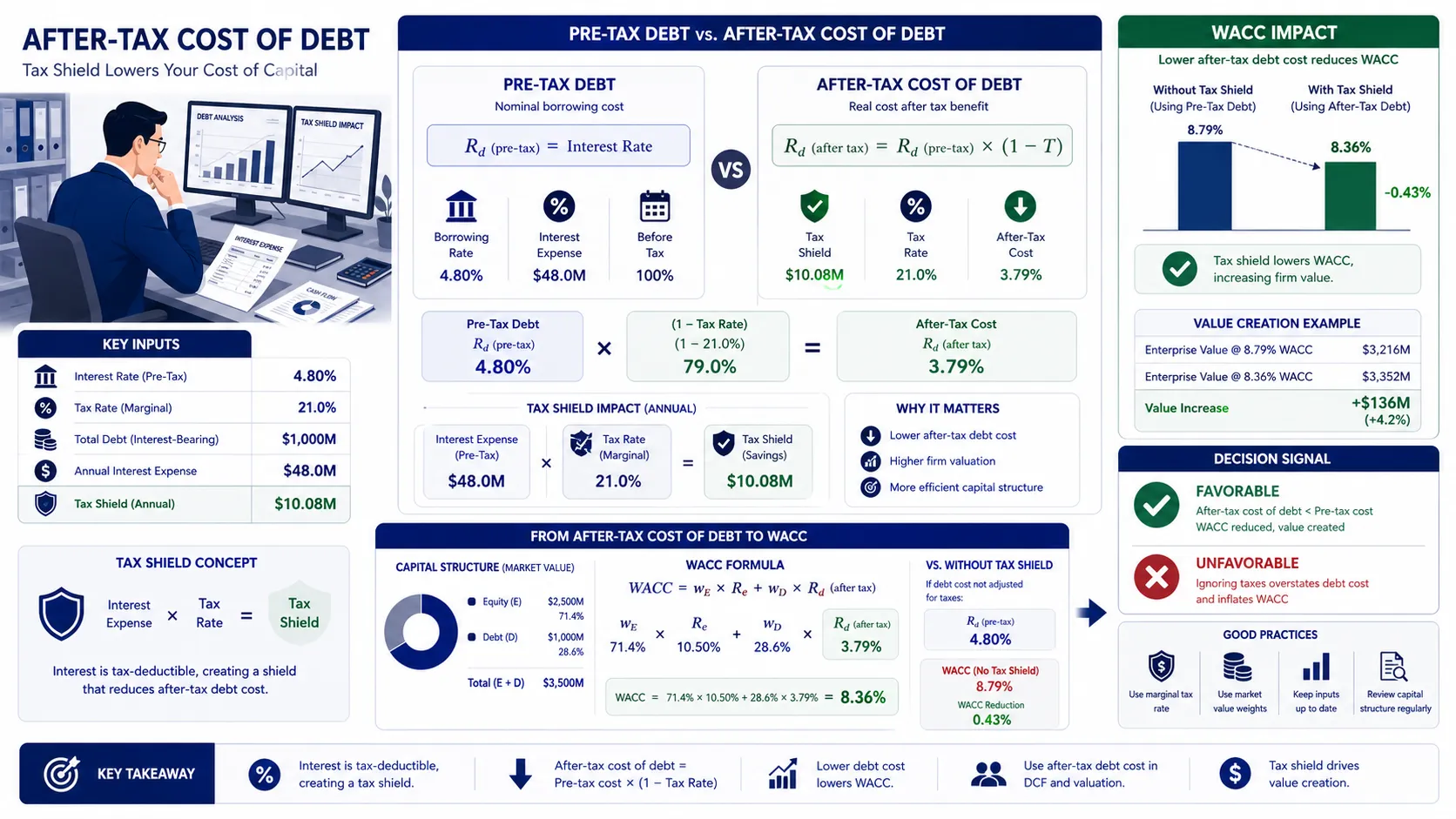
What Is After-Tax Cost of Debt and How Does It Lower WACC?
Interest payments are tax-deductible, making debt cheaper than equity and lowering your company's WACC. The after-tax cost of debt reveals this true, subsidized borrowing rate.
Frequently asked questions
How is rental vacancy rate calculated?
Is occupancy always 100% minus vacancy?
What is economic vacancy?
Should renovation units count as vacant?
How does vacancy affect NOI and DSCR?
The real estate calculations, yield projections, and cash flow reports generated by BizToolkitPro are for educational and informational purposes only. They do not constitute formal real estate brokerage, lending underwriting, tax counsel, or legal advice.
Investment returns, debt coverage ratios, and capitalization metrics (including Cap Rate, DSCR, Cash-on-Cash, and Waterfall distributions) are simulated based on user-provided inputs and assumptions. Local housing laws, property taxes, market vacancies, and interest rates fluctuate dynamically; therefore, BizToolkitPro makes no warranties regarding the accuracy or real-world applicability of these projections.
Always perform your own independent physical and financial due diligence on properties, and consult with a licensed Real Estate Broker, Mortgage Underwriter, Tax Advisor, or real estate attorney before signing purchase agreements or securing loans.