
Amortization Calculator: Monthly Payoff & Extra Principal
Map your long-term debt trajectory using our professional Amortization calculator. An amortization schedule shows you exactly how much of your monthly mortgage payment goes toward paying off the loan principal versus paying interest to the lender.
By adding extra payments (monthly, annual, or one-time lump sums), you can reduce your total interest expense and pay off your mortgage years ahead of schedule. Utilize our builder to calculate your custom amortization table, export the raw payoff ledger, and run interest-saving calculations.
Have a suggestion or found a calculation discrepancy? Let us know!
Understanding Amortization Schedules: Principal vs Interest
Amortization is the process of spreading out a loan into a series of equal, periodic payments over a predetermined period. At the start of a mortgage, the vast majority of your monthly payment is allocated to interest expenses, with only a small fraction going toward reducing the loan balance. This is because interest is calculated based on the outstanding loan balance, which is at its highest point during the first years of ownership.
How amortization shifts over the life of a loan
As you make monthly payments, your outstanding principal balance slowly decreases. Consequently, the interest charge for the next period—calculated on this lower balance—decreases as well. Since your total monthly payment remains constant (assuming a fixed-rate loan), the amount allocated toward principal reduction increases. This shifting balance creates a curve where principal reduction accelerates during the middle and final years of the loan term.
How to Calculate Amortization (Step-by-Step)
The Math of Payoffs
We apply standard monthly amortization calculations to isolate principal shifts:
Building the monthly ledger
To construct a complete schedule, the calculator runs a month-by-month calculation:
- Step 1: Compute the monthly interest charge by multiplying the current balance by the monthly interest rate (annual rate / 12).
- Step 2: Subtract that interest charge from your total monthly payment. The remainder is your base principal payment.
- Step 3: Add any extra payments (monthly, annual, or one-time) to the base principal payment.
- Step 4: Subtract the total principal payment from the outstanding balance. The remaining balance becomes the starting point for the next month's calculation.
Example Acceleration Calculation
Baseline Loan
Let's evaluate a standard conventional home loan:
- Loan Amount: $300,000
- Interest Rate: 6.00%
- Loan Term: 30 Years
- Base Monthly P&I Payment: $1,798.65
Over 30 years (360 payments), the borrower will make total payments of $647,514, resulting in a total interest expense of $347,514.
Adding $200 Monthly Extra
Now, let's add a constant $200 monthly extra principal payment:
By paying $1,998.65 monthly, the borrower pays down the principal balance faster. This reduces the interest charge for each subsequent month.
The Results:Total Interest Paid = $277,532 (a savings of $69,982 in interest).Time to Payoff = 23 Years & 3 Months (the loan is paid off 6 years and 9 months early).
This example demonstrates how a minor increase in monthly payments can generate major interest savings over time.
Comparing Paydown Strategies: Monthly vs Annual
Lump Sum vs Recurring Extra Payments
Borrowers can choose between different methods for paying down loan principal:
- Monthly Extra Payments: Provide consistent principal reduction, compounding your interest savings immediately.
- Annual Extra Payments: Ideal for utilizing tax refunds, year-end bonuses, or profit shares to make a larger impact once a year.
- One-Time Lump Sum: The earlier you make a lump-sum payment, the greater your long-term interest savings will be, as you stop the interest compounding effect early.
Direct Principal Applied
Make sure your loan does not have prepayment penalties. Most conventional loans allow you to make extra principal payments at any time without fees.
- Specify that your extra payments should be applied directly to the loan principal, not to future monthly payments.
- Track your statements regularly to verify the principal balance is being adjusted correctly.
Common Mistakes in Principal Paydown Strategies
Failing to Maintain an Emergency Reserve
Once you pay extra principal to a lender, that cash is locked up in the home's equity. You cannot easily withdraw it if you face financial issues. Always build a liquid emergency fund (3 to 6 months of living expenses) before making extra principal payments on your mortgage.
Paying Off Low-Interest Loans Instead of High-Interest Debts
If your mortgage has a very low fixed interest rate (e.g. 3.0%), making extra payments is often less efficient than paying off high-interest debt (such as credit cards or auto loans) or investing the cash in assets that deliver a higher return.
Real-world case study: American Tower Corporation (AMT, FY 2023)
American Tower Corporation metrics profile
American Tower Corporation, a major global real estate investment trust (REIT), regularly raises capital through debt issuances to fund its extensive portfolio of communication infrastructure. This case study examines a specific bond issuance from 2023 to illustrate how a large-scale loan amortizes over its term.
For American Tower, effective debt management and understanding amortization schedules are crucial for financial planning and investor relations. The fixed monthly payments on a bond like the 2023 DL-Notes allow the company to forecast its cash outflows accurately, which is vital for maintaining liquidity and funding ongoing operations and expansion. The total interest paid represents a significant cost of capital, impacting profitability, while the principal repayment strengthens the company's balance sheet over time. This structured approach to debt ensures predictable financial obligations, enabling stable long-term growth for this capital-intensive REIT.
Related Calculators
Estimate real estate capitalization rate.
Open Tool →Occupancy Rate CalculatorCalculate occupancy and vacancy rate.
Open Tool →Cash-on-Cash ReturnMeasure levered cash return on equity.
Open Tool →NOI CalculatorCompute net operating income.
Open Tool →DSCR CalculatorSolve debt service coverage ratios.
Open Tool →Rental Property ROIEvaluate rental buy-and-hold returns.
Open Tool →Related Articles & Guides
 Real Estate
Cap Rate Calculator: Calculate Capitalization Rate Step by Step
Stop guessing property values. The cap rate formula delivers a single-year yield metric that strips out debt, letting you compare diverse assets instantly. Misjudge this rate, and you risk locking capital into an underperforming investment.
 Corporate Finance
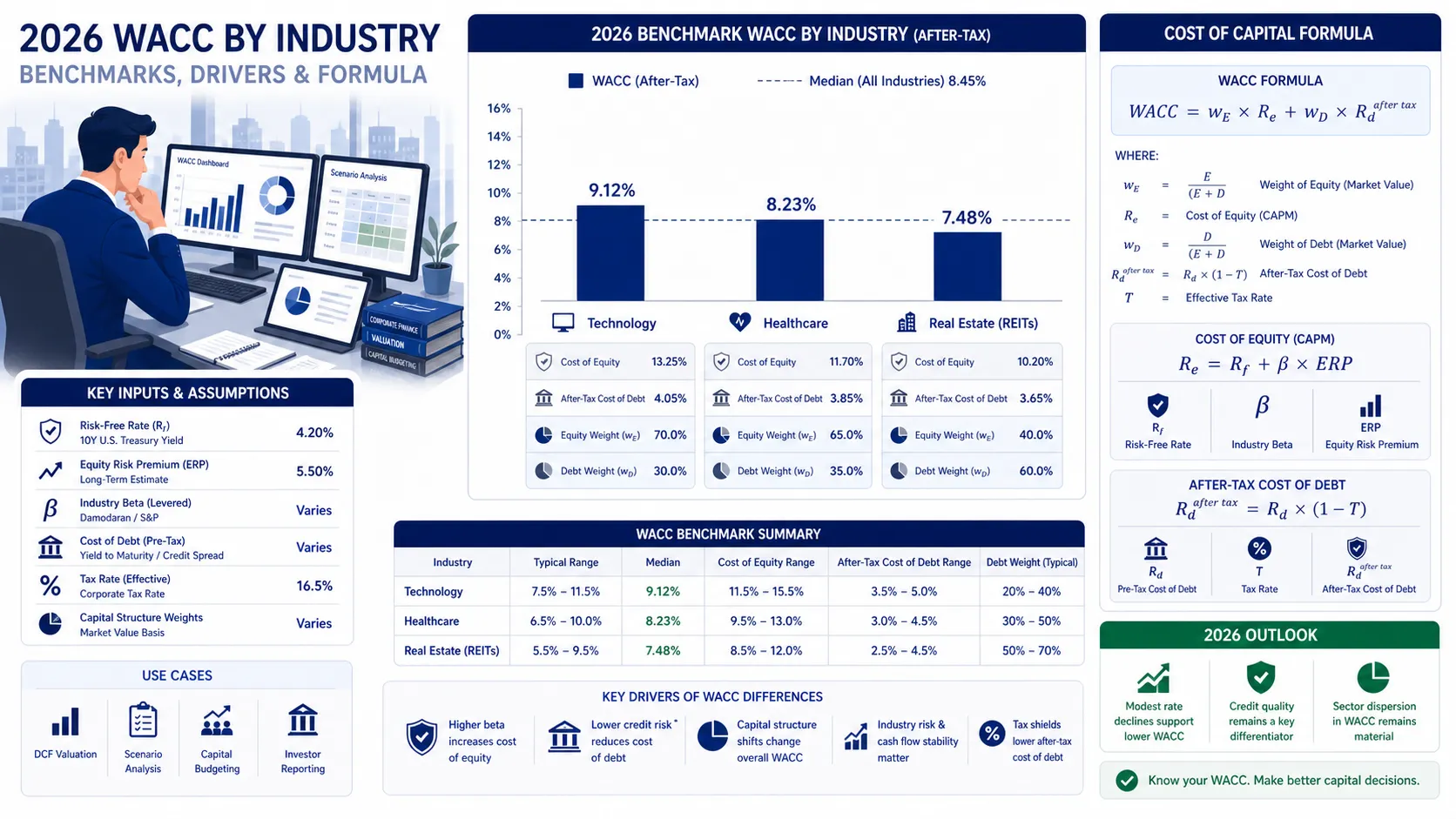
WACC by Industry: 2026 Benchmarks for Technology, Healthcare, and Real Estate
In 2026, industry WACC diverges sharply, from 5.5% for utilities to over 11.5% for software. CFOs must benchmark their discount rate against peers to ground valuations in market reality.
 Corporate Finance
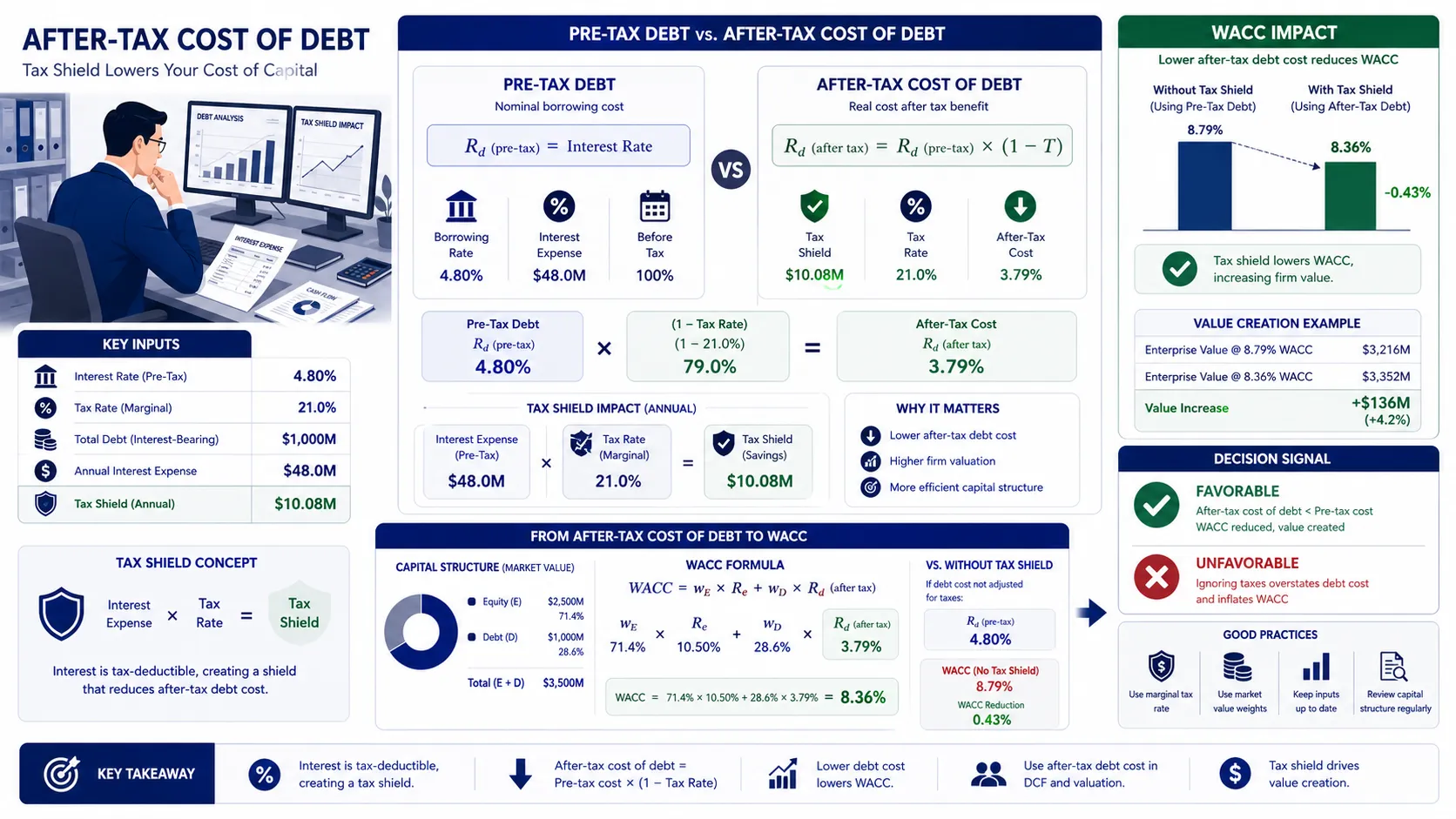
What Is After-Tax Cost of Debt and How Does It Lower WACC?
Interest payments are tax-deductible, making debt cheaper than equity and lowering your company's WACC. The after-tax cost of debt reveals this true, subsidized borrowing rate.
Methodology, Frequently Asked Questions (FAQ) & Disclaimers
FAQ: Frequently Asked Questions
Q: What is a loan amortization schedule?
A: It is a complete table detailing each periodic payment on an amortizing loan. For each payment, it shows the interest portion, principal reduction portion, and remaining balance.
Q: How do extra payments save money?
A: Extra payments reduce your outstanding principal balance directly. Since interest is calculated based on this remaining balance, reducing the principal balance reduces the interest accrued in subsequent periods, shortening your loan term.
Disclaimer: Informational Guidance Only
The financial calculations and schedule projections provided by the Amortization Calculator are intended solely for educational and high-level budgeting purposes.
Calculations are based on fixed-rate mathematical formulas and do not account for adjustable rates (ARMs), localized escrow requirements, tax adjustments, or transaction fees. Consult certified financial advisors and mortgage specialists prior to executing prepayment options.
The real estate calculations, yield projections, and cash flow reports generated by BizToolkitPro are for educational and informational purposes only. They do not constitute formal real estate brokerage, lending underwriting, tax counsel, or legal advice.
Investment returns, debt coverage ratios, and capitalization metrics (including Cap Rate, DSCR, Cash-on-Cash, and Waterfall distributions) are simulated based on user-provided inputs and assumptions. Local housing laws, property taxes, market vacancies, and interest rates fluctuate dynamically; therefore, BizToolkitPro makes no warranties regarding the accuracy or real-world applicability of these projections.
Always perform your own independent physical and financial due diligence on properties, and consult with a licensed Real Estate Broker, Mortgage Underwriter, Tax Advisor, or real estate attorney before signing purchase agreements or securing loans.