
Terminal Value Calculator
Use this focused Terminal Value calculator, an advanced valuation utility designed to estimate the terminal value (TV) of a business. In corporate finance and discounted cash flow (DCF) modeling, the terminal value represents the present value of all future cash flows beyond the explicit forecast period.
This calculator computes TV side-by-side using the Perpetual Growth Method and the Exit Multiple Method, providing corporate analysts and investment bankers with a dual-method comparison and 5x5 sensitivity matrix grids.
Have a suggestion or found a calculation discrepancy? Let us know!
How to use this terminal value calculator
Inputs you need to gather
To run the terminal value models, you will need to gather the following forecast parameters from your DCF model sheets:
- Final Year Cash Flow (FCF_n): The projected free cash flow in the final year of your explicit forecast period (typically Year 5 or Year 10).
- Final Year EBITDA: The projected earnings before interest, taxes, depreciation, and amortization in that same final year.
- Discount Rate (WACC): The weighted average cost of capital used as the hurdle rate to discount future cash flows.
- Perpetual Growth Rate (g): The long-term rate at which the business is expected to grow indefinitely (usually set to match long-term GDP growth or inflation, typically 1.5% to 3.0%).
- Exit EBITDA Multiple: The target enterprise value multiple applied to the final year's EBITDA.
Reading the valuation outputs
The calculator computes the terminal value using both methods and immediately discounts those values to present value (PV).
By comparing the present value of the terminal values side-by-side, you can check if your perpetuity growth assumptions are in line with market multiples. The sensitivity matrix tabs allow you to stress-test your terminal value against changes in discount rates, growth rates, and multiples.
Terminal Value Formula and Methodology
Perpetuity Formula
The Gordon Growth Model assumes the business will generate cash flows that grow at a constant rate forever. The terminal value is calculated as:
Selecting a sustainable perpetual growth rate
The perpetual growth rate (g) must be lower than the discount rate (WACC) to avoid division by zero or a negative value. Theoretically, a company cannot grow faster than the overall economy in perpetuity, otherwise it would eventually become larger than the global GDP.
Analysts usually set the perpetual growth rate to match the long-term risk-free rate or expected inflation rate (typically 1.5% to 3.0%). Setting a growth rate higher than 4.0% for a mature company is generally considered unrealistic by investment committees.
The Exit Multiple Method
Exit Multiple Formula
The Exit Multiple Method assumes the business will be sold at the end of the forecast period to a strategic buyer or private equity firm:
Selecting comparable industry exit multiples
The exit multiple is usually based on a peer group of public comparable companies or recent private equity acquisitions in the same sector. For example, software-as-a-service (SaaS) companies might trade at 6x to 15x EBITDA multiples, while manufacturing firms might trade at 5x to 8x.
When using this method, it is important to verify the implied perpetual growth rate to ensure the multiple is realistic. If an exit multiple implies an unrealistic growth rate, the valuation model may lead to overpaying or underestimating corporate value.
Terminal value step-by-step example calculation
Example parameters
Consider a business valuation with a 5-year forecast period and the following Year 5 metrics:
- Year 5 Free Cash Flow (FCF_5) = $500,000
- Year 5 EBITDA = $1,200,000
- WACC Discount Rate = 9.50%
- Perpetual Growth Rate (g) = 2.50%
- Exit Multiple = 8.5x
Calculation execution
Method A (Gordon Growth): TV = ($500,000 * 1.025) / (0.095 - 0.025) = $512,500 / 0.07 = $7,321,429. Present Value = $7,321,429 / (1.0955) = $4,650,815.
Method B (Exit Multiple): TV = $1,200,000 * 8.5 = $10,200,000. Present Value = $10,200,000 / (1.0955) = $6,479,350.
By comparing the two values, you can see that the exit multiple method yields a higher terminal valuation. This suggests that the 8.5x multiple implies a higher perpetual growth rate than 2.50%.
Common terminal value calculation mistakes
Double-counting cash flows
A common mistake in DCF models is double-counting cash flows. Make sure that Year N cash flow is not counted both in the explicit forecast period and in the terminal value calculation. The terminal value represents cash flows *after* Year N, so it must start from the Year N FCF adjusted for the perpetual growth rate.
- Check perpetual growth limits: Ensure the growth rate (g) stays below the long-term GDP inflation rate (usually 2%-3%).
- Verify discount timing: Double-check that the terminal value is discounted back using the correct forecast period (N years).
- Sanity-check implied metrics: Check the implied growth rate of your exit multiple to ensure the valuation makes logical sense.
Real-world case study: Apple Inc. (AAPL, FY 2024 (Projected FCF))
Apple Inc. metrics profile
Apple Inc. (AAPL), a global technology giant, is analyzed here to illustrate the calculation of Terminal Value, a critical component in Discounted Cash Flow (DCF) valuation models. This case uses Apple's projected Free Cash Flow for fiscal year 2024 and its Weighted Average Cost of Capital to estimate the company's value beyond the explicit forecast period. This analysis provides insights into Apple's long-term intrinsic value, assuming a stable growth phase.
The calculated Terminal Value of $1,573.02 billion for Apple Inc. represents a significant portion of the company's total intrinsic value in a DCF model. This value is derived by assuming Apple's free cash flow will grow at a perpetual rate of 2.50% beyond 2024, discounted by its 9.59% Weighted Average Cost of Capital. A stable and conservative perpetual growth rate, typically below the WACC and long-term GDP growth, is crucial for mature companies like Apple. Investors and analysts use this terminal value alongside the present value of explicit forecast period cash flows to arrive at a comprehensive valuation of the company's equity, informing investment decisions.
Related Calculators
Estimate weighted average cost of capital.
Open Tool →DCF CalculatorValue a business using discounted cash flows.
Open Tool →NPV CalculatorCompute net present value of cash flows.
Open Tool →IRR CalculatorSolve project internal rates of return.
Open Tool →Free Cash Flow CalculatorEstimate operating free cash flow.
Open Tool →Break-Even ROI CalculatorAnalyze payback thresholds and returns.
Open Tool →Related Articles & Guides
 Corporate Finance
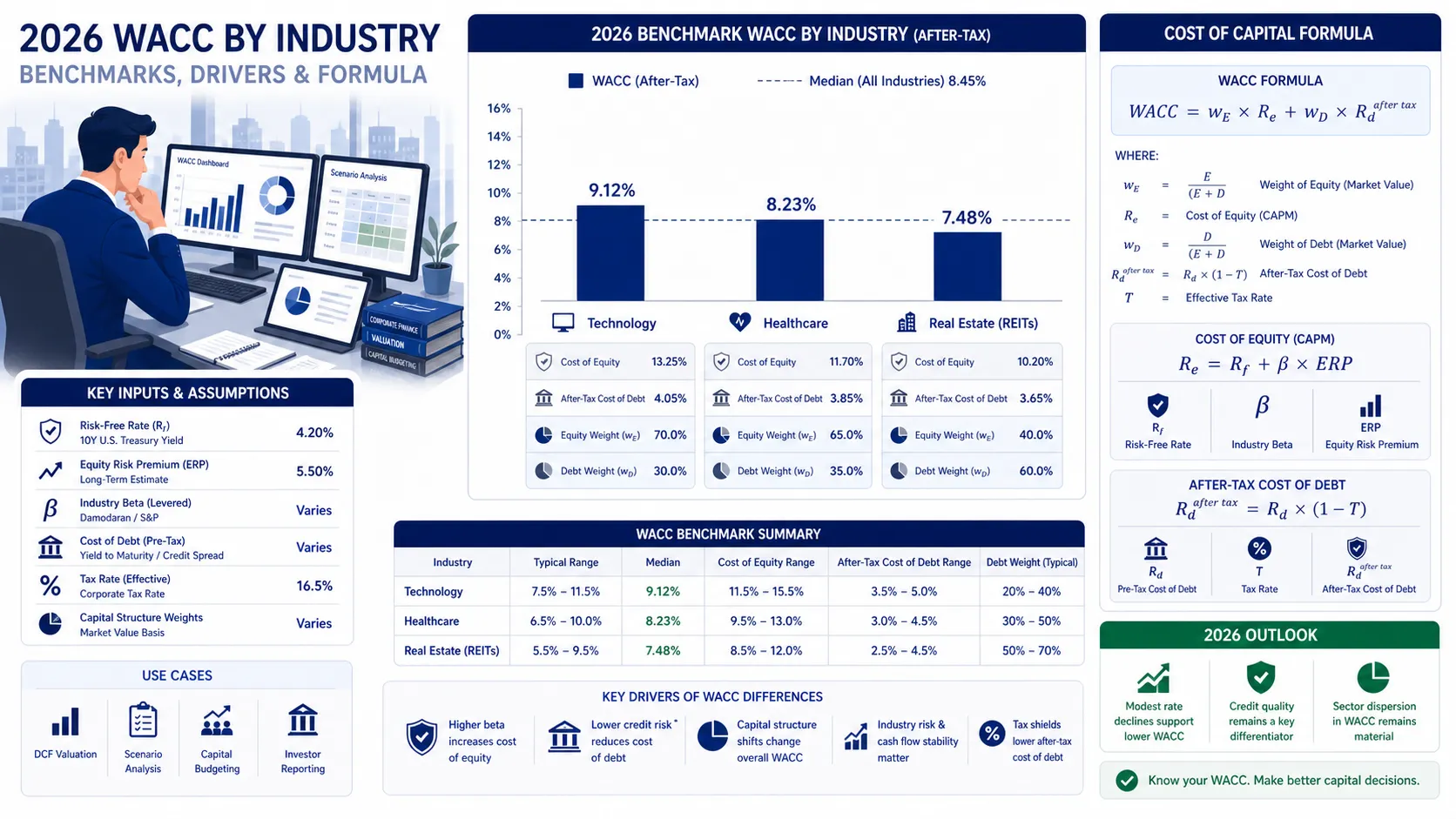
WACC by Industry: 2026 Benchmarks for Technology, Healthcare, and Real Estate
In 2026, industry WACC diverges sharply, from 5.5% for utilities to over 11.5% for software. CFOs must benchmark their discount rate against peers to ground valuations in market reality.
 Corporate Finance
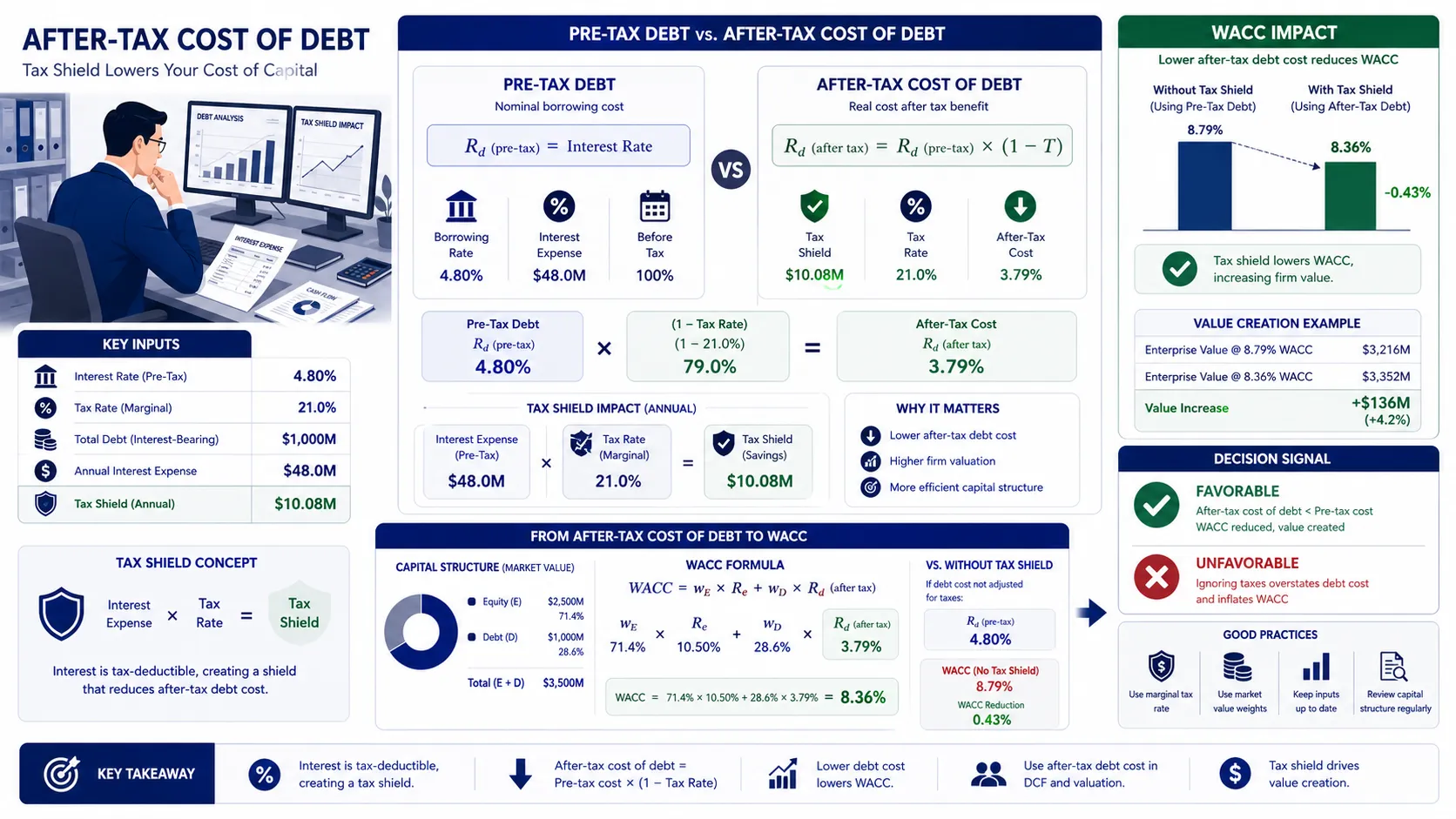
What Is After-Tax Cost of Debt and How Does It Lower WACC?
Interest payments are tax-deductible, making debt cheaper than equity and lowering your company's WACC. The after-tax cost of debt reveals this true, subsidized borrowing rate.
 Corporate Finance
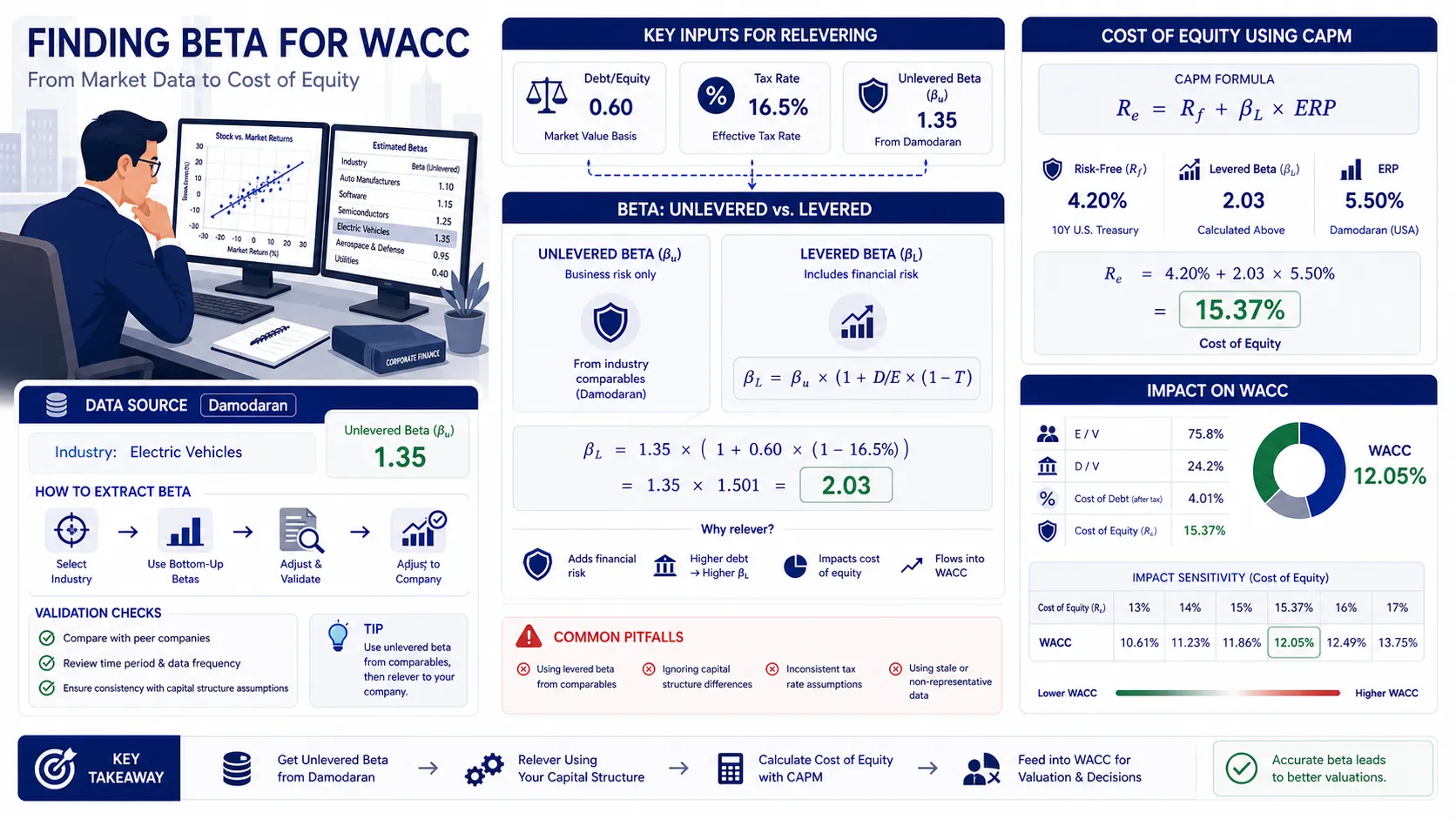
How to Find Beta for WACC: Unlevered vs Levered Beta Calculati
Unlock institutional-grade WACC by mastering bottom-up beta: unlever public peers to strip debt risk, then re-lever for your target's capital structure. This precision method solves CAPM's toughest hurdle, delivering accurate equity risk pricing for DCF models.
Frequently Asked Questions
Why is terminal value so large in a DCF model?
Which method is better: Gordon Growth or Exit Multiple?
Can I use a negative perpetual growth rate?
How do changes in WACC affect terminal value?
The calculations, projections, and reports generated by BizToolkitPro are for educational and informational purposes only. They do not represent professional investment advice, financial planning, tax guidance, legal counsel, or formal business valuation.
Financial models and valuation formulas (including WACC, DCF, IRR, and NPV) rely on assumptions and inputs provided directly by the user. Actual financial markets and business metrics fluctuate; therefore, BizToolkitPro makes no warranties, express or implied, regarding the accuracy, completeness, or suitability of the outputs for any investment strategy or corporate decision.
Always perform your own independent diligence and consult with a licensed Financial Analyst, Certified Public Accountant (CPA), or certified valuation specialist before committing capital or executing corporate transactions.