
IRR Calculator - Internal Rate of Return Yield
Use this IRR calculator to solve internal rate of return for capital allocation projects, real estate deals, venture investments, and uneven cash flow schedules.
This online utility calculates Periodic IRR for fixed intervals and dated XIRR for irregular date-spaced cash flows. Evaluate your projected yields against corporate hurdle rate targets and inspect the resulting NPV Profile Curve. High-risk structures, such as projects returning multiple mathematical roots, are flagged dynamically to maintain analytical safety.
Have a suggestion or found a calculation discrepancy? Let us know!
How to use this IRR calculator
Enter cash flows and timing dates
Begin by defining your cash flow timeline. Period 0 represents your initial capital outlay (which must be input as a negative value, representing an cash outflow). Add subsequent periods representing annual or monthly cash inflows (positive values). For dated projects (XIRR solver), supply the exact calendar date for each cash flow event to capture irregular spacing.
Select compounding and hurdle parameters
Define your corporate Hurdle Rate (e.g. WACC) to assess project feasibility. The tool will calculate the exact IRR and display it alongside the hurdle indicator. If you are comparing multiple scenarios, toggle the Base, Bull, and Bear modes to map varying operational cash projections.
IRR Scenario Analysis
Scenario cash flows inputs
Capital budgeting relies on sensitivity bounds. In the left panel, you can independently configure the cash flows for Bull (upside), Base (expected), and Bear (downside) parameters. The inputs are isolated in separate scenario scopes to prevent data cross-contamination during active modeling.
Intrinsic IRR yield outputs comparison
The Scenario Comparison Card maps the calculated IRR of each profile side-by-side. Inspecting the differences in internal yields relative to the hurdle rate highlights whether downside events (Bear) will drop the project below its required capital cost threshold.
IRR and NPV sensitivity profiling
Hurdle rate vs NPV table
Since the IRR is the discount rate that forces Net Present Value to zero (NPV = 0), the calculator plots a discount rate sensitivity matrix. It calculates the resulting NPV at discount steps ranging from -4.00% to +4.00% around the base hurdle rate, mapping out the project's NPV Profile Curve.
Newton-Raphson vs bisection solver modes
The underlying calculation engine uses numeric approximation to solve for the root. The Newton-Raphson solver converges rapidly but can fail if cash flows fluctuate frequently, causing derivative slopes to cycle. Under such conditions, the engine falls back to a Bisection solver to guarantee mathematical safety.
IRR example calculation
Example cash flow assumptions
To demonstrate the IRR calculation, let's look at a simple capital project with a 3-year timeline:
- Initial Outlay (Year 0) = -$100,000 (Cash Outflow)
- Year 1 Cash Inflow = $30,000
- Year 2 Cash Inflow = $40,000
- Year 3 Cash Inflow = $50,000
Step-by-step yield solving
We solve for the rate (r) that satisfies: NPV = -$100,000 + $30,000/(1+r)^1 + $40,000/(1+r)^2 + $50,000/(1+r)^3 = 0.
By testing trial rates, if we choose r = 10%, NPV is +$9,635. If we choose r = 15%, NPV is -$1,102.
Through numerical interpolation, the exact rate that drives the NPV to exactly zero is solved at 14.42%. This 14.42% is the project's Internal Rate of Return (IRR).
IRR formula and mathematical methodology
Core periodic IRR
The Internal Rate of Return (IRR) solves for the discount rate (r) at which the Net Present Value (NPV) of cash flows equals zero:
XIRR dated yield formula
When cash flows occur on irregular dates, the standard formula fails. The dated XIRR formula accounts for the exact days between the initial outflow (d_0) and each subsequent event (d_t):NPV = Sum( CF_t / (1 + XIRR)^((d_t - d_0)/365) ) = 0This annualizes the internal yield based on a 365-day calendar year, making it standard for equity investments.
Multiple roots and Descartes' rule of signs
A standard investment has one sign change (initial outflow followed by inflows), yielding a single unique IRR. If cash flows flip signs multiple times (e.g. outflows, inflows, then decommissioning costs), multiple rates can solve the equation. Descartes' Rule of Signs dictates that the maximum number of positive roots equals the number of cash flow sign changes. Under these conditions, IRR is misleading, and analysts rely on NPV or MIRR.
What your IRR result means
Yield vs hurdle rate thresholds
If the solved IRR is strictly greater than the Corporate Hurdle Rate (e.g., WACC), the project is economically viable as it generates returns exceeding its funding costs. If the IRR is below the hurdle rate, the investment destroys value on a present-value basis and should be rejected.
Reinvestment rate assumption limits
A major caveat of IRR is the reinvestment rate assumption. The formula implicitly assumes all positive cash inflows are immediately reinvested at the calculated IRR yield. For highly profitable projects with IRRs of 40%+, this assumption is often unrealistic. NPV or Modified IRR (MIRR) should be used as secondary checks.
IRR use cases for venture capital, real estate, and capital budgeting
Venture capital cash-on-cash yield
Venture capital and private equity rely on IRR to track fund performances. VCs contrast the IRR against the Cash-on-Cash multiple (Multiple on Invested Capital / MOIC) to understand how the velocity of capital gains shifts portfolio returns.
Real estate IRR and developer hurdle limits
Property developers use IRR to structure joint-venture equity waterfalls. As project returns cross predefined IRR hurdles, the cash distribution shifts (promoted interest) to award the general partner a higher share of the cash flows.
Corporate budgeting capital allocation
Corporate finance divisions rank competing capital expansion projects by sorting them by IRR. Projects are funded in descending order of yield until the corporate capital budget limit is fully allocated, maximizing capital efficiency.
- Mixing intervals and dates: Using standard periodic formulas on cash flows occurring at irregular calendar dates.
- Misinterpreting multiple roots: Presenting a single mathematical rate output while ignoring secondary root solutions.
- Ignoring cash flow scale: Preferring a small project with a 50% IRR over a massive project with a 20% IRR that generates far more absolute cash wealth.
Real-world case study: Prologis, Inc. (PLD, FY 2023)
Prologis, Inc. metrics profile
Prologis, a leading global industrial REIT, initiated a significant development project in Dallas, Texas, during the fourth quarter of 2023. This case study analyzes the potential profitability of such a real estate investment using the Internal Rate of Return (IRR) framework, based on reported initial investment and expected stabilized yield. This provides a real-world example of capital allocation in commercial real estate.
The reported expected stabilized yield of 6.0% for the Dallas development project indicates the initial annual cash flow generation relative to the total investment. For investors, a higher IRR signifies a more attractive investment opportunity, suggesting efficient capital deployment and strong potential for value creation over the project's life. While the actual IRR would depend on the precise timing and magnitude of future cash flows, including eventual disposition, this yield provides a key input for evaluating the project's long-term viability and contribution to Prologis's overall portfolio performance, influencing future capital allocation decisions and investor confidence. The resulting 6.00% IRR, based on these assumptions, directly reflects the stabilized yield when the terminal value equals the initial investment.
Related Calculators
Estimate weighted average cost of capital.
Open Tool →DCF CalculatorValue a business using discounted cash flows.
Open Tool →NPV CalculatorCompute net present value of cash flows.
Open Tool →Free Cash Flow CalculatorEstimate operating free cash flow.
Open Tool →Break-Even ROI CalculatorAnalyze payback thresholds and returns.
Open Tool →EBITDA Margin CalculatorAssess earnings margin before interest and tax.
Open Tool →Related Articles & Guides
 Corporate Finance
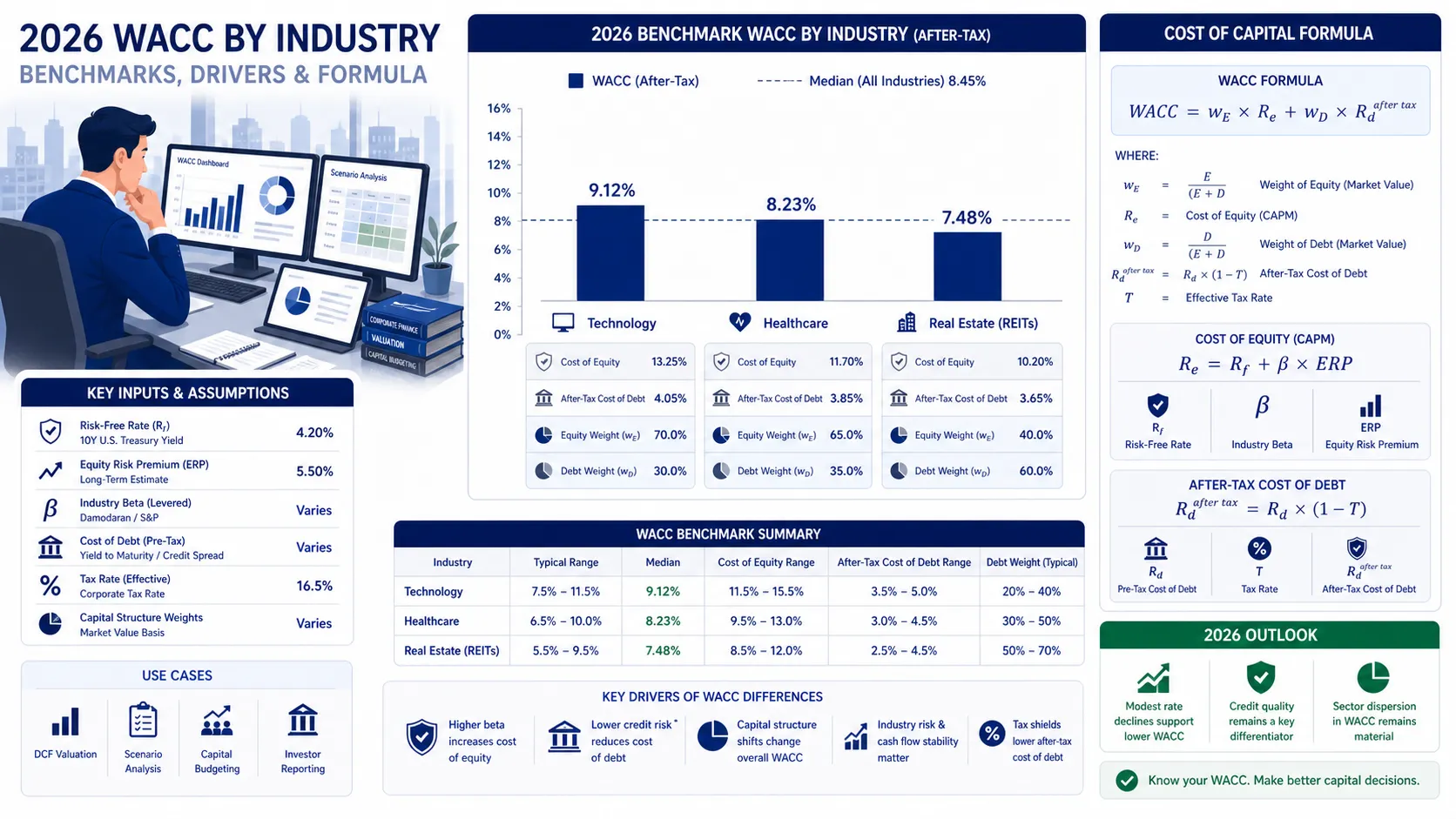
WACC by Industry: 2026 Benchmarks for Technology, Healthcare, and Real Estate
In 2026, industry WACC diverges sharply, from 5.5% for utilities to over 11.5% for software. CFOs must benchmark their discount rate against peers to ground valuations in market reality.
 Corporate Finance
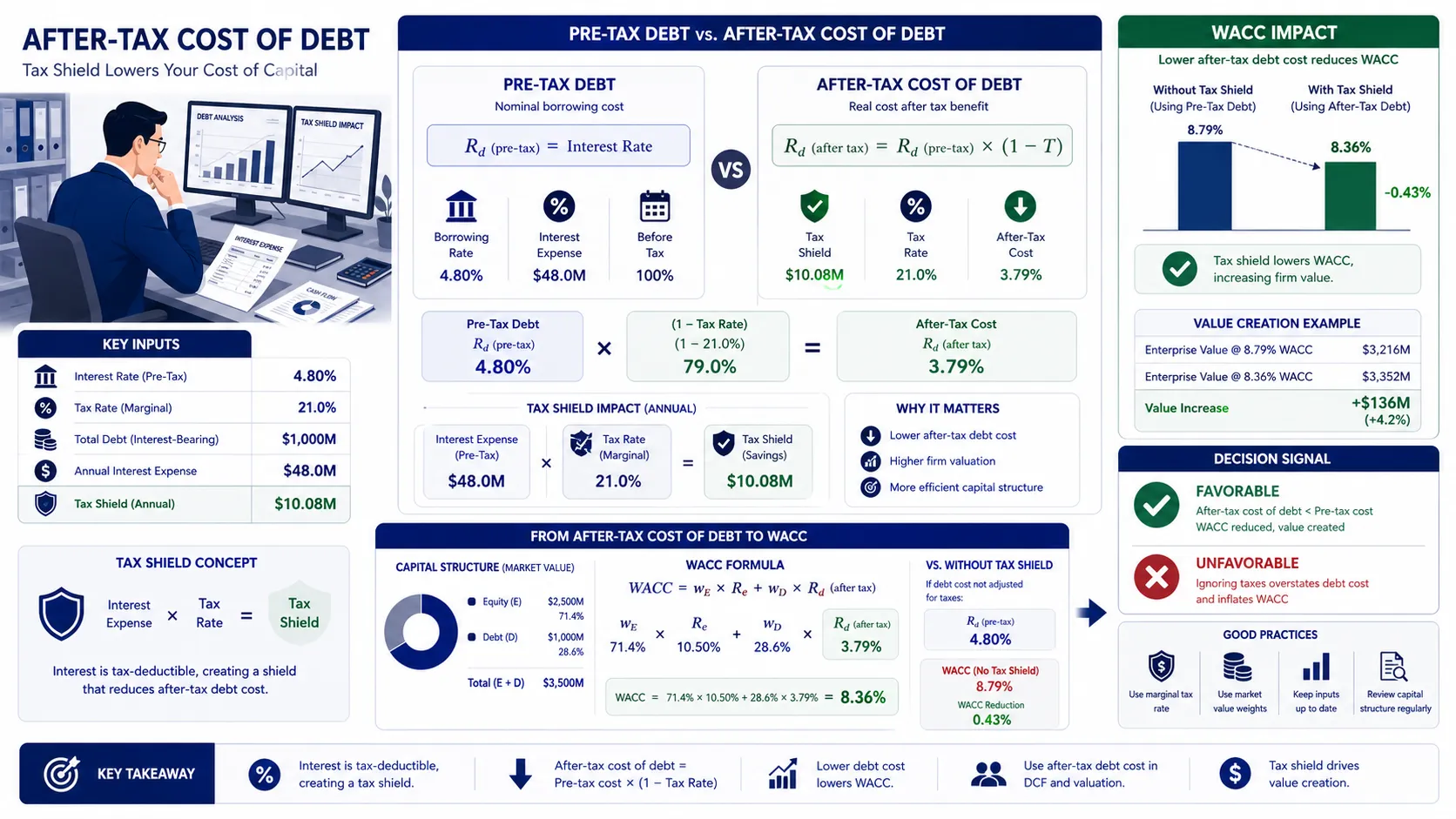
What Is After-Tax Cost of Debt and How Does It Lower WACC?
Interest payments are tax-deductible, making debt cheaper than equity and lowering your company's WACC. The after-tax cost of debt reveals this true, subsidized borrowing rate.
 Corporate Finance
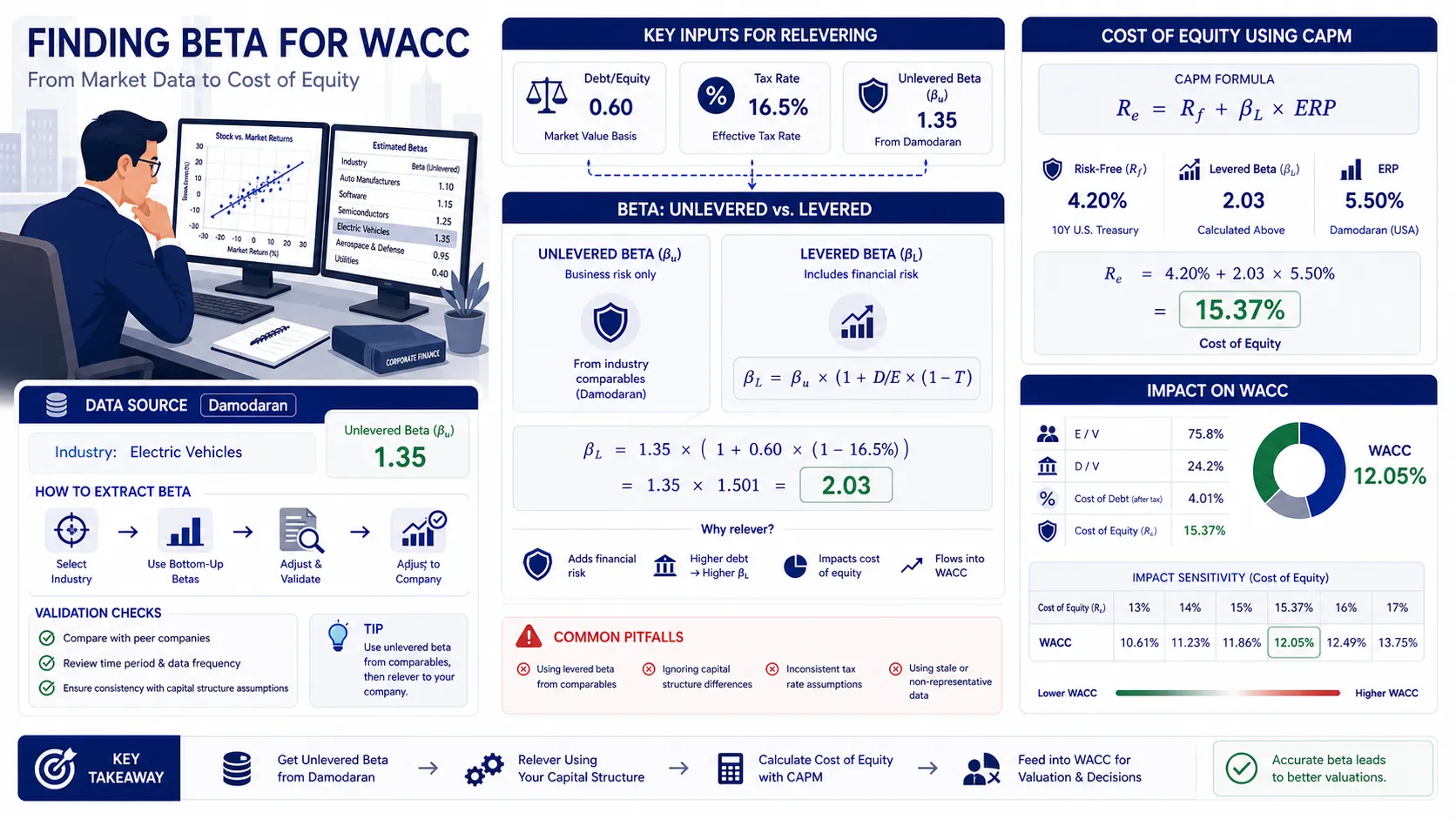
How to Find Beta for WACC: Unlevered vs Levered Beta Calculati
Unlock institutional-grade WACC by mastering bottom-up beta: unlever public peers to strip debt risk, then re-lever for your target's capital structure. This precision method solves CAPM's toughest hurdle, delivering accurate equity risk pricing for DCF models.
Frequently Asked Questions
What is a Hurdle Rate?
What does the NPV Profile Curve represent?
What is the main limitation of IRR?
Can I import cash flows from my DCF model?
The calculations, projections, and reports generated by BizToolkitPro are for educational and informational purposes only. They do not represent professional investment advice, financial planning, tax guidance, legal counsel, or formal business valuation.
Financial models and valuation formulas (including WACC, DCF, IRR, and NPV) rely on assumptions and inputs provided directly by the user. Actual financial markets and business metrics fluctuate; therefore, BizToolkitPro makes no warranties, express or implied, regarding the accuracy, completeness, or suitability of the outputs for any investment strategy or corporate decision.
Always perform your own independent diligence and consult with a licensed Financial Analyst, Certified Public Accountant (CPA), or certified valuation specialist before committing capital or executing corporate transactions.