
NPV Calculator - Net Present Value
Use this NPV calculator to calculate net present value for uneven cash flows, capital projects, real estate investments, and corporate finance decisions. NPV measures value creation after discounting future cash flows and subtracting the initial outlay.
Enter a discount rate, upfront investment, and projected cash flows to estimate present value, NPV, and profitability index. The sections below explain the NPV formula, how to calculate NPV, and why discount rate assumptions can materially change the result.
Have a suggestion or found a calculation discrepancy? Let us know!
How to Calculate NPV
Enter cash flows and period schedules
Begin by defining your cash flow timeline. Period 0 represents your initial capital outlay (which must be input as a negative value, representing an cash outflow). Add subsequent periods representing annual or monthly cash inflows (positive values). For dated projects, supply the exact calendar date for each cash flow event to capture irregular spacing.
Select compounding and timing parameters
Define your discount rate (e.g. WACC) to assess project feasibility. Select the discounting timing: End of Period assumes cash flows occur at the end of each period, while Beginning of Period discounts flows immediately.
NPV Scenario Analysis
Scenario cash flow inputs
Capital budgeting relies on sensitivity bounds. In the left panel, you can independently configure the cash flows for Bull (upside), Base (expected), and Bear (downside) parameters. The inputs are isolated in separate scenario scopes to prevent data cross-contamination during active modeling.
Present value outputs comparison
The Scenario Comparison Card maps the calculated NPV of each profile side-by-side. Inspecting the differences in net present values relative to the hurdle rate highlights whether downside events (Bear) will drop the project below its required capital cost threshold.
How Discount Rate Changes NPV
Timing conventions: End vs Beginning of period
Under End of Period, cash flows occur at the end of each period, so Year 1 FCF is discounted by 1 period. Under Beginning of Period, cash flows occur immediately, meaning Year 1 flows are discounted by 0 periods. Excel defaults to End of Period timing.
Hurdle rate vs NPV sensitivity matrix
The 5x5 sensitivity matrix automatically cross-references the Hurdle Discount Rate against different compounding assumptions. This grids WACC adjustments (vertical) against discounting frequency (horizontal), calculating the resulting NPV at each intersection.
How timing shifts absolute present values
Receiving cash flows earlier preserves capital value because of discounting compounding over time. Consequently, Beginning of Period timing yields higher present values compared to End of Period timing under identical cash inflow quantities.
NPV Example with Uneven Cash Flows
Example cash flow assumptions
To demonstrate the Net Present Value calculation, let's analyze an investment with a 3-year forecast:
- Initial Outlay (Year 0) = -$100,000 (Cash Outflow)
- Year 1 Cash Inflow = $40,000
- Year 2 Cash Inflow = $50,000
- Year 3 Cash Inflow = $30,000
- Hurdle Discount Rate (WACC) = 10.00%
Step-by-step present value discounting
First, calculate the discount factors at 10%: Year 1 = 0.90909; Year 2 = 0.82645; Year 3 = 0.75131.
Discount the cash inflows: PV of Year 1 = $36,364; PV of Year 2 = $41,322; PV of Year 3 = $22,539.
Sum the present values and deduct outlay: NPV = -$100,000 + ($36,364 + $41,322 + $22,539) = -$100,000 + $100,225 = +$225. The project adds $225 in present value and is marginally viable.
NPV Formula
Core net present value
NPV sums the present values of all cash flows over the project lifecycle:
Compounding interval adjustments
Adjusting compounding intervals shifts the periodic discount rate:Effective Rate = (1 + r/m)^m - 1Where (m) represents the compounding frequency (e.g. 12 for monthly, 4 for quarterly). This increases effective interest yields.
Profitability Index (PI)
The Profitability Index (PI) measures the value created per dollar of initial capital outlay:PI = PV of Future Cash Inflows / Initial OutflowA PI above 1.0 indicates a profitable project, while a PI below 1.0 destroys value.
NPV vs IRR
NPV measures value dollars
NPV estimates the absolute present-value dollars a project creates or destroys. This makes it useful for capital allocation because a larger positive NPV usually means more value creation.
IRR measures percentage return
IRR solves the discount rate that makes NPV equal zero. It is useful for comparing return rates, but it can be misleading when projects have different sizes, timing patterns, or multiple sign changes.
Common NPV Calculation Mistakes
Mixing nominal and real cash flows
Nominal cash flows should be discounted with a nominal discount rate. Inflation-adjusted real cash flows should use a real discount rate.
Forgetting the initial outlay
NPV requires the upfront investment or acquisition cost. Omitting the initial outflow converts the model into a present value calculation, not an NPV calculation.
Using the wrong discount rate
The discount rate should match the risk of the cash flows. A mature infrastructure project and a venture-stage product launch should not automatically use the same hurdle rate.
What your NPV result means
Intrinsic value creation vs capital destruction
A positive NPV indicates the project will generate cash inflows exceeding its hurdle funding cost, creating net wealth for shareholders. A negative NPV indicates the project is value-destructive on a present-value basis and should be rejected.
NPV vs IRR for competing projects
When comparing mutually exclusive projects, NPV and IRR can sometimes yield conflicting results due to reinvestment rate assumptions. In such cases, NPV is the preferred metric as it measures absolute wealth creation in currency units rather than percentages.
NPV use cases for capital budgeting, corporate acquisitions, and real estate
Capital budgeting project prioritization
Corporate finance divisions rank competing capital expansion projects by sorting them by NPV. Projects are funded in descending order of yield until the corporate capital budget limit is fully allocated, maximizing capital efficiency.
Corporate acquisitions business valuations
M&A analysts calculate the NPV of a target company's projected synergy cash flows to determine the maximum purchase premium the acquirer should pay without destroying shareholder value.
Real estate investment yield benchmarks
Property developers use NPV to value acquisition deals. The initial land cost is compared against the present value of future rental yields and sale proceeds to check if the investment meets capital hurdle limits.
- Mixing nominal and real terms: Discounting inflation-adjusted (real) cash flows using nominal rates, which artificially deflates NPV.
- Misapplying periods: Applying Period 1 discount factors to Period 2 cash flows, shifting calculations.
- Omitting Period 0 outlay: Calculating the present value of future inflows but forgetting to subtract the initial outlay cost.
Real-world case study: NVIDIA Corp (NVDA, FY 2026)
NVIDIA Corp metrics profile
NVIDIA, a global leader in AI computing, is making significant capital investments to expand its AI infrastructure, including advanced data centers. This case study analyzes a hypothetical new AI data center project, representing a portion of NVIDIA's strategic capital allocation, to demonstrate the application of Net Present Value (NPV) in evaluating such initiatives, given the company's strong growth trajectory in the AI sector.
This NPV analysis highlights the significant value potential of NVIDIA's strategic investments in AI infrastructure. A positive NPV indicates that, based on the estimated cash flows and the company's cost of capital, this hypothetical project is expected to generate more value than its cost, thereby increasing shareholder wealth. Such projects are crucial for NVIDIA to maintain its leadership in the rapidly expanding AI market, allowing it to support hyperscalers and enterprises with cutting-edge computing capabilities and capitalize on future AI demand. The robust projected returns underscore the high-growth nature and profitability expected from critical AI-driven expansions.
Related Calculators
Estimate weighted average cost of capital.
Open Tool →DCF CalculatorValue a business using discounted cash flows.
Open Tool →IRR CalculatorSolve project internal rates of return.
Open Tool →Free Cash Flow CalculatorEstimate operating free cash flow.
Open Tool →Break-Even ROI CalculatorAnalyze payback thresholds and returns.
Open Tool →EBITDA Margin CalculatorAssess earnings margin before interest and tax.
Open Tool →Related Articles & Guides
 Corporate Finance
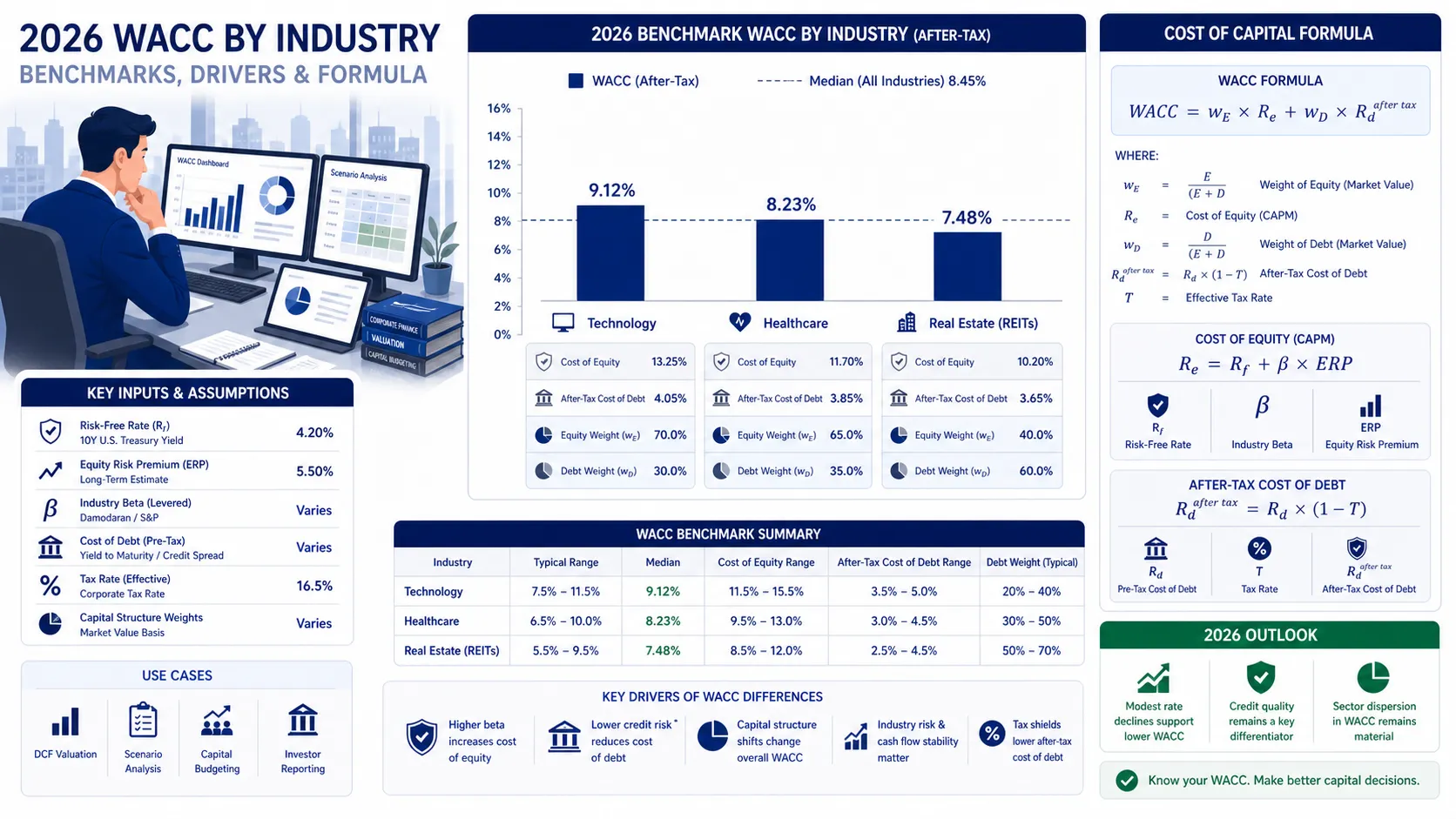
WACC by Industry: 2026 Benchmarks for Technology, Healthcare, and Real Estate
In 2026, industry WACC diverges sharply, from 5.5% for utilities to over 11.5% for software. CFOs must benchmark their discount rate against peers to ground valuations in market reality.
 Corporate Finance
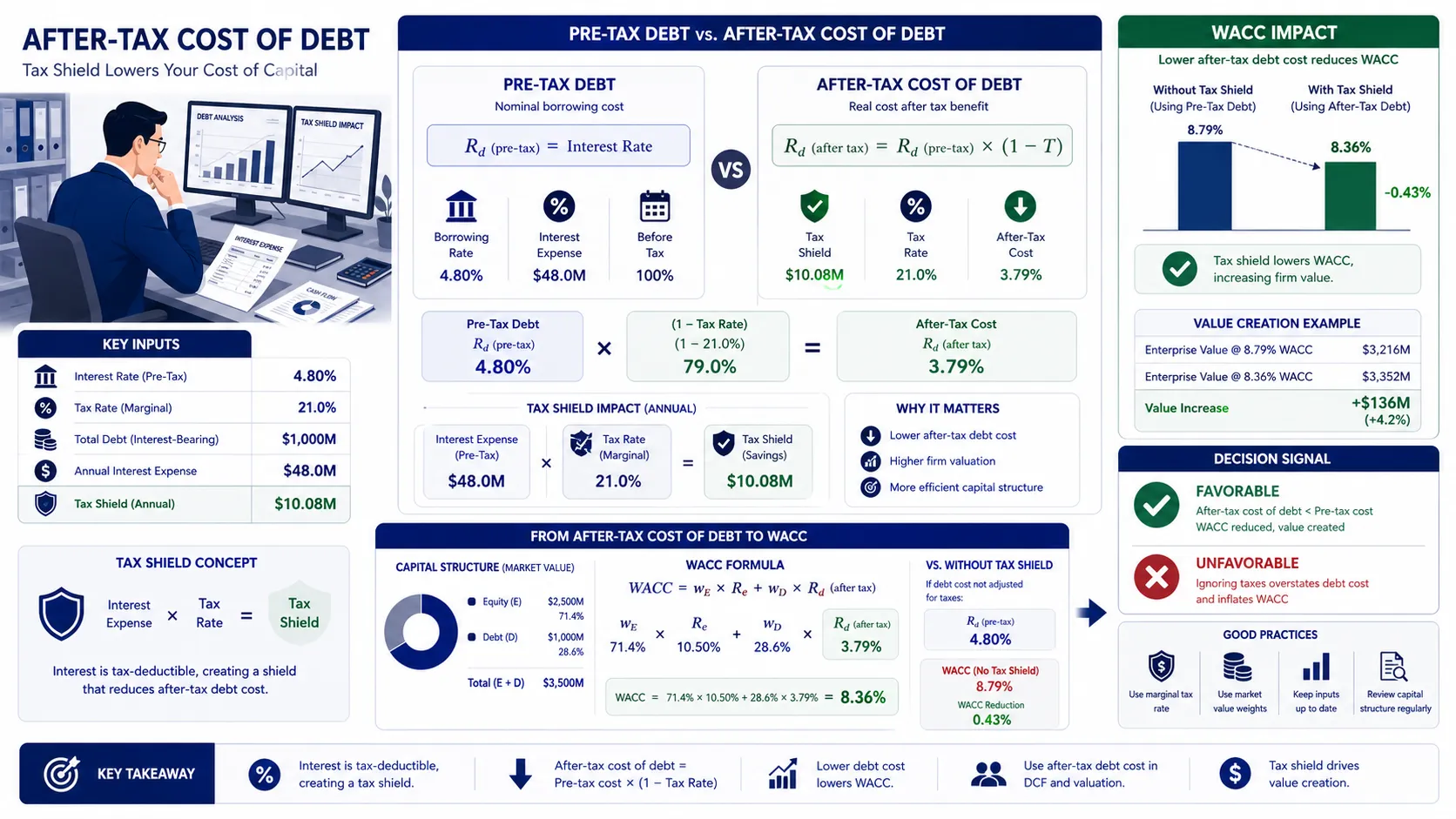
What Is After-Tax Cost of Debt and How Does It Lower WACC?
Interest payments are tax-deductible, making debt cheaper than equity and lowering your company's WACC. The after-tax cost of debt reveals this true, subsidized borrowing rate.
 Corporate Finance
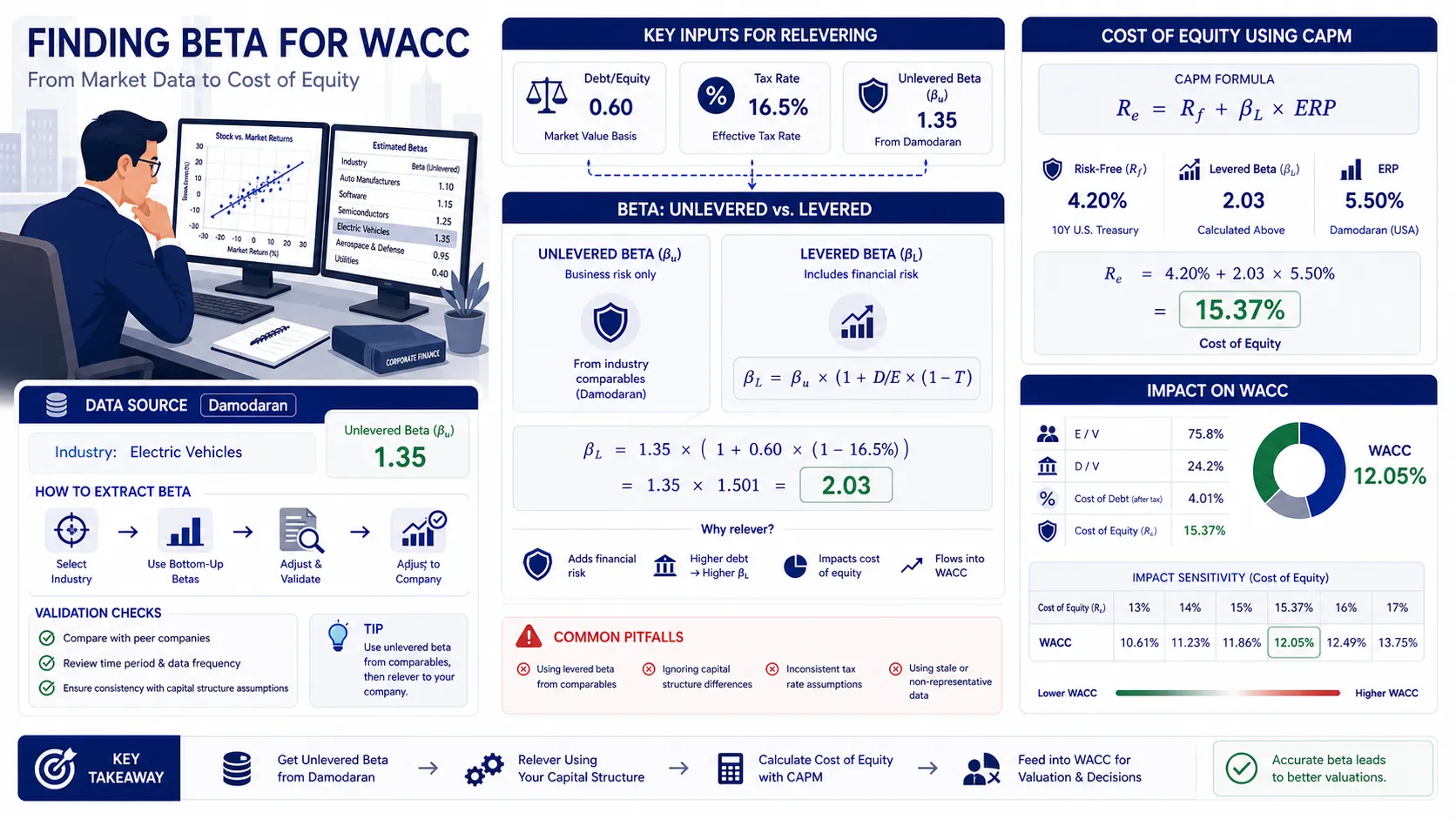
How to Find Beta for WACC: Unlevered vs Levered Beta Calculati
Unlock institutional-grade WACC by mastering bottom-up beta: unlever public peers to strip debt risk, then re-lever for your target's capital structure. This precision method solves CAPM's toughest hurdle, delivering accurate equity risk pricing for DCF models.
Frequently Asked Questions
What is a good net present value?
How does WACC change NPV?
What is the difference between NPV and IRR?
Why compounding frequency shifts NPV results?
Can NPV handle negative cash flows in future years?
The calculations, projections, and reports generated by BizToolkitPro are for educational and informational purposes only. They do not represent professional investment advice, financial planning, tax guidance, legal counsel, or formal business valuation.
Financial models and valuation formulas (including WACC, DCF, IRR, and NPV) rely on assumptions and inputs provided directly by the user. Actual financial markets and business metrics fluctuate; therefore, BizToolkitPro makes no warranties, express or implied, regarding the accuracy, completeness, or suitability of the outputs for any investment strategy or corporate decision.
Always perform your own independent diligence and consult with a licensed Financial Analyst, Certified Public Accountant (CPA), or certified valuation specialist before committing capital or executing corporate transactions.