
Startup Valuation Calculator (Pre-Revenue Berkus & Scorecard Models)
Use this focused Startup Valuation Calculator, a corporate finance tool designed specifically for modeling early-stage, pre-revenue company valuations. Estimating the value of a startup without historical revenue or EBITDA can be challenging for both founders and angel investors.
This utility solves that challenge by implementing two of the industry's most trusted pre-revenue valuation methodologies: the Berkus Method and the Scorecard Method. Additionally, you can run a Blended weighted valuation model to balance the milestone-based framework of Berkus with the peer-comparison mechanisms of Scorecard. By evaluating qualitative parameters such as founding team capability, MVP software maturity, market size, and strategic partnerships, this tool outputs post-money scenarios, a multi-dimensional sensitivity matrix, and a downloadable negotiation memo.
Choose pricing framework for pre-revenue traction.
Allocate value based on incremental product steps.
Input peer baselines and scale factors (50% - 150%).
Have a suggestion or found a calculation discrepancy? Let us know!
How to use this startup valuation calculator
Configuring the Berkus Method drivers
The Berkus Method values a pre-revenue startup by assigning up to $500,000 to five core milestones that reduce startup risk. To model this correctly:
- Sound Idea (Core Concept): Assess the commercial potential of your business model and target value proposition. Assign up to $500,000.
- Prototype / MVP Quality: Evaluate the maturity of your functional product. If the prototype is fully functional and reduces technology risk, push the slider higher.
- Management Quality: Rate the capability of the founders. Experienced operators with past exits deserve a higher allocation.
- Strategic Relationships: Consider your advisory board quality, key vendor partnerships, or early distributor networks.
- Product Rollout & Sales Pipeline: Estimate GTM strength. If you have enterprise pilots signed, award a higher allocation.
Setting Scorecard Method valuation parameters
The Scorecard Method compares your startup to average pre-revenue peers in your sector. Fill in the following inputs:
Start by inputting a Baseline Peer Valuation (the average valuation of pre-revenue peers in your region/industry). Next, adjust the seven comparison sliders representing key company drivers relative to that average (100% means equal to peers, 150% means superior to peers):
- Management Team (30% weight): Evaluates founders' industry competence and alignment.
- Size of Opportunity (25% weight): Analyzes total addressable market (TAM) growth.
- Product & Technology (15% weight): Assesses defensibility, IP, and product architecture.
- Competitive Environment (10% weight): Accounts for barriers to entry and competitor count.
- Marketing & Sales (10% weight): Evaluates customer acquisition strategy and channels.
- Additional Funding Needs (10% weight): Evaluates capital efficiency and runway metrics.
Pre-revenue startup valuation methodology and models explained
Milestone vs multiple frameworks
Early-stage startup valuations rely on risk mitigation and peer positioning rather than discounted cash flow models:
The Berkus Method: Valuing milestones
Created by super-angel investor Dave Berkus, the Berkus Method assumes that pre-revenue startups rarely meet their initial financial forecasts. Therefore, instead of discounting speculative cash flows, investors should price the company based on milestone accomplishments. By assigning a maximum value of $500,000 to each of the five core criteria, the method caps pre-revenue valuation at $2.5 million. This approach enforces discipline on both founders and early angels, focusing conversations on execution risk.
The Scorecard Method: Peer-comparison multipliers
Developed by angel investor Bill Payne, the Scorecard Method adjusts a peer-group baseline valuation based on how a target startup compares on key performance indicators. The baseline valuation is typically derived from regional market reports (e.g., Crunchbase or PitchBook data showing the average valuation of local pre-seed startups). The Payne scorecard allocates specific weights to seven parameters (with Team and Opportunity size representing over 55% of the total value). The company is graded against peers, creating a cumulative factor multiplier that is applied directly to the baseline.
The Blended approach: Reducing estimation bias
Relying on a single method can lead to skewed results. Founders might overvalue their product's technical maturity, while investors might select a low peer baseline. Combining the Berkus and Scorecard methods into a weighted, blended model helps mitigate this bias. The blended valuation averages the milestone-centric approach and the market-centric approach based on user-defined weights, providing a more balanced starting point for equity discussions.
Startup pre-revenue valuation worked example
Example inputs for a pre-revenue SaaS startup
Let's walk through an illustrative valuation scenario for a pre-revenue SaaS startup preparing to raise a pre-seed round. The founders collect the following parameters for the calculation:
- Berkus Milestones: Sound Idea = $300,000; Prototype = $250,000; Team = $400,000; Strategic Partnerships = $200,000; Rollout Pipeline = $150,000.
- Scorecard parameters: Baseline Peer Valuation = $2,000,000.
- Scorecard driver factors relative to peers: Team = 120% (1.2x); Market Opportunity = 100% (1.0x); Product/Tech = 90% (0.9x); Competition = 80% (0.8x); Marketing = 100% (1.0x); Additional Funding Needs = 100% (1.0x).
- Weight selection: Berkus weight = 50%, Scorecard weight = 50%.
Step-by-step mathematical calculation
First, calculate the Berkus Valuation by summing the risk-mitigation milestones:
Berkus Value = $300k + $250k + $400k + $200k + $150k = $1,300,000
Next, calculate the Scorecard Factor by summing the weighted multipliers:
Scorecard Factor = (1.2 * 0.30) + (1.0 * 0.25) + (0.9 * 0.15) + (0.8 * 0.10) + (1.0 * 0.10) + (1.0 * 0.10) = 1.025
Apply this factor to the baseline valuation to find the Scorecard output:
Scorecard Value = $2,000,000 * 1.025 = $2,050,000
Finally, calculate the Blended Valuation by applying the 50/50 weights:
Blended Valuation = ($1,300,000 * 50 + $2,050,000 * 50) / 100 = $1,675,000
This example illustrates how combining a milestone-based valuation with market-comparison multipliers helps balance qualitative assessments and produce a realistic pre-revenue valuation for investor presentations.
Negotiating and presenting startup valuation to investors
Defending qualitative driver assumptions
When presenting a pre-revenue valuation to angels or VCs, be prepared to defend your scorecard and milestone assumptions. Instead of simply asserting that your team is worth a 120% multiplier, back it up with evidence of past execution, technical expertise, or industry experience.
Aligning pre-seed funding requirements
Your valuation should align with your capital requirements. Raising $500,000 on a $5 million pre-revenue valuation represents 10% dilution, which is highly founder-friendly. However, if investors require 20% to 25% ownership, you may need to adjust your valuation targets or raise less capital to avoid excessive dilution.
Leveraging milestone-based valuations
The Berkus Method is particularly useful for pre-seed discussions because it ties valuation directly to risk reduction. If an investor argues that your company is worth less, you can use the milestone framework to show how achieving specific development or sales milestones will increase the company's value.
Common mistakes in early-stage equity valuation
Overvaluing technological prototypes
Founders often overvalue the technical sophistication of their prototype. While a working product is a significant milestone, it only represents 15% to 20% of the company's total value under the Berkus and Scorecard frameworks. Commercial traction, team execution, and market size are equally important to investors.
Relying too heavily on product maturity while ignoring customer acquisition or market opportunity can lead to unrealistic valuation expectations and failed fundraising rounds.
Ignoring regional market differences
Valuation benchmarks vary significantly by region. A SaaS startup in Silicon Valley will have a higher baseline peer valuation than a similar company in a smaller regional market. When avoiding valuation mistakes:
- Research Local Transactions: Use regional databases or speak with local angel groups to establish a realistic peer baseline.
- Account for Cost differences: Adjust baseline valuations to reflect local operating costs and salary benchmarks.
- Consider Sector Multipliers: Make sure your baseline reflects transactions in your specific industry rather than broad startup averages.
Real-world case study: Snowflake Inc. (SNOW, FY 2024 (ended Jan 31, 2024))
Snowflake Inc. metrics profile
Snowflake is a cloud-based data platform company that provides data warehousing, data lakes, data engineering, and data science solutions. It serves a broad range of enterprise customers, enabling them to unify and analyze their data across various public clouds. The company is analyzed here due to its high-growth profile and relevance to valuation methodologies used for rapidly scaling technology companies.
Snowflake's robust 38% annual product revenue growth for FY2024, coupled with an impressive 131% net revenue retention rate, highlights strong customer satisfaction and expansion within its existing client base. The current market capitalization of $83.79 billion, reflecting a revenue multiple of approximately 31.38x, indicates that investors place a high value on Snowflake's future growth potential and market leadership in the data cloud space. These metrics are crucial for startup valuation, as they demonstrate the company's ability to not only acquire new customers but also significantly grow revenue from its existing ones, suggesting a scalable and defensible business model despite its current scale.
Related Calculators
Estimate weighted average cost of capital.
Open Tool →DCF CalculatorValue a business using discounted cash flows.
Open Tool →NPV CalculatorCompute net present value of cash flows.
Open Tool →IRR CalculatorSolve project internal rates of return.
Open Tool →Free Cash Flow CalculatorEstimate operating free cash flow.
Open Tool →Break-Even ROI CalculatorAnalyze payback thresholds and returns.
Open Tool →Related Articles & Guides
 Corporate Finance
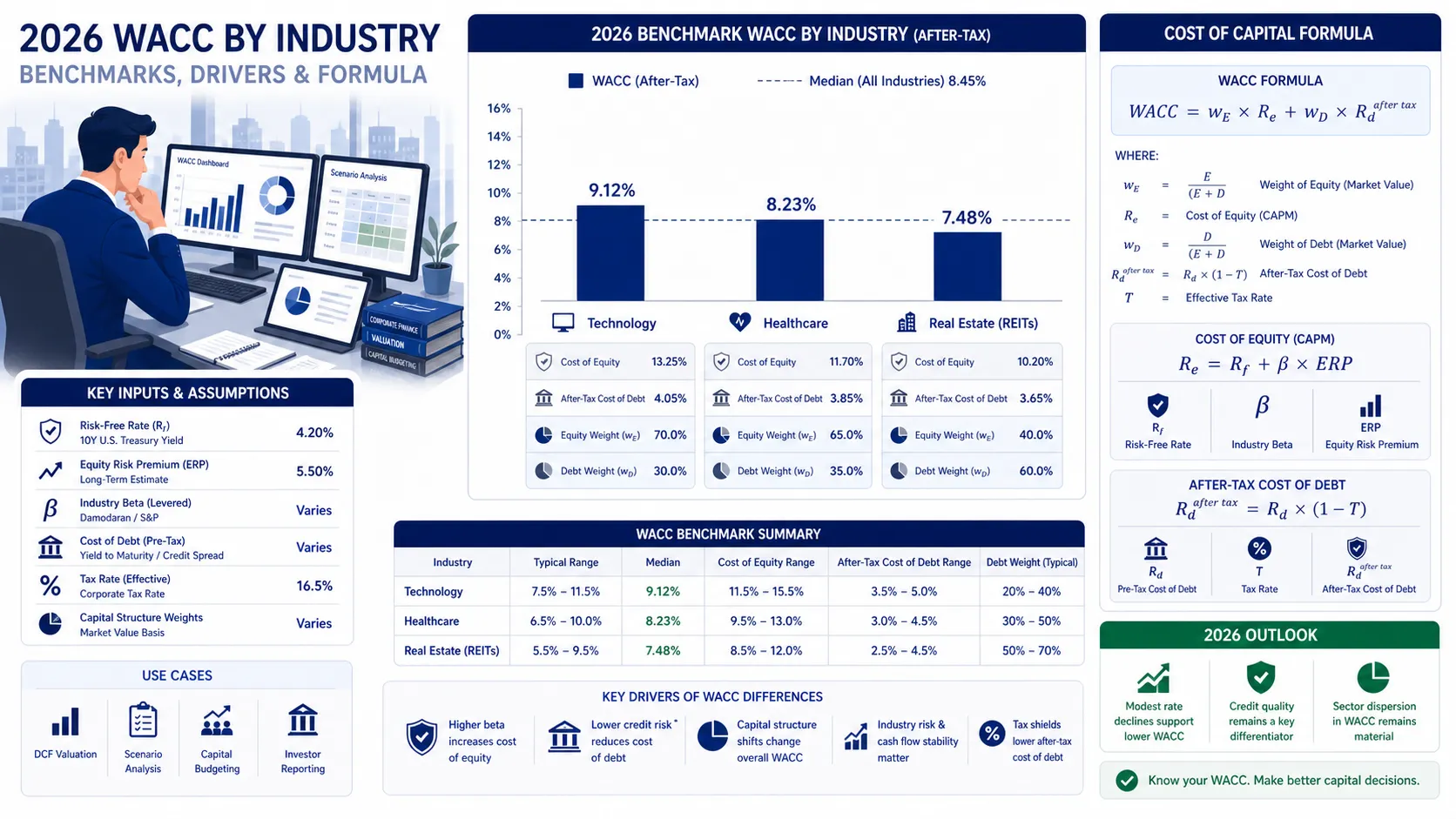
WACC by Industry: 2026 Benchmarks for Technology, Healthcare, and Real Estate
In 2026, industry WACC diverges sharply, from 5.5% for utilities to over 11.5% for software. CFOs must benchmark their discount rate against peers to ground valuations in market reality.
 Corporate Finance
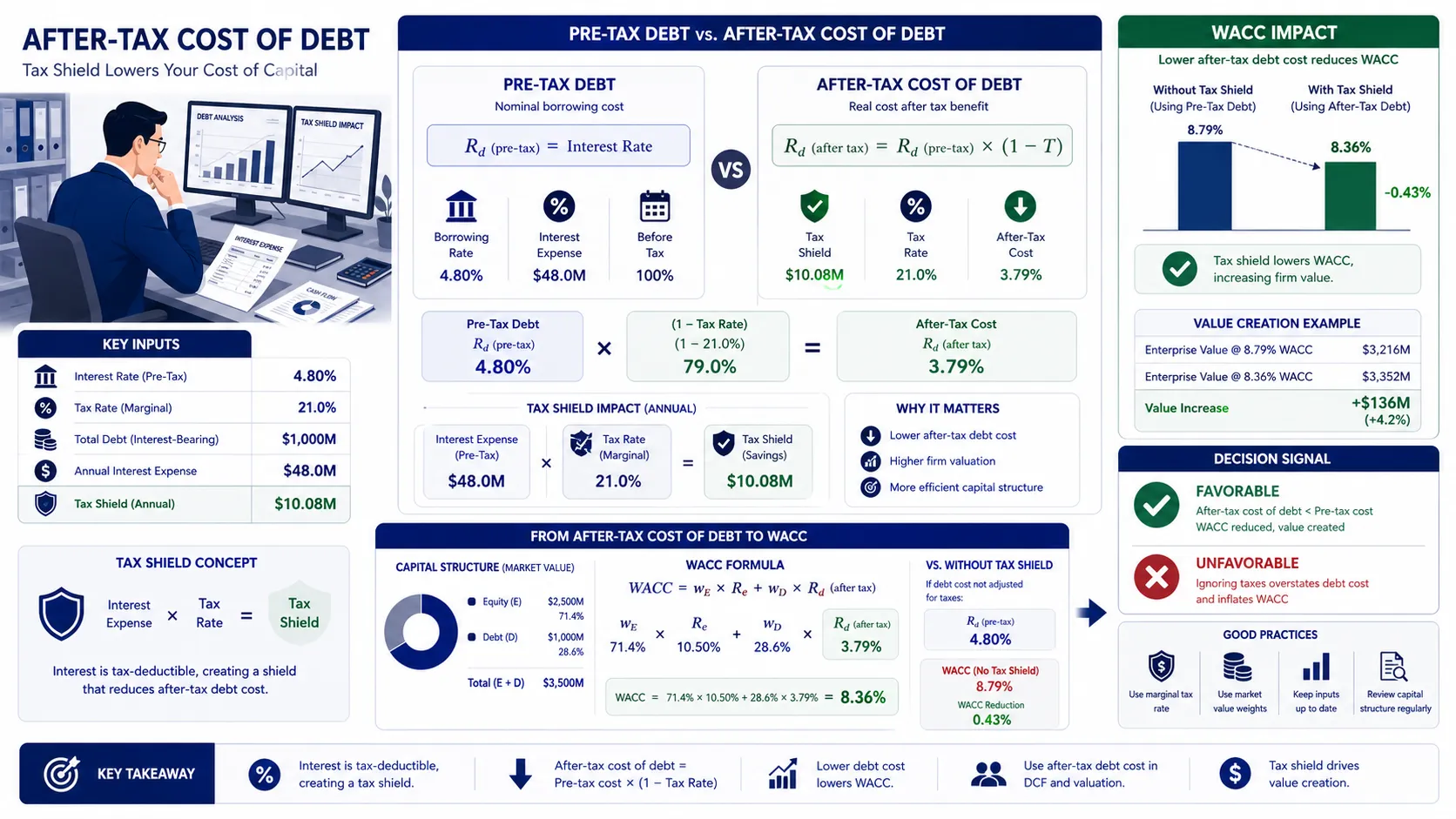
What Is After-Tax Cost of Debt and How Does It Lower WACC?
Interest payments are tax-deductible, making debt cheaper than equity and lowering your company's WACC. The after-tax cost of debt reveals this true, subsidized borrowing rate.
 Corporate Finance
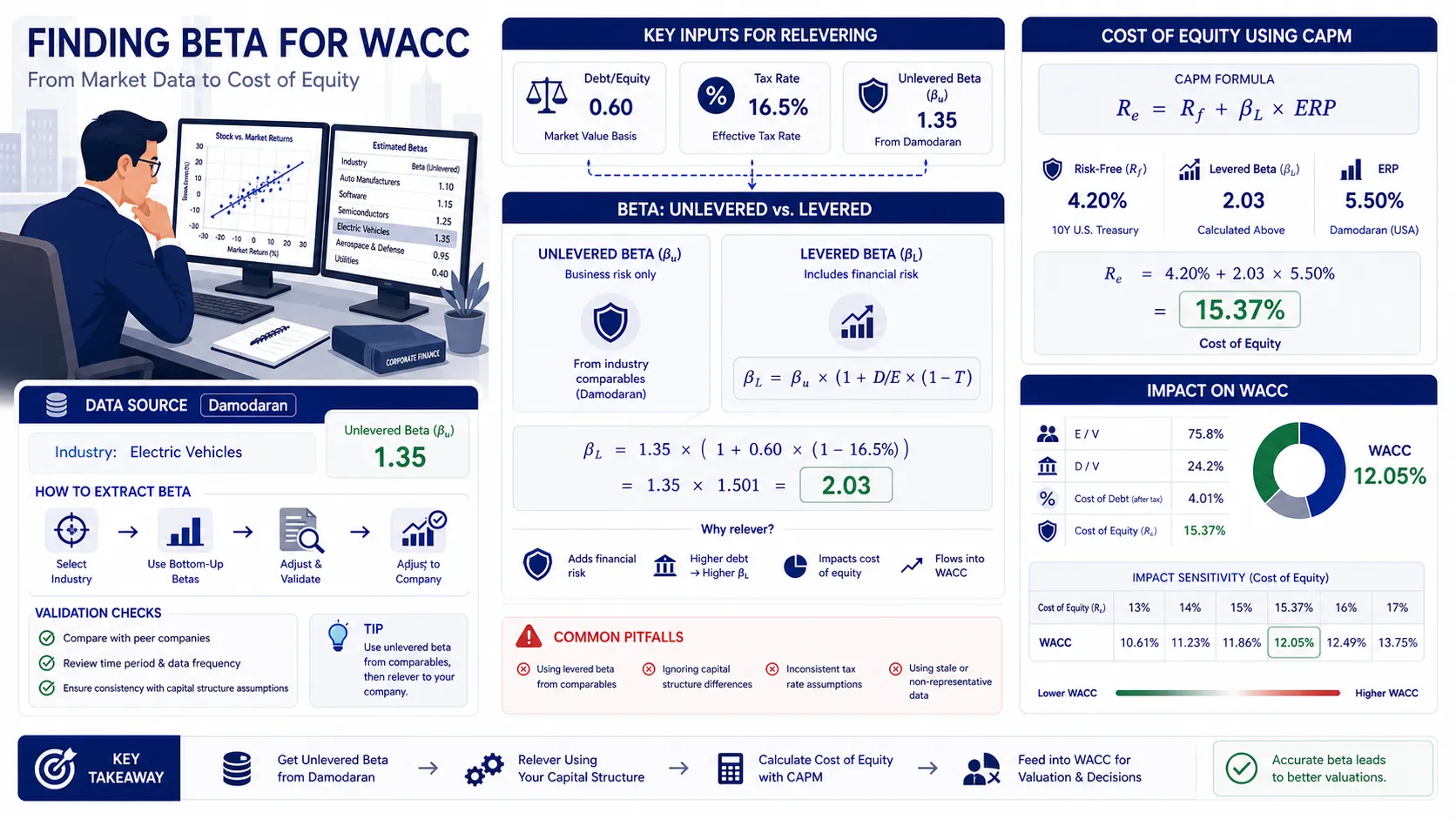
How to Find Beta for WACC: Unlevered vs Levered Beta Calculati
Unlock institutional-grade WACC by mastering bottom-up beta: unlever public peers to strip debt risk, then re-lever for your target's capital structure. This precision method solves CAPM's toughest hurdle, delivering accurate equity risk pricing for DCF models.
Frequently Asked Questions (FAQ)
What is the difference between pre-money and post-money valuation?
How is the peer baseline determined in the Scorecard method?
When should a startup use the Berkus method over the Scorecard method?
Does the Berkus method limit a startup's valuation to $2.5 million?
Can I export this valuation assessment for angel negotiations?
The calculations, projections, and reports generated by BizToolkitPro are for educational and informational purposes only. They do not represent professional investment advice, financial planning, tax guidance, legal counsel, or formal business valuation.
Financial models and valuation formulas (including WACC, DCF, IRR, and NPV) rely on assumptions and inputs provided directly by the user. Actual financial markets and business metrics fluctuate; therefore, BizToolkitPro makes no warranties, express or implied, regarding the accuracy, completeness, or suitability of the outputs for any investment strategy or corporate decision.
Always perform your own independent diligence and consult with a licensed Financial Analyst, Certified Public Accountant (CPA), or certified valuation specialist before committing capital or executing corporate transactions.