
Enterprise Value Calculator
Use this focused Enterprise Value calculator, an operational corporate finance utility built to evaluate the comprehensive acquisition cost of a business entity. Enterprise Value (EV) is a metric that represents the theoretical price tag of a firm before accounting for its capital structure changes.
This page calculates the implied EV and Net Debt using balance sheet segments, providing corporate developers, business owners, and investment analysts with a stacked bar visualizer and a dynamic 5x5 sensitivity matrix grid.
Have a suggestion or found a calculation discrepancy? Let us know!
How to use this Enterprise Value calculator
Inputs you need to gather
To run the Enterprise Value model, you will need to gather the following financial values from the company's latest balance sheet and market data:
- Market Capitalization: The total value of common shares outstanding. For public companies, this is the share price multiplied by total shares; for private companies, this is the assessed equity valuation.
- Total Debt: The sum of short-term and long-term interest-bearing debt liabilities on the balance sheet.
- Cash & Cash Equivalents: The cash, bank deposits, and highly liquid short-term investments held by the firm.
- Preferred Stock (optional): The market value or book value of outstanding preferred shares.
- Minority Interest (optional): The non-controlling interest in subsidiaries that is consolidated on the balance sheet.
Interpreting the valuation outputs
Once computed, the tool outputs the Enterprise Value (EV) and the Net Debt.
The stacked bar visualizer details the composition of the company's value, showing how much of the EV is funded by equity (Market Cap) versus debt and other claims. The cash deduction segment shows how the company's liquid holdings reduce the net cost of acquisition. The sensitivity grid shows how the EV shifts as debt levels and cash holdings change.
Enterprise Value Formula and Methodology
The EV Formula
Enterprise Value measures the total economic value of a company. It is calculated by adding equity value, debt, and other claims, and subtracting cash:
Why we add debt and subtract cash
To understand Enterprise Value, imagine buying a house. If the house costs $1,000,000 (Equity Value) but has a $300,000 mortgage (Debt) that you must assume, the total cost to buy the house rises to $1,300,000.
However, if the house contains a safe with $150,000 in cash (Cash & Equivalents) that becomes yours after the purchase, the net economic cost of the acquisition drops to $1,150,000. This net cost represents the Enterprise Value of the property.
Preferred stock and minority interest adjustments
Preferred stock is added because preferred shareholders have a senior claim on corporate assets, similar to debt holders. Minority interest (non-controlling interest) is added because it represents the portion of consolidated subsidiaries that the parent company does not own, but whose cash flows are consolidated in the group financial statements. Adding minority interest ensures that the numerator (EV) matches the consolidated operating cash flows.
Enterprise Value step-by-step example calculation
Example inputs
Let's calculate the Enterprise Value for a mid-sized technology corporation with the following balance sheet metrics:
- Market Capitalization = $10,000,000
- Total Debt = $3,000,000
- Cash & Cash Equivalents = $1,500,000
- Preferred Stock = $0
- Minority Interest = $200,000
Step-by-step execution
Step 1: Calculate the total additions to value: Equity ($10,000,000) + Debt ($3,000,000) + Preferred ($0) + Minority ($200,000) = $13,200,000.
Step 2: Subtract cash and cash equivalents: $13,200,000 - Cash ($1,500,000) = $11,700,000.
Step 3: Calculate Net Debt: Debt ($3,000,000) - Cash ($1,500,000) = $1,500,000. The net economic cost of acquiring this business is $11,700,000, with $1,500,000 in net debt assumed by the acquirer.
Difference between Enterprise Value and Equity Value
What is Equity Value?
Equity Value represents the total value of the company that is owned by its shareholders. It is the value that remains after all debts and other liabilities have been paid off. For public companies, Equity Value is equal to the market capitalization.
What is Enterprise Value?
Enterprise Value represents the total value of the company's operations, regardless of how those operations are financed (whether through equity or debt). It reflects the value of the entire business entity, making it the standard metric used in acquisitions and buyouts.
How they relate in DCF models
In a Discounted Cash Flow model, discounting Free Cash Flows to the Firm (FCFF) yields the Enterprise Value. To find the Equity Value, you must subtract Net Debt, Preferred Stock, and Minority Interest from the calculated EV. This is a critical step in determining the per-share value of common stock.
Common Enterprise Value calculation mistakes
Using book value instead of market value
A frequent mistake is using the book value of equity from the balance sheet instead of the market capitalization. Since book values reflect historical accounting allocations, they do not represent the current market value of the company's shares. Always use current market equity value for public firms.
- Check all interest-bearing debt: Ensure both short-term and long-term loans, bonds, and notes are included in total debt.
- Verify restricted cash limits: Exclude restricted cash from cash and cash equivalents, as it cannot be used immediately by an acquirer to offset debt.
- Include capital leases: Under modern accounting standards (IFRS 16 / ASC 842), capital leases should be included in the total debt calculation.
Real-world case study: Apple Inc. (AAPL, Q1 2026)
Apple Inc. metrics profile
Apple Inc. (AAPL) is a global technology leader known for its consumer electronics, software, and online services. Analyzing its enterprise value provides a holistic view of the company's total worth, encompassing both equity and debt, making it a crucial metric for potential acquirers and investors. This case study utilizes recent financial data to illustrate the calculation of Apple's enterprise value.
Apple's substantial market capitalization reflects its robust market presence and investor confidence. By incorporating total debt and subtracting cash and cash equivalents, the enterprise value provides a more comprehensive measure of the company's true value, as it accounts for all sources of capital. The relatively high enterprise value indicates the significant capital required to acquire Apple, highlighting its scale and financial strength. This metric is particularly useful for investors and analysts in comparing Apple's valuation against competitors and assessing its potential as an acquisition target, offering a clearer picture beyond just equity market value.
Related Calculators
Estimate weighted average cost of capital.
Open Tool →DCF CalculatorValue a business using discounted cash flows.
Open Tool →NPV CalculatorCompute net present value of cash flows.
Open Tool →IRR CalculatorSolve project internal rates of return.
Open Tool →Free Cash Flow CalculatorEstimate operating free cash flow.
Open Tool →Break-Even ROI CalculatorAnalyze payback thresholds and returns.
Open Tool →Related Articles & Guides
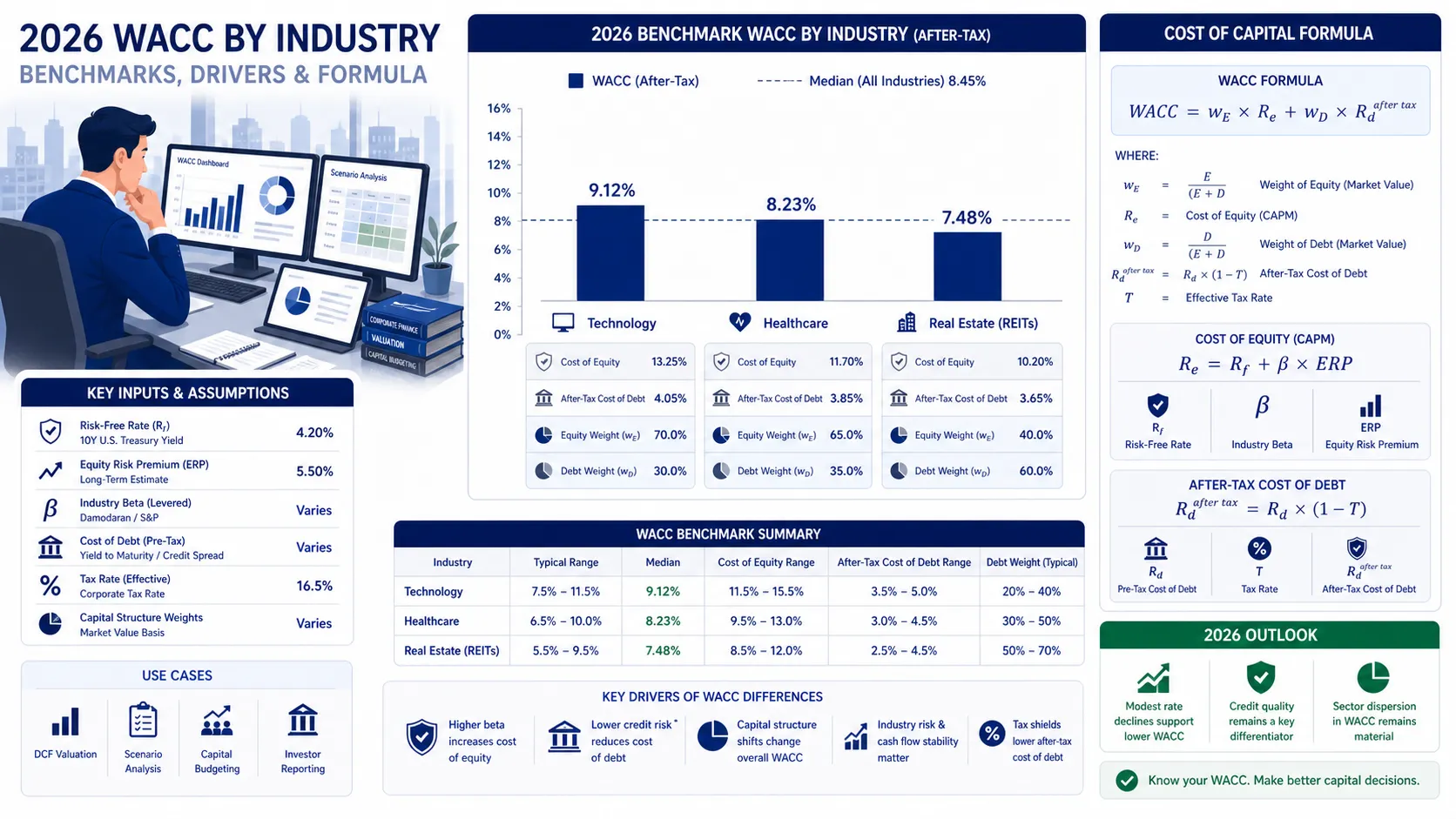 Corporate Finance
WACC by Industry: 2026 Benchmarks for Technology, Healthcare, and Real Estate
In 2026, industry WACC diverges sharply, from 5.5% for utilities to over 11.5% for software. CFOs must benchmark their discount rate against peers to ground valuations in market reality.
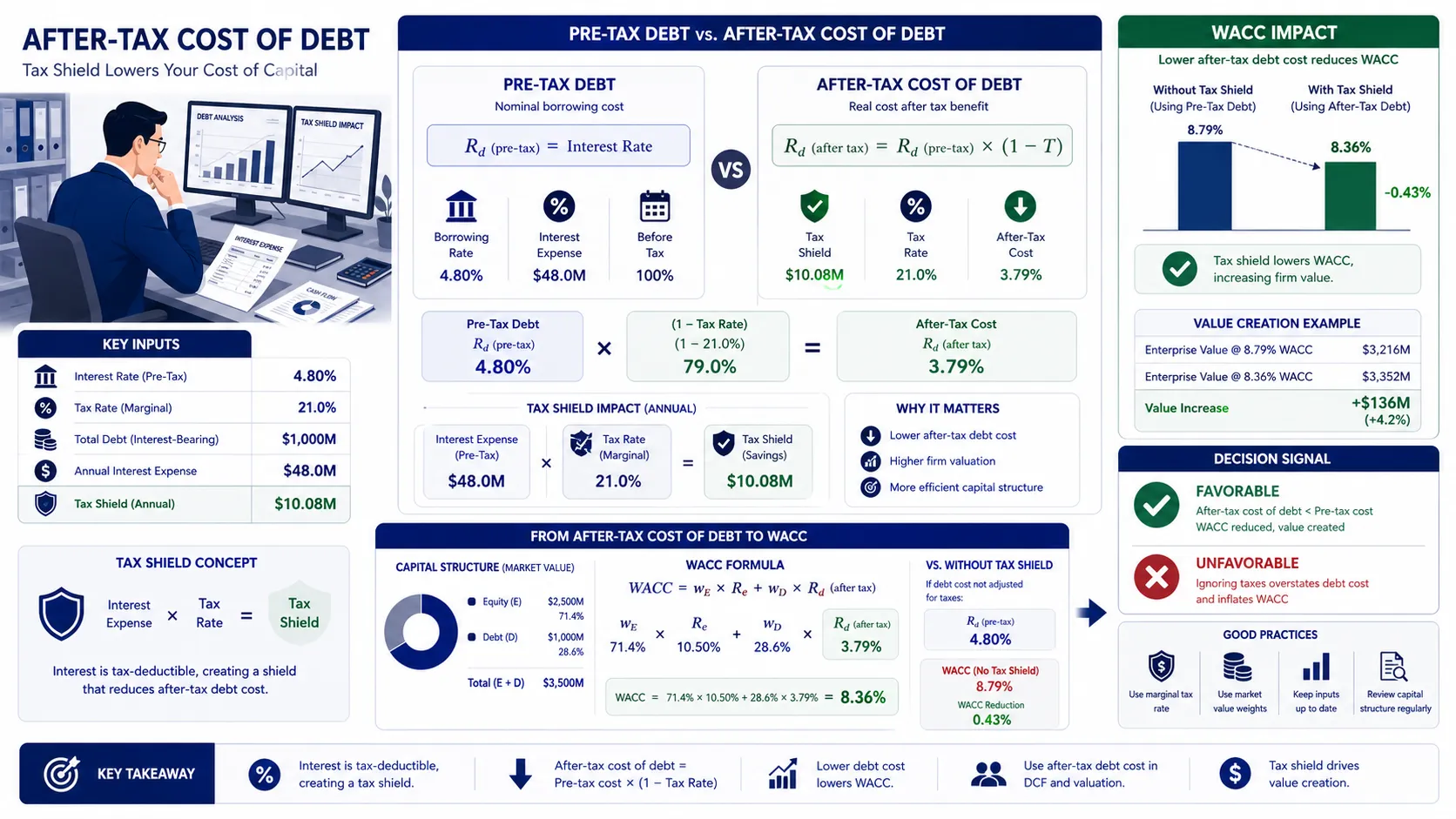 Corporate Finance
What Is After-Tax Cost of Debt and How Does It Lower WACC?
Interest payments are tax-deductible, making debt cheaper than equity and lowering your company's WACC. The after-tax cost of debt reveals this true, subsidized borrowing rate.
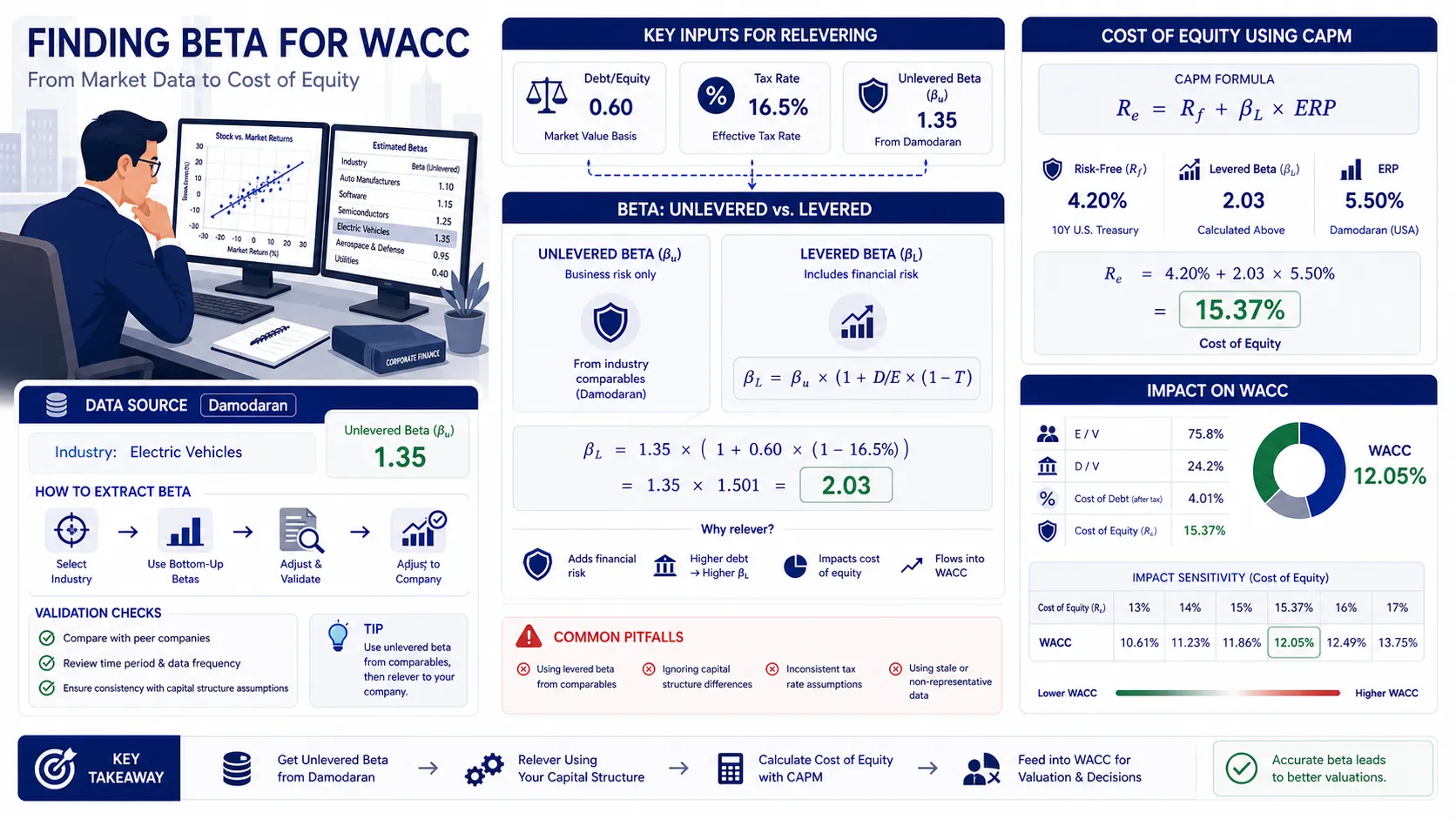 Corporate Finance
How to Find Beta for WACC: Unlevered vs Levered Beta Calculati
Unlock institutional-grade WACC by mastering bottom-up beta: unlever public peers to strip debt risk, then re-lever for your target's capital structure. This precision method solves CAPM's toughest hurdle, delivering accurate equity risk pricing for DCF models.
Frequently Asked Questions
Can Enterprise Value be negative?
Why is cash subtracted when calculating Enterprise Value?
Should I include lease liabilities in total debt?
How does minority interest affect Enterprise Value?
The calculations, projections, and reports generated by BizToolkitPro are for educational and informational purposes only. They do not represent professional investment advice, financial planning, tax guidance, legal counsel, or formal business valuation.
Financial models and valuation formulas (including WACC, DCF, IRR, and NPV) rely on assumptions and inputs provided directly by the user. Actual financial markets and business metrics fluctuate; therefore, BizToolkitPro makes no warranties, express or implied, regarding the accuracy, completeness, or suitability of the outputs for any investment strategy or corporate decision.
Always perform your own independent diligence and consult with a licensed Financial Analyst, Certified Public Accountant (CPA), or certified valuation specialist before committing capital or executing corporate transactions.