Discount Rate Calculator
Access this comprehensive discount rate calculator, a premium corporate finance utility designed to compute hurdle rates for asset valuations, investment underwritings, and capital budgeting models. In corporate finance, the discount rate represents the required rate of return that investors demand to justify the risk of buying a company's cash flows.
This interactive tool supports two standard industry models: the Capital Asset Pricing Model (CAPM) to evaluate the Cost of Equity, and the Weighted Average Cost of Capital (WACC) to model blended capital structure hurdle rates. Adjust risk-free rate, beta, size premium, and leverage limits to see how hurdle requirements shift across different investment profiles.
How to use this discount rate calculator
Key inputs for CAPM and WACC models
To calculate a firm's required discount rate, compile the following capital market and corporate inputs:
- Risk-Free Rate (Rf): Typically represented by the yield on a 10-year US Treasury bond, representing zero-default investment returns.
- Equity Beta (β): A metric of systemic risk compared to the broader market. A beta of 1.0 matches market risk; higher betas reflect tech/leveraged equity volatility.
- Equity Risk Premium (ERP): The additional return required by investors above treasury rates to hold stocks (typically 5.0% to 6.5%).
Adding leverage and size adjustments
Under **WACC mode**, you specify the company's leverage structure (Debt vs. Equity weights) and tax rate. The debt weight reduces the discount hurdle rate due to interest tax shielding.
You can also add a **Size Premium** (e.g. 1.0% to 2.5%) when valuing small-cap or private companies, compensating for liquidity risk and standard small-firm premium anomalies.
Discount rate calculation formulas
CAPM and WACC equations
The calculator applies standard corporate finance frameworks:
Understanding the Cost of Capital denominator
In discounted cash flow (DCF) models, the discount rate acts as the denominator. It dictates the compound discounting weight: Present Value = CF_t / (1 + r)^t.
A higher discount rate reflects a higher risk profile, heavily depressing the present value of distant cash flows. For stable companies with predictable cash flows (utility companies, consumer staples), lower discount rates (typically 6% to 8%) preserve asset value. High-growth tech startups or cyclical operations require higher discount hurdles (10% to 15%) to account for systemic risk profiles.
Discount rate step-by-step example calculation
Hypothetical firm parameters
Let's analyze a mid-cap tech firm with a leveraged capital structure:
- 10-year US Treasury Rate (Rf) = 4.00%
- Equity Beta (β) = 1.25 | Equity Risk Premium (ERP) = 5.50%
- Size Premium (SP) = 0.75%
- Capital weights: Equity Weight = 70% | Debt Weight = 30%
- Cost of Debt = 6.00% | Tax Rate = 20.00%
Step-by-step calculations
- Calculate Cost of Equity (Ke):
Ke = 4.0% + (1.25 * 5.5%) + 0.75% = 4.0% + 6.875% + 0.75% = 11.625%. - Calculate After-Tax Cost of Debt:
After-tax Kd = 6.0% * (1 - 0.20) = 4.80%. - Blend into WACC structure:
WACC = (70% * 11.625%) + (30% * 4.80%) = 8.138% + 1.440% = 9.58%. The final discount hurdle rate is 9.58%.
Strategic guidelines and common mistakes
Relying on book values instead of market values
When applying WACC weighting, using book values of equity and debt from the balance sheet is a common error. Book value represents historical cost. Discount rates must reflect current opportunity costs, meaning equity weights should always be calculated using current market capitalization.
Underestimating beta systemic risk parameters
Selecting historical industry betas without adjusting for current balance sheet leverage understates required returns. Unlevered betas must be relevered using the company's specific target debt-to-equity ratio to capture financial distress risks.
Omitting size premium adjustments
Valuing small private companies (revenue < $50M) using large-cap market risk premiums results in unrealistically low discount rates and inflated valuations. Small firms face severe liquidity and operational risks, necessitating size premium adjustments.
Real-world case study: Equity Residential (EQR, FY 2025)
Equity Residential financial profile
Interpretation of EQR discount rate model
Equity Residential (EQR) is an S&P 500 Real Estate Investment Trust (REIT) focused on acquisition and management of luxury apartment assets in high-barrier coastal US markets. REIT businesses are capital-intensive, typically carrying substantial long-term mortgages to leverage real estate yields.
Using the Capital Asset Pricing Model (CAPM) with a baseline risk-free rate of 4.25% and a market premium of 5.50%, EQR's lower systematic risk profile (Beta of 0.85) yields a required Cost of Equity of 8.925%. Because real estate rental income is historically less volatile than aggregate industrial production, defensive equity investors demand a lower hurdle rate to hold apartment equities.
In corporate WACC structuring, EQR blends this 8.925% Cost of Equity with an after-tax Cost of Debt of 3.555% (4.50% pre-tax interest adjusted for a 21% corporate shield). Given their actual funding mix of 71% equity and 29% debt, the corporate discount rate solves to 7.37%. Real estate appraisers utilize this 7.37% hurdle rate to discount multifamily operational cash flows and determine intrinsic asset portfolio values.
Related Calculators
Estimate weighted average cost of capital.
Open Tool →DCF CalculatorValue a business using discounted cash flows.
Open Tool →NPV CalculatorCompute net present value of cash flows.
Open Tool →IRR CalculatorSolve project internal rates of return.
Open Tool →Free Cash Flow CalculatorEstimate operating free cash flow.
Open Tool →Break-Even ROI CalculatorAnalyze payback thresholds and returns.
Open Tool →Related Articles & Guides
 Corporate Finance
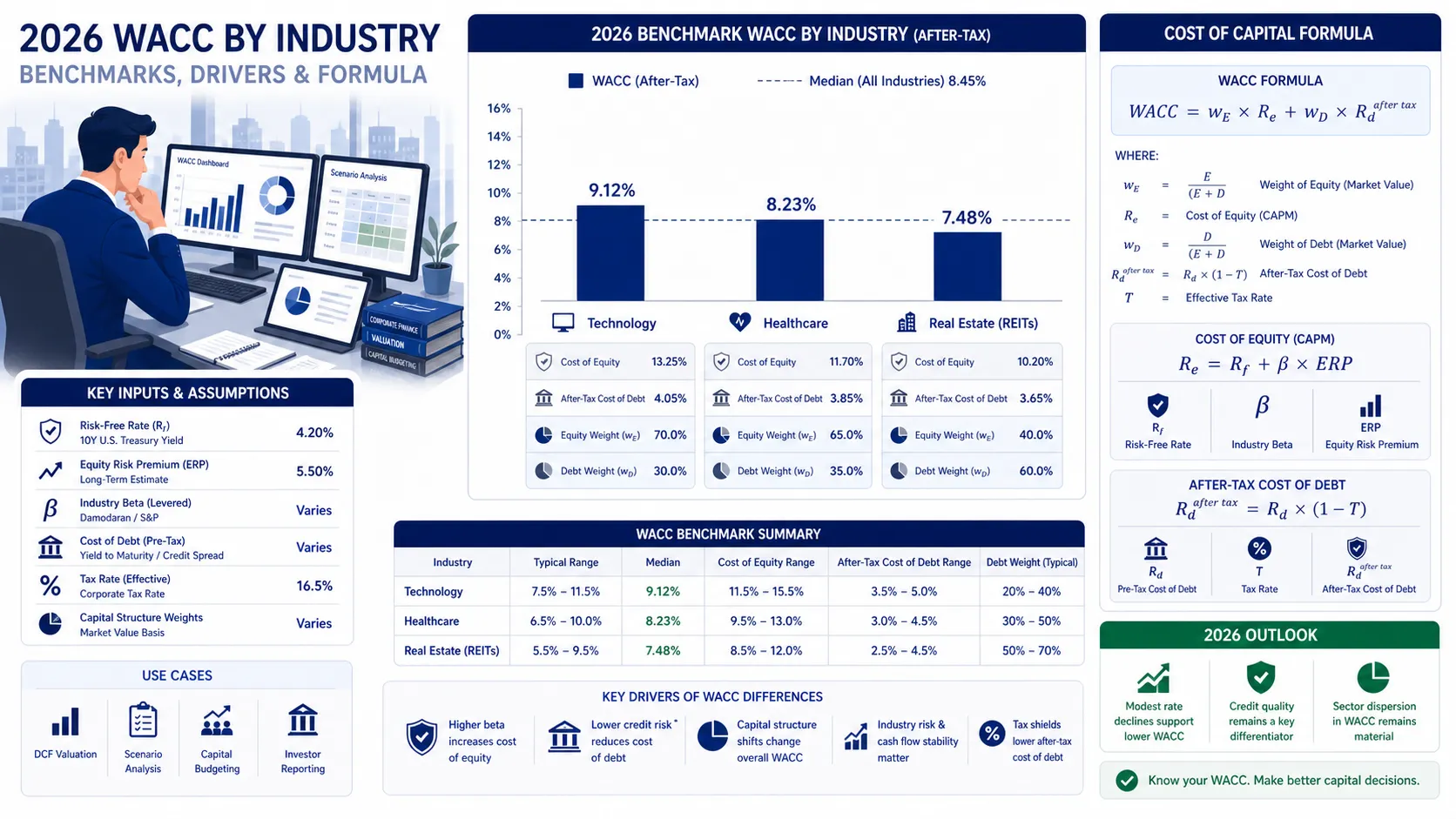
WACC by Industry: 2026 Benchmarks for Technology, Healthcare, and Real Estate
In 2026, industry WACC diverges sharply, from 5.5% for utilities to over 11.5% for software. CFOs must benchmark their discount rate against peers to ground valuations in market reality.
 Corporate Finance
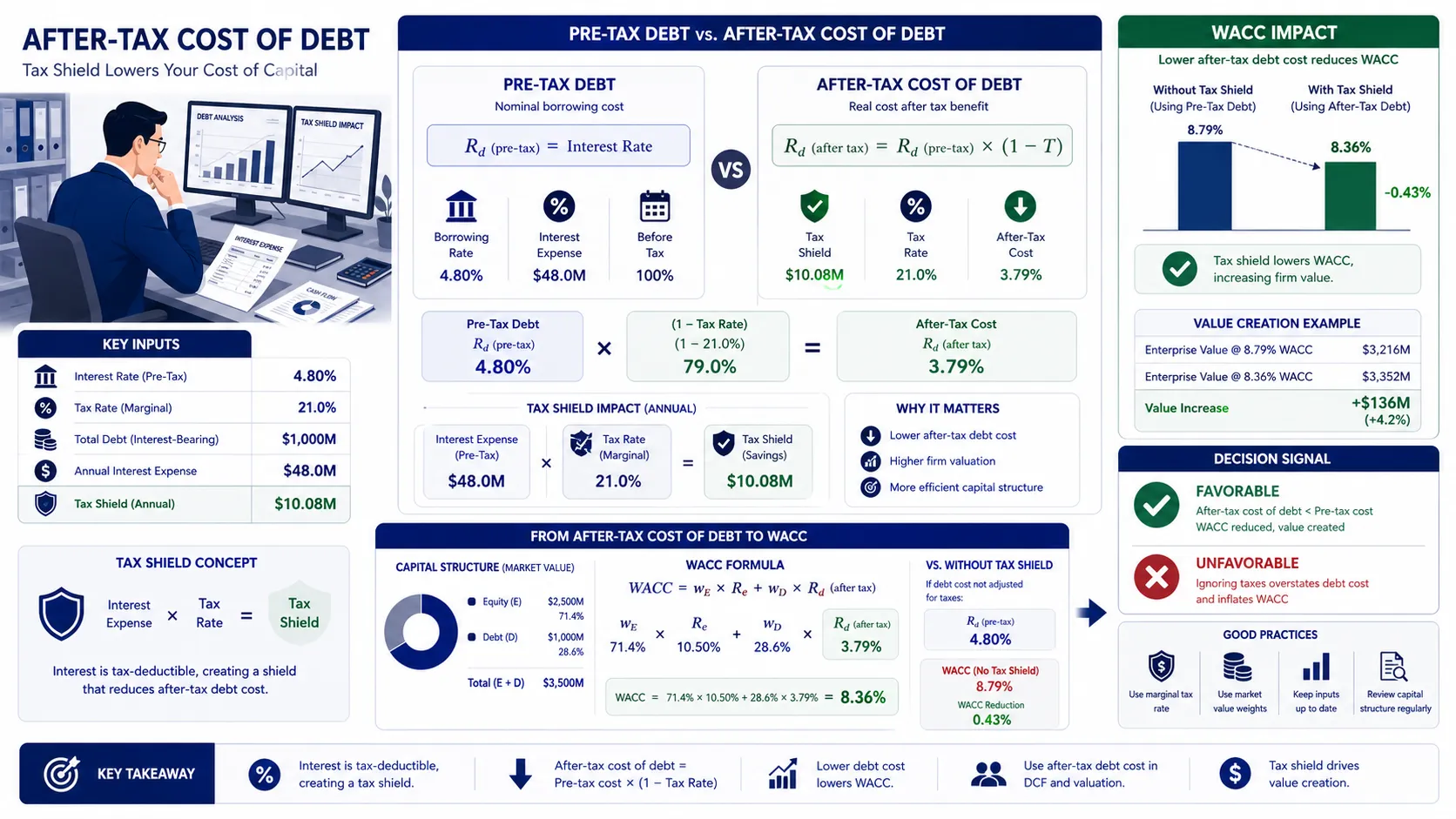
What Is After-Tax Cost of Debt and How Does It Lower WACC?
Interest payments are tax-deductible, making debt cheaper than equity and lowering your company's WACC. The after-tax cost of debt reveals this true, subsidized borrowing rate.
 Corporate Finance
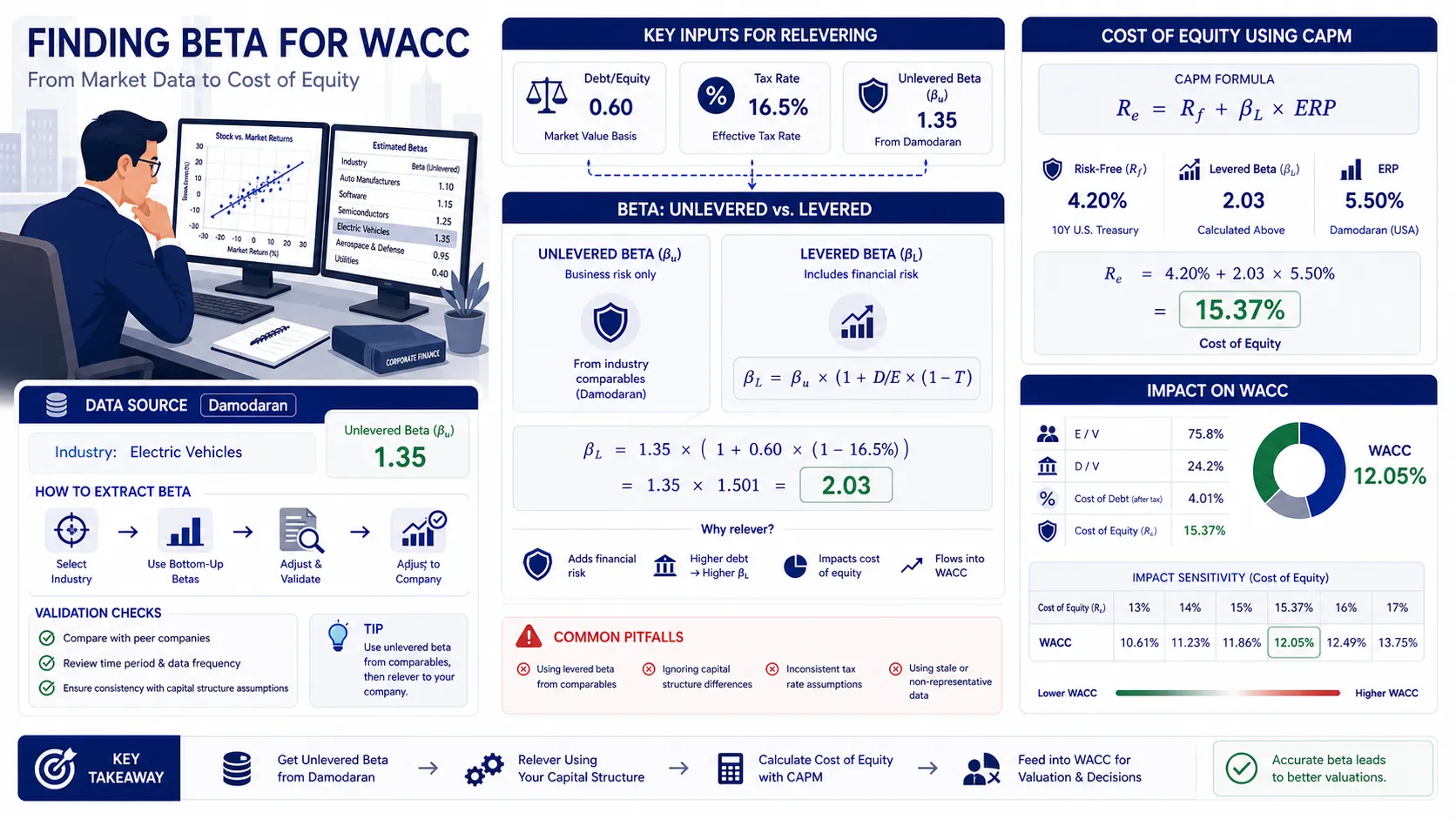
How to Find Beta for WACC: Unlevered vs Levered Beta Calculati
Unlock institutional-grade WACC by mastering bottom-up beta: unlever public peers to strip debt risk, then re-lever for your target's capital structure. This precision method solves CAPM's toughest hurdle, delivering accurate equity risk pricing for DCF models.
Frequently Asked Questions (FAQ)
What is a discount rate in simple terms?↓
How does WACC differ from CAPM?↓
Why is the cost of debt usually lower than the cost of equity?↓
How does changing the discount rate affect property or business valuation?↓
The calculations, projections, and reports generated by BizToolkitPro are for educational and informational purposes only. They do not represent professional investment advice, financial planning, tax guidance, legal counsel, or formal business valuation.
Financial models and valuation formulas (including WACC, DCF, IRR, and NPV) rely on assumptions and inputs provided directly by the user. Actual financial markets and business metrics fluctuate; therefore, BizToolkitPro makes no warranties, express or implied, regarding the accuracy, completeness, or suitability of the outputs for any investment strategy or corporate decision.
Always perform your own independent diligence and consult with a licensed Financial Analyst, Certified Public Accountant (CPA), or certified valuation specialist before committing capital or executing corporate transactions.