
Dilution Calculator for Startup Funding and Equity Modeling
Use this focused Dilution Calculator, a finance analysis tool designed to model equity ownership changes during venture capital funding rounds. Managing startup capitalization requires precise planning of founder shares, employee option pools (ESOP), and investor ownership ratios.
This online utility calculates post-money structures, individual share allocations, and implied share prices, creating a dynamic post-money cap table overview and a two-dimensional sensitivity grid. Whether you are a founder preparing for a Series A round, a venture investor auditing term sheet parameters, or a compensation committee structuring stock option expansions, this tool delivers the mathematical clarity needed to avoid excessive ownership dilution and align equity structures for growth.
Negotiate pre-money valuations and target round raise sizes.
Define shares base and post-money ESOP pool allocations.
Have a suggestion or found a calculation discrepancy? Let us know!
How to use this dilution calculator
Inputs you need before modeling dilution
To model an accurate startup funding round, collect four key parameters representing your current cap table and proposed deal terms:
- Pre-Money Valuation: The agreed-upon valuation of the company before the new investment is added. This is the primary driver of equity pricing.
- Investment Amount: The total cash being invested by new shareholders in the current funding round.
- Existing Shares: The total number of shares currently outstanding, held by founders, early employees, and past investors.
- Option Pool Target (ESOP): The target percentage of the company's post-money equity to reserve for the employee stock option plan.
Reading the dilution results
Once computed, the calculator outputs a detailed breakdown of the post-round capital structure:
The Post-Money Valuation reflects the total paper value of the company immediately after the round, calculated as pre-money valuation plus the investment amount. The Share Price represents the price per new share issued to investors.
The Ownership Breakdown displays the resulting percentages for existing shareholders, new investors, and the option pool. Additionally, the Sensitivity Grid illustrates how founder ownership shifts under different combinations of pre-money valuation and investment amount.
Dilution formula and methodology
Core dilution equations
Equity dilution during a funding round is calculated using several interconnected formulas:
Understanding share price and capital structures
When a startup issues new equity, it creates new shares rather than selling existing founder shares. This process increases the total share count and dilutes the ownership percentage of existing shareholders, although the total value of their shares may rise if the valuation increases.
New Share Price: Calculated by dividing the pre-money valuation by the existing share count. This price applies to both the new shares issued to investors and the shares allocated to the new option pool.
The Option Pool Effect: Reserving an option pool post-money is a standard requirement in VC term sheets. Because investors want the pool created *before* their investment to protect their own shares from dilution, the dilution for the option pool is borne entirely by the existing shareholders. This reduces the founders' ownership percentage before the investor's cash is added.
Startup dilution example calculation
Illustrative round inputs
Let's walk through an illustrative scenario for a startup raising its Series A round. The founders collect the following inputs:
- Pre-Money Valuation = $8,000,000
- Investment Amount = $2,000,000
- Existing Shares = 8,000,000 shares
- Target Option Pool = 10.00%
Step-by-step math walkthrough
First, calculate the Post-Money Valuation:
Post-Money Valuation = $8,000,000 + $2,000,000 = $10,000,000
Next, calculate the investor's ownership percentage:
Investor Ownership = ($2,000,000 / $10,000,000) * 100 = 20.00%
Calculate the remaining ownership for existing shareholders:
Founder Ownership = 100% - 20.00% (Investor) - 10.00% (ESOP) = 70.00%
Finally, calculate the total new share count:
Total Post-Money Shares = 8,000,000 / 0.70 = 11,428,571 shares
This illustrative calculation shows that the founders' ownership is diluted from 100% to 70%, while the new investors acquire 20% and the employee option pool receives 10% of the company's equity.
What your equity dilution results mean
Understanding founder ownership dilution
Dilution is a natural consequence of raising capital to scale a business. While your percentage ownership decreases, the goal is for the value of your remaining shares to increase. A smaller percentage of a larger, well-funded company is often worth significantly more than 100% of an unfunded startup.
Evaluating investor ownership thresholds
Most venture capital rounds target investor ownership levels between 15% and 25% per round. If investor ownership exceeds 30%, it can indicate that the valuation is low relative to the cash raised, which can lead to excessive dilution for the founding team.
Managing voting control and board dynamics
Dilution affects both financial returns and voting control. If founder ownership drops below 50%, you may lose absolute voting control over corporate decisions. Reviewing the terms of the investment and board structures helps ensure you maintain adequate influence over the company's direction.
Strategic dilution scenarios and ESOP pool timing
Pre-money vs post-money option pool creation
The timing of option pool creation is a key point of negotiation in funding rounds. Creating the option pool *pre-money* places the entire dilution burden on the founders, lowering the effective pre-money valuation.
Creating the pool *post-money* distributes the dilution across both the founders and the new investors. Standard VC term sheets typically require a pre-money option pool of 10% to 15% to ensure there is equity available for future hires without diluting the new investors immediately.
Common dilution modeling mistakes to watch out for
Avoiding common modeling mistakes helps you maintain capitalization table accuracy:
- Confusing Pre-Money and Post-Money Valuation: Treating valuation terms interchangeably can lead to significant calculation errors. Post-money valuation is always pre-money valuation plus the cash invested.
- Ignoring the Option Pool Dilution: Failing to account for the option pool dilution in your calculations can result in founders' actual ownership being lower than expected.
- Overlooking Convertible Notes and SAFEs: Outstanding convertible debt or SAFEs will convert into equity during the round. Exclude these from your baseline calculations to ensure accuracy.
Real-world case study: Salesforce, Inc. (CRM, FY 2023)
Salesforce, Inc. metrics profile
Salesforce, a leading cloud-based software company, reports a difference between its basic and diluted weighted-average shares outstanding, primarily due to employee stock awards. This serves as a clear illustration of equity dilution, where potential shares from stock-based compensation increase the total share count used for diluted earnings per share calculations.
Salesforce's reporting of 5 million dilutive shares from employee stock awards in FY2023, representing approximately 0.50% dilution, highlights the common practice of using equity as a form of compensation in growth-oriented tech companies. While this increases the total shares outstanding and slightly reduces earnings per share, it incentivizes employees and aligns their interests with shareholders. For investors, understanding this consistent dilution is crucial for accurately assessing per-share performance and valuing the company, as it reflects the ongoing cost of talent acquisition and retention strategies.
Related Calculators
Estimate weighted average cost of capital.
Open Tool →DCF CalculatorValue a business using discounted cash flows.
Open Tool →NPV CalculatorCompute net present value of cash flows.
Open Tool →IRR CalculatorSolve project internal rates of return.
Open Tool →Free Cash Flow CalculatorEstimate operating free cash flow.
Open Tool →Break-Even ROI CalculatorAnalyze payback thresholds and returns.
Open Tool →Related Articles & Guides
 Corporate Finance
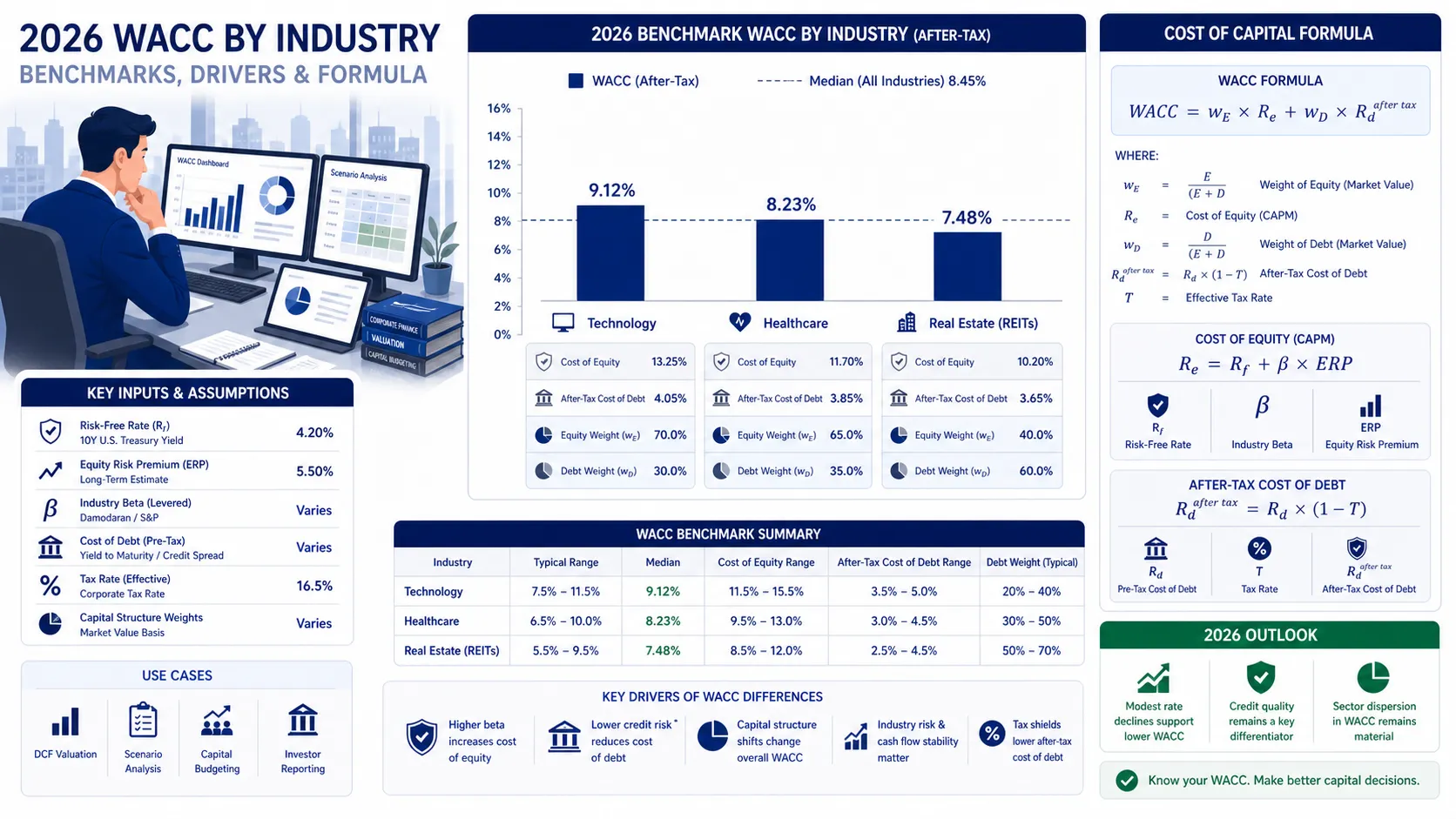
WACC by Industry: 2026 Benchmarks for Technology, Healthcare, and Real Estate
In 2026, industry WACC diverges sharply, from 5.5% for utilities to over 11.5% for software. CFOs must benchmark their discount rate against peers to ground valuations in market reality.
 Corporate Finance
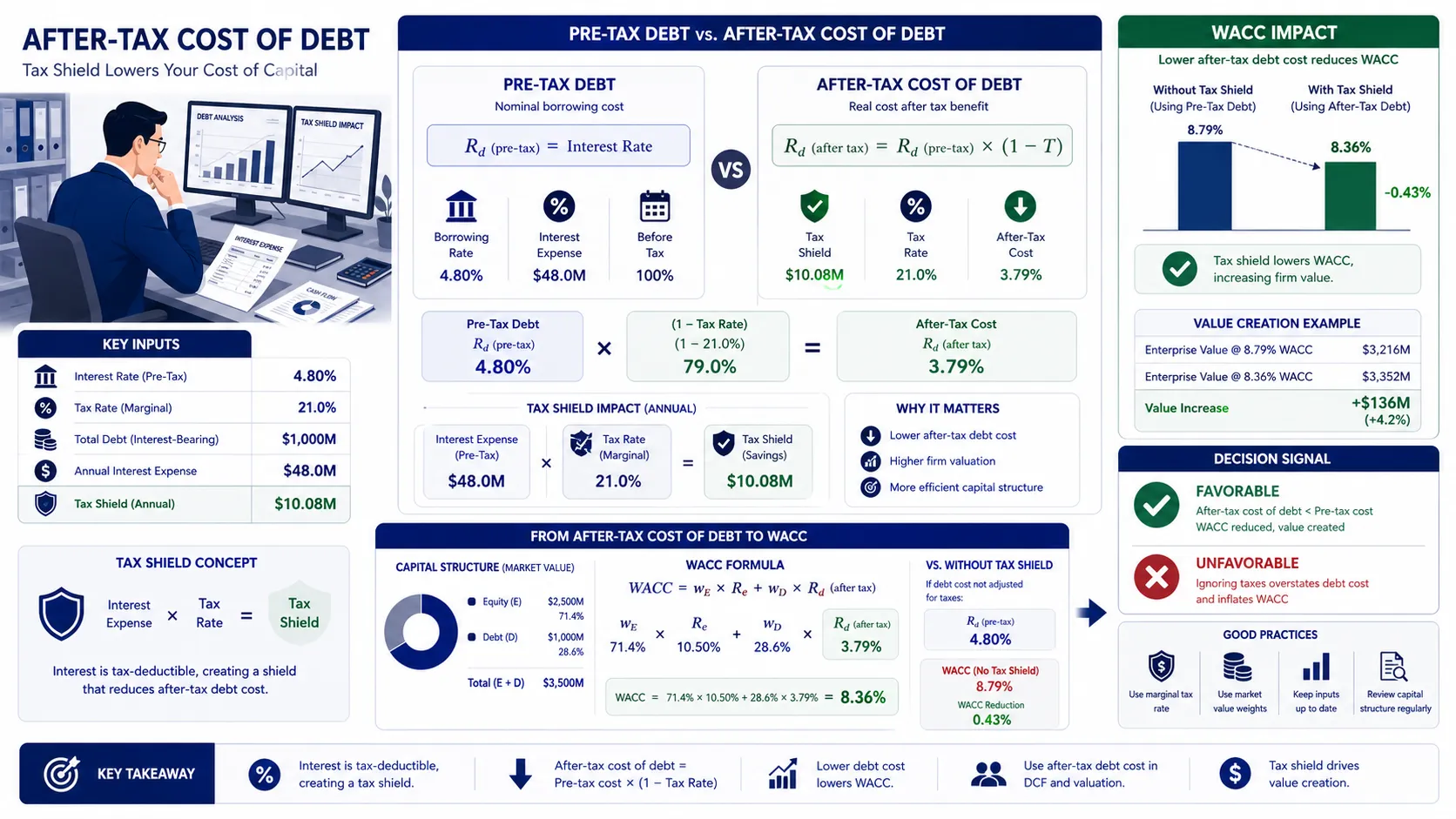
What Is After-Tax Cost of Debt and How Does It Lower WACC?
Interest payments are tax-deductible, making debt cheaper than equity and lowering your company's WACC. The after-tax cost of debt reveals this true, subsidized borrowing rate.
 Corporate Finance
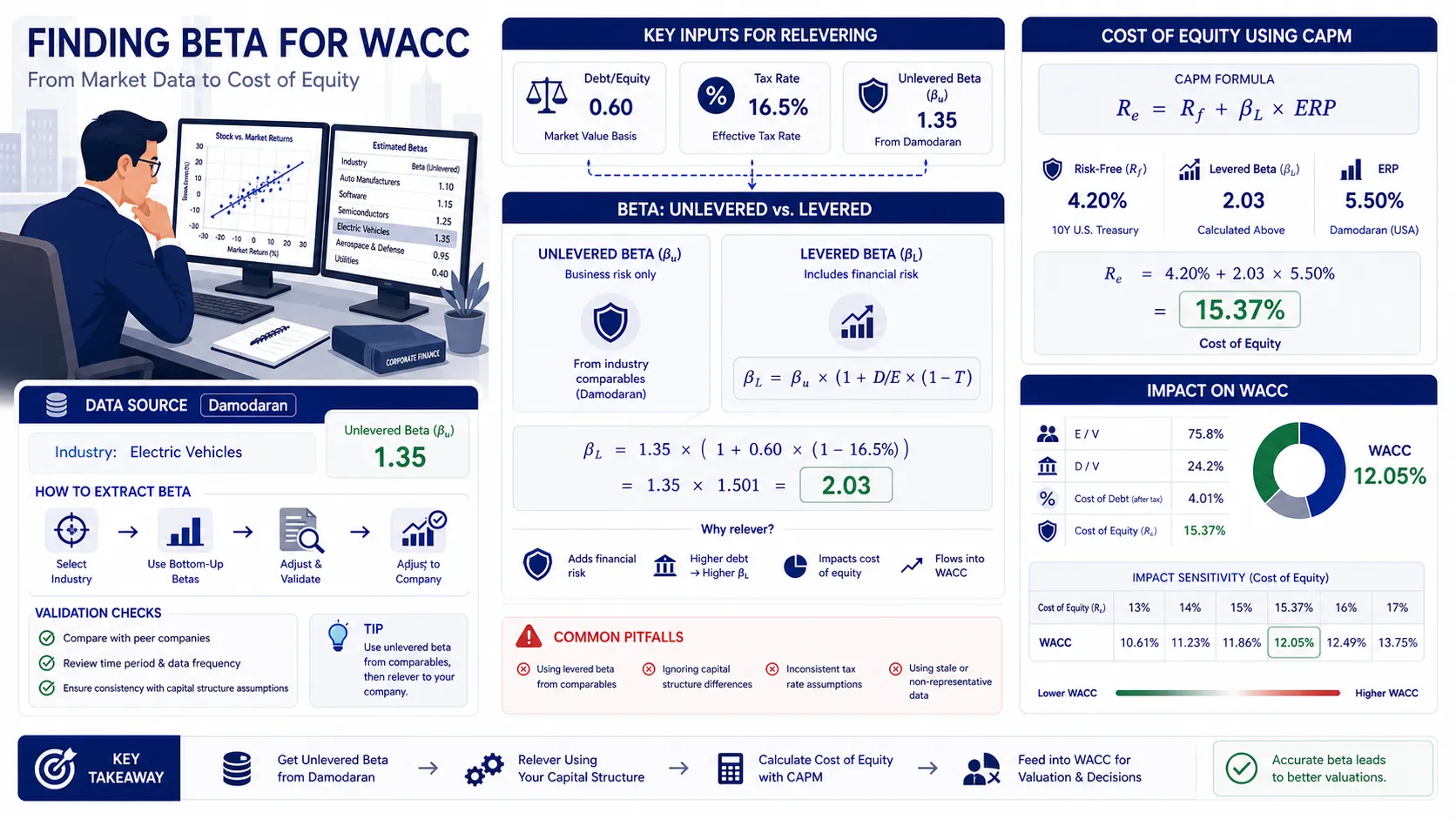
How to Find Beta for WACC: Unlevered vs Levered Beta Calculati
Unlock institutional-grade WACC by mastering bottom-up beta: unlever public peers to strip debt risk, then re-lever for your target's capital structure. This precision method solves CAPM's toughest hurdle, delivering accurate equity risk pricing for DCF models.
Frequently Asked Questions (FAQ)
What is a typical option pool size for a venture round?
Why do investors prefer the option pool to be created pre-money?
How do SAFEs and convertible notes impact Series A dilution?
Can dilution be prevented in subsequent rounds?
What is the difference between dilution and value dilution?
The calculations, projections, and reports generated by BizToolkitPro are for educational and informational purposes only. They do not represent professional investment advice, financial planning, tax guidance, legal counsel, or formal business valuation.
Financial models and valuation formulas (including WACC, DCF, IRR, and NPV) rely on assumptions and inputs provided directly by the user. Actual financial markets and business metrics fluctuate; therefore, BizToolkitPro makes no warranties, express or implied, regarding the accuracy, completeness, or suitability of the outputs for any investment strategy or corporate decision.
Always perform your own independent diligence and consult with a licensed Financial Analyst, Certified Public Accountant (CPA), or certified valuation specialist before committing capital or executing corporate transactions.