
Cost of Capital Calculator
Utilize this advanced cost of capital calculator, an advanced corporate valuation utility designed to estimate the Weighted Average Cost of Capital (WACC) for businesses, capital structures, and investment portfolios. In financial analysis and corporate investment, the cost of capital represents the minimum rate of return a company must earn on its existing asset base to satisfy its creditors, owners, and other providers of capital.
This online calculator computes the weighted cost across all segments of a firm's capital structure—including common equity, interest-bearing debt, and preferred shares. Additionally, it applies the tax shield adjustments for interest expenses, giving corporate managers and equity research analysts a precise hurdle rate to evaluate project NPVs and execute DCF valuations.
How to use this cost of capital calculator
Inputs required for capital structure evaluation
To run a complete cost of capital analysis, you need to input data for each portion of your financing structure:
- Equity Component: Enter the market value of equity (usually share price times total shares outstanding) and the cost of equity. The cost of equity is typically solved via the Capital Asset Pricing Model (CAPM).
- Debt Component: Enter the market value of interest-bearing debt, the pre-tax interest rate (pre-tax cost of debt), and the marginal corporate tax rate.
- Preferred Stock: If applicable, enter the market value of preferred shares and their corresponding cost (dividend yield).
Analyzing the WACC output and contributions
Once you click "Calculate Cost of Capital", the tool calculates the total value of your capital structure and determines the relative weight of each component. It applies the tax rate to the pre-tax cost of debt to find the after-tax cost of debt, since interest payments reduce taxable income.
The calculator then multiplies each component's weight by its after-tax cost to find its contribution to WACC. Summing these contributions gives the final Weighted Average Cost of Capital, which represents the firm's blended hurdle rate.
Methodology and mathematical equations
WACC formulation
The calculator implements the standard Weighted Average Cost of Capital (WACC) methodology:
E = Equity market value, Ke = Cost of equity
D = Debt market value, Kd = Pre-tax cost of debt
P = Preferred market value, Kp = Cost of preferred
Tc = Corporate tax rate, V = Total capital value
The debt tax shield and capital components
In corporate finance methodology, the cost of debt is adjusted downward because interest payments are tax-deductible. The tax shield is represented by the term (1 - Tc). For instance, if a firm pays a 6% interest rate on its debt and faces a 21% corporate tax rate, the net economic cost of that debt is only 6% * (1 - 0.21) = 4.74%.
Unlike debt, dividend payments on common equity and preferred shares are not tax-deductible. Consequently, no tax shield applies to the Cost of Equity (Ke) or the Cost of Preferred Stock (Kp). Common equity is also riskier than debt since equity holders are the last to be paid in liquidation, so Ke is almost always higher than Kd.
Step-by-step example calculation
Example input parameters
Let's walk through an example calculation for a mid-market manufacturing firm with preferred shares outstanding:
- Market Value of Equity (E) = $6,000,000
- Cost of Equity (Ke) = 12.00%
- Market Value of Debt (D) = $3,000,000
- Pre-Tax Cost of Debt (Kd) = 7.00%
- Corporate Tax Rate (Tc) = 21.00%
- Market Value of Preferred (P) = $1,000,000
- Cost of Preferred (Kp) = 8.00%
WACC calculation steps
- Calculate Total Capital (V):
V = $6M (Equity) + $3M (Debt) + $1M (Preferred) = $10,000,000. - Determine Weights:
Equity Weight = 60%, Debt Weight = 30%, Preferred Weight = 10%. - Calculate After-Tax Cost of Debt:
After-tax Kd = 7.00% * (1 - 0.21) = 5.53%. - Sum Component Contributions:
Equity Contribution =60% * 12.00% = 7.20%.
Debt Contribution =30% * 5.53% = 1.66%.
Preferred Contribution =10% * 8.00% = 0.80%.
WACC = 7.20% + 1.66% + 0.80% = 9.66%.
Strategic valuation guidelines and common mistakes
Using book value of equity instead of market value
A frequent mistake in cost of capital calculations is using the book value of equity from the balance sheet rather than market capitalization. Book value reflects historical accounting transactions, whereas the cost of capital represents the current opportunity cost of capital. Always use the market value of equity.
Failing to apply the tax shield on debt
Because interest expense is tax-deductible, it lowers the firm's overall tax bill. Neglecting to multiply the cost of debt by (1 - Tax Rate) leads to an inflated estimate of the after-tax cost of debt and WACC, which will artificially depress project NPVs and lead to rejected profitable investments.
Applying the tax shield to preferred stock dividends
Preferred stock dividends are paid out of after-tax earnings, meaning they do not reduce taxable income. Applying a tax shield to the cost of preferred stock is a common conceptual mistake that understates the WACC. Only debt interest receives the tax-deductible benefit.
Real-world case study: General Dynamics Corporation (GD, FY 2025)
General Dynamics capital metrics
Analysis of GD three-tier WACC
General Dynamics Corporation (GD) is a global aerospace and defense giant. Defense contractors operate in highly regulated capital-intensive industries with massive supply chain commitments, necessitating multiple layers of capital funding.
Unlike standard companies, GD's capital structure leverages a small portion of preferred shares ($500 Million) alongside $81.2 Billion in common equity and $9.2 Billion in debt. In WACC calculations, preferred stock is evaluated as a third capital component: Wd * after-tax Kd + We * Ke + Wp * Kp.
Evaluating GD's components, we resolve their weights: Equity Weight is 89.3%, Debt Weight is 10.1%, and Preferred Weight is 0.6%. Multiplying these weights by their respective costs (Ke = 9.8%, after-tax Kd = 3.318%, and Kp = 6.50%), we derive their contributions to WACC. Adding these gives the final blended cost of capital of 9.07%. GD uses this hurdle rate internally to appraise aerospace production line build-outs and government contract bids.
Related Calculators
Estimate weighted average cost of capital.
Open Tool →DCF CalculatorValue a business using discounted cash flows.
Open Tool →NPV CalculatorCompute net present value of cash flows.
Open Tool →IRR CalculatorSolve project internal rates of return.
Open Tool →Free Cash Flow CalculatorEstimate operating free cash flow.
Open Tool →Break-Even ROI CalculatorAnalyze payback thresholds and returns.
Open Tool →Related Articles & Guides
 Corporate Finance
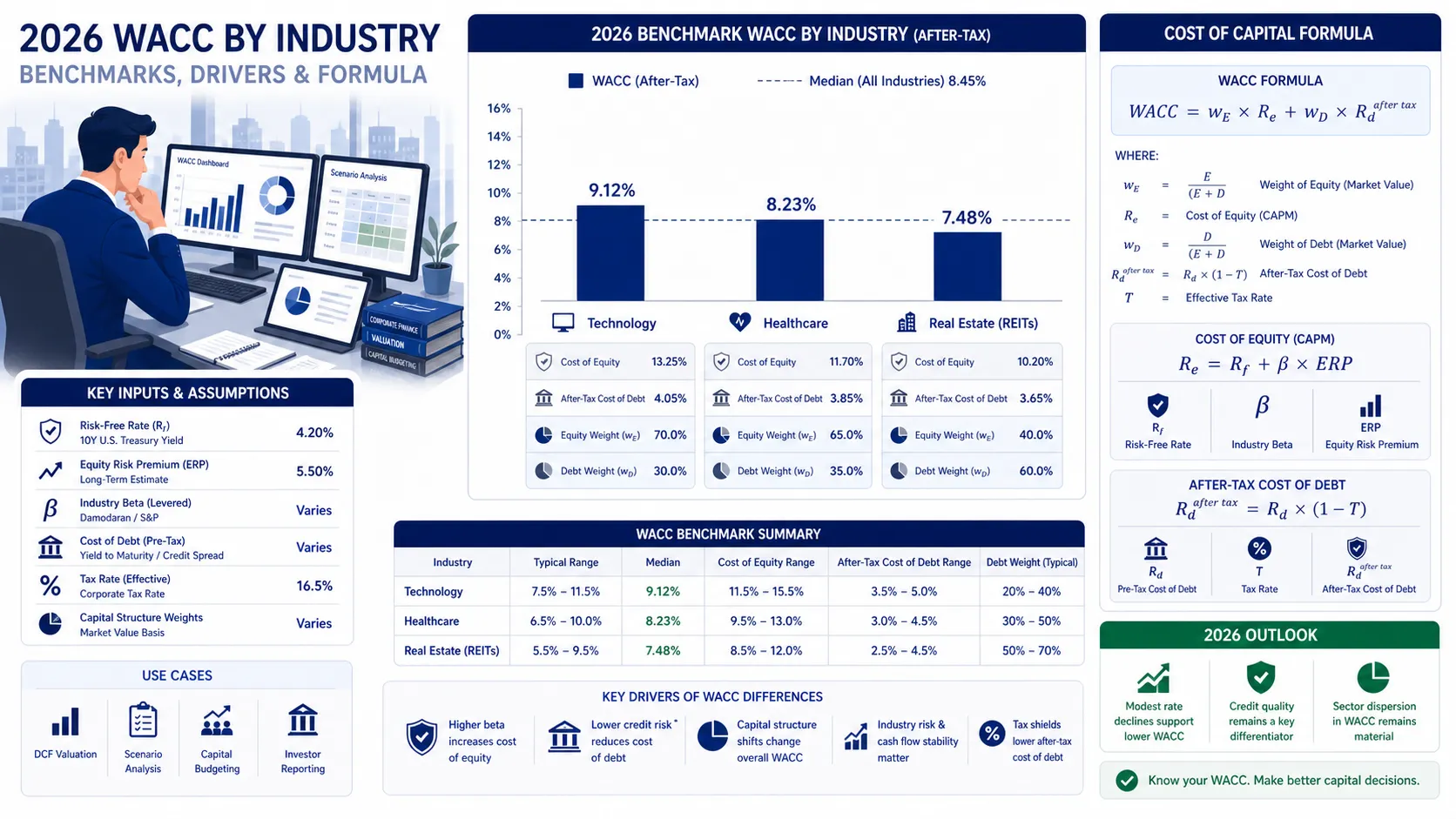
WACC by Industry: 2026 Benchmarks for Technology, Healthcare, and Real Estate
In 2026, industry WACC diverges sharply, from 5.5% for utilities to over 11.5% for software. CFOs must benchmark their discount rate against peers to ground valuations in market reality.
 Corporate Finance
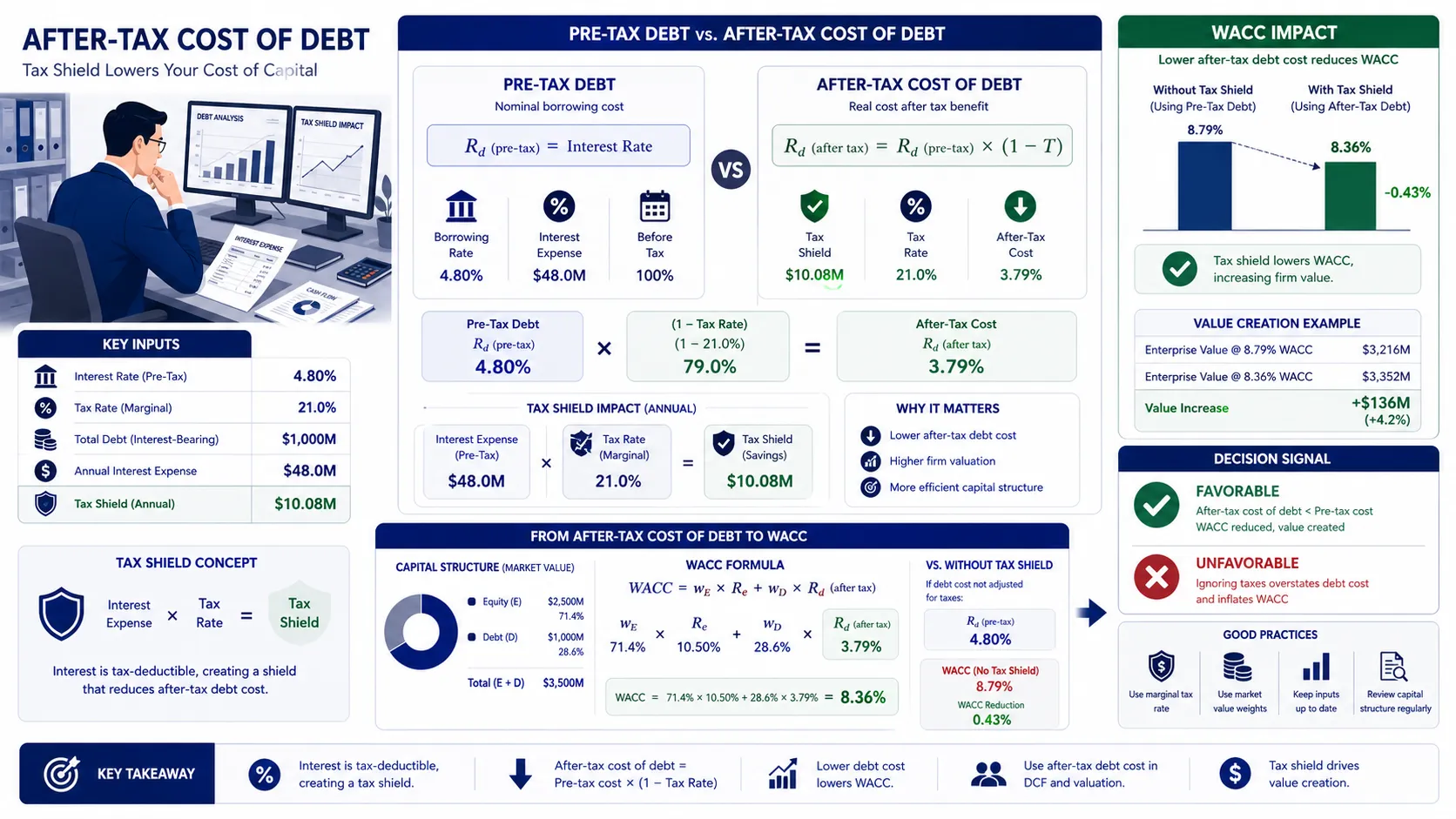
What Is After-Tax Cost of Debt and How Does It Lower WACC?
Interest payments are tax-deductible, making debt cheaper than equity and lowering your company's WACC. The after-tax cost of debt reveals this true, subsidized borrowing rate.
 Corporate Finance
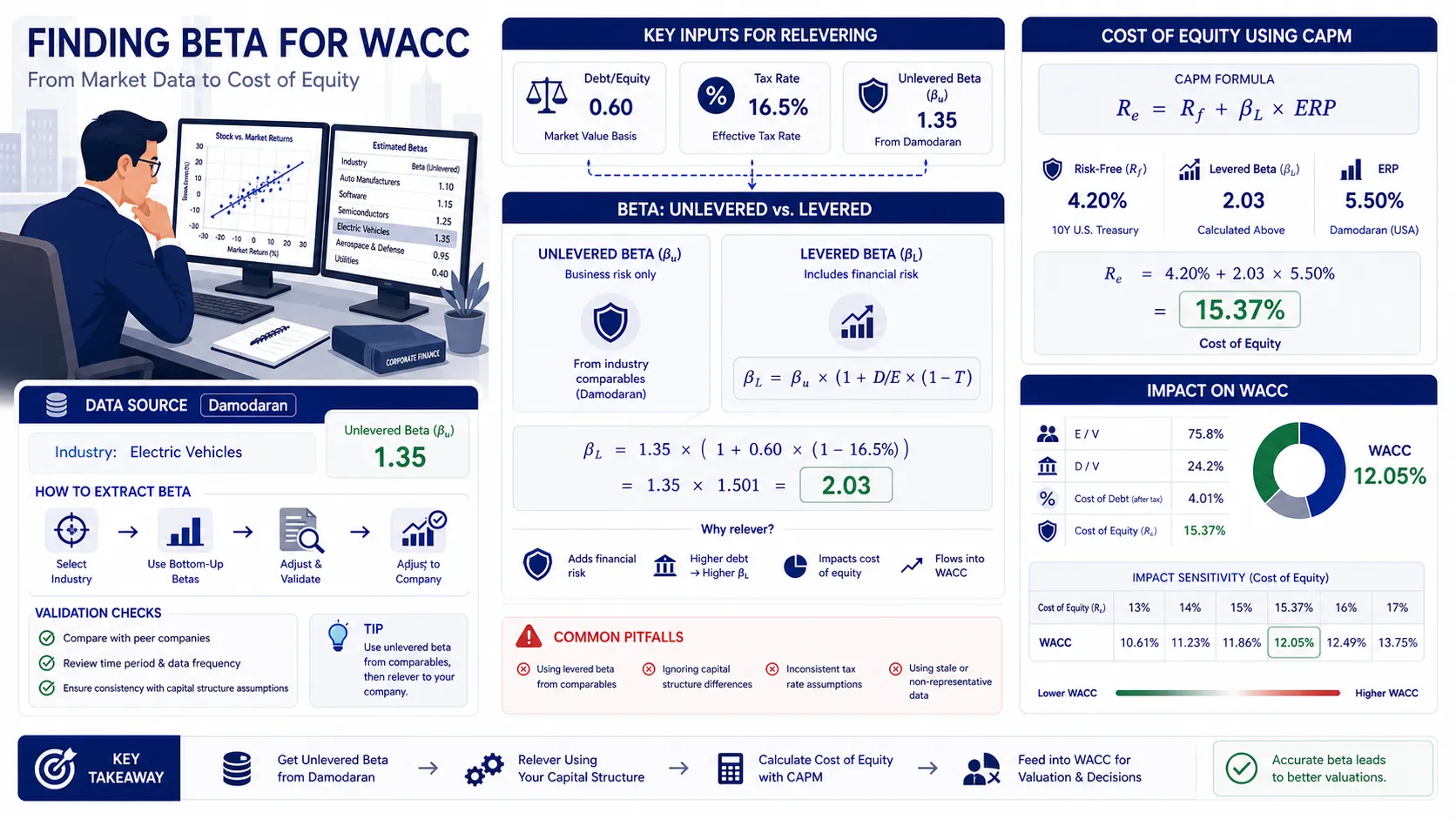
How to Find Beta for WACC: Unlevered vs Levered Beta Calculati
Unlock institutional-grade WACC by mastering bottom-up beta: unlever public peers to strip debt risk, then re-lever for your target's capital structure. This precision method solves CAPM's toughest hurdle, delivering accurate equity risk pricing for DCF models.
Frequently Asked Questions (FAQ)
What is the difference between cost of capital and WACC?↓
Why is the cost of equity higher than the cost of debt?↓
How does inflation affect a company's WACC?↓
Should short-term debt be included in the cost of capital?↓
The calculations, projections, and reports generated by BizToolkitPro are for educational and informational purposes only. They do not represent professional investment advice, financial planning, tax guidance, legal counsel, or formal business valuation.
Financial models and valuation formulas (including WACC, DCF, IRR, and NPV) rely on assumptions and inputs provided directly by the user. Actual financial markets and business metrics fluctuate; therefore, BizToolkitPro makes no warranties, express or implied, regarding the accuracy, completeness, or suitability of the outputs for any investment strategy or corporate decision.
Always perform your own independent diligence and consult with a licensed Financial Analyst, Certified Public Accountant (CPA), or certified valuation specialist before committing capital or executing corporate transactions.