
Comparable Company Valuation Calculator (Market Peer Multiples Model)
Use this focused Comparable Company Valuation Calculator, a corporate finance tool designed to perform Comparable Company Analysis (CCA), also known as trading multiples valuation. In the investment banking and corporate development sectors, multiples-based valuation is the most widely used technique for valuing a target company.
By leveraging market metrics such as Enterprise Value to Revenue (EV/Revenue) and Enterprise Value to EBITDA (EV/EBITDA) of comparable public or recently acquired companies, this online utility calculates implied enterprise values, bridges debt structures to show equity values, and generates a two-dimensional sensitivity grid. Whether you are an M&A analyst pricing an acquisition target, a business owner preparing for a capital sale, or a venture capital investor calibrating market pricing, this calculator provides a quick, data-backed assessment of your target's relative valuation.
Input target's recurring performance and net debt structures.
Specify average EV-based peer valuation multiples.
Have a suggestion or found a calculation discrepancy? Let us know!
How to use this comparable company valuation calculator
Configuring target financial inputs
To run a comparable company analysis, start by entering the trailing twelve months (LTM) financial metrics of the target company you want to value:
- LTM Revenue: Enter the total sales generated by the target over the last twelve months. This is the primary driver for high-growth or pre-profit businesses.
- LTM EBITDA: Input the earnings before interest, taxes, depreciation, and amortization. This represents the core operating profitability of the target.
- Target Net Debt: Input total interest-bearing debt minus cash and cash equivalents. If the target has more cash than debt, enter a negative number (Net Cash).
Choosing representative peer multiples
The accuracy of your valuation depends on selecting appropriate multiples from comparable industry peers:
Identify similar companies in terms of industry, size, growth rates, and margins. Find their Enterprise Value (EV) and calculate their multiples:
- Peer EV/Revenue Multiple: Calculated as peer Enterprise Value divided by peer revenue. Enter the average multiple of the peer group.
- Peer EV/EBITDA Multiple: Calculated as peer Enterprise Value divided by peer EBITDA. Typically ranges between 8x and 25x depending on growth.
Understanding Comparable Company Analysis (CCA) methodology
Multiples valuation equations
CCA derives enterprise value from peer ratios and then adjusts for debt structures:
Why multiples-based valuation works
Comparable Company Analysis operates on the principle of relative valuation: that similar assets should trade at similar price multiples. Multiples summarize complex financial statements into simple ratios, expressing how much investors are willing to pay per dollar of revenue or profit. Because multiples are derived from current market prices, they reflect real-time market sentiment and industry-specific macroeconomic trends, providing a realistic pricing context for deal negotiations.
The EV/Revenue multiple vs. the EV/EBITDA multiple
The EV/Revenue multiple measures a company's total valuation relative to its sales. It is particularly useful for early-stage tech companies or startups focused on market expansion rather than short-term profits. However, it does not account for operating cost efficiency. The EV/EBITDA multiple addresses this by measuring value relative to operating cash generation. EBITDA is widely used because it eliminates differences in capital structures, tax environments, and depreciation policies, making it a reliable ratio for comparing mature businesses.
Bridging Enterprise Value to Equity Value
Multiples yield Enterprise Value (EV), which represents the total value of the operating business (accessible by both debt and equity holders). To determine the value available to shareholders—the Equity Value—you must deduct net interest-bearing debt from the implied Enterprise Value. If a target has more cash than debt (Net Cash), the equity value will be higher than the enterprise value. Understanding this difference is crucial for structuring transactions, as acquisition bids are ultimately priced on equity value rather than enterprise value.
Worked example: Valuing a tech company using peer multiples
Target financials and peer multiples
Let's walk through an illustrative valuation scenario for an enterprise SaaS provider preparing for a Series B exit. The M&A team gathers the following parameters:
- Target LTM Revenue = $10,000,000
- Target LTM EBITDA = $2,500,000
- Target Net Debt = $2,000,000 (comprising $3M bank debt minus $1M cash)
- Average Peer EV/Revenue Multiple = 6.0x
- Average Peer EV/EBITDA Multiple = 20.0x
Step-by-step mathematical walkthrough
First, calculate the implied Enterprise Value using the Revenue Multiple:
Implied EV (Revenue) = $10,000,000 * 6.0 = $60,000,000
Next, calculate the implied Enterprise Value using the EBITDA Multiple:
Implied EV (EBITDA) = $2,500,000 * 20.0 = $50,000,000
Average the two implied Enterprise Values to determine the blended EV:
Blended Enterprise Value = ($60,000,000 + $50,000,000) / 2 = $55,000,000
Finally, subtract Net Debt to calculate the implied Equity Value available to shareholders:
Implied Equity Value = $55,000,000 - $2,000,000 = $53,000,000
This illustrative calculation shows how blending multiple methods helps smooth out outlier results (such as high revenue multiples that ignore profitability) to produce a defensible valuation range.
How to select the right peer group for valuation
Analyzing business models and revenue quality
Ensure your peer group shares a similar business model. For instance, comparing a software-as-a-service (SaaS) provider with high recurring revenue to a consulting agency with transactional billing will produce skewed multiples, as recurring revenue models command a significant premium in the market.
Aligning growth profiles and profit margins
Comparable peers should have similar growth rates and margins. A high-growth target expanding at 50% annually should not be valued using multiples from a mature peer growing at 5%. Look for peers with comparable growth profiles to ensure a realistic valuation range.
Adjusting for size and liquidity discounts
Public companies typically trade at a premium due to liquidity and regulatory standards. When valuing a smaller, private business, analysts often apply a size or marketability discount of 20% to 30% to public peer multiples to reflect transaction risks.
Limitations and mistakes of multiples valuation
The risk of importing market bubbles
Relative valuation measures value based on comparable assets. While this is helpful for pricing transactions, it means multiples-based valuations are vulnerable to market bubbles. If the entire peer group is overvalued due to market exuberance, your target valuation will also be inflated, creating significant downside risk.
To avoid these common mistakes, analysts typically combine comparable company analysis with intrinsic valuation models, such as Discounted Cash Flow (DCF) models, to establish a valuation floor.
Overlooking non-financial transaction drivers
Multiples only capture the quantitative aspect of a business. They do not account for critical qualitative factors:
- Proprietary IP and Defensibility: Patents, trade secrets, or exclusive licensing agreements can justify a premium multiple above the peer average.
- Customer Concentration Risk: If a company relies on a single client for 50% of its revenue, it should trade at a discount relative to peers with diversified customer bases.
- Strategic Synergies: A strategic acquirer may pay a premium for synergies that are not captured in historical multiples.
Real-world case study: Apple Inc. (AAPL, FY 2023 (ending Sep 30, 2023) & Recent Market Cap (June 2026))
Apple Inc. metrics profile
Apple Inc., a global technology leader, serves as an excellent case study for comparable company valuation due to its stable financial performance and significant market presence. This analysis uses its Fiscal Year 2023 financial results, which ended on September 30, 2023, combined with a recent market capitalization to derive key valuation multiples.
Apple's P/E ratio of 45.26x and P/S ratio of 11.45x reflect a premium valuation, indicative of its strong brand loyalty, robust ecosystem, consistent profitability, and significant market leadership within the technology sector. Investors are willing to pay a higher multiple for Apple's earnings and sales, anticipating continued innovation and growth, particularly in its high-margin services segment. These metrics are crucial for benchmarking against industry peers and assessing whether the company is over or undervalued relative to its growth prospects and risk profile. Such high multiples suggest investor confidence in Apple's long-term strategic execution and financial resilience.
Related Calculators
Estimate weighted average cost of capital.
Open Tool →DCF CalculatorValue a business using discounted cash flows.
Open Tool →NPV CalculatorCompute net present value of cash flows.
Open Tool →IRR CalculatorSolve project internal rates of return.
Open Tool →Free Cash Flow CalculatorEstimate operating free cash flow.
Open Tool →Break-Even ROI CalculatorAnalyze payback thresholds and returns.
Open Tool →Related Articles & Guides
 Corporate Finance
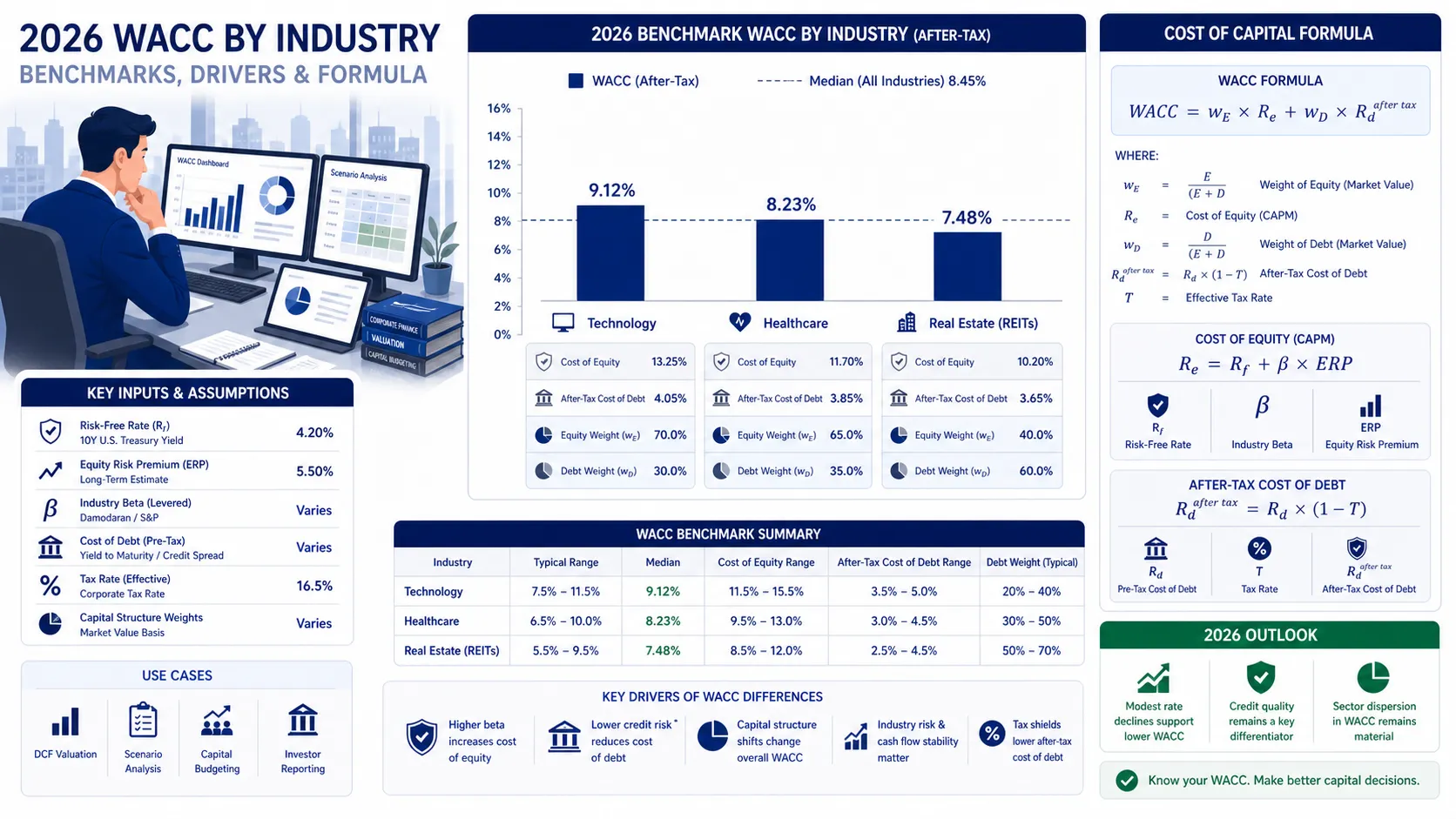
WACC by Industry: 2026 Benchmarks for Technology, Healthcare, and Real Estate
In 2026, industry WACC diverges sharply, from 5.5% for utilities to over 11.5% for software. CFOs must benchmark their discount rate against peers to ground valuations in market reality.
 Corporate Finance
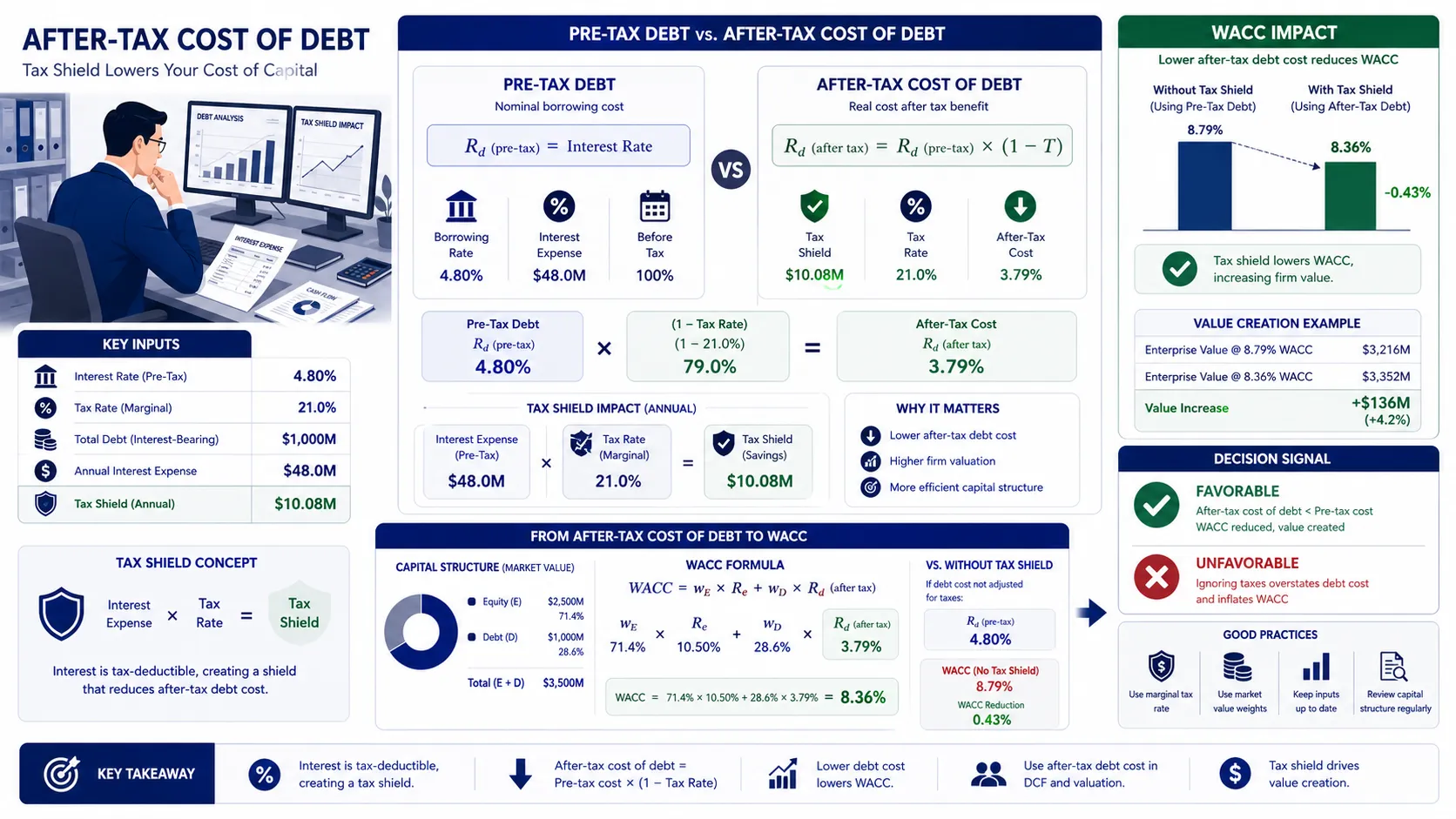
What Is After-Tax Cost of Debt and How Does It Lower WACC?
Interest payments are tax-deductible, making debt cheaper than equity and lowering your company's WACC. The after-tax cost of debt reveals this true, subsidized borrowing rate.
 Corporate Finance
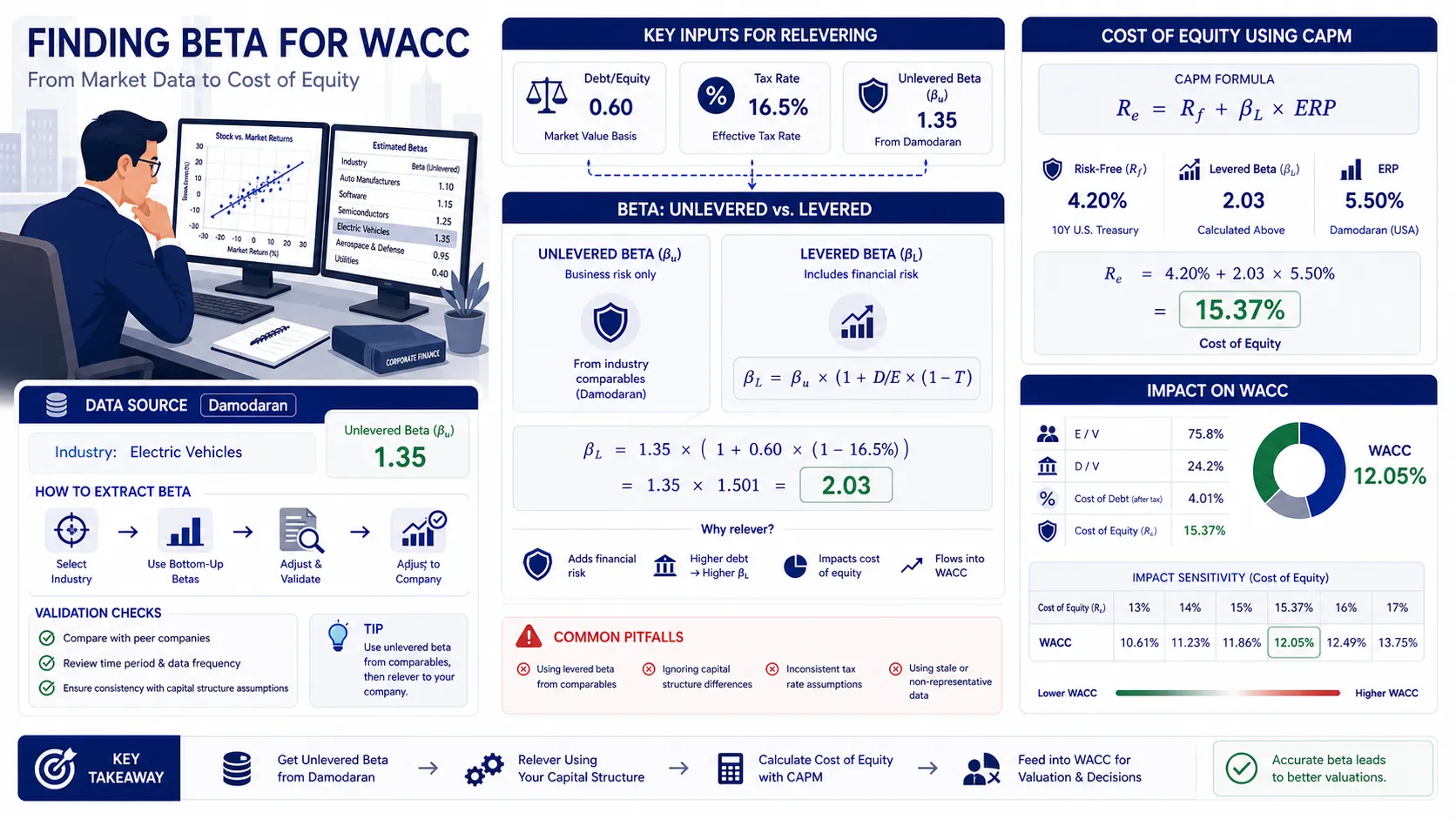
How to Find Beta for WACC: Unlevered vs Levered Beta Calculati
Unlock institutional-grade WACC by mastering bottom-up beta: unlever public peers to strip debt risk, then re-lever for your target's capital structure. This precision method solves CAPM's toughest hurdle, delivering accurate equity risk pricing for DCF models.
Frequently Asked Questions (FAQ)
What is LTM in financial multiples analysis?
Why do we subtract Net Debt from Enterprise Value to get Equity Value?
How do multiples differ between private and public companies?
What is a good EV/EBITDA multiple for valuation?
Can I export this valuation analysis for deal bidding?
The calculations, projections, and reports generated by BizToolkitPro are for educational and informational purposes only. They do not represent professional investment advice, financial planning, tax guidance, legal counsel, or formal business valuation.
Financial models and valuation formulas (including WACC, DCF, IRR, and NPV) rely on assumptions and inputs provided directly by the user. Actual financial markets and business metrics fluctuate; therefore, BizToolkitPro makes no warranties, express or implied, regarding the accuracy, completeness, or suitability of the outputs for any investment strategy or corporate decision.
Always perform your own independent diligence and consult with a licensed Financial Analyst, Certified Public Accountant (CPA), or certified valuation specialist before committing capital or executing corporate transactions.