
Acquisition Premium Calculator for Mergers & Acquisitions (M&A)
Use this focused Acquisition Premium Calculator, a dedicated investment banking tool designed to model M&A transaction pricing, individual stock premium margins, and cumulative cash premiums paid. During corporate acquisitions, buying entities rarely purchase a target at its current market trading value.
To secure board approval and shareholder consent, acquirers pay a price premium above the target company's unaffected share price. This online tool calculates key M&A pricing parameters, including the dollar premium per share, the transaction percentage premium, the unaffected market value, and the total transaction value. Additionally, M&A analysts can leverage the integrated 2D sensitivity matrix to stress-test different bidding ranges against target stock fluctuations, generating compliant documentation for strategic valuation reviews.
Adjust share price parameters and outstanding stocks.
Have a suggestion or found a calculation discrepancy? Let us know!
How to use this acquisition premium calculator
Entering unaffected stock base prices
To begin modeling your transaction premium, collect the initial baseline market capitalization details of the target firm before corporate disclosures affect trading:
- Unaffected Target Share Price: Enter the closing share price of the target prior to M&A rumors or formal public announcements. This represents the true market valuation.
- Shares Outstanding: Input the total number of common shares issued by the target company. Do not include unvested options unless calculating on a fully-diluted basis.
Selecting premium offer ranges
Adjust your acquisition bid terms to evaluate premium margins and transactional cash requirements:
Input your proposed Proposed Offer Share Price. The tool immediately computes the spread per share and the percentage premium. Review the resulting Capitalization comparison chart to visualize how much of the purchase price is composed of the target's unaffected value versus the premium cash paid to secure the transaction.
Understanding Acquisition Premiums in Mergers & Acquisitions (M&A) methodology
M&A premium equations
Acquisition premiums represent the pricing spread paid to gain voting control of a target corporate entity:
Why acquirers pay a premium
In public markets, a stock price represents the value of a minority share (a single unit without control). To acquire 100% of a company or a controlling majority, the buyer must pay a premium to incentivize existing shareholders to sell their voting stock. This "control premium" compensates target shareholders for giving up future dividends and capital gains, while reflecting the strategic value the acquirer expects to unlock through the transaction.
Calculating the percentage and total dollar premium
The acquisition premium is expressed both as a dollar amount per share and as a percentage over the target's unaffected trading price. The unaffected trading price is typically measured 30 to 90 days before the transaction announcement to ensure that M&A leaks or speculative trading volume do not distort the baseline valuation. The total cash premium paid represents the incremental capital the buyer must raise or spend beyond the target's standalone market value.
Hostile vs. friendly takeovers premium trends
The premium level varies based on transaction dynamics. Friendly takeovers, where the target's board supports the merger, typically feature premiums between 20% and 40%. Hostile takeovers, where the acquirer bypasses the board and goes directly to shareholders, often require significantly higher premiums (often exceeding 50%) to overcome board opposition and trigger shareholder action.
Worked example: M&A acquisition premium calculation
Illustrative transaction inputs
Let's walk through an illustrative scenario for an enterprise security provider acquiring a niche software company. The corporate development team collects the following inputs:
- Unaffected Share Price = $40.00
- Proposed Offer Share Price = $54.00
- Target Shares Outstanding = 5,000,000 shares
Step-by-step mathematical walkthrough
First, calculate the premium per share:
Premium per Share = $54.00 - $40.00 = $14.00
Next, calculate the acquisition premium percentage:
Acquisition Premium % = ($14.00 / $40.00) * 100 = 35.00%
Calculate the target's unaffected market value:
Total Unaffected Value = $40.00 * 5,000,000 = $200,000,000
Calculate the total transaction value:
Total Transaction Value = $54.00 * 5,000,000 = $270,000,000
Subtract the unaffected value from the transaction value to find the total premium cash paid:
Total Premium Paid = $270,000,000 - $200,000,000 = $70,000,000
This illustrative scenario shows that the acquirer pays a 35% premium, resulting in an additional $70 million cash payout to target shareholders to gain control of the business.
Key factors driving acquisition premium levels
Anticipated synergy value
Buyers justify transaction premiums based on expected synergies—the value generated by combining the businesses (e.g., cross-selling, duplicate staff reductions, or shared technology). If expected synergies are high, the buyer will pay a higher premium to close the deal.
Competitive bidding environments
If a target company attracts multiple bidders, the transaction can turn into a bidding war. In these competitive environments, premium percentages often rise as buyers increase their offers to outbid competitors, occasionally leading to overvaluation.
Target ownership concentration
If a target has a concentrated shareholder base (e.g., a few institutional funds holding the majority of stock), the buyer can negotiate directly with a small group of decision-makers, which can lead to a lower, more controlled premium. A highly fragmented shareholder base, by contrast, requires a higher premium to incentivize broad participation.
Risks and mistakes of paying overly high acquisition premiums
The winner's curse in corporate M&A
In M&A, the "winner's curse" occurs when the successful bidder overpays for the target. If the premium exceeds the actual value of the synergies achieved, the transaction will destroy value for the acquirer's shareholders, often leading to post-merger stock declines and asset write-downs.
To avoid these winner's curse mistakes, corporate development teams must establish strict walk-away prices and stress-test synergy assumptions under conservative scenarios.
Goodwill write-downs and financial integration risks
Paying a high premium creates significant goodwill on the acquirer's balance sheet. Under accounting standards (such as US GAAP or IFRS), if the acquired unit fails to meet performance targets, the goodwill must be written down. Keep these factors in mind during deal structuring:
- Impairment Risk: High premiums increase the risk of massive goodwill impairment charges in subsequent fiscal years.
- Integration delays: Overestimating integration speed can delay synergy capture, making the premium harder to justify.
- Cultural misalignment: Cultural clashes between teams can disrupt operations, reducing transaction value.
Real-world case study: VMware, Inc. (Acquired by Broadcom) (VMW, FY 2023)
VMware, Inc. (Acquired by Broadcom) metrics profile
Broadcom's acquisition of VMware was a significant technology deal completed in November 2023, marking Broadcom's strategic expansion into enterprise software. The transaction involved a substantial premium paid for VMware's established virtualization and cloud computing business.
Broadcom's payment of a 44% premium to acquire VMware highlights the strategic value placed on VMware's leading position in enterprise virtualization and cloud software. This significant premium, based on the per-share consideration of $138.23 representing a 44% premium to VMware's stock price on May 20, 2022, demonstrates Broadcom's aggressive move to diversify into high-margin infrastructure software, aiming for immediate accretion and substantial EBITDA growth. For investors, this indicates that acquiring established, mission-critical technology platforms can command substantial valuations, driven by the acquirer's long-term strategic goals and anticipated synergies in a consolidating technology landscape.
Related Calculators
Estimate weighted average cost of capital.
Open Tool →DCF CalculatorValue a business using discounted cash flows.
Open Tool →NPV CalculatorCompute net present value of cash flows.
Open Tool →IRR CalculatorSolve project internal rates of return.
Open Tool →Free Cash Flow CalculatorEstimate operating free cash flow.
Open Tool →Break-Even ROI CalculatorAnalyze payback thresholds and returns.
Open Tool →Related Articles & Guides
 Corporate Finance
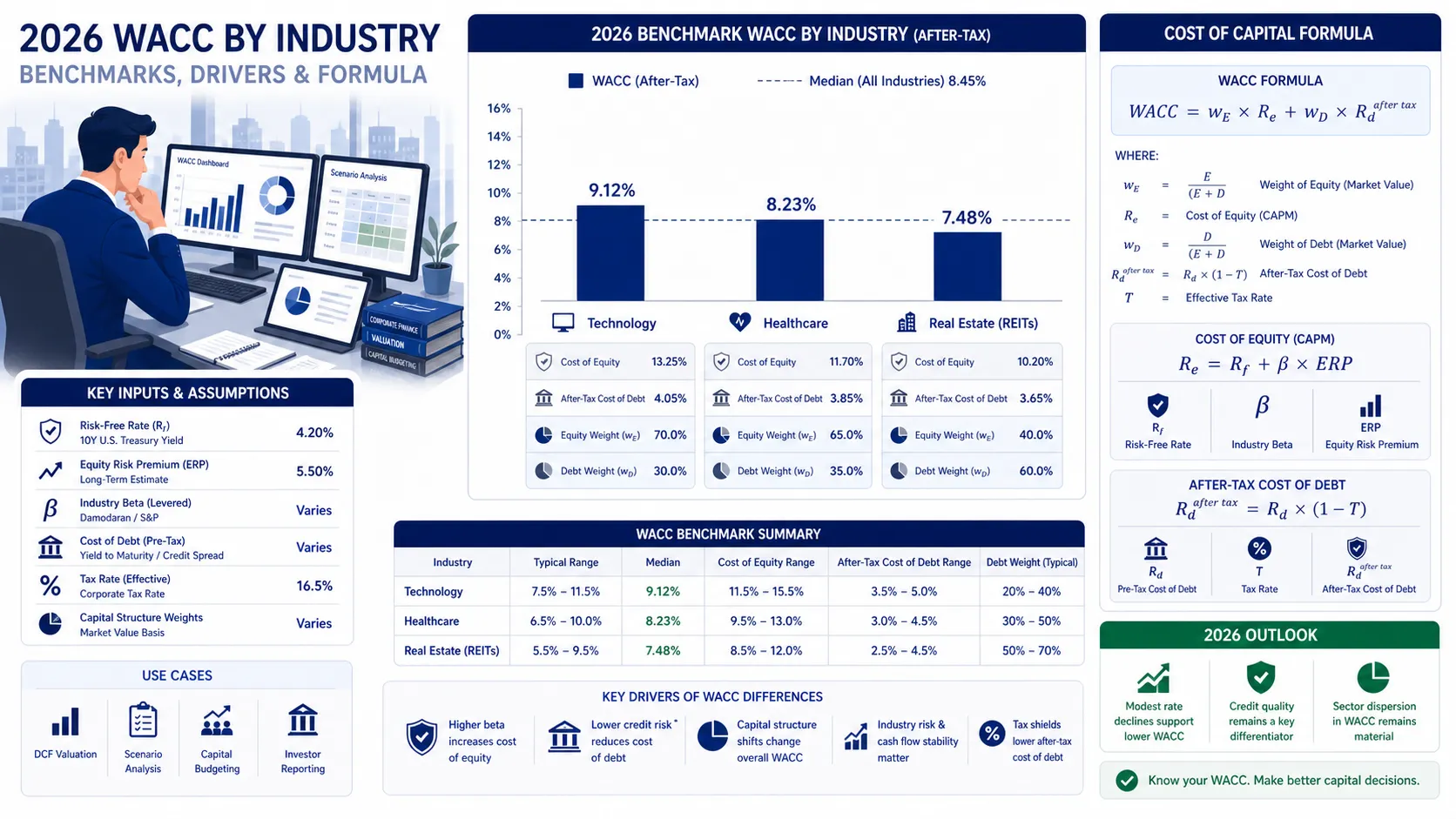
WACC by Industry: 2026 Benchmarks for Technology, Healthcare, and Real Estate
In 2026, industry WACC diverges sharply, from 5.5% for utilities to over 11.5% for software. CFOs must benchmark their discount rate against peers to ground valuations in market reality.
 Corporate Finance
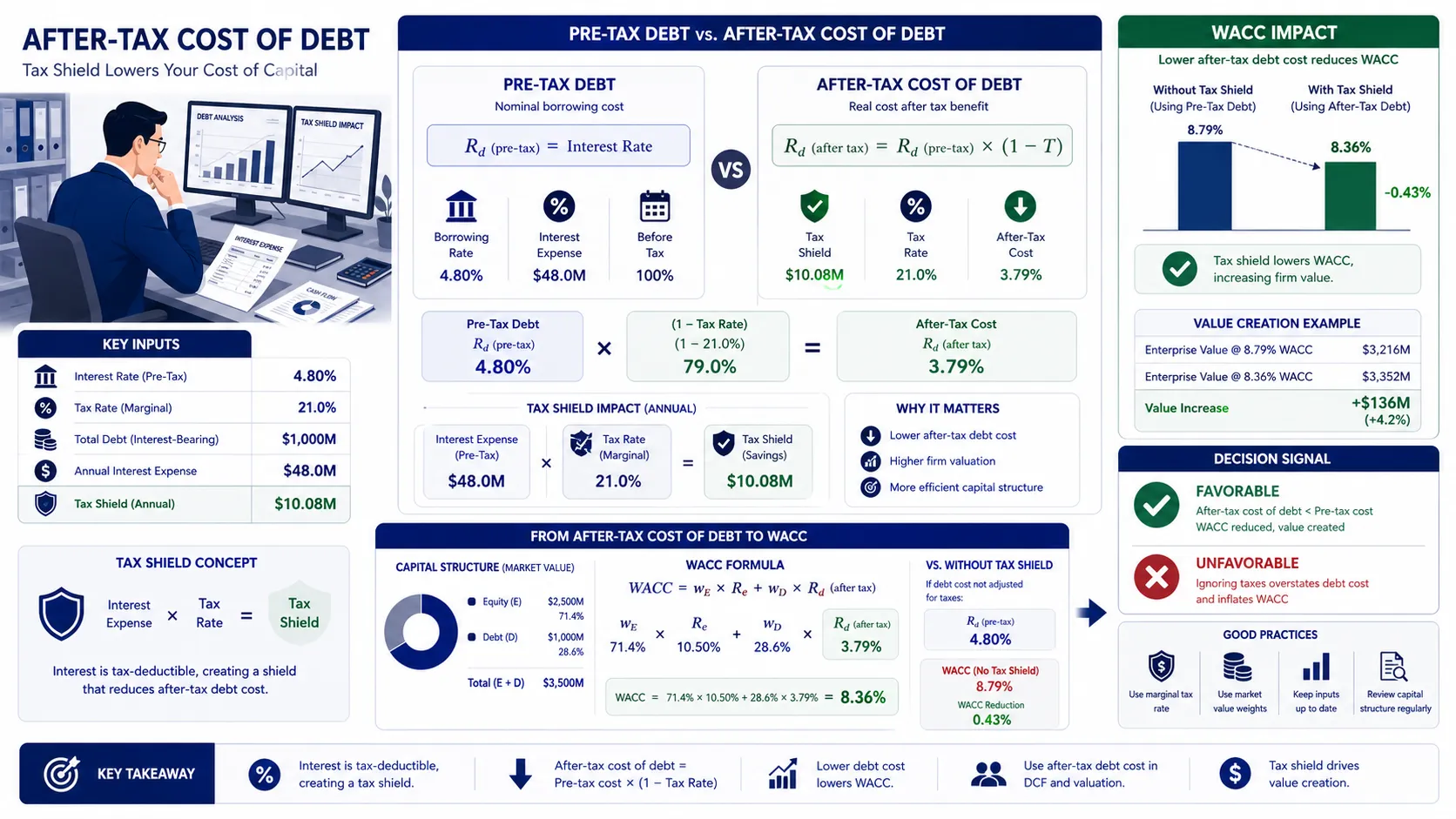
What Is After-Tax Cost of Debt and How Does It Lower WACC?
Interest payments are tax-deductible, making debt cheaper than equity and lowering your company's WACC. The after-tax cost of debt reveals this true, subsidized borrowing rate.
 Corporate Finance
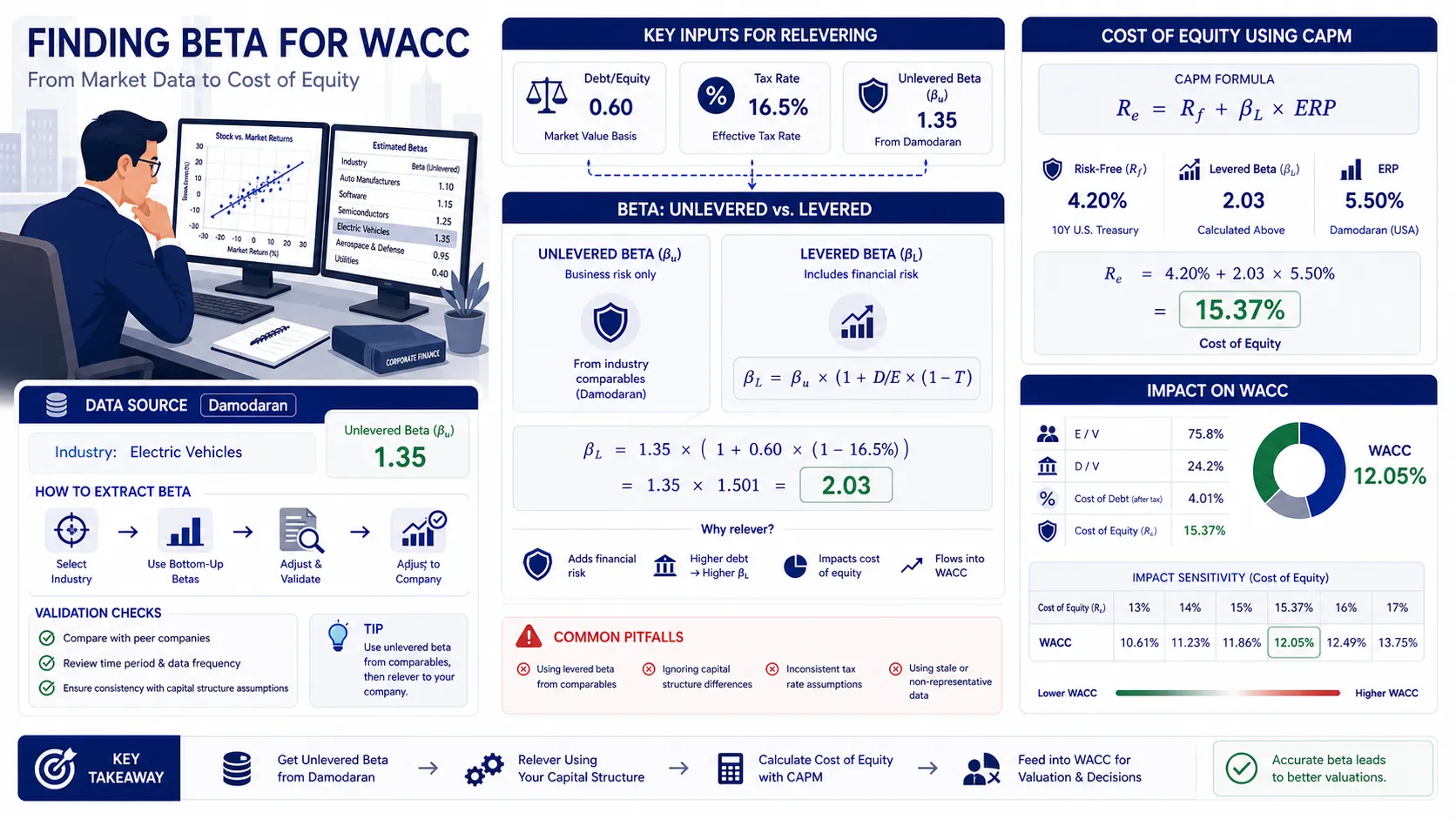
How to Find Beta for WACC: Unlevered vs Levered Beta Calculati
Unlock institutional-grade WACC by mastering bottom-up beta: unlever public peers to strip debt risk, then re-lever for your target's capital structure. This precision method solves CAPM's toughest hurdle, delivering accurate equity risk pricing for DCF models.
Frequently Asked Questions (FAQ)
What is an unaffected share price?
What is a typical acquisition premium percentage?
Why do shareholders sometimes reject high premium offers?
How do synergies justify paying acquisition premiums?
Can M&A premium metrics be exported for boardroom decks?
The calculations, projections, and reports generated by BizToolkitPro are for educational and informational purposes only. They do not represent professional investment advice, financial planning, tax guidance, legal counsel, or formal business valuation.
Financial models and valuation formulas (including WACC, DCF, IRR, and NPV) rely on assumptions and inputs provided directly by the user. Actual financial markets and business metrics fluctuate; therefore, BizToolkitPro makes no warranties, express or implied, regarding the accuracy, completeness, or suitability of the outputs for any investment strategy or corporate decision.
Always perform your own independent diligence and consult with a licensed Financial Analyst, Certified Public Accountant (CPA), or certified valuation specialist before committing capital or executing corporate transactions.