
EBITDA Margin Calculator - Professional Financial Underwriting
Use this focused ebitda margin calculator, a finance analysis tool designed to evaluate EBITDA margin ratios by adding back D&A expenses. EBITDA margin is the standard benchmark in leveraged buyouts, corporate acquisitions, and valuation multiples analysis.
By adding back non-cash depreciation and amortization (D&A) alongside interest and taxes, EBITDA margin evaluates core cash earning capability, ensuring capital-intensive firms are comparable regardless of funding structure.
Have a suggestion or found a calculation discrepancy? Let us know!
Understanding this metric in corporate finance decisions
Ebitda Margin decision context
Underwriting corporate transactions requires establishing clear boundaries for operational and capital return yields. Financial managers use this analytical module to size projections, ensure adequate liquidity, and manage debt compliance. For Ebitda Margin Calculator, apply this guidance to cash flow, margin, growth, debt, and return assumptions, then compare the result against finance-ready ratios, dollar impacts, and decision thresholds.
Without a ebitda margin framework, assessing multiple investment paths is subject to planning bias, raising default risks.
Ebitda Margin planning relevance
Capital budgeting centers on allocating available budget and operating resources to projects yielding returns that exceed hurdle rates. Blending top-line growth with margin analysis allows finance teams to track overall cash conversion efficiency. For Ebitda Margin Calculator, apply this guidance to cash flow, margin, growth, debt, and return assumptions, then compare the result against finance-ready ratios, dollar impacts, and decision thresholds.
This process forms the basis for long-term strategic plans and equity valuation profiles. For Ebitda Margin Calculator, apply this guidance to cash flow, margin, growth, debt, and return assumptions, then compare the result against finance-ready ratios, dollar impacts, and decision thresholds.
Ebitda Margin risk and financing context
Operational metrics are deeply affected by how capital is funded. Whether utilizing bank debt or issuing stock, understanding pre-financing cash flows versus post-financing equity returns protects project solvency. For Ebitda Margin Calculator, apply this guidance to cash flow, margin, growth, debt, and return assumptions, then compare the result against finance-ready ratios, dollar impacts, and decision thresholds.
How to use this financial calculator
Prepare Ebitda Margin inputs
Start by populating the primary variables in the inputs panel on the left. The calculator processes financial parameters, interest levels, or sales volumes. Double-check all compounding frequencies or timing settings to match your underlying contract documents. For Ebitda Margin Calculator, apply this guidance to cash flow, margin, growth, debt, and return assumptions, then compare the result against finance-ready ratios, dollar impacts, and decision thresholds.
Review Ebitda Margin outputs
Submit variables to update charts and grids in the output dashboard. Key metrics are highlighted at the top, showing solved ratios or periods, alongside sensitivity matrices. For Ebitda Margin Calculator, apply this guidance to cash flow, margin, growth, debt, and return assumptions, then compare the result against finance-ready ratios, dollar impacts, and decision thresholds.
Compare Ebitda Margin scenarios
Toggle base, bull, and bear scenarios to compare outcomes side-by-side, or use the sensitivity tab to identify boundary thresholds. Recommending saving calculation outputs to your dashboard for internal archiving. For Ebitda Margin Calculator, apply this guidance to cash flow, margin, growth, debt, and return assumptions, then compare the result against finance-ready ratios, dollar impacts, and decision thresholds.
Scenario planning for Ebitda Margin
Ebitda Margin baseline scenario
The baseline projection reflects normalized operational assumptions and moderate growth paths, providing a steady-state return profile for standard corporate reviews. For Ebitda Margin Calculator, apply this guidance to cash flow, margin, growth, debt, and return assumptions, then compare the result against finance-ready ratios, dollar impacts, and decision thresholds.
Ebitda Margin upside scenario
The optimistic projection models accelerated demand, higher pricing power, or compressed cost of goods sold, showing upside return velocities. For Ebitda Margin Calculator, apply this guidance to cash flow, margin, growth, debt, and return assumptions, then compare the result against finance-ready ratios, dollar impacts, and decision thresholds.
Ebitda Margin downside scenario
The conservative projection models market contractions, higher financing costs, or compressed margins, stress-testing downside cash thresholds. For Ebitda Margin Calculator, apply this guidance to cash flow, margin, growth, debt, and return assumptions, then compare the result against finance-ready ratios, dollar impacts, and decision thresholds.
Finance sensitivity analysis and decision thresholds
Parameter variance tracking
The sensitivity grid varies inputs simultaneously to show how shifts affect the target output, vital for evaluating volatility limits. For Ebitda Margin Calculator, apply this guidance to cash flow, margin, growth, debt, and return assumptions, then compare the result against finance-ready ratios, dollar impacts, and decision thresholds.
Identifying key threshold metrics
Observing cell transitions helps pinpoint the boundaries where the asset return rate drops below your corporate hurdle cost base. For Ebitda Margin Calculator, apply this guidance to cash flow, margin, growth, debt, and return assumptions, then compare the result against finance-ready ratios, dollar impacts, and decision thresholds.
Assessing business model stability
If a small variable change triggers a massive return drop, the venture carries high systematic risk, requiring additional equity buffers. For Ebitda Margin Calculator, apply this guidance to cash flow, margin, growth, debt, and return assumptions, then compare the result against finance-ready ratios, dollar impacts, and decision thresholds.
Financial formula and analysis methodology
Methodology
Underwriters calculate EBITDA by reconciling net income upward. In private equity underwriting, adjustments are made to generate 'Adjusted EBITDA', normalizing executive salaries, personal expenses, or non-recurring transaction costs to establish steady-state cash generation. The primary mathematical formula is expressed as:
Analytical derivation and logic
Solving this formula requires normalizing cash parameters over congruent periods. For compound returns, timing factors (such as intra-period cash flows) must be adjusted to match contract dates. Underwriters use this logic to compare disparate opportunities on a normalized ebitda margin benchmark.
Step-by-step example calculation
Underwriting assumptions
A business generates total revenues of $1,500,000. It reports a net income of $150,000, statutory taxes of $40,000, interest expenses of $30,000, and non-cash depreciation and amortization expenses of $80,000.
Solving the financial formula
The mathematical steps to resolve the outputs are:
- Add back Depreciation & Amortization: $220,000 + $80,000 = $300,000 (EBITDA).
- Divide EBITDA by total revenue: $300,000 / $1,500,000 = 0.2000.
- Convert to percentage velocity: 0.2000 * 100 = 20.00% EBITDA margin.
Common mistakes in financial analysis
Misinterpreting cash timings and structures
A frequent mistake is using linear interest instead of compounded interest over multi-year holding horizons, understating capital opportunity costs. For Ebitda Margin Calculator, apply this guidance to cash flow, margin, growth, debt, and return assumptions, then compare the result against finance-ready ratios, dollar impacts, and decision thresholds.
EBITDA margin does not reflect cash outflows for equipment replacements (CapEx) or debt principal payments. For businesses with aging equipment pools, EBITDA margin can mask high cash drain and distress risks.
Neglecting operational cost adjustments
Underwriters often project top-line revenues without factoring in working capital shifts or depreciation reserves, resulting in unrealistic returns. For Ebitda Margin Calculator, apply this guidance to cash flow, margin, growth, debt, and return assumptions, then compare the result against finance-ready ratios, dollar impacts, and decision thresholds.
Real-world case study: Apple Inc. (AAPL, FY 2023)
Apple Inc. metrics profile
Apple Inc., a global technology leader, reported its fiscal year 2023 results, showcasing robust financial performance. This analysis focuses on key financial metrics to determine the company's EBITDA margin, providing insight into its operational efficiency before accounting for non-operating expenses. Apple's diverse product and services ecosystem continues to drive substantial revenue streams.
Apple's EBITDA margin of 32.39% for FY 2023 highlights the company's strong core operational profitability, demonstrating its ability to generate significant earnings from its primary business activities before the impact of interest, taxes, depreciation, and amortization. This high margin suggests efficient cost management in its production and sales processes, as well as robust demand for its premium products and growing services. For investors, a healthy EBITDA margin like Apple's indicates a financially sound company with strong cash-generating capabilities, which can support ongoing investments in innovation, shareholder returns, and strategic growth initiatives.
Related Calculators
Estimate weighted average cost of capital.
Open Tool →DCF CalculatorValue a business using discounted cash flows.
Open Tool →NPV CalculatorCompute net present value of cash flows.
Open Tool →IRR CalculatorSolve project internal rates of return.
Open Tool →Free Cash Flow CalculatorEstimate operating free cash flow.
Open Tool →Break-Even ROI CalculatorAnalyze payback thresholds and returns.
Open Tool →Related Articles & Guides
 Corporate Finance
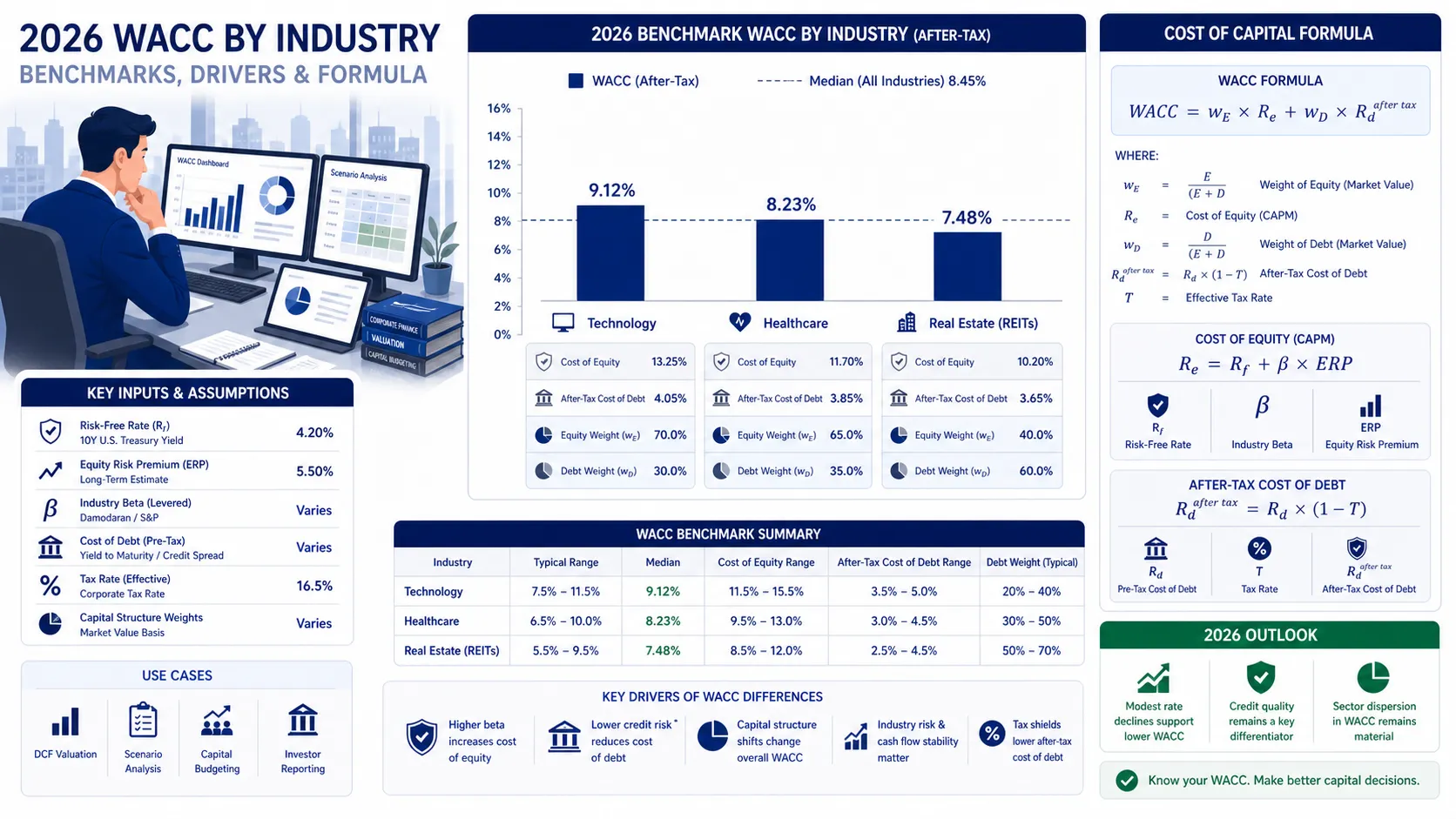
WACC by Industry: 2026 Benchmarks for Technology, Healthcare, and Real Estate
In 2026, industry WACC diverges sharply, from 5.5% for utilities to over 11.5% for software. CFOs must benchmark their discount rate against peers to ground valuations in market reality.
 Corporate Finance
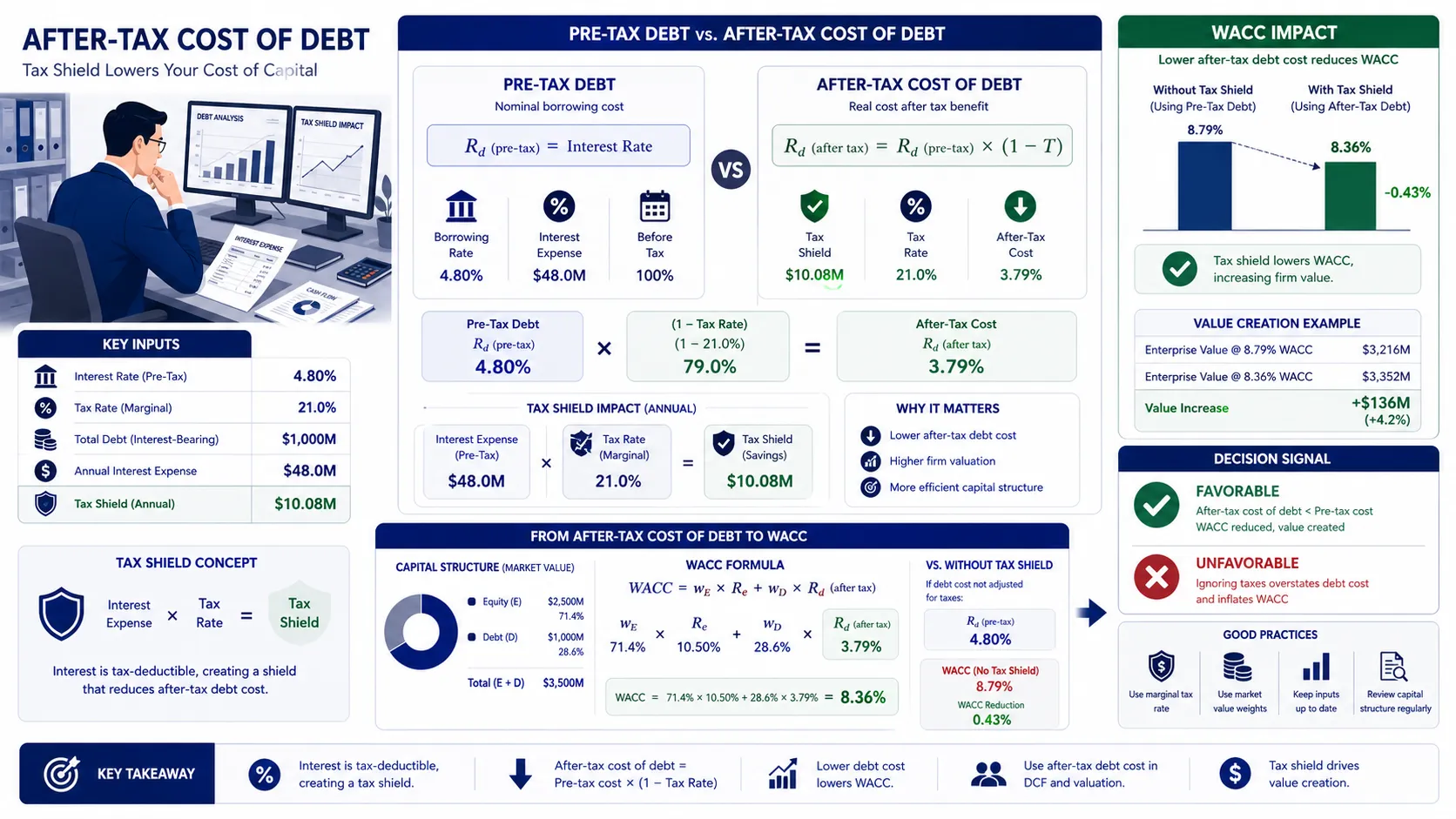
What Is After-Tax Cost of Debt and How Does It Lower WACC?
Interest payments are tax-deductible, making debt cheaper than equity and lowering your company's WACC. The after-tax cost of debt reveals this true, subsidized borrowing rate.
 Corporate Finance
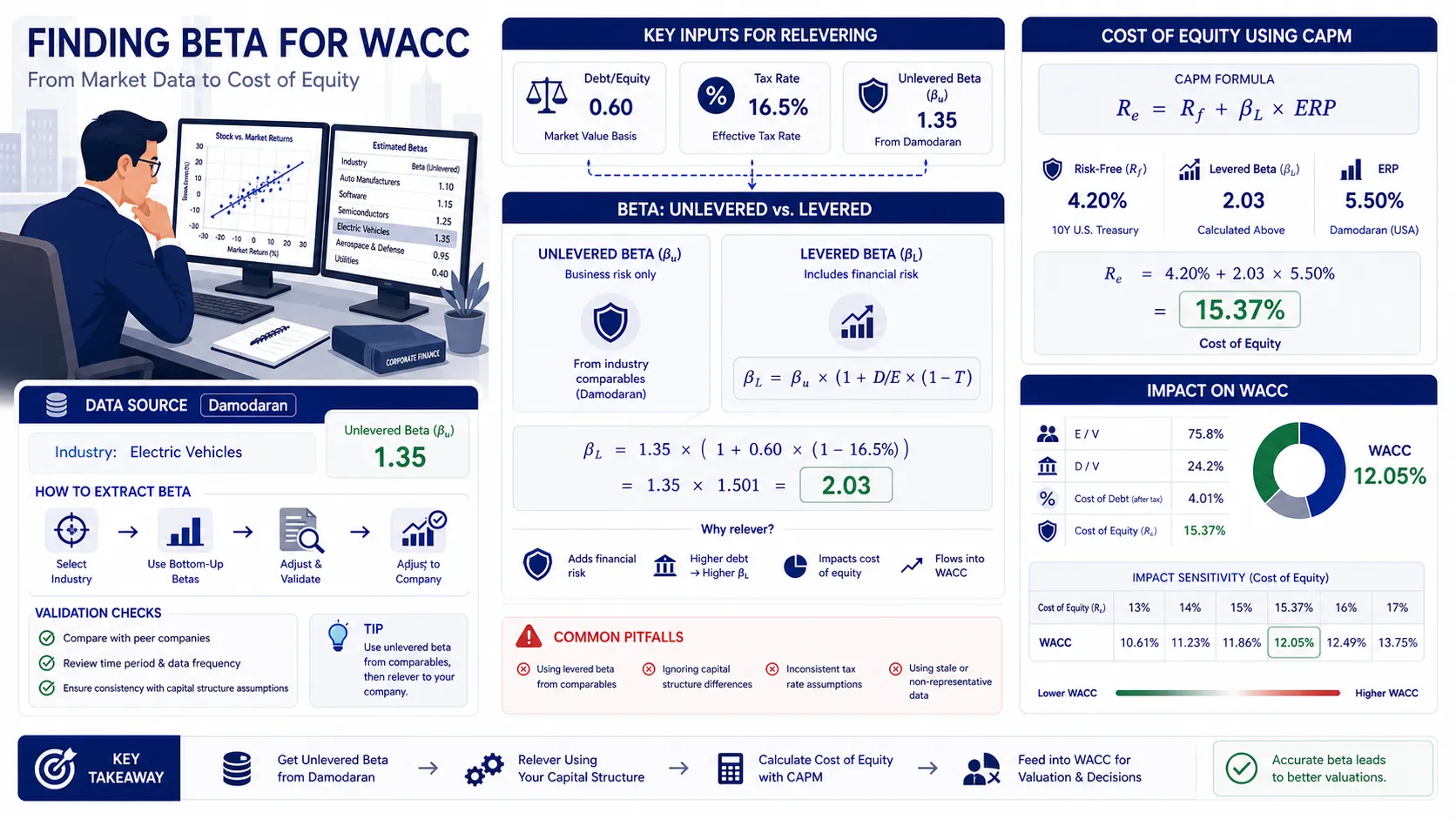
How to Find Beta for WACC: Unlevered vs Levered Beta Calculati
Unlock institutional-grade WACC by mastering bottom-up beta: unlever public peers to strip debt risk, then re-lever for your target's capital structure. This precision method solves CAPM's toughest hurdle, delivering accurate equity risk pricing for DCF models.
Frequently Asked Questions
Why is EBITDA widely used in mergers and acquisitions (M&A)?
How is EBITDA reconciled from Net Income?
What is a major criticism of EBITDA margin?
How does EBITDA margin compare to Operating Margin?
The calculations, projections, and reports generated by BizToolkitPro are for educational and informational purposes only. They do not represent professional investment advice, financial planning, tax guidance, legal counsel, or formal business valuation.
Financial models and valuation formulas (including WACC, DCF, IRR, and NPV) rely on assumptions and inputs provided directly by the user. Actual financial markets and business metrics fluctuate; therefore, BizToolkitPro makes no warranties, express or implied, regarding the accuracy, completeness, or suitability of the outputs for any investment strategy or corporate decision.
Always perform your own independent diligence and consult with a licensed Financial Analyst, Certified Public Accountant (CPA), or certified valuation specialist before committing capital or executing corporate transactions.