
Cash Conversion Cycle (CCC) Calculator for Working Capital Efficiency
Audit operational working capital efficiency using the professional Cash Conversion Cycle calculator.
Solve for DIO, DSO, and DPO metrics, model payment optimization scenarios, and test inventory turnover resilience.
Have a suggestion or found a calculation discrepancy? Let us know!
How to use this cash conversion cycle calculator
Inputs you need before calculating the cash cycle
To run a precise Cash Conversion Cycle (CCC) diagnostic, collect these metrics from your company's income statement and balance sheet:
- •Annual Revenue: Total sales for the 12-month period, used to compute Days Sales Outstanding.
- •Cost of Goods Sold (COGS): Total manufacturing or procurement costs, used to calculate DIO and DPO.
- •Average Inventory: The average value of raw materials, work-in-progress, and finished goods held during the period.
- •Average Accounts Receivable: Average customer balance outstanding awaiting payment.
- •Average Accounts Payable: Average credit balance outstanding owed to suppliers.
Interpreting the operations dashboard and sub-metrics
The calculator evaluates operational velocity across three dimensions of working capital:
- The CCC Safety Gauge: Maps your total cycle duration in days, identifying whether your business has Optimal, Moderate, or Extended capital lockups.
- Days Inventory Outstanding (DIO): Measures the average number of days inventory sits in warehouses before being sold.
- Days Sales Outstanding (DSO): Measures the average time it takes to collect cash from customers after credit sales.
- Days Payable Outstanding (DPO): Solves for the average duration the company takes to pay its suppliers. A higher DPO improves the cash cycle by delaying payments.
Cash conversion cycle formula and methodology
Formula Framework
The Cash Conversion Cycle (CCC) solves for the net number of days capital is tied up in operations. It is mathematically formulated as:
Where the three operational sub-metrics are calculated as:
Working capital cycle dynamics and operational velocity
In corporate operations, cash is the lifeblood of survival. The Cash Conversion Cycle measures the time lag between purchasing raw materials and receiving cash from sales.
A shorter CCC indicates highly efficient working capital management. Companies that minimize inventory hold times (low DIO) and collect customer receivables quickly (low DSO) require less working capital. When combined with delayed supplier payments (high DPO), a business can achieve a negative Cash Conversion Cycle.
A negative CCC represents a significant operational advantage: suppliers are effectively financing the business's operations interest-free. Conversely, an extended CCC indicates that cash is locked in warehouses and unpaid customer invoices, requiring external debt or equity to fund day-to-day operations.
Cash conversion cycle example calculation
E-commerce Solvency Case Study
Let us analyze the operational metrics of an e-commerce retail company with the following annual registers:
| Operational Account | Value (USD) |
|---|---|
| Annual Revenue | $1,200,000 |
| Cost of Goods Sold (COGS) | $800,000 |
| Average Inventory held | $80,000 |
| Average Accounts Receivable | $60,000 |
| Average Accounts Payable | $100,000 |
Step-by-step arithmetic resolution
Solve for individual turnover天数 and final Cash Conversion Cycle:
- Step 1: Calculate Days Inventory Outstanding (DIO)
DIO = ($80,000 / $800,000) * 365 = 36.5 days. - Step 2: Calculate Days Sales Outstanding (DSO)
DSO = ($60,000 / $1,200,000) * 365 = 18.25 days. - Step 3: Calculate Days Payable Outstanding (DPO)
DPO = ($100,000 / $800,000) * 365 = 45.625 days. - Step 4: Solve for Cash Conversion Cycle (CCC)
CCC = 36.5 + 18.25 - 45.625 = 9.125 days.
This audit indicates that cash is locked in operations for approximately 9 days, representing a highly efficient cash cycle.
What your cash conversion cycle results mean
Negative or Low Cycle (≤ 15 Days)
An optimal cash cycle indicates that your receivables are collected and inventory is sold before you pay your suppliers. This minimal lockup reduces interest costs on working capital lines of credit.
Moderate Cycle (15 to 60 Days)
Standard for most manufacturing and wholesale businesses. Cash is tied up for a moderate period, requiring a liquid cash reserve or short-term line of credit to manage seasonal operating costs.
Extended Cycle (> 60 Days)
Signals potential operational inefficiencies. Cash is locked up in unsold warehouse inventory or overdue customer invoices. This increases dependency on expensive short-term financing.
Cash Conversion Cycle use cases across business models
Retail & E-commerce: High Inventory Turnover
In retail, minimizing DIO is critical to cash cycle optimization. Businesses focus on just-in-time logistics to prevent cash from being tied up in physical inventory. Using accounts receivable factoring or upfront payments can further shorten DSO.
Wholesale & Distribution: Supplier Leverage
Distributors operate with low margins and high volumes. Negotiating extended payment terms (increasing DPO) with key suppliers is a primary strategy for optimizing working capital cash cycles.
- ✓Using Revenue to Calculate DIO or DPO: Revenue includes markup, which distorts cost-based metrics. COGS must be used.
- ✓Using End-of-Period Balances: Using ending balances instead of average balances can lead to seasonal distortions.
- ✓Over-extending Supplier Payments: Delaying payables (increasing DPO) excessively can damage vendor relationships and lead to loss of early payment discounts.
Real-world case study: Walmart Inc. (WMT, FY 2024 (ended January 31, 2024))
Walmart Inc. metrics profile
Walmart Inc., a global retail giant, provides a compelling case study for the Cash Conversion Cycle due to its vast inventory management, extensive supplier network, and high sales volume. Analyzing its CCC offers insights into how efficiently a large-scale retailer manages its working capital to support its expansive operations.
Walmart's Cash Conversion Cycle of approximately 4.27 days in FY2024 indicates highly efficient working capital management for a company of its scale. A low CCC, especially a positive one, suggests that Walmart can convert its investments in inventory and accounts receivable into cash relatively quickly, while also leveraging its suppliers through extended payment terms. This short cycle is a significant operational advantage, freeing up cash for strategic investments, debt reduction, or strategic capital redistribution, and reflecting strong bargaining power with suppliers and effective inventory turnover. Investors often view a low and stable CCC positively as it signals robust liquidity and operational health.
Related Calculators
Estimate weighted average cost of capital.
Open Tool →DCF CalculatorValue a business using discounted cash flows.
Open Tool →NPV CalculatorCompute net present value of cash flows.
Open Tool →IRR CalculatorSolve project internal rates of return.
Open Tool →Free Cash Flow CalculatorEstimate operating free cash flow.
Open Tool →Break-Even ROI CalculatorAnalyze payback thresholds and returns.
Open Tool →Related Articles & Guides
 Corporate Finance
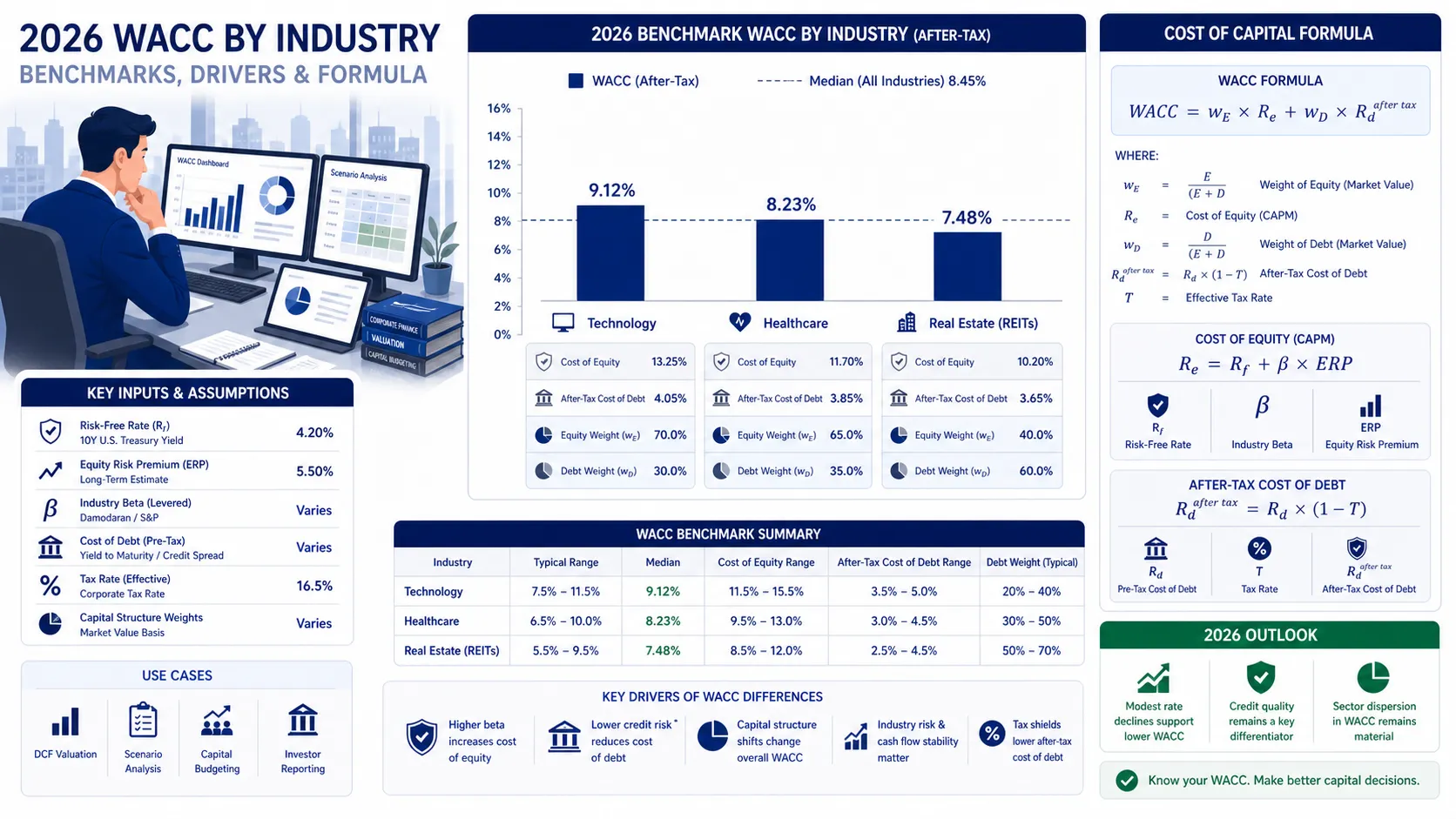
WACC by Industry: 2026 Benchmarks for Technology, Healthcare, and Real Estate
In 2026, industry WACC diverges sharply, from 5.5% for utilities to over 11.5% for software. CFOs must benchmark their discount rate against peers to ground valuations in market reality.
 Corporate Finance
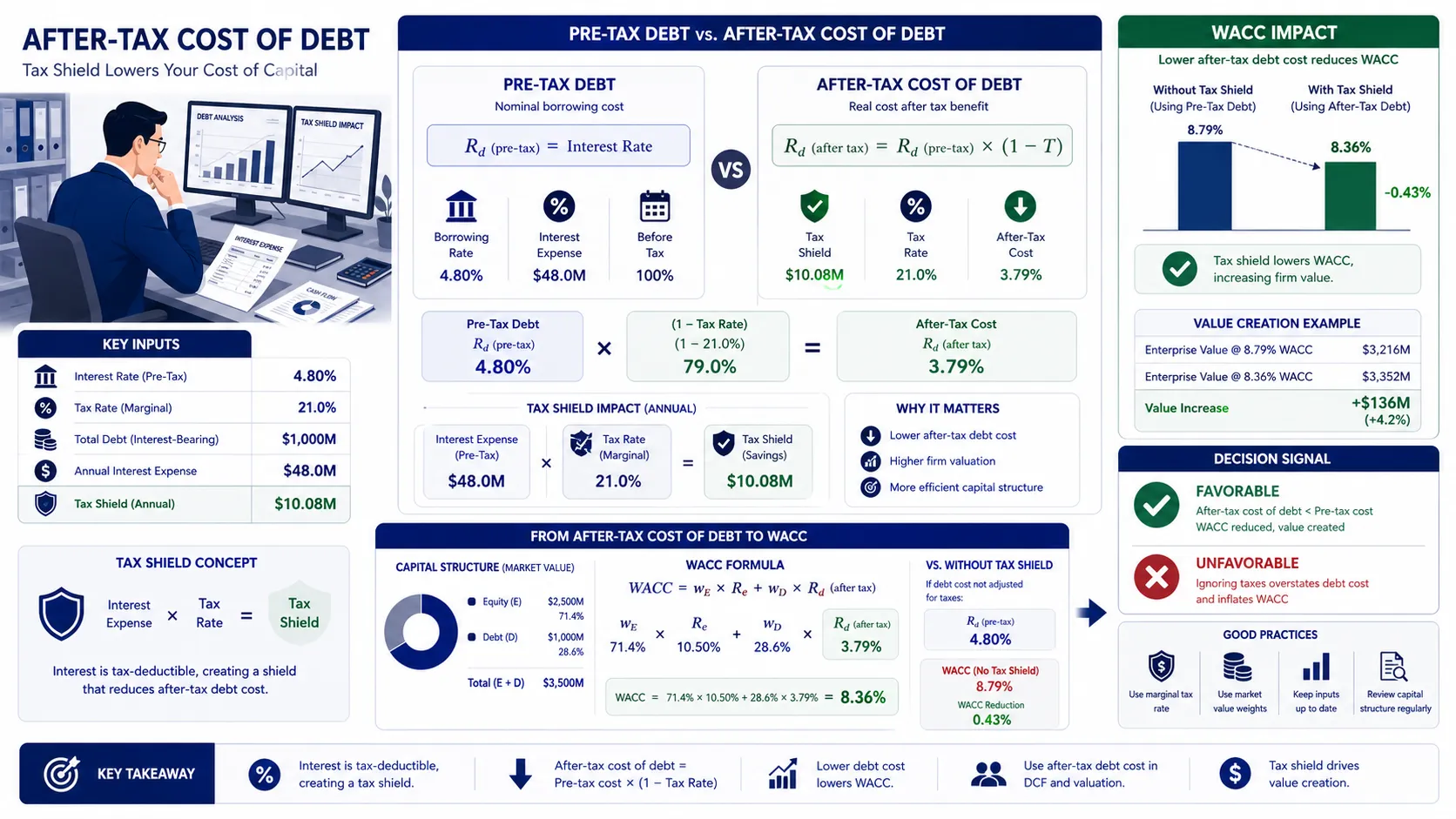
What Is After-Tax Cost of Debt and How Does It Lower WACC?
Interest payments are tax-deductible, making debt cheaper than equity and lowering your company's WACC. The after-tax cost of debt reveals this true, subsidized borrowing rate.
 Corporate Finance
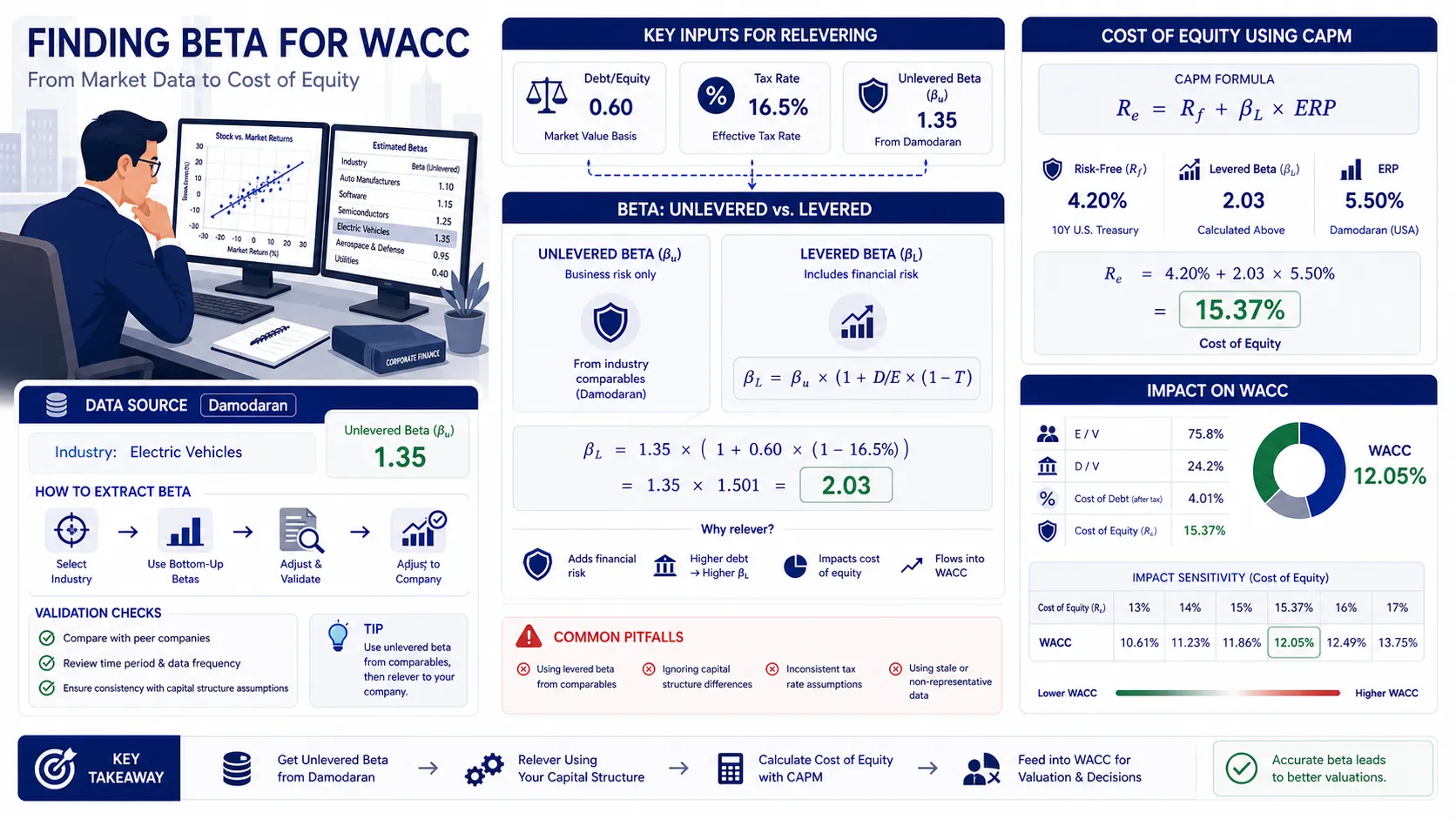
How to Find Beta for WACC: Unlevered vs Levered Beta Calculati
Unlock institutional-grade WACC by mastering bottom-up beta: unlever public peers to strip debt risk, then re-lever for your target's capital structure. This precision method solves CAPM's toughest hurdle, delivering accurate equity risk pricing for DCF models.
Frequently Asked Questions (FAQ)
What is a good Cash Conversion Cycle target?
Can a business have a negative Cash Conversion Cycle?
How do I reduce my Cash Conversion Cycle?
The operations calculations, inventory models, and capacity forecasts generated by BizToolkitPro are for educational and informational purposes only. They do not represent certified engineering specifications, audit-ready supply chain audits, or logistics advice.
Logistics schedules, inventory turn rates, and capacity models (including EOQ, Reorder Point, Safety Stock, and Warehouse Capacity) rely on variables, lead times, and carrying cost rates provided by the user. Real-world supply chain bottlenecks, vendor delays, demand fluctuations, and carrying cost variances occur frequently; BizToolkitPro makes no warranties regarding the operational efficiency or reliability of these results.
Always perform local production and warehouse audits, and consult with a Certified Supply Chain Professional (CSCP), Certified Logistics Planner, or industrial operations engineer before signing supplier agreements or investing in inventory warehousing.