
M&A Synergy Calculator: Cost & Revenue Synergy Modeler
Quantify transactional value creation using our premium Synergy calculator.
Analyze cost-saving redundancies, incremental revenue margin uplifts, corporate tax shields, and multi-year realization ramps with institutional discount rates.
Have a suggestion or found a calculation discrepancy? Let us know!
How to use this M&A synergy calculator
Inputs required for synergy modeling
To construct an accurate post-transaction integration profile, collect the following data points from the target's operating model and joint integration planning committees:
- -Annual Cost Savings: Estimated hard cost savings (e.g. overhead consolidation, IT systems overlap, redundant real estate, staff reductions).
- -Annual Revenue Uplift: Gross new revenue projected from joint distribution, cross-selling products, or expanded geographical reach.
- -Incremental Margin: The net profit margin applied to revenue uplifts, reflecting variable delivery costs.
- -Corporate Tax Rate: The effective marginal tax rate applied to net savings.
- -Realization Ramp: The period (in years) needed to fully implement operational changes and hit 100% of target synergies.
- -One-Time Integration Costs: Total estimated costs to achieve the synergies (severance, consulting fees, system migration, office exit fees).
- -Discount Rate: Typically set to the combined entity's Weighted Average Cost of Capital (WACC) to discount future synergy cash flows.
Understanding the synergy outputs
Once you trigger calculations, the M&A model populates multiple visual analyses:
- Synergy Valuation Summary: View fully realized gross and net after-tax figures, as well as the Net Present Value (NPV) and Payback Period.
- Cash Flows Stack Tab: Graphically displays Year 0 integration cost outflows followed by Year 1 through 5 ramped savings and revenue synergy additions.
- NPV Sensitivity Tab: A 5x5 matrix illustrating how discount rates and realization percentage changes affect NPV.
- Scenario Analysis: Compares conservative, target, and optimistic scenarios to evaluate down-side integration risks.
M&A synergy formulas and financial methodology
Synergy Math Principles
Annual gross synergies are determined by summing annual cost savings and the net profit contribution of revenue uplifts:
After-tax synergy cash flows are calculated using the corporate tax rate:
The Net Present Value (NPV) discounts ramped after-tax synergy flows over 5 years and subtracts integration costs:
Cost vs. Revenue Synergies: The Strategic Difference
In mergers and acquisitions, synergies are divided into two main categories: cost synergies and revenue synergies.
Cost Synergies (Hard Synergies): These represent expenses that can be eliminated after combining operations. Examples include shutting down duplicate offices, migrating to a single software license, combining sales forces, and reducing overhead. Because these savings are mostly under the management's direct control, lenders and investment committees assign them a high probability of success (typically 75% to 90%).
Revenue Synergies (Soft Synergies): These refer to additional revenues created by the merger. Examples include cross-selling products, leveraging a larger customer base, and expanding into new markets. These are harder to predict and depend on customer response. As a result, analysts discount revenue synergies heavily (usually modeling them at a 20% to 50% success rate) and apply the target's incremental profit margin rather than gross revenue figures.
The Realization Ramp and Integration Burden: Synergies are rarely achieved immediately on day one. Operations teams must align systems and workflows over time. We model a linear realization ramp to account for this delay. Integration costs represent the upfront costs required to achieve these long-term operational savings.
M&A synergy valuation example calculation
Synergy Integration Case Study
A retail chain acquires a competitor for $40M. Joint teams identify the following potential synergies and integration costs:
| Financial Parameter | Value |
|---|---|
| Annual Cost Savings | $2,500,000 |
| Annual Revenue Uplift | $4,000,000 |
| Incremental Revenue Margin | 35% |
| Corporate Tax Rate | 21% |
| Realization Ramp Period | 3 Years |
| One-Time Integration Costs | $3,000,000 |
| Discount Rate (WACC) | 10% |
Reconciliation step-by-step arithmetic
To find the net present value of these synergies, execute the following steps:
- Step 1: Calculate Fully Realized Gross & Net Synergies
Gross Synergy = $2,500,000 + ($4,000,000 脳 0.35) = $3,900,000.After-Tax Synergy = $3,900,000 脳 (1 - 0.21) = $3,081,000. - Step 2: Project After-Tax Ramped Cash Flows
Year 1 (33.3% realized): $3,081,000 脳 (1/3) = $1,027,000.Year 2 (66.7% realized): $3,081,000 脳 (2/3) = $2,054,000.Years 3-5 (100% realized): $3,081,000. - Step 3: Discount Cash Flows to Present Value
PV Year 1 = $1,027,000 / 1.10^1 = $933,636.PV Year 2 = $2,054,000 / 1.10^2 = $1,697,521.PV Year 3 = $3,081,000 / 1.10^3 = $2,314,801.PV Year 4 = $3,081,000 / 1.10^4 = $2,104,364.PV Year 5 = $3,081,000 / 1.10^5 = $1,913,059.Sum PV = $8,963,381. - Step 4: Subtract Integration Cost for Net NPV
Synergy Net NPV = $8,963,381 - $3,000,000 = $5,963,381.
The net value created by the synergies, after accounting for time value and integration costs, is $5,963,381, with the transaction breaking even on integration costs in 1.96 years.
What your synergy results mean for the deal
Positive NPV > Integration Costs
A positive Synergy NPV indicates that the combined company is expected to generate returns above its WACC. This justifies paying a control premium to the target's shareholders, as long as the premium is less than the Synergy NPV.
Negative Synergy NPV
If the Synergy NPV is negative, the upfront integration costs and discount rate exceed the value of the expected operational savings. This is a common reason why mergers fail to create value, often referred to as the "acquirer's bane."
Integration Burden Ratio
An integration burden ratio below 1.0 indicates that one-time integration expenses are less than one year of fully realized synergies. This points to a highly efficient integration profile. Ratios above 2.5 suggest a complex and costly integration.
Common synergy modeling mistakes to avoid
Private Equity: LBO Synergy Adjustments
Private equity sponsors use synergy models to justify higher bid multiples in competitive auctions. They present verified cost synergies to lenders to secure higher debt leverage.
Corporate Development: Post-Closing Auditing
Corporate development teams track synergy realization progress year-by-year against initial deal models, holding integration managers accountable for cost savings and revenue targets.
- xOverestimating Revenue Synergy Margins: Applying the overall gross margin instead of the lower incremental net margin to new sales.
- xIgnoring the Realization Ramp: Assuming 100% of synergies are achieved on Day 1, which overstates the NPV of the deal.
- xUnderestimating Integration Costs: Leaving out severance packages, retention bonuses, and IT contract termination fees.
Real-world case study: Broadcom Inc. (AVGO, FY 2024 (projected synergies))
Broadcom Inc. metrics profile
Broadcom's acquisition of VMware, completed in November 2023, was a strategic move to significantly expand its enterprise software portfolio. A key driver for this deal was the anticipated realization of substantial cost synergies through operational efficiencies and the streamlining of overlapping functions within the combined entity.
Broadcom's targeted annual cost synergy of $1.00 billion (derived from a $3 billion target over three years) represents approximately 11.7% of VMware's prior annual operating expenses. This significant percentage underscores Broadcom's strategy in large technology mergers, which often prioritizes achieving rapid operational efficiencies and reducing redundancies in areas like sales, marketing, and general administration. For investors, the successful realization of these synergy targets is crucial, as it directly impacts the combined company's profitability, free cash flow generation, and ultimately, shareholder value post-acquisition.
Related Calculators
Estimate weighted average cost of capital.
Open Tool →DCF CalculatorValue a business using discounted cash flows.
Open Tool →NPV CalculatorCompute net present value of cash flows.
Open Tool →IRR CalculatorSolve project internal rates of return.
Open Tool →Free Cash Flow CalculatorEstimate operating free cash flow.
Open Tool →Break-Even ROI CalculatorAnalyze payback thresholds and returns.
Open Tool →Related Articles & Guides
 Corporate Finance
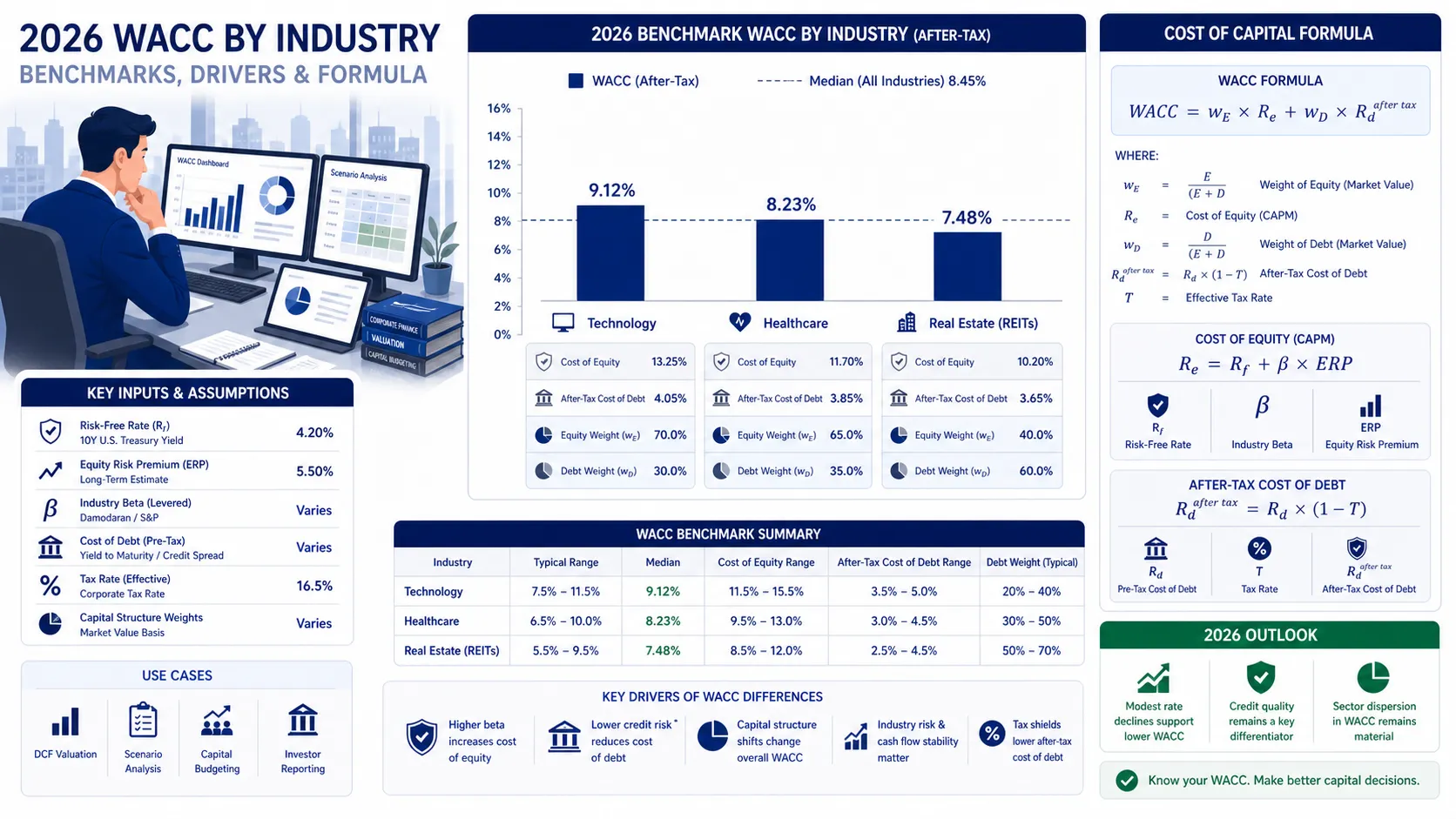
WACC by Industry: 2026 Benchmarks for Technology, Healthcare, and Real Estate
In 2026, industry WACC diverges sharply, from 5.5% for utilities to over 11.5% for software. CFOs must benchmark their discount rate against peers to ground valuations in market reality.
 Corporate Finance
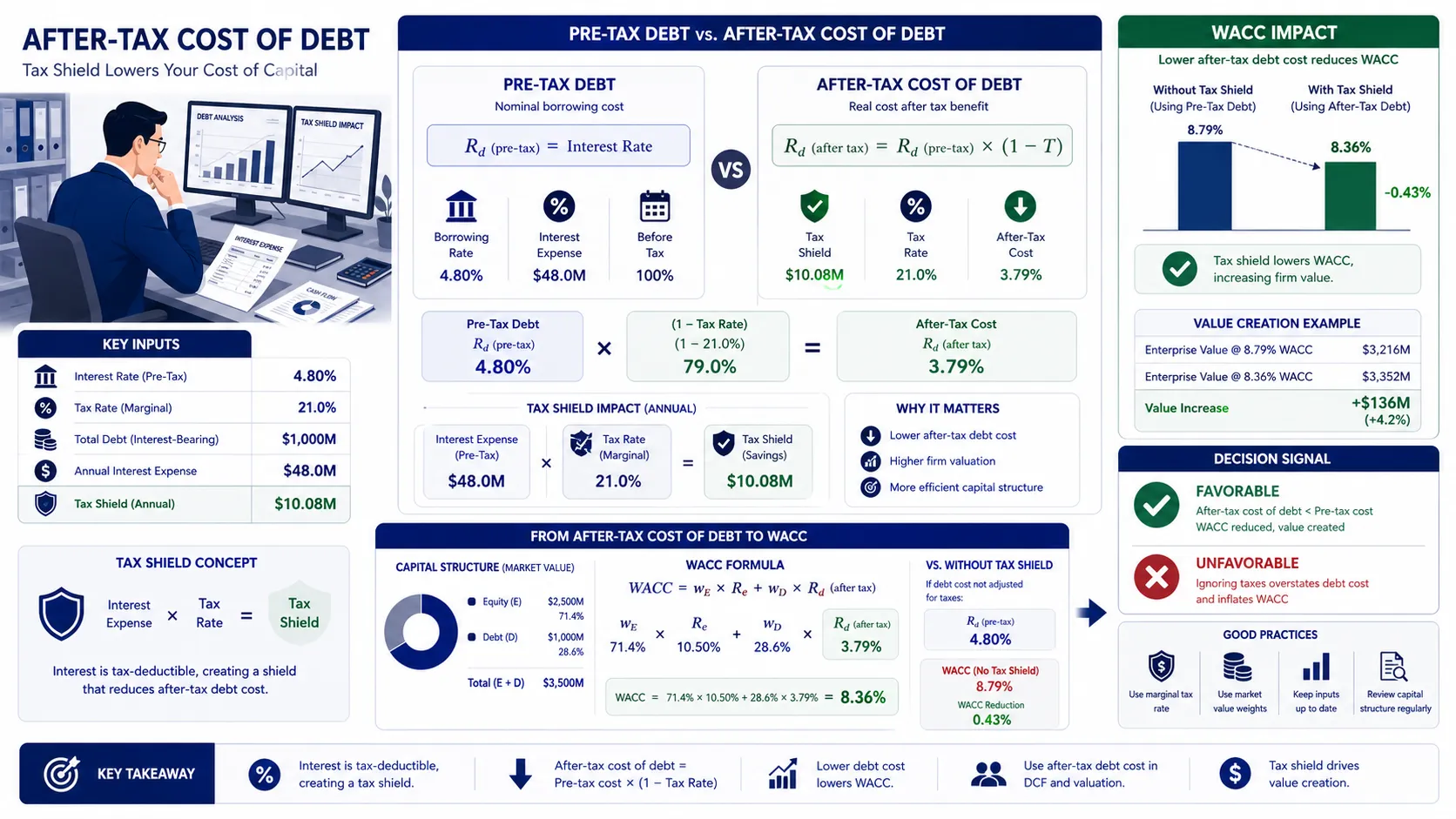
What Is After-Tax Cost of Debt and How Does It Lower WACC?
Interest payments are tax-deductible, making debt cheaper than equity and lowering your company's WACC. The after-tax cost of debt reveals this true, subsidized borrowing rate.
 Corporate Finance
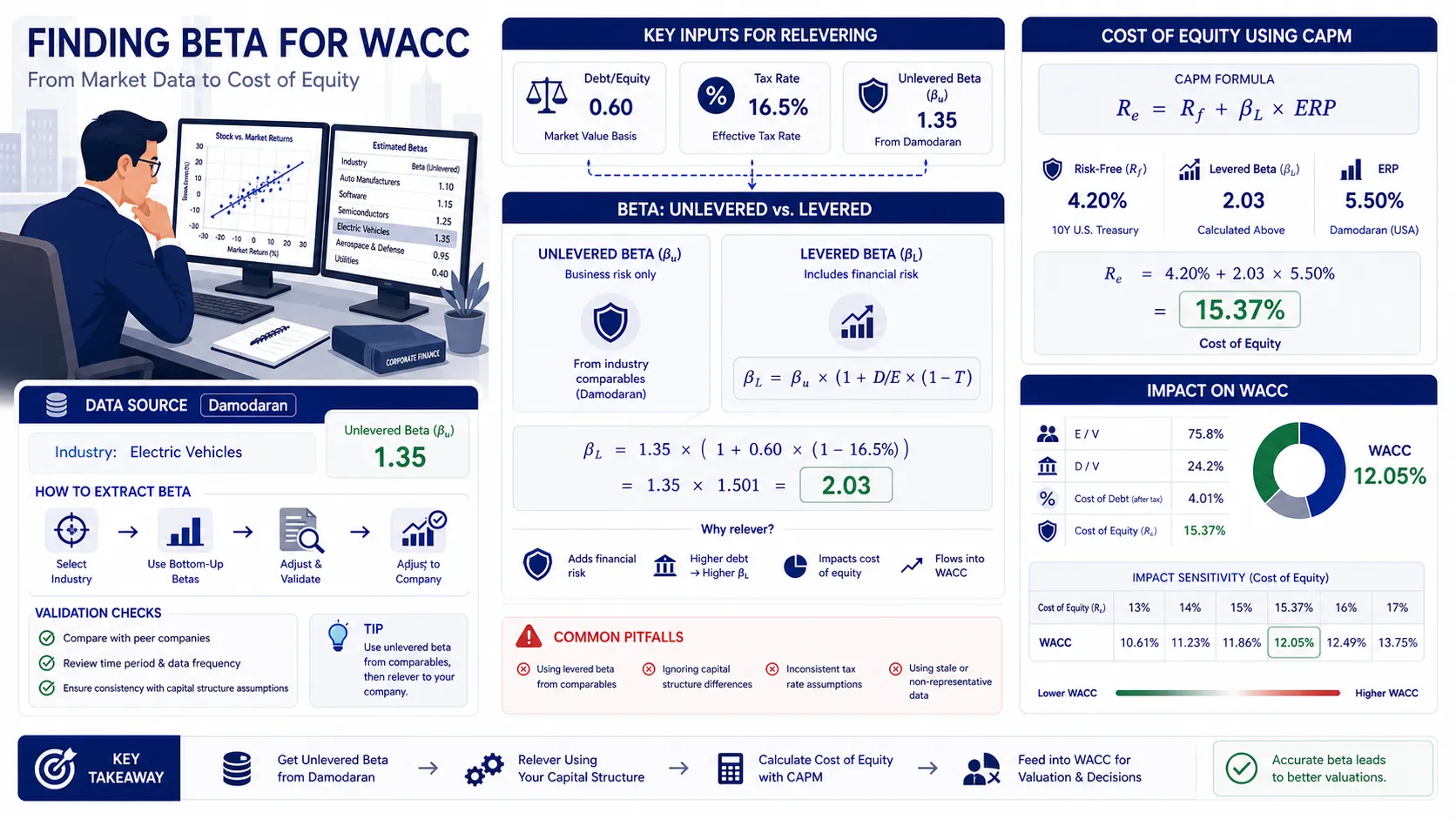
How to Find Beta for WACC: Unlevered vs Levered Beta Calculati
Unlock institutional-grade WACC by mastering bottom-up beta: unlever public peers to strip debt risk, then re-lever for your target's capital structure. This precision method solves CAPM's toughest hurdle, delivering accurate equity risk pricing for DCF models.
Frequently Asked Questions (FAQ)
Why are cost synergies valued more than revenue synergies?
How does the realization ramp affect the NPV of synergies?
What is a typical discount rate used in synergy calculations?
How do integration costs impact the payback period?
The calculations, projections, and reports generated by BizToolkitPro are for educational and informational purposes only. They do not represent professional investment advice, financial planning, tax guidance, legal counsel, or formal business valuation.
Financial models and valuation formulas (including WACC, DCF, IRR, and NPV) rely on assumptions and inputs provided directly by the user. Actual financial markets and business metrics fluctuate; therefore, BizToolkitPro makes no warranties, express or implied, regarding the accuracy, completeness, or suitability of the outputs for any investment strategy or corporate decision.
Always perform your own independent diligence and consult with a licensed Financial Analyst, Certified Public Accountant (CPA), or certified valuation specialist before committing capital or executing corporate transactions.