
M&A Purchase Price Allocation Calculator: Goodwill Solver
Audit acquired balance sheet valuations using the premium Purchase Price Allocation calculator.
Determine asset write-ups, identifiable intangible values, deferred tax adjustments, and residual goodwill allocations under international accounting standards.
Have a suggestion or found a calculation discrepancy? Let us know!
How to use this PPA calculator
Financial variables needed for PPA modeling
To structure a purchase price allocation bridge, gather these figures from the target's audited statements and the post-merger integration valuation studies:
- -Purchase Consideration: The total transaction price paid to target shareholders (equity price plus any assumed debt).
- -Book Value of Net Assets: Historical net equity of the target (total book assets minus book liabilities).
- -Fair Value of Net Assets: The audited market value of the target's physical assets and working capital.
- -Identifiable Intangibles: Off-balance sheet values identified at close (patents, customer lists, brand names).
- -Property Asset Step-ups: Write-ups of plant, machinery, or land to current market value.
- -Deferred Tax Liability: Future tax liabilities created by the step-up of depreciable assets.
Interpreting the purchase price allocation stack
The PPA model outputs structured metrics to explain goodwill formation:
- The Allocation Stack Tab: Visualizes how each asset class builds on book values to absorb the purchase price.
- Goodwill-to-Purchase Price Gauge: Indicates the percentage of the deal price allocated to goodwill. High percentages point to premium tech or brand plays; low percentages suggest tangible asset acquisitions.
- Bargain Purchase Gain: Displays when the fair value of net assets exceeds the purchase price.
PPA accounting formulas and financial methodology
PPA Math Principles
Fair Value Adjustments (Asset write-ups) are computed as:
Total Identifiable Net Assets includes all step-up tangible and intangible items, net of tax liabilities:
Goodwill represents the excess purchase price paid above identifiable assets:
What is Purchase Price Allocation (ASC 805 / IFRS 3)?
Under modern accounting rules (ASC 805 in the US and IFRS 3 globally), when a corporation buys another business, it cannot simply dump the entire premium over book value into "Goodwill". Instead, auditors require the buyer to allocate the purchase price to the fair value of all identifiable assets acquired and liabilities assumed.
Fair Value Adjustments & Asset Step-ups: Tangible assets like property, machinery, and inventory are appraised. If their market value exceeds historical book value, they are written up (stepped-up). This write-up increases future depreciation expenses, shielding the buyer's earnings from taxes.
Identifiable Intangibles: The buyer must separate intangible assets that meet either the "contractual-legal" or "separability" criteria. Common examples include customer contracts, technology licenses, patents, and trademarks. These are amortized over their estimated useful lives.
Deferred Tax Liabilities (DTL): Because step-up asset write-ups increase book depreciation but are not immediately deductible for tax purposes, a Deferred Tax Liability must be recognized, which in turn increases the residual Goodwill amount.
PPA example calculation
Corporate PPA Case Study
Acquirer Corp purchases Target Inc for $50,000,000. Target's audited statements and subsequent valuations show:
| Financial Account | Value (USD) |
|---|---|
| Purchase Consideration | $50,000,000 |
| Book Value of Net Assets | $25,000,000 |
| Fair Value of Net Assets | $35,000,000 |
| Identifiable Intangible Assets | $8,000,000 |
| Property Step-up Adjustments | $4,000,000 |
| Deferred Tax Liabilities | $2,500,000 |
| Non-Controlling Interest (NCI) | $5,000,000 |
Step-by-step PPA calculations
To find the final Goodwill allocation under ASC 805 rules:
- Step 1: Calculate Fair Value Adjustments
FV Adjustments = Fair Value ($35M) - Book Value ($25M) = $10,000,000. - Step 2: Calculate Identifiable Net Assets
Identifiable Assets = Fair Value Net Assets ($35.0M) + Intangibles ($8.0M) + Step-ups ($4.0M) - DTL ($2.5M) = $44,500,000. - Step 3: Solve for Goodwill Allocation
Goodwill = Purchase Price ($50.0M) + NCI ($5.0M) - Identifiable Assets ($44.5M) = $10,500,000.
Of the $50M purchase consideration, $10,500,000 is recognized as residual goodwill on the combined balance sheet, while identifiable net assets account for $44,500,000.
What PPA goodwill results mean for the deal
High Goodwill Allocations (> 50%)
This is common in technology, software, and brand-heavy acquisitions. A high proportion of goodwill indicates that the target's value lies in future growth, proprietary code, brand loyalty, or team synergies rather than physical assets.
Asset-Heavy Allocations
Found in manufacturing, real estate, and utility sectors. Write-ups of plant, property, and machinery (step-ups) reduce residual goodwill, increasing future depreciation tax shields.
Bargain Purchase Gain
Occurs when the transaction price is less than the fair value of net assets. This gain must be recognized immediately in the acquirer's earnings statement at closing.
PPA audit and tax use cases
Pre-Deal Structuring: Tax Shield Audits
Financial sponsors model asset step-ups and amortization schedules during due diligence to estimate the tax shield benefits and project net cash flows.
Post-Merger Integration: Audited Financials
Accounting teams use purchase price allocations to prepare opening balance sheets for the combined company, ensuring compliance with SEC and regional audit requirements.
- xIgnoring Deferred Taxes on Step-ups: Failing to recognize deferred tax liabilities, which artificially reduces goodwill.
- xDouble Counting Intangibles: Counting customer lists or brands twice by duplicating their values in overall goodwill.
- xExcluding Non-Controlling Interest: Forgetting NCI in partial acquisitions, which distorts total goodwill calculations.
Real-world case study: Broadcom Inc. (AVGO, FY 2024)
Broadcom Inc. metrics profile
Broadcom Inc. acquired VMware, Inc. in November 2023, a significant move to expand its infrastructure software capabilities. The acquisition involved a substantial cash and stock consideration, requiring Broadcom to perform a detailed purchase price allocation to account for VMware's assets and liabilities.
Broadcom's preliminary purchase price allocation for the VMware acquisition highlights a substantial amount of goodwill, totaling $61.719 billion. This indicates that a significant portion of the acquisition price was attributed to factors beyond identifiable tangible and intangible assets, such as expected synergies, assembled workforce, and strong market position of VMware. The $33.514 billion allocated to identified intangible assets further emphasizes the strategic value placed on VMware's intellectual property and customer relationships. This allocation reflects Broadcom's strategy to enhance its infrastructure software portfolio, anticipating future economic benefits from the acquired business that exceed the fair value of its individual assets and liabilities.
Related Calculators
Estimate weighted average cost of capital.
Open Tool →DCF CalculatorValue a business using discounted cash flows.
Open Tool →NPV CalculatorCompute net present value of cash flows.
Open Tool →IRR CalculatorSolve project internal rates of return.
Open Tool →Free Cash Flow CalculatorEstimate operating free cash flow.
Open Tool →Break-Even ROI CalculatorAnalyze payback thresholds and returns.
Open Tool →Related Articles & Guides
 Corporate Finance
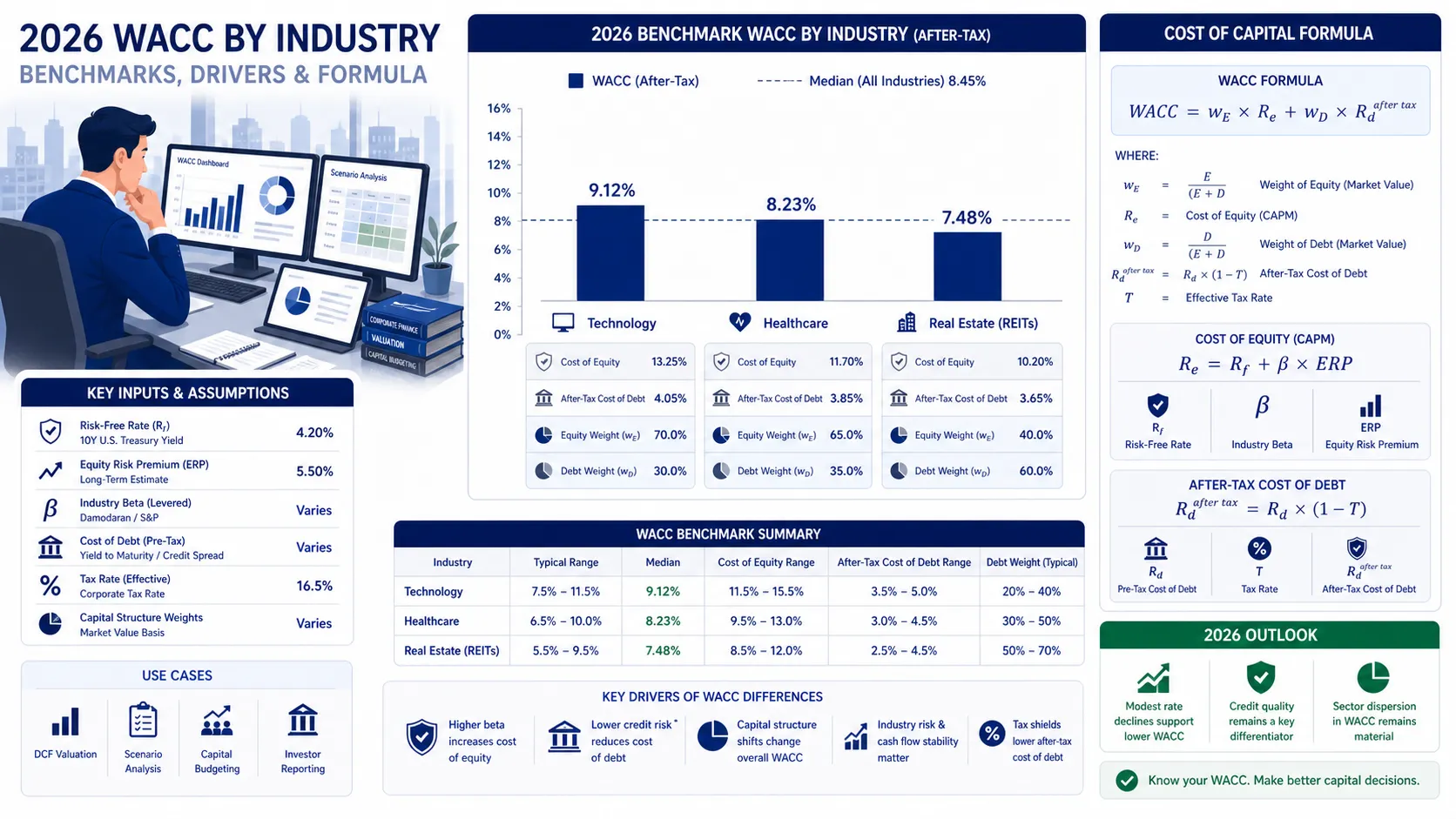
WACC by Industry: 2026 Benchmarks for Technology, Healthcare, and Real Estate
In 2026, industry WACC diverges sharply, from 5.5% for utilities to over 11.5% for software. CFOs must benchmark their discount rate against peers to ground valuations in market reality.
 Corporate Finance
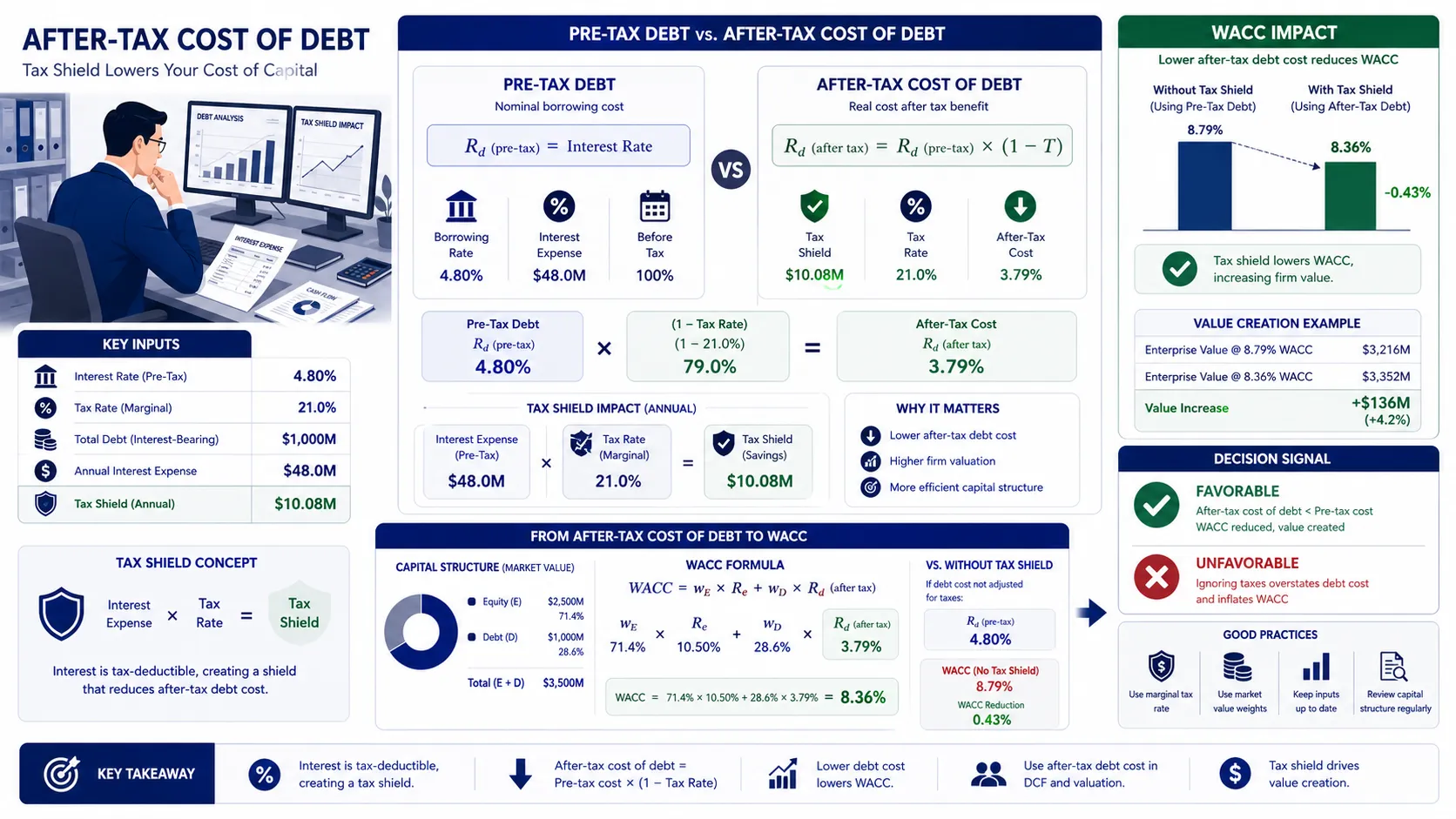
What Is After-Tax Cost of Debt and How Does It Lower WACC?
Interest payments are tax-deductible, making debt cheaper than equity and lowering your company's WACC. The after-tax cost of debt reveals this true, subsidized borrowing rate.
 Corporate Finance
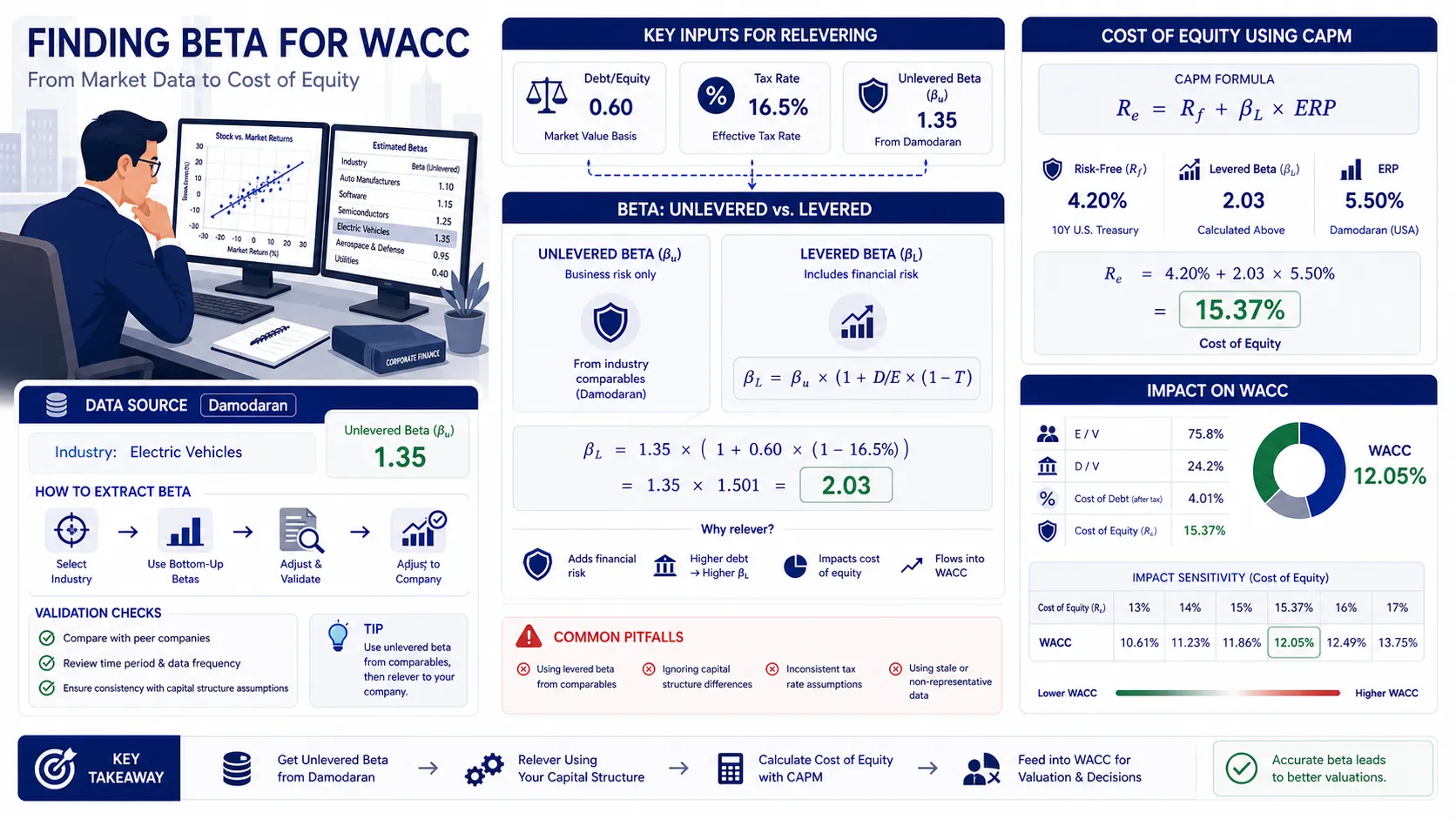
How to Find Beta for WACC: Unlevered vs Levered Beta Calculati
Unlock institutional-grade WACC by mastering bottom-up beta: unlever public peers to strip debt risk, then re-lever for your target's capital structure. This precision method solves CAPM's toughest hurdle, delivering accurate equity risk pricing for DCF models.
Frequently Asked Questions (FAQ)
Why is goodwill amortization no longer allowed under US GAAP?
How do asset step-ups benefit the acquirer's tax position?
What triggers a bargain purchase gain?
Why do asset step-ups create Deferred Tax Liabilities?
The calculations, projections, and reports generated by BizToolkitPro are for educational and informational purposes only. They do not represent professional investment advice, financial planning, tax guidance, legal counsel, or formal business valuation.
Financial models and valuation formulas (including WACC, DCF, IRR, and NPV) rely on assumptions and inputs provided directly by the user. Actual financial markets and business metrics fluctuate; therefore, BizToolkitPro makes no warranties, express or implied, regarding the accuracy, completeness, or suitability of the outputs for any investment strategy or corporate decision.
Always perform your own independent diligence and consult with a licensed Financial Analyst, Certified Public Accountant (CPA), or certified valuation specialist before committing capital or executing corporate transactions.