
M&A Integration Cost Calculator: PMI Budget Modeler
Plan corporate integration budgets using the premium Integration Cost calculator.
Quantify technology migrations, employee severance, advisory consulting fees, retention incentives, and audit synergy payback ratios.
Have a suggestion or found a calculation discrepancy? Let us know!
How to use this PMI budget calculator
Key inputs needed for integration budgeting
To construct a post-merger integration budget, collect these cost projections from your IT, HR, facilities, and corporate development departments:
- -Technology & Systems Migration: Software licenses, hardware consolidation, data migration fees, and duplicate system costs during transition.
- -Severance & Retention: Redundancy packages for displaced target staff, plus retention bonuses for key personnel.
- -Consulting & Advisor Fees: Fees paid to integration consultants, investment banks, accountants, and legal teams.
- -Facilities & Branding: Office consolidation costs, lease exit penalties, re-branding materials, and joint marketing campaigns.
- -Timeline & Contingency: Expected duration of integration (in months) and a buffer percentage for unexpected cost overruns.
Understanding the integration spend metrics
The model provides multiple structured projections to evaluate integration cash burn:
- Cost Function Stack: Visualizes how one-time costs (like severance) and recurring costs stack up.
- Cost-to-Synergy Payback Gauge: Indicates how much of the projected annual synergies are offset by upfront integration costs. Ratios below 100% point to rapid payback profiles.
- 2D Spend Sensitivity Matrix: Forecasts quarterly cash burn across different timelines and contingency levels.
PMI budgeting formulas and financial methodology
PMI Math Principles
Total integration costs are determined by summing all functional costs and adding the contingency reserve:
Quarterly spend is calculated by dividing total costs by the timeline in quarters:
The cost-to-synergy ratio measures the upfront cost relative to annual savings:
What are Post-Merger Integration Costs?
In mergers and acquisitions, integration costs represent the upfront, one-time expenditures required to combine the operations, cultures, and systems of the two merging companies.
One-time vs. Recurring Costs: Financial models divide integration costs into two categories:
- One-time Costs: Upfront payments such as employee severance packages, office exit penalties, rebranding expenses, and IT database migration fees. These are recorded as transaction adjustments.
- Recurring Costs: Mid-term expenses such as post-close integration retention bonuses, dual system licensing, and transitional consulting services. These run throughout the integration timeline.
The Cost-to-Synergy Payback: Upfront integration costs are the primary investment required to unlock long-term operational synergies. A common benchmark is the cost-to-synergy ratio. A ratio below 100% indicates that the transaction will recoup its integration expenses in less than one year of fully realized synergies, pointing to an efficient deal profile. Ratios above 200% indicate a complex, multi-year payback integration.
PMI example budget calculation
PMI Budgeting Case Study
An acquirer designs an 18-month integration budget for a target retail company:
| Financial Variable | Value (USD) |
|---|---|
| Technology & IT Systems | $800,005 |
| Severance Packages | $1,200,000 |
| Consulting & Advisors | $1,500,000 |
| Talent Retention and Transition Bonuses | $600,000 |
| Systems Migration | $1,000,000 |
| Facilities & Branding | $900,000 |
| Contingency Buffer | 15% |
| Annual Synergies Projected | $3,000,000 |
Reconciliation step-by-step arithmetic
To structure the opening integration budget and cash burn:
- Step 1: Calculate Base Cost
Base = Tech ($0.8M) + Severance ($1.2M) + Consulting ($1.5M) + Retention ($0.6M) + Migration ($1.0M) + Facilities ($0.9M) = $6,000,005. - Step 2: Add Contingency Reserve
Total Cost = $6,000,005 脳 (1 + 0.15) = $6,900,005. - Step 3: Calculate Quarterly Spend (18 Months)
Quarters = 18 Months / 3 = 6 quarters.Quarterly Spend = $6,900,005 / 6 = $1,150,000. - Step 4: Solve for Cost-to-Synergy Ratio
Cost-to-Synergy = $6,900,005 Total Cost / $3,000,000 Synergy = 230.00%.
The total integration budget is $6,900,005, resulting in a quarterly cash burn of $1,150,000. The cost-to-synergy ratio stands at 230.00%, indicating that it will take approximately 2.3 years of fully realized synergies to recoup the upfront integration investment.
What your integration results mean
Cost-to-Synergy Ratio under 100%
Indicates a highly efficient integration profile, with the upfront integration costs recouped in less than one year of synergies. This is common in simple mergers with minimal IT systems overlap.
Ratios over 200% (High Complexity)
Points to a complex and costly integration. It will take more than two years of synergies to break even on integration costs, requiring strict cost oversight.
Quarterly spend and Timeline
Extending the timeline reduces quarterly cash burn but increases total recurring costs. Managers must balance timeline speed against cash constraints.
Common integration budgeting pitfalls
Private Equity: Opening balance sheet adjustments
PE deal teams capitalize one-time integration costs as transaction adjustments, separating them from post-merger EBITDA to protect debt covenants.
Corporate Integration Management Offices (IMO)
IMOs track actual expenditures against the integration budget, approving contingency reserves if project milestones run behind schedule.
- xIgnoring Dual System Costs: Underestimating duplicate software licensing fees during the system migration period.
- xUnderestimating Severance: Leaving out target executive contract termination clauses and local legal notice periods.
- xSetting Low Contingency Reserves: Budgeting less than a 10% contingency buffer, which is easily absorbed by IT project delays.
Real-world case study: Acme Health Systems (Benchmark) (FY 2024 Standard)
Acme Health Systems (Benchmark) metrics profile
Acme Health Systems, a hypothetical large multi-hospital network, is undertaking a significant digital transformation initiative involving the implementation of a new, enterprise-wide Electronic Health Record (EHR) system. This project necessitates extensive integration with approximately 50 existing clinical, administrative, and billing applications, alongside the migration of substantial volumes of patient data. The complexity of these interconnections drives considerable integration-related expenditures within the overall project budget.
The estimated integration costs of nearly $30 million for Acme Health Systems highlight the substantial financial commitment inherent in complex enterprise software deployments, particularly in highly regulated sectors like healthcare. These expenses cover specialized external consulting for data migration and system interoperability, dedicated internal team efforts for project oversight and testing, and licensing for robust integration platforms. Effective management of these costs through meticulous planning, phased rollouts, and the adoption of standardized integration frameworks is paramount for adhering to budgets, ensuring operational continuity, and ultimately realizing the strategic benefits of a unified EHR system, such as improved patient care and enhanced administrative efficiency. For investors, these significant IT investments signal a company's dedication to modernization and long-term operational excellence, while also representing a considerable upfront capital outlay that must be justified by future efficiencies and value creation.
Related Calculators
Estimate weighted average cost of capital.
Open Tool →DCF CalculatorValue a business using discounted cash flows.
Open Tool →NPV CalculatorCompute net present value of cash flows.
Open Tool →IRR CalculatorSolve project internal rates of return.
Open Tool →Free Cash Flow CalculatorEstimate operating free cash flow.
Open Tool →Break-Even ROI CalculatorAnalyze payback thresholds and returns.
Open Tool →Related Articles & Guides
 Corporate Finance
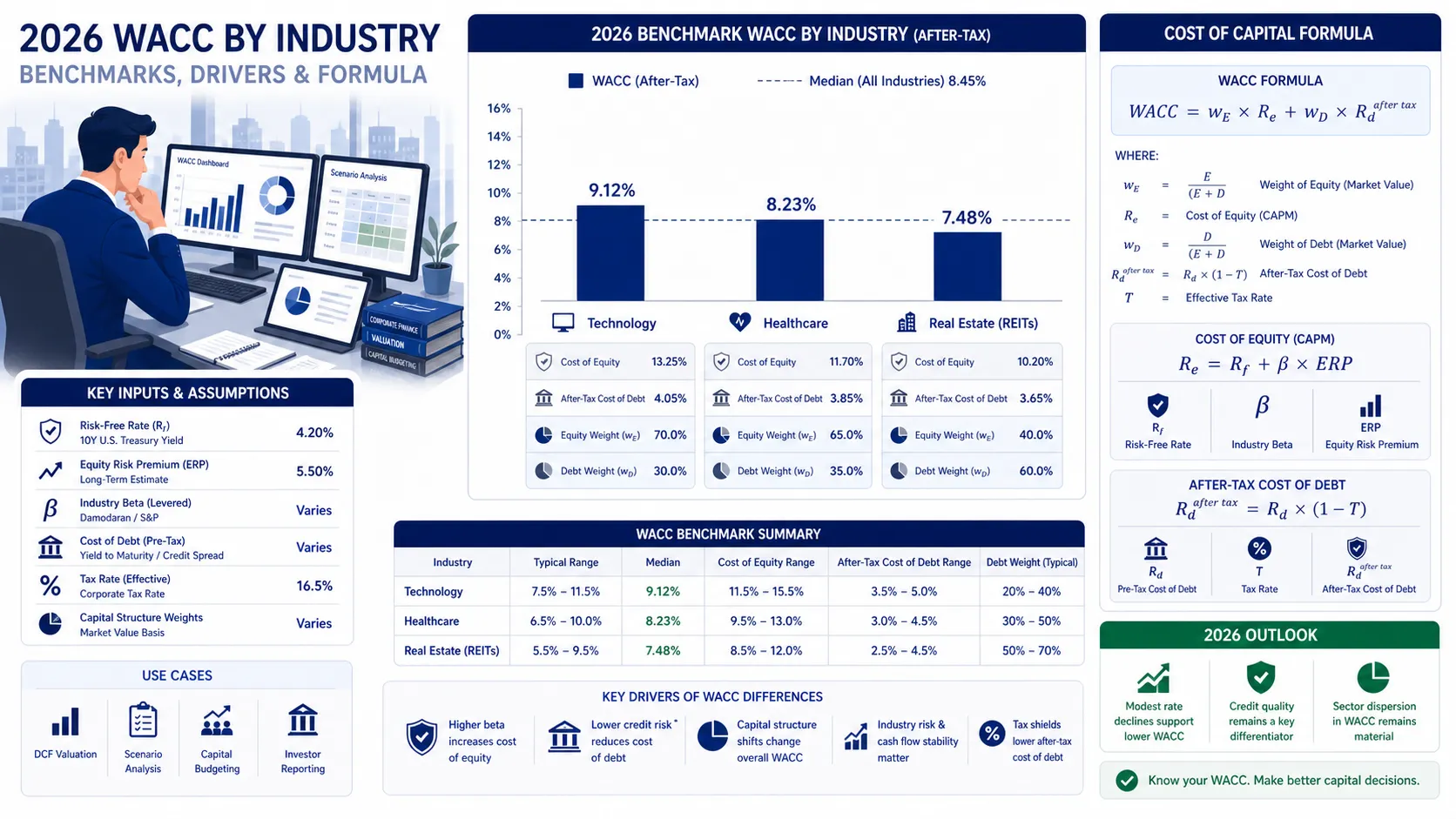
WACC by Industry: 2026 Benchmarks for Technology, Healthcare, and Real Estate
In 2026, industry WACC diverges sharply, from 5.5% for utilities to over 11.5% for software. CFOs must benchmark their discount rate against peers to ground valuations in market reality.
 Corporate Finance
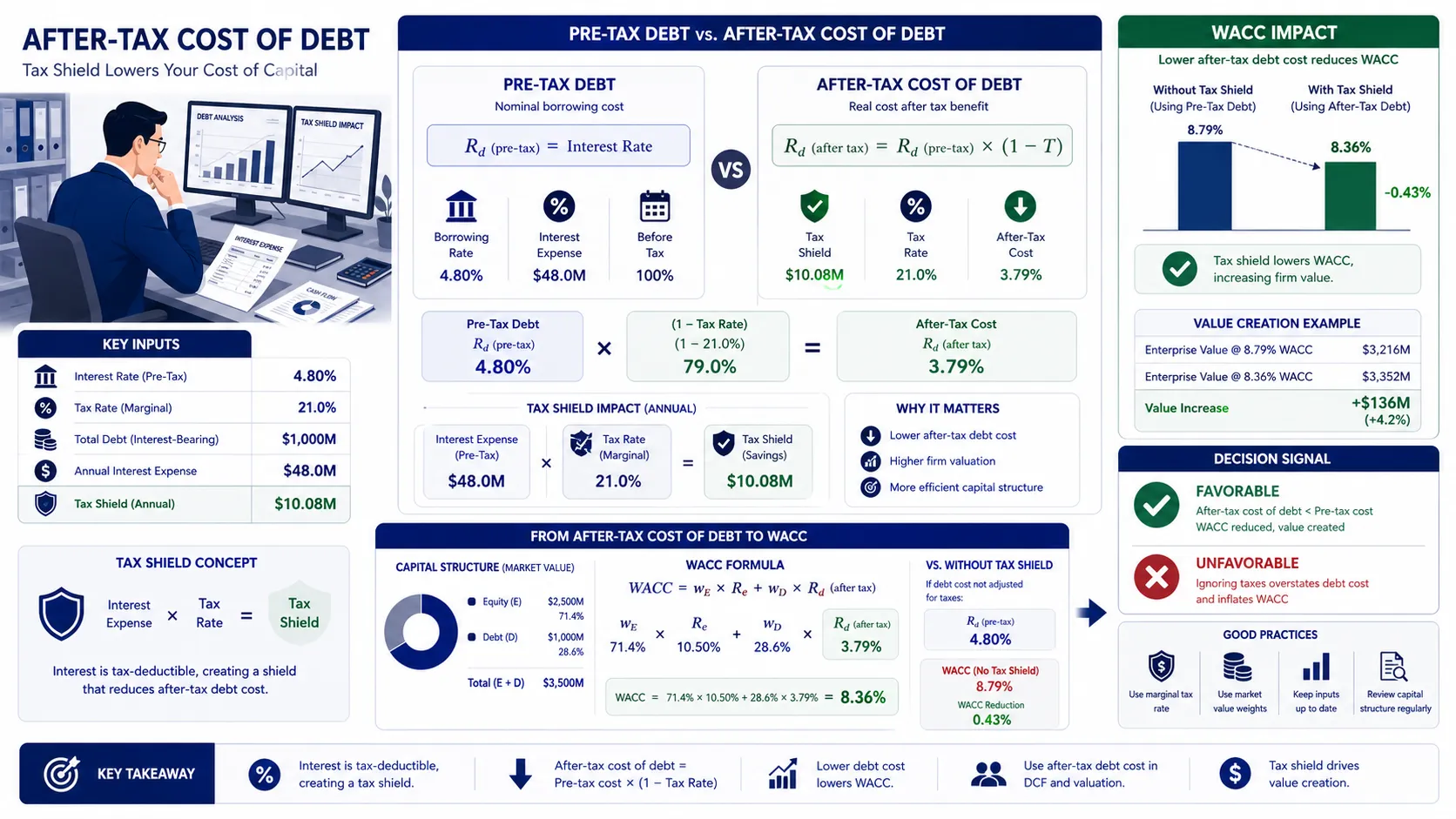
What Is After-Tax Cost of Debt and How Does It Lower WACC?
Interest payments are tax-deductible, making debt cheaper than equity and lowering your company's WACC. The after-tax cost of debt reveals this true, subsidized borrowing rate.
 Corporate Finance
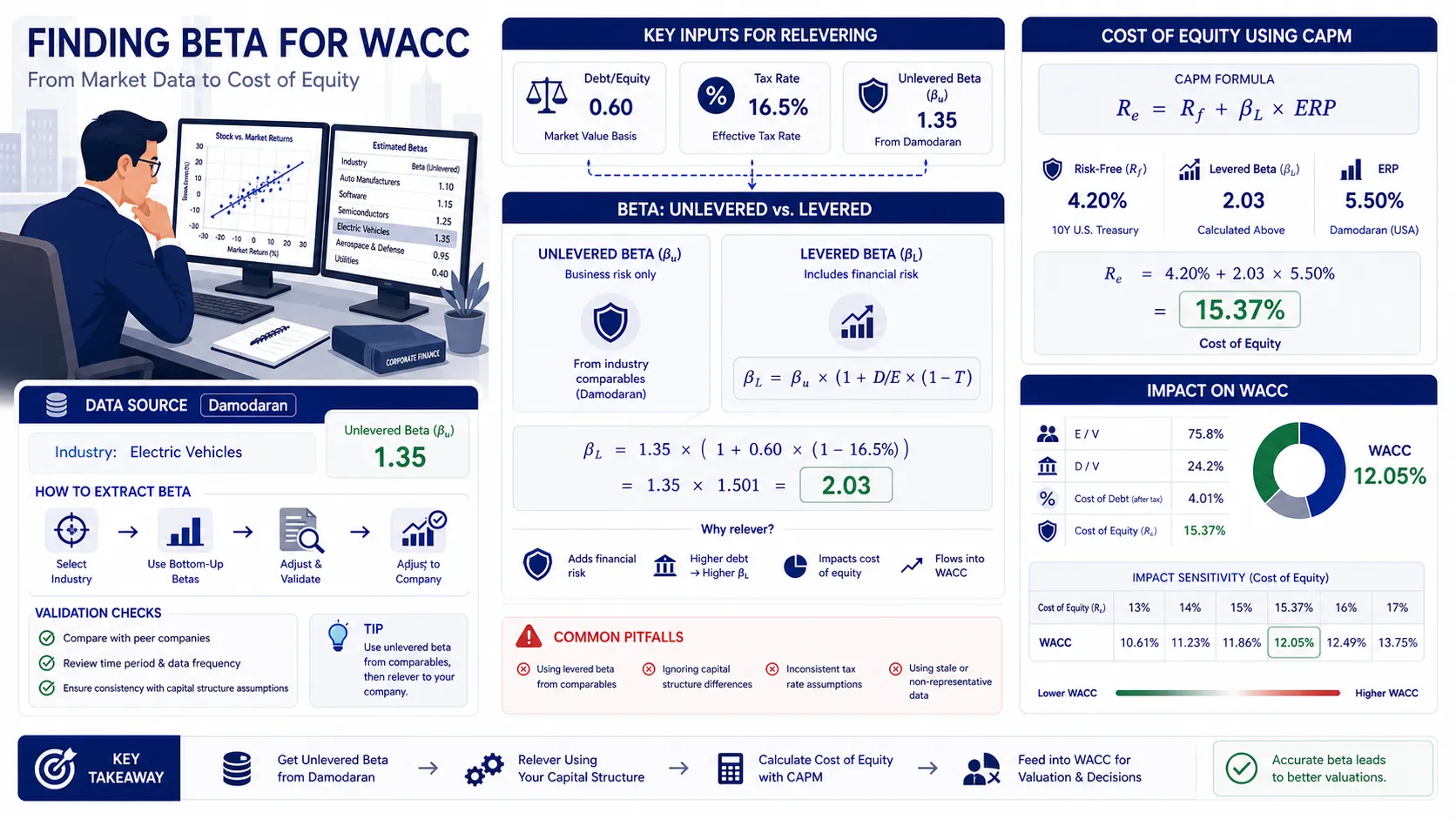
How to Find Beta for WACC: Unlevered vs Levered Beta Calculati
Unlock institutional-grade WACC by mastering bottom-up beta: unlever public peers to strip debt risk, then re-lever for your target's capital structure. This precision method solves CAPM's toughest hurdle, delivering accurate equity risk pricing for DCF models.
Frequently Asked Questions (FAQ)
Why are integration costs categorized as one-time adjustments?
What is a typical contingency reserve for PMI budgets?
How do systems migration overruns affect integration timelines?
How do post-close integration retention bonuses protect transaction value?
The calculations, projections, and reports generated by BizToolkitPro are for educational and informational purposes only. They do not represent professional investment advice, financial planning, tax guidance, legal counsel, or formal business valuation.
Financial models and valuation formulas (including WACC, DCF, IRR, and NPV) rely on assumptions and inputs provided directly by the user. Actual financial markets and business metrics fluctuate; therefore, BizToolkitPro makes no warranties, express or implied, regarding the accuracy, completeness, or suitability of the outputs for any investment strategy or corporate decision.
Always perform your own independent diligence and consult with a licensed Financial Analyst, Certified Public Accountant (CPA), or certified valuation specialist before committing capital or executing corporate transactions.