
M&A Deal Value Calculator: Enterprise to Equity Bridge
Audit mergers and acquisition transaction metrics using the premium Deal Value calculator.
Reconcile headline enterprise value to equity purchase price, audit working capital pegs, and design funding mixes with institutional-grade precision.
Have a suggestion or found a calculation discrepancy? Let us know!
How to use this M&A deal value calculator
Inputs you need before modeling transaction valuation
To construct a cash-free debt-free bridge between Enterprise Value and Equity Value, gather these parameters from the target's balance sheet and letters of intent:
- -Headline Purchase Price: The initial target transaction price (usually representing EV under a cash-free debt-free term sheet).
- -Cash & Cash-like Items: Cash on the balance sheet at close plus items like prepayments, tax refunds, and security deposits due to the seller.
- -Debt & Debt-like Items: Bank loans, overdrafts, unfunded pension obligations, deferred tax liabilities, and outstanding litigation settlements.
- -Working Capital Adjustment: The variance between target working capital peg and actual net working capital at closing.
- -Seller Transaction Expenses: Advisor fees, investment banking commissions, audit, and legal costs paid by the seller out of proceeds.
- -Consideration Mix: The payment layout divided into Cash Consideration, Stock Consideration, and Other (Earnouts or Seller Notes).
Interpreting the transaction bridge and sensitivity matrix
The M&A solver outputs standard and adjusted transaction metrics to help analyze the transaction structure:
- The Valuation Bridge Tab: Renders a dynamic waterfall structure, showing exactly how EV increases with cash and decreases with debt, transaction fees, and working capital peg shifts to arrive at the final Equity Purchase Price.
- Consideration Mix Gauge: A color-coded radial meter demonstrating the proportion of Cash Consideration. This helps analyze cash drain versus dilution.
- 2D Sensitivity Grid: Evaluates the impact on Equity Purchase Price as Headline Price and Net Debt adjustments fluctuate, helping investment bankers check pricing limits.
M&A valuation bridge formula and methodology
Bridge Math Principles
Under a Cash-Free Debt-Free (CFDF) transaction structure, Enterprise Value (EV) is bridged to Equity Value (purchase price of stock) as follows:
For equity-based term sheets, the formula bridges in reverse to solve for Enterprise Value:
Net Debt Adjustment represents the net effect of cash and debt components:
The Cash-Free Debt-Free (CFDF) deal mechanism
Most mid-market M&A transactions are negotiated on a Cash-Free Debt-Free (CFDF) basis. Under this arrangement, the seller is entitled to keep all operational cash on hand at closing, but must also pay off all outstanding bank loans, credit lines, and long-term liabilities prior to close.
However, in practice, a company cannot be transferred with exactly zero cash and debt. Operating cash must remain to cover daily activities, and debt payoffs can trigger prepayment penalties. At closing, the buyer and seller agree to a "Reconciliation Bridge". The headline Enterprise Value is adjusted by adding the actual cash remaining at close and subtracting all remaining debt obligations.
Working Capital Adjustments: To prevent the seller from draining working capital (e.g., delaying supplier payments or accelerating collection of receivables) before close, deals define a "Working Capital Peg" target. If actual working capital at close is higher than the peg, the buyer pays a surplus adjustment to the seller. If it is lower, the purchase price is reduced by the deficit.
Debt-Like Items: Underwriters closely analyze deferred liabilities (such as unpaid employee bonuses, deferred tax assets, capital lease obligations, or litigation provisions) and classify them as debt-like items, which are deducted from the equity purchase price at close.
M&A deal value example calculation
Transactional Structuring Case Study
An acquirer intends to buy a target SaaS company. The parties agree on a headline Enterprise Value of $50,000,000 on a CFDF basis. At the closing audit, the following figures are confirmed:
| Audit Account Category | Value (USD) |
|---|---|
| Headline Enterprise Value | $50,000,000 |
| Closing Cash Balance | $4,000,000 |
| Outstanding Bank Debt | $10,000,000 |
| Working Capital Peg Surplus | $500,000 |
| Debt-Like Lease Liabilities | $1,500,000 |
| Unrestricted Cash-Like Assets | $800,000 |
| Seller Advisor Transaction Expenses | $1,200,000 |
Reconciliation step-by-step arithmetic
To find the final Equity Purchase Price, apply the CFDF bridge calculations:
- Step 1: Calculate Net Debt Adjustments
Net Debt = Cash ($4.0M) + Cash-Like ($0.8M) - Debt ($10.0M) - Debt-Like ($1.5M)Net Debt = $4.8M - $11.5M = -$6,700,000. - Step 2: Add Working Capital Surplus
WC Adjustments = +$500,000(increases the purchase price). - Step 3: Subtract Seller Transaction Expenses
Seller Expenses = -$1,200,000(deducted from proceeds). - Step 4: Solve for Equity Purchase Price
Equity Price = EV ($50.0M) + Net Debt (-$6.7M) + WC (+$0.5M) - Expenses ($1.2M)Equity Price = $50,000,000 - $6,700,000 + $500,000 - $1,200,000 = $42,600,000.
The final Equity Purchase Price paid to shareholders at closing is $42,600,000, with the net debt adjustment and advisor fees accounting for the $7,400,000 reduction from headline EV.
What your M&A deal value results mean
EV > Equity Price (Common Gearing)
In most leveraged corporate transactions, Enterprise Value exceeds Equity Value. This occurs because the target carries more debt and debt-like liabilities than cash reserves. The buyer assumes the target's operating liabilities (or pays them off), which reduces the cash proceeds paid directly to the sellers.
Equity Price > EV (Cash-Rich Targets)
When a company's Cash and cash-like reserves exceed its debt, Equity Value exceeds Enterprise Value. This is common in asset-light tech startups or cash-generative service companies that carry no bank debt. The buyer pays a premium over Enterprise Value to acquire the target's cash balance.
Net Debt and WC pegs
The net debt adjustment and working capital peg are major points of negotiation in M&A deals. Even small changes in the definition of "debt-like items" or the "working capital target" can change the final purchase price by millions.
M&A Deal Value use cases across private and public sectors
Investment Banking: Valuation Pitchbooks
M&A advisors use CFDF bridge calculations in valuation models and client pitchbooks. They bridge public trading multiples (EV/EBITDA) to implied equity share values to present transaction ranges to corporate boards.
Private Equity: Closing Balance Sheet Audits
PE fund operations teams conduct detailed audits of the closing balance sheet. They identify lease contracts, pension liabilities, and tax adjustments to classify them as debt-like items, minimizing equity price leakage.
- xExcluding Operating Leases: Failing to adjust for capital or operating leases, understating total debt-like liabilities.
- xFailing to Set a Working Capital Peg: Leaving out a WC peg, which allows sellers to pull cash out of the company before close.
- xDouble Counting Cash: Adding cash reserves that are already restricted or pledged as collateral for debt payoffs.
Real-world case study: Broadcom Inc. acquiring VMware, Inc. (AVGO, FY 2023 (VMware's last full fiscal year before acquisition))
Broadcom Inc. acquiring VMware, Inc. metrics profile
Broadcom Inc.'s acquisition of VMware, Inc. in late 2023 was a landmark deal in the technology sector, aimed at significantly expanding Broadcom's enterprise software portfolio. This case study highlights key financial metrics associated with the transaction, demonstrating the valuation applied to VMware's robust cloud and virtualization business. The deal underscores Broadcom's strategic pivot towards a more balanced semiconductor and software business model.
The substantial Enterprise Value of $69 billion for VMware, representing a 44% premium to its pre-announcement stock price, reflects Broadcom's strong strategic imperative to bolster its software capabilities. The resulting EV/Revenue multiple of 5.07x and EV/Operating Income multiple of 18.45x indicate a significant valuation, driven by VMware's established market position in cloud infrastructure and virtualization. This acquisition demonstrates Broadcom's commitment to diversifying its business beyond semiconductors and signals a bullish outlook on the synergies expected from integrating VMware's software portfolio, despite the high multiples paid. For investors, these metrics suggest that Broadcom is betting on long-term growth and enhanced profitability through a more comprehensive enterprise software offering.
Related Calculators
Estimate weighted average cost of capital.
Open Tool →DCF CalculatorValue a business using discounted cash flows.
Open Tool →NPV CalculatorCompute net present value of cash flows.
Open Tool →IRR CalculatorSolve project internal rates of return.
Open Tool →Free Cash Flow CalculatorEstimate operating free cash flow.
Open Tool →Break-Even ROI CalculatorAnalyze payback thresholds and returns.
Open Tool →Related Articles & Guides
 Corporate Finance
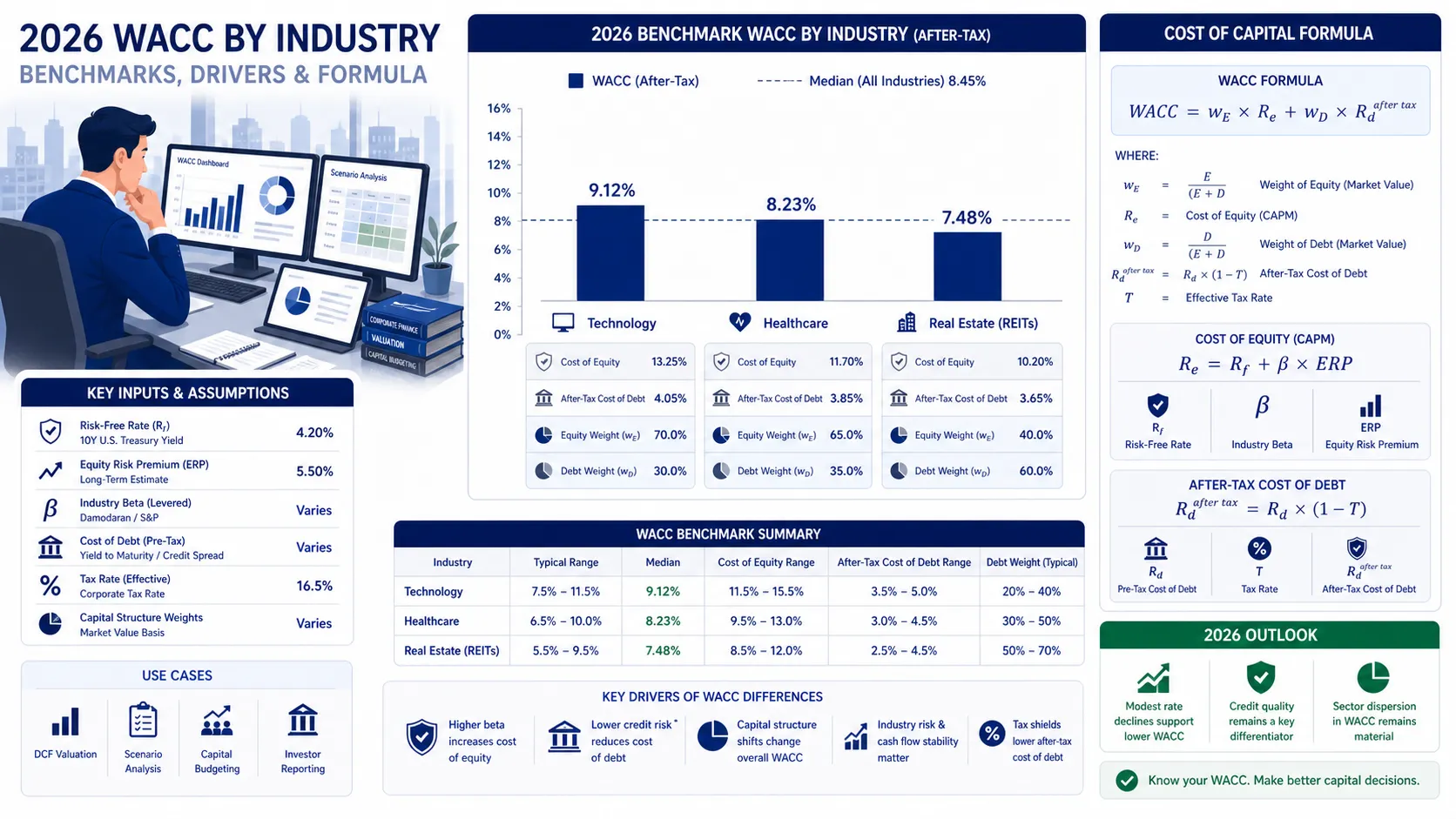
WACC by Industry: 2026 Benchmarks for Technology, Healthcare, and Real Estate
In 2026, industry WACC diverges sharply, from 5.5% for utilities to over 11.5% for software. CFOs must benchmark their discount rate against peers to ground valuations in market reality.
 Corporate Finance
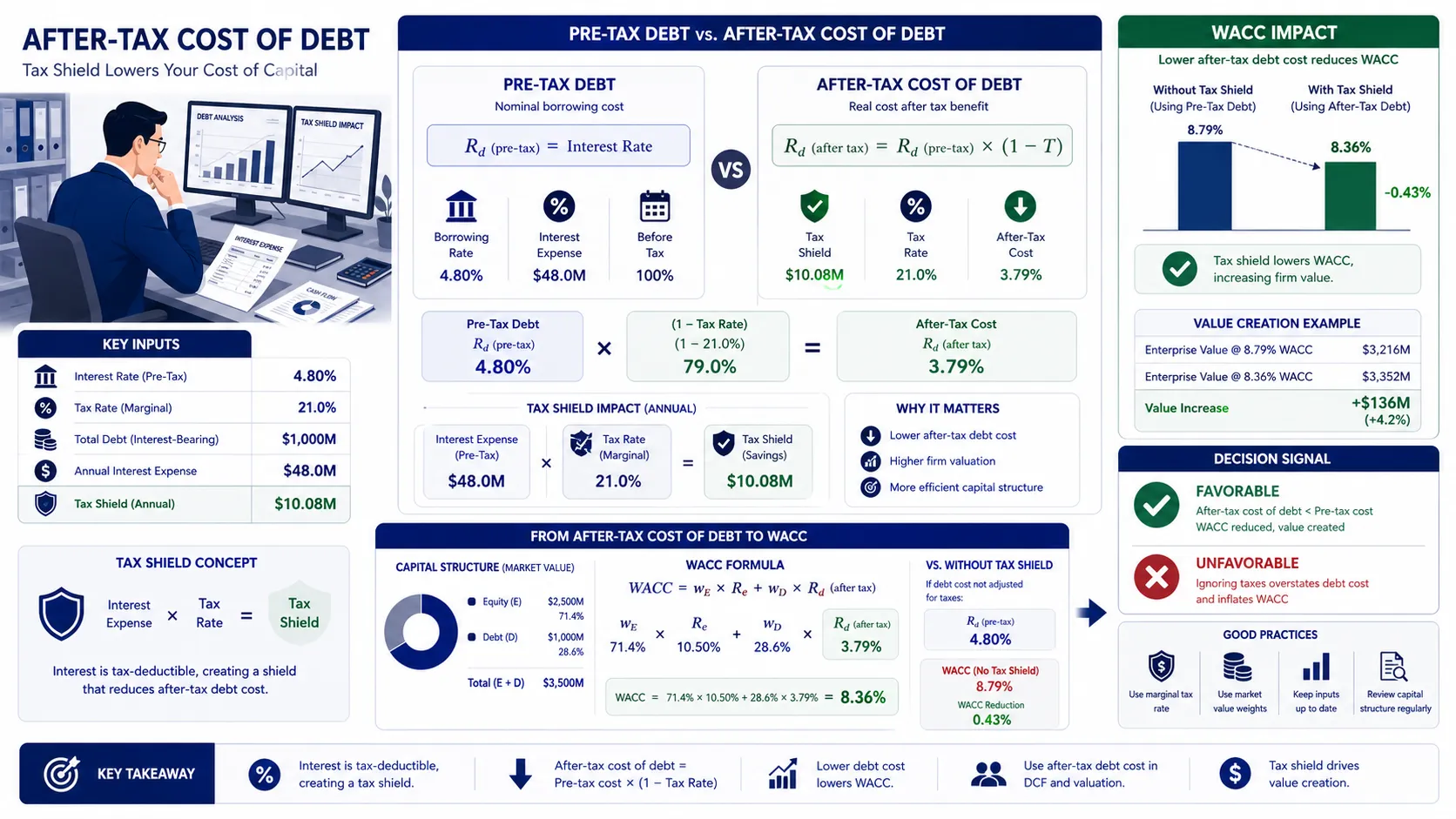
What Is After-Tax Cost of Debt and How Does It Lower WACC?
Interest payments are tax-deductible, making debt cheaper than equity and lowering your company's WACC. The after-tax cost of debt reveals this true, subsidized borrowing rate.
 Corporate Finance
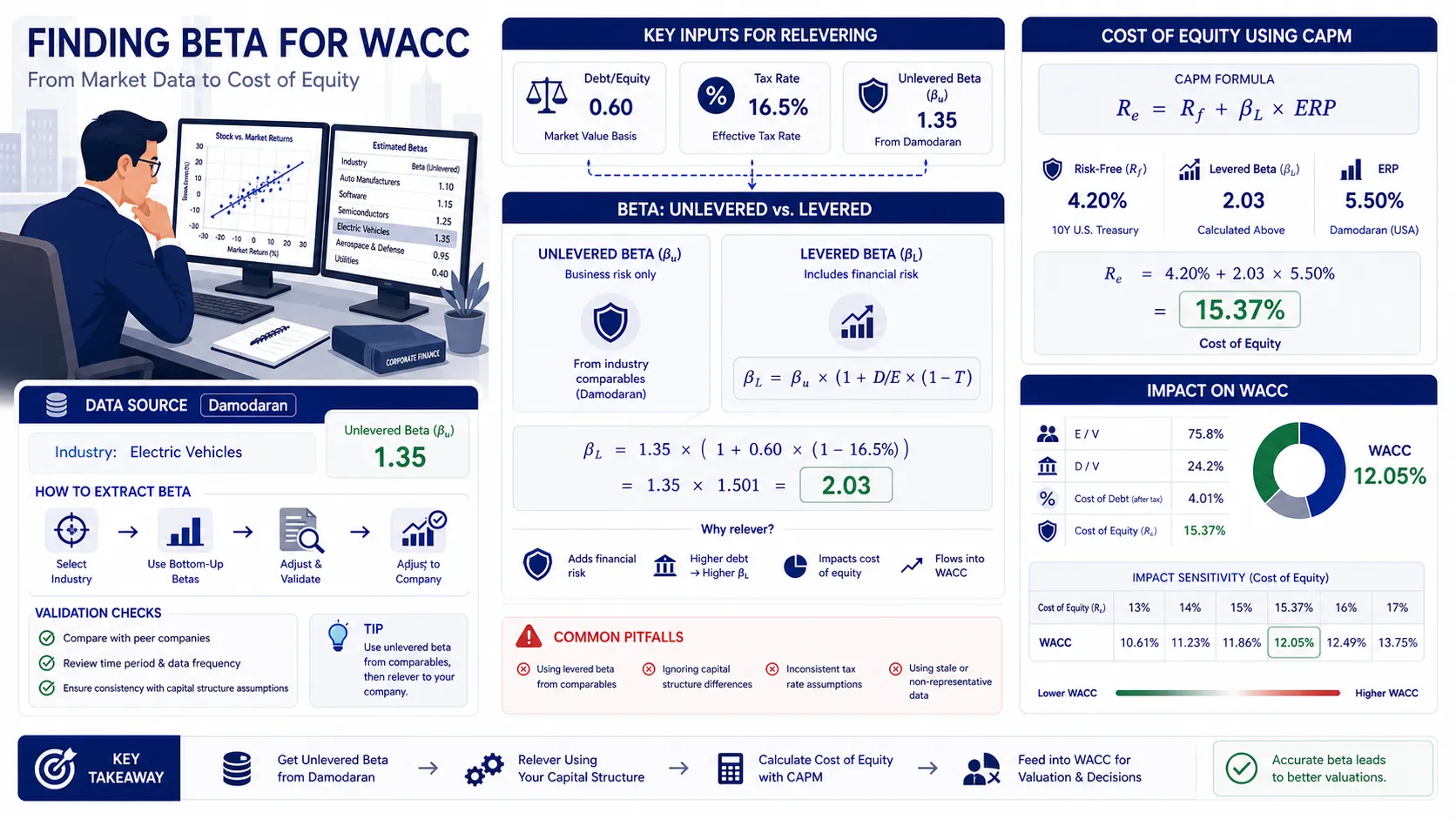
How to Find Beta for WACC: Unlevered vs Levered Beta Calculati
Unlock institutional-grade WACC by mastering bottom-up beta: unlever public peers to strip debt risk, then re-lever for your target's capital structure. This precision method solves CAPM's toughest hurdle, delivering accurate equity risk pricing for DCF models.
Frequently Asked Questions (FAQ)
What does Cash-Free Debt-Free (CFDF) actually mean in M&A?
Why is the Working Capital Adjustment necessary at closing?
What are examples of debt-like items?
How does stock consideration affect deal value calculations?
The calculations, projections, and reports generated by BizToolkitPro are for educational and informational purposes only. They do not represent professional investment advice, financial planning, tax guidance, legal counsel, or formal business valuation.
Financial models and valuation formulas (including WACC, DCF, IRR, and NPV) rely on assumptions and inputs provided directly by the user. Actual financial markets and business metrics fluctuate; therefore, BizToolkitPro makes no warranties, express or implied, regarding the accuracy, completeness, or suitability of the outputs for any investment strategy or corporate decision.
Always perform your own independent diligence and consult with a licensed Financial Analyst, Certified Public Accountant (CPA), or certified valuation specialist before committing capital or executing corporate transactions.