
M&A Deal IRR Calculator: Levered vs Unlevered Returns
Audit transaction investment returns using the premium Deal IRR calculator.
Reconcile levered shareholder equity IRR against unlevered asset deal IRR, audit exit values, and project holding period cash flows with institutional precision.
Have a suggestion or found a calculation discrepancy? Let us know!
How to use this Deal IRR calculator
Key inputs needed for return projections
To construct a leveraged buyout (LBO) cash flow model and determine internal rates of return, collect these parameters from the target's operating model and financing sheet:
- -Enterprise Purchase Price: The total buying enterprise value (net assets plus assumed debt).
- -Debt Financing: The total amount of bank debt or senior notes used to finance the purchase.
- -Initial Equity Investment: The cash outflow paid by target shareholders at close (automatically solved).
- -Annual Cash Flow: The annual free cash distributions projected during the holding period.
- -Holding Period (Years): The planned years of investment holding prior to exit (commonly 3 to 7 years).
- -Exit Enterprise Value & Debt: The projected enterprise value and remaining debt balance at exit.
Interpreting return metrics and multiple charts
The M&A solver outputs levered and unlevered returns to evaluate deal feasibility:
- The Return Bridge Tab: Compares the initial equity investment against total holding period distributions and net exit proceeds.
- Levered IRR Gauge: A color-coded radial meter showing shareholder Equity IRR. Ratios above 20% point to high-return profiles.
- 2D Sensitivity Grid: Evaluates Equity IRR variations across different exit enterprise values and holding periods.
Deal IRR formulas and financial methodology
IRR Calculation Principles
The Internal Rate of Return (IRR) is the discount rate that sets the Net Present Value (NPV) of cash flows to zero:
Unlevered (Deal) cash flows evaluate the project return based on the total enterprise price:
Levered (Equity) cash flows evaluate the shareholder return based on the equity investment:
Levered vs. Unlevered IRR: The Impact of Debt
In mergers and acquisitions, return models separate project-level returns from shareholder-level returns:
Unlevered IRR (Deal IRR): This measures the return of the target business assuming zero debt financing. It reflects the operating quality of the underlying assets. Unlevered IRR is compared directly to the Weighted Average Cost of Capital (WACC) to evaluate project feasibility.
Levered IRR (Equity IRR): This measures the return to the equity shareholders. Because debt financing is cheaper than equity and the interest costs are tax-deductible, adding debt to the capitalization structure (leverage) boosts the shareholder's return. As long as the unlevered IRR exceeds the interest rate on the debt, increasing leverage increases the Levered IRR.
The Money Multiple (Multiple on Invested Capital - MoIC): While IRR measures the annual rate of return (factoring in the timing of cash flows), the Money Multiple measures the total cash return relative to the initial equity check. Sponsors use both metrics: IRR evaluates the speed of returns, while MoIC measures the absolute dollar return of the investment.
M&A return step-by-step example
Leveraged Return Case Study
A private equity fund purchases a target SaaS company for $40M, holding it for 5 years:
| Financial Variable | Value |
|---|---|
| Enterprise Purchase Price | $40,000,000 |
| Debt Financing Issued | $25,000,000 |
| Initial Equity Investment | $15,000,000 |
| Annual Cash Flow | $2,000,000 / Year |
| Exit Enterprise Value | $55,000,000 |
| Exit Debt Outstanding | $15,000,000 |
| Transaction Costs at Exit | $1,500,000 |
| Holding Period | 5 Years |
Reconciliation step-by-step arithmetic
To find the Equity IRR and Money Multiple:
- Step 1: Calculate Exit Equity Value
Exit Equity = Exit EV ($55.0M) - Exit Debt ($15.0M) = $40,000,000. - Step 2: Construct Equity Cash Flows
Year 0: -$15,000,000(initial equity check).Years 1-4: $2,000,000 / Year.Year 5 (exit): $2.0M (CF) + $40.0M (Exit Equity) - $1.5M (Fees) = $40,500,000. - Step 3: Solve for Equity IRRFind the rate `r` setting the cash flow NPV to zero:
0 = -$15M + $2M/(1+r)^1 + ... + $40.5M/(1+r)^5.
Solving gives:Equity IRR = 25.10%. - Step 4: Solve for Money Multiple (MoIC)
Total Distributions = ($2.0M 脳 5) + $40.0M - $1.5M = $48,500,000.Money Multiple = $48,500,000 / $15,000,000 = 3.23x.
The transaction achieves an Equity IRR of 25.10% and a 3.23x money multiple, meaning the fund more than triples its initial equity over the 5-year hold.
What your M&A return results mean
Levered IRR > Unlevered IRR
Indicates positive leverage. The target's operating returns (unlevered IRR) exceed the cost of debt financing, meaning that debt increases shareholder returns.
Levered IRR < Unlevered IRR
Indicates negative leverage. This happens when the cost of debt is higher than the operating returns of the business. In this case, debt reduces shareholder returns, and the buyer should decrease leverage.
Money Multiple vs. IRR
IRR is highly sensitive to time. A short holding period can show a high IRR even with a low MoIC. Conversely, a long hold can show a high MoIC but a lower IRR. Deal teams evaluate both to structure optimal exit timelines.
Strategic use cases of deal IRR
LBO Underwriting
Private equity associates run leverage sensitivity analyses to determine the optimal debt-to-equity ratio that meets the fund's target IRR (typically 20% to 25%).
Strategic corporate acquisitions
Corporate development teams evaluate unlevered deal IRR against the corporate WACC to ensure the transaction creates long-term value for shareholders.
- xIgnoring Exit Debt: Failing to subtract remaining debt from the exit enterprise value, overstating exit equity proceeds.
- xIgnoring Transaction Fees: Underestimating closing fees at entry and exit, which reduces cash flows.
- xAggressive Exit Multiples: Modeling high exit EBITDA multiples that are not supported by industry benchmarks.
Real-world case study: Microsoft Corporation (Illustrative Activision Blizzard Acquisition) (MSFT, FY 2023 (Acquisition))
Microsoft Corporation (Illustrative Activision Blizzard Acquisition) metrics profile
Microsoft completed its landmark acquisition of Activision Blizzard on October 13, 2023, with the total cost amounting to approximately $75.4 billion. This case illustrates a potential Internal Rate of Return (IRR) analysis for such a strategic investment, demonstrating how hypothetical future cash flows and terminal value contribute to overall deal profitability.
This illustrative IRR of 12.0% suggests that, under these hypothetical cash flow projections, Microsoft's acquisition of Activision Blizzard could generate a solid return on investment over a five-year period. For investors, a positive and robust IRR indicates the deal's potential to create significant shareholder value, exceeding the company's cost of capital. Operationally, achieving such an IRR would hinge on successful integration, realizing anticipated synergies from expanded gaming ecosystems, and sustaining growth in the highly competitive gaming market, thereby strengthening Microsoft's strategic position in the industry.
Related Calculators
Estimate weighted average cost of capital.
Open Tool →DCF CalculatorValue a business using discounted cash flows.
Open Tool →NPV CalculatorCompute net present value of cash flows.
Open Tool →IRR CalculatorSolve project internal rates of return.
Open Tool →Free Cash Flow CalculatorEstimate operating free cash flow.
Open Tool →Break-Even ROI CalculatorAnalyze payback thresholds and returns.
Open Tool →Related Articles & Guides
 Corporate Finance
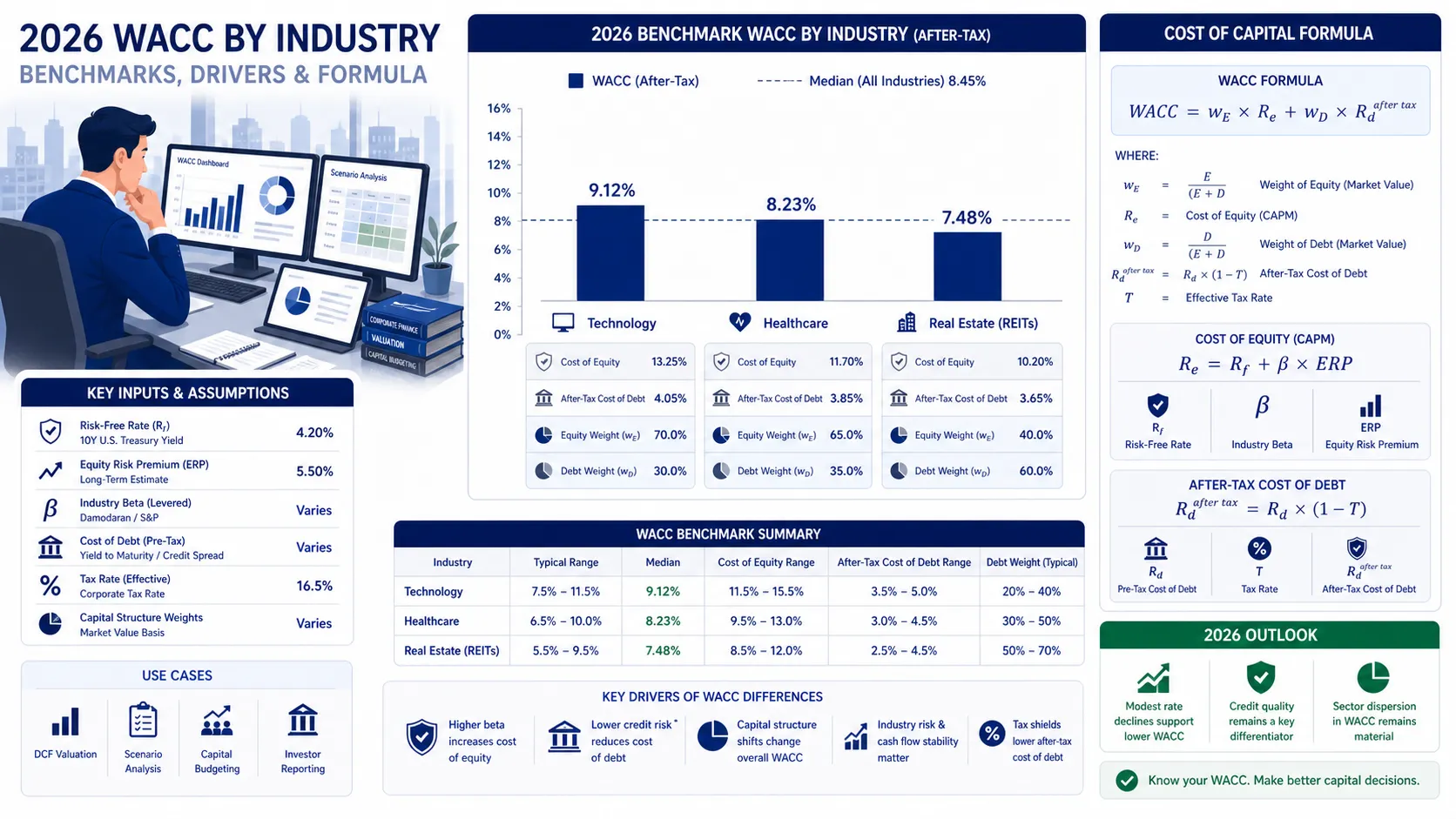
WACC by Industry: 2026 Benchmarks for Technology, Healthcare, and Real Estate
In 2026, industry WACC diverges sharply, from 5.5% for utilities to over 11.5% for software. CFOs must benchmark their discount rate against peers to ground valuations in market reality.
 Corporate Finance
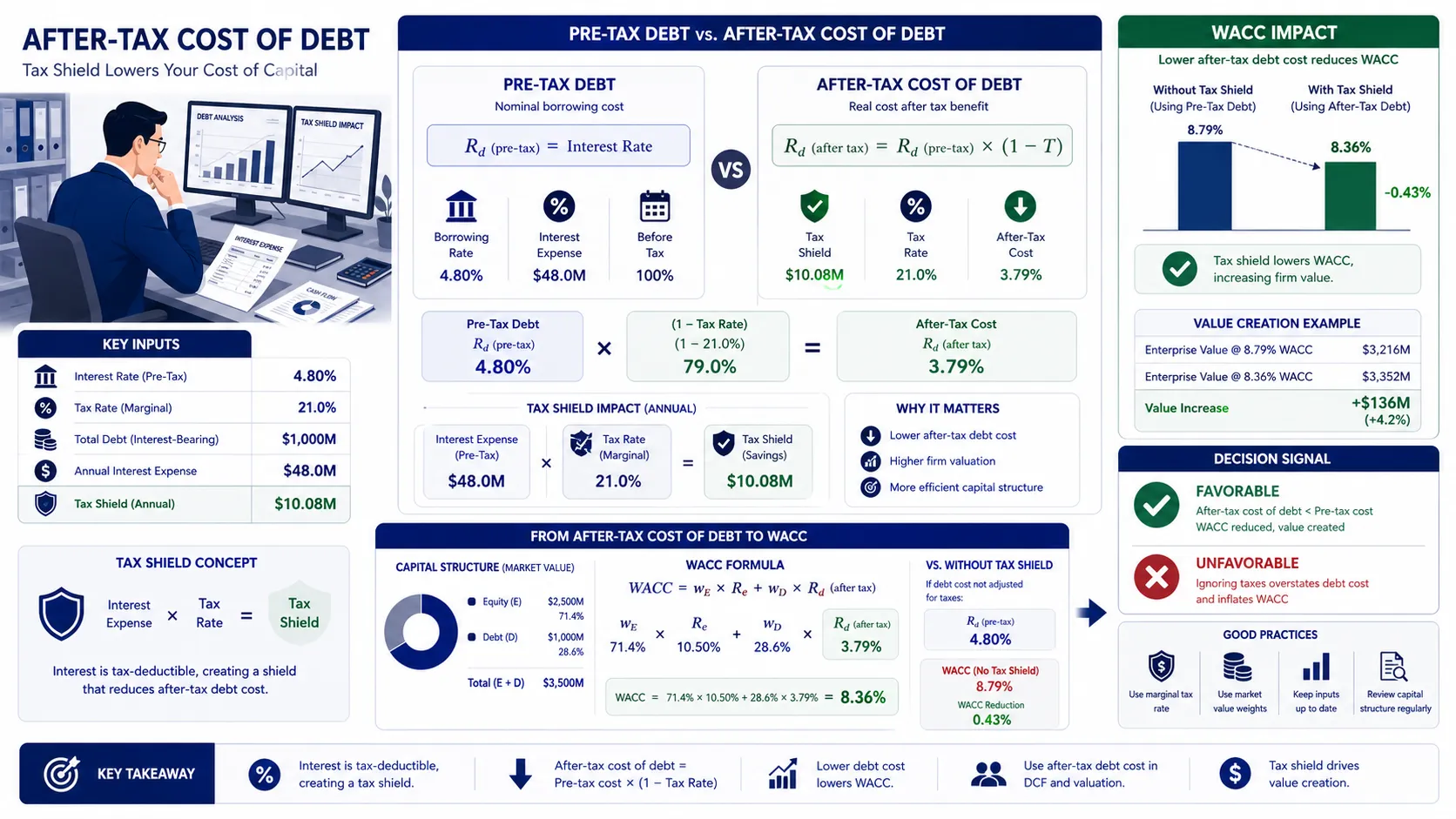
What Is After-Tax Cost of Debt and How Does It Lower WACC?
Interest payments are tax-deductible, making debt cheaper than equity and lowering your company's WACC. The after-tax cost of debt reveals this true, subsidized borrowing rate.
 Corporate Finance
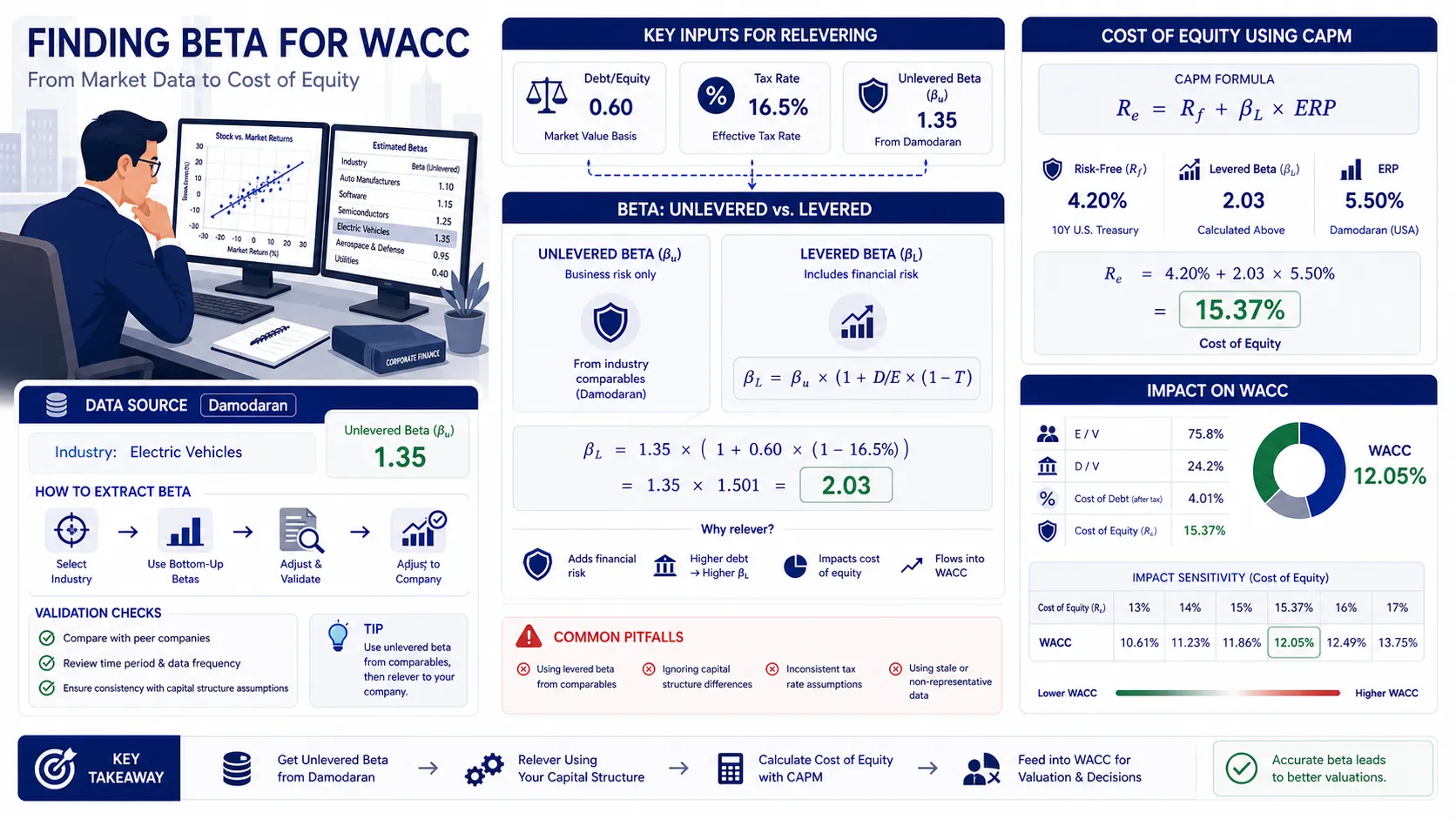
How to Find Beta for WACC: Unlevered vs Levered Beta Calculati
Unlock institutional-grade WACC by mastering bottom-up beta: unlever public peers to strip debt risk, then re-lever for your target's capital structure. This precision method solves CAPM's toughest hurdle, delivering accurate equity risk pricing for DCF models.
Frequently Asked Questions (FAQ)
What is the difference between levered and unlevered IRR?
Why is the money multiple (MoIC) important alongside IRR?
How does debt paydown affect exit equity returns?
What is a good target IRR for a private equity transaction?
The calculations, projections, and reports generated by BizToolkitPro are for educational and informational purposes only. They do not represent professional investment advice, financial planning, tax guidance, legal counsel, or formal business valuation.
Financial models and valuation formulas (including WACC, DCF, IRR, and NPV) rely on assumptions and inputs provided directly by the user. Actual financial markets and business metrics fluctuate; therefore, BizToolkitPro makes no warranties, express or implied, regarding the accuracy, completeness, or suitability of the outputs for any investment strategy or corporate decision.
Always perform your own independent diligence and consult with a licensed Financial Analyst, Certified Public Accountant (CPA), or certified valuation specialist before committing capital or executing corporate transactions.