
M&A Accretion Dilution Calculator: Pro Forma EPS Modeler
Evaluate post-transaction earnings performance using the premium Accretion Dilution calculator.
Model the impact of stock dilution, cash payments, debt interest burdens, and operational synergies on merged company Earnings Per Share (EPS).
Have a suggestion or found a calculation discrepancy? Let us know!
How to use this M&A accretion dilution calculator
Key inputs you need before starting your EPS audit
To run a pro forma transaction review, gather the following operating metrics from both the buyer and target financials, as well as the proposed acquisition term sheet:
- -Buyer Financials: Acquirer's annual net income, total shares outstanding, and current share price.
- -Target Financials: Target's annual net income and the purchase price agreed in the letter of intent.
- -Financing Mix: The split of the purchase price into cash payments, stock consideration, and new debt issued.
- -After-Tax Interest Cost: Net interest expense on new debt (reduced by the corporate tax shield).
- -Adjustments: Estimated annual after-tax operational synergies and one-time transaction fees.
Interpreting accretion dilution charts and outputs
The calculator provides a detailed breakdown of the transaction's financial impact:
- The Swing Dial: Immediately shows the percentage change in EPS, indicating whether the deal is accretive (green swing) or dilutive (red swing).
- EPS Comparison Bridge: A visual bar chart comparing standalone buyer EPS to pro forma combined EPS.
- 2D Sensitivity: A matrix showing how the accretion/dilution percentage changes as synergies and debt interest costs fluctuate.
- Scenario Analysis: Compares results under high-synergy and high-interest rate scenarios to identify potential risks.
M&A accretion dilution formulas and financial methodology
Formula Principles
Standalone Earnings Per Share (EPS) for the buyer is calculated as:
Pro Forma Combined Net Income adds target earnings and synergies, while subtracting new interest and fees:
Pro Forma Shares includes new shares issued for stock consideration:
Understanding Accretion & Dilution in Mergers
An acquisition is accretive if the pro forma combined EPS is higher than the acquirer's standalone EPS. It is dilutive if the pro forma EPS falls below the standalone figure.
The EPS Drivers: Three main factors determine the earnings impact of a deal:
- The Target's Standalone Earnings: The net income of the target company immediately adds to the combined entity's earnings.
- Acquisition Synergies: Cost savings and revenue enhancements increase pro forma net income, improving the accretion profile.
- Transaction Costs and Financing: Debt interest expenses and transaction fees reduce net income. More importantly, using stock to finance the deal increases the total share count, diluting earnings.
P/E Multiples and Dilution: As a general rule of thumb, if an acquirer buys a target with a lower Price-to-Earnings (P/E) multiple using 100% stock, the transaction is accretive. If the target has a higher P/E multiple, the transaction is dilutive unless significant synergies are achieved to offset the premium paid.
Accretion dilution step-by-step example
EPS Impact Case Study
Acquirer Corp proposes to buy Target Ltd for $40M. Financial details include:
| Financial Category | Value |
|---|---|
| Buyer Net Income | $25,000,000 |
| Buyer Shares Outstanding | 5,000,000 Shares |
| Buyer Share Price | $50.00 |
| Target Net Income | $6,000,000 |
| Stock Consideration Issued | $20,000,000 |
| New Debt Issued | $10,000,000 |
| After-Tax Interest Cost (6%) | $600,000 |
| After-Tax Synergies | $1,500,000 |
| Transaction Costs (After-Tax) | $800,000 |
Step-by-step pro forma calculations
Follow these steps to determine the accretion or dilution percentage of the deal:
- Step 1: Calculate Standalone Buyer EPS
Standalone EPS = $25,000,000 Net Income / 5,000,000 Shares = $5.00 per share. - Step 2: Calculate Pro Forma Combined Shares
New Shares Issued = $20,000,000 Stock Consideration / $50.00 Share Price = 400,000 Shares.Pro Forma Shares = 5,000,000 + 400,000 = 5,400,000 Shares. - Step 3: Calculate Pro Forma Combined Net Income
Pro Forma Net Income = Buyer Net Income ($25.0M) + Target Net Income ($6.0M) + Synergies ($1.5M) - Interest ($0.6M) - Fees ($0.8M) = $31,100,000. - Step 4: Solve for Pro Forma EPS & Accretion %
Pro Forma EPS = $31,100,000 / 5,400,000 Shares = $5.76 per share.EPS Variance = ($5.76 - $5.00) / $5.00 = +15.19%.
The transaction is accretive by 15.19%, adding $0.76 per share to the buyer's earnings.
What your M&A EPS results mean
Accretive Deals (Positive Swings)
Accretive deals increase the buyer's earnings per share. This is generally well-received by public markets and can lead to an increase in the buyer's share price post-announcement.
Dilutive Deals (Negative Swings)
Dilutive deals reduce the buyer's EPS, often due to high share dilution or debt financing costs. This can result in selling pressure on the buyer's stock unless the long-term strategic benefits are clear.
Break-Even Synergies
This represents the minimum synergies required to make the transaction EPS neutral. If target synergies fall below this level, the transaction becomes dilutive.
Strategic use cases of accretion dilution analysis
Corporate Board Presentations
CFOs present accretion/dilution analyses to corporate boards to justify the transaction structure, comparing stock dilution against debt capacity constraints.
Equity Research: Estimating Share Price Impact
Sell-side research analysts run independent models to predict post-merger EPS, adjusting their recommendations based on estimated synergy realization.
- xIgnoring Stock Dilution: Underestimating the impact of newly issued shares on the total share count.
- xOverestimating Synergy Timelines: Modeling 100% of synergies on day one instead of using a realistic ramp.
- xIgnoring Transaction Fees: Underestimating banker, audit, and legal fees, which reduce net income.
Real-world case study: Microsoft Corporation (MSFT, FY 2024)
Microsoft Corporation metrics profile
Microsoft's significant acquisition of Activision Blizzard, a major video game developer and publisher, was completed in October 2023, marking a strategic expansion into the gaming industry. This all-cash transaction was closely scrutinized for its potential impact on Microsoft's financial performance. Following the acquisition, Microsoft reported an immediate, albeit temporary, dilutive effect on its earnings per share.
Microsoft's acquisition of Activision Blizzard, while strategically significant for bolstering its position in the gaming market and expanding its Game Pass ecosystem, resulted in a reported $0.04 per share dilution to EPS in Q1 FY24. This short-term dilution is often a consequence of large, cash-financed acquisitions due to factors such as increased interest expense from debt financing, foregone interest income on cash used, and integration costs, which can outweigh the acquired company's net income contribution in the initial phases. For investors, this suggests a trade-off where immediate earnings take a slight hit for anticipated long-term strategic gains, including increased market share, diversified revenue streams, and potential future synergies. The company expects the dilutive impact to continue for the balance of the fiscal year, indicating a focus on long-term value creation over immediate EPS enhancement.
Related Calculators
Estimate weighted average cost of capital.
Open Tool →DCF CalculatorValue a business using discounted cash flows.
Open Tool →NPV CalculatorCompute net present value of cash flows.
Open Tool →IRR CalculatorSolve project internal rates of return.
Open Tool →Free Cash Flow CalculatorEstimate operating free cash flow.
Open Tool →Break-Even ROI CalculatorAnalyze payback thresholds and returns.
Open Tool →Related Articles & Guides
 Corporate Finance
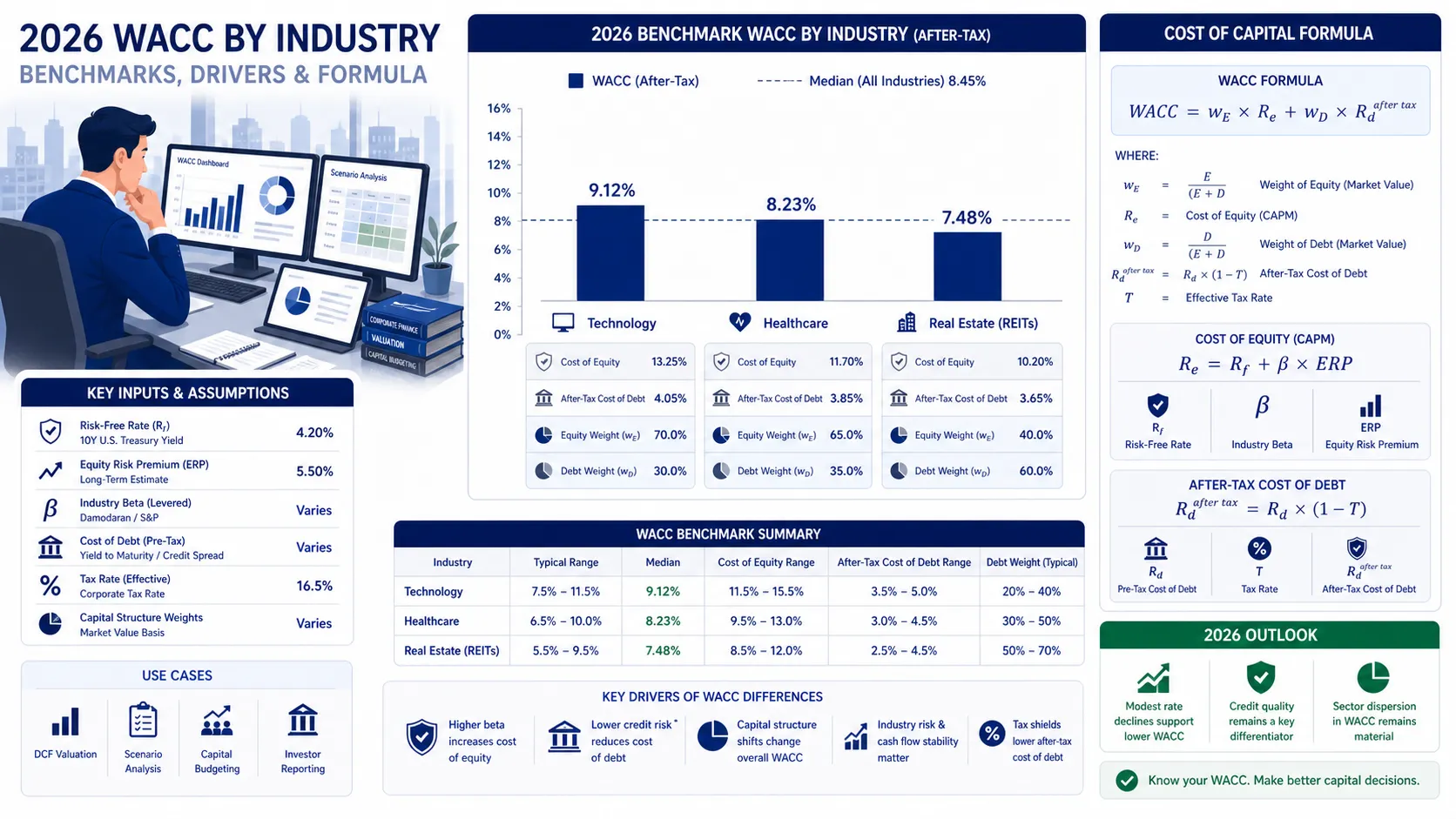
WACC by Industry: 2026 Benchmarks for Technology, Healthcare, and Real Estate
In 2026, industry WACC diverges sharply, from 5.5% for utilities to over 11.5% for software. CFOs must benchmark their discount rate against peers to ground valuations in market reality.
 Corporate Finance
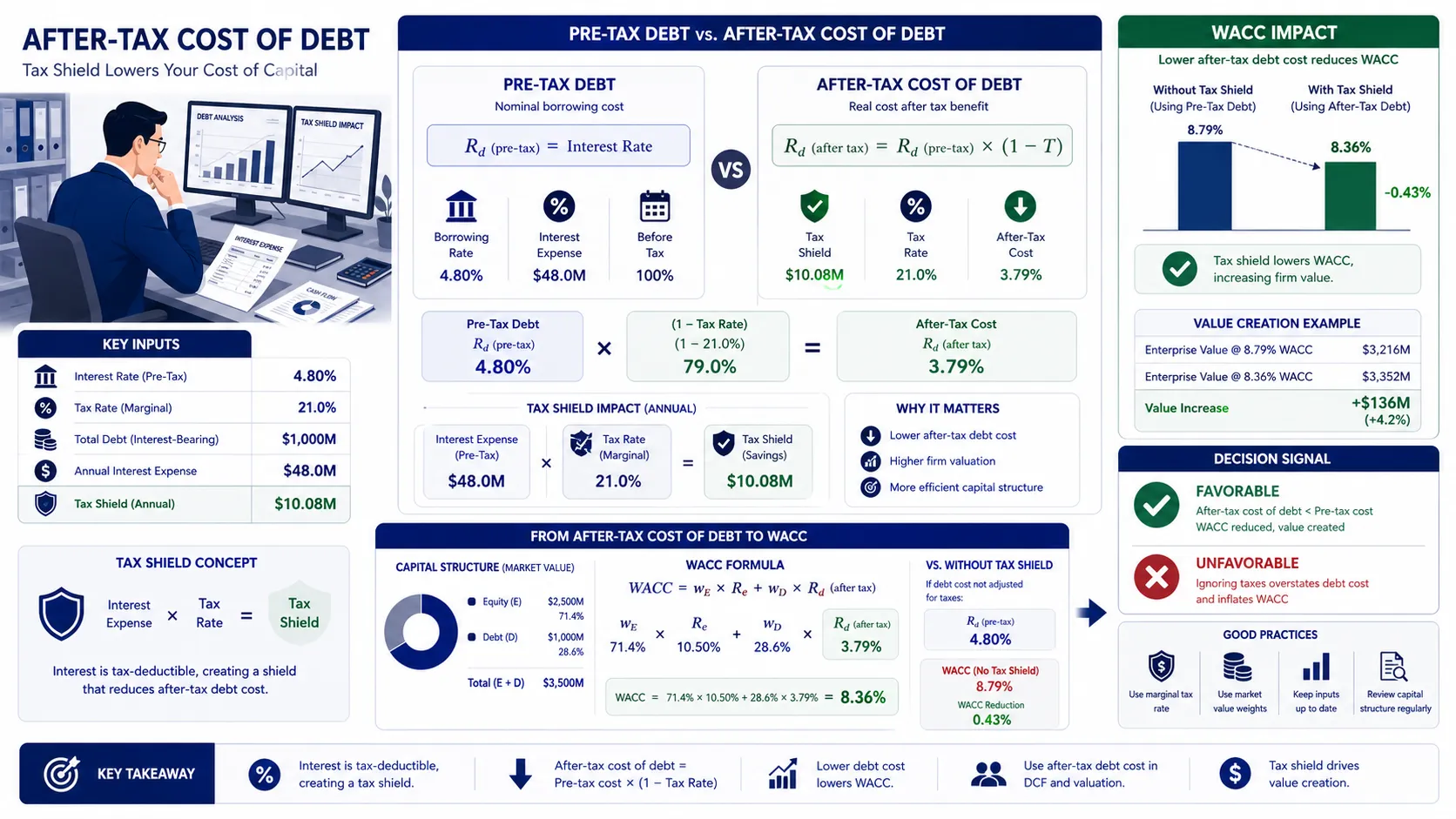
What Is After-Tax Cost of Debt and How Does It Lower WACC?
Interest payments are tax-deductible, making debt cheaper than equity and lowering your company's WACC. The after-tax cost of debt reveals this true, subsidized borrowing rate.
 Corporate Finance
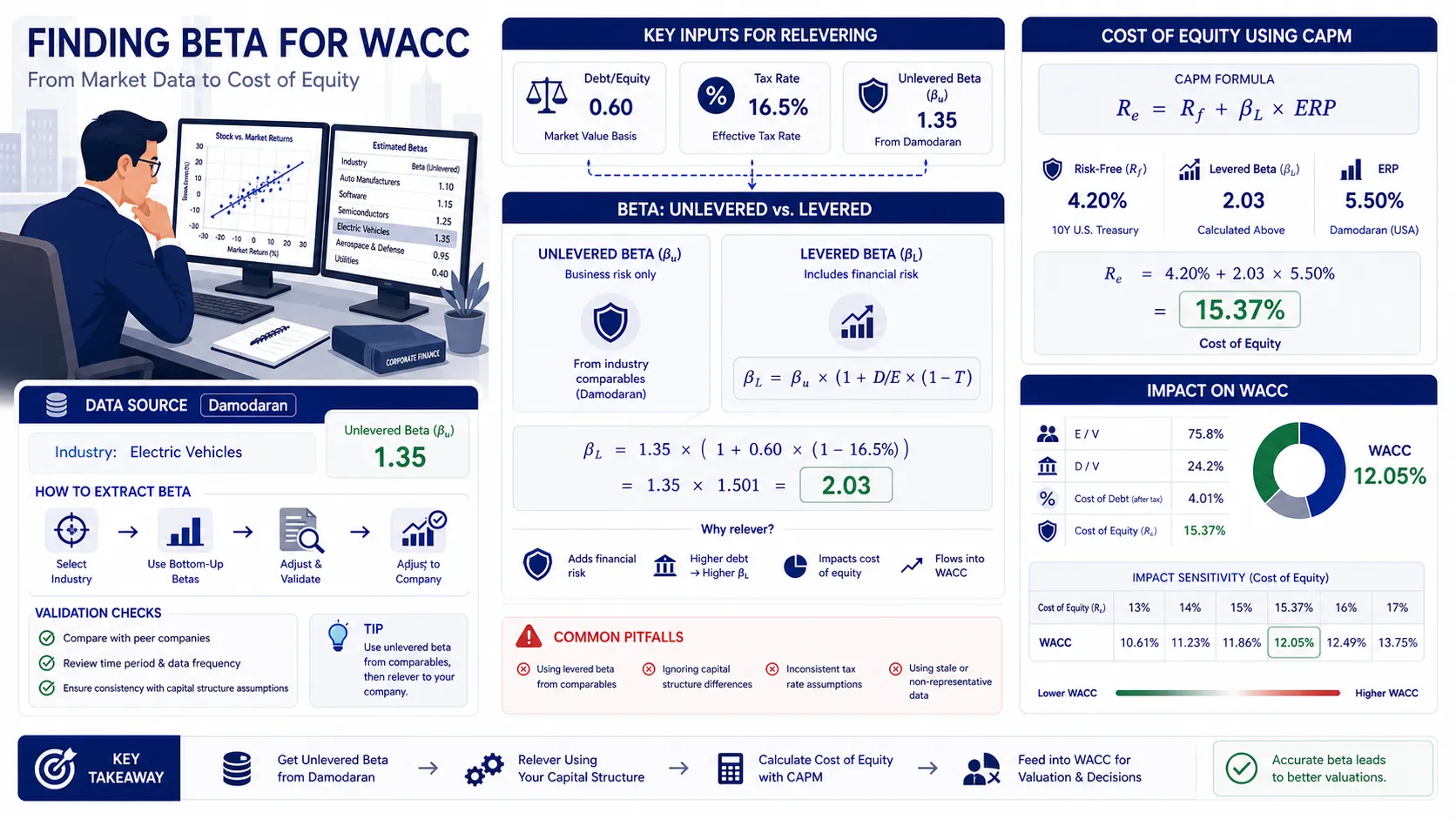
How to Find Beta for WACC: Unlevered vs Levered Beta Calculati
Unlock institutional-grade WACC by mastering bottom-up beta: unlever public peers to strip debt risk, then re-lever for your target's capital structure. This precision method solves CAPM's toughest hurdle, delivering accurate equity risk pricing for DCF models.
Frequently Asked Questions (FAQ)
Why is an accretive transaction generally preferred?
Can a dilutive transaction still be strategically sound?
How does using stock instead of cash affect accretion/dilution?
What are break-even synergies?
The calculations, projections, and reports generated by BizToolkitPro are for educational and informational purposes only. They do not represent professional investment advice, financial planning, tax guidance, legal counsel, or formal business valuation.
Financial models and valuation formulas (including WACC, DCF, IRR, and NPV) rely on assumptions and inputs provided directly by the user. Actual financial markets and business metrics fluctuate; therefore, BizToolkitPro makes no warranties, express or implied, regarding the accuracy, completeness, or suitability of the outputs for any investment strategy or corporate decision.
Always perform your own independent diligence and consult with a licensed Financial Analyst, Certified Public Accountant (CPA), or certified valuation specialist before committing capital or executing corporate transactions.