
Quick Ratio Calculator for Acid-Test Solvency Analysis
Evaluate immediate corporate liquidity using the Quick Ratio calculator (Acid-Test solver).
This professional tool calculates standard, adjusted, and cash ratios, stripping away inventory and accounts receivable discounts to assess core operational solvency under cash stress conditions.
Have a suggestion or found a calculation discrepancy? Let us know!
How to use this quick ratio calculator
Inputs you need before calculating quick assets
To run a precise acid-test solvency assessment, gather the following metrics from your company's balance sheet:
- •Cash & Equivalents: Unrestricted checking, savings, and short-term capital account deposits.
- •Marketable Securities: High-velocity trade papers, government bonds, or T-bills convertible within 90 days.
- •Accounts Receivable: Gross outstanding customer invoices currently due under normal terms.
- •Doubtful Receivables: Haircut allowance for unpaid client accounts with a high likelihood of default.
- •Restricted Cash: Cash pledged for escrow, capital projects, or bank lending covenants.
- •Current Liabilities: Accounts payable, short-term notes, and accrued operations costs (taxes, employee wages).
Interpreting standard vs adjusted quick ratio results
After entering your data and clicking "Calculate Solvency", evaluate these key results:
- Standard Quick Ratio: Evaluates your baseline liquidity by comparing liquid cash, marketable securities, and accounts receivable against immediate debt.
- Adjusted Quick Ratio: This represents a critical solvency indicator. It automatically deducts doubtful receivables (accounts receivable haircut) and restricted cash balances, ensuring credit line underwriters evaluate real deployable assets.
- The Cash Ratio: A hyper-conservative solvency measure that drops accounts receivable entirely. It solves for the worst-case scenario where customer collections drop to zero, leaving only cash and marketable securities to pay short-term bills.
Quick ratio formula and methodology
Solvency Formula Suite
The Standard Quick Ratio (Acid-Test) excludes slow-moving warehouse inventory. It is formulated as:
To apply accounts receivable haircuts and adjust for restricted reserves:
The Cash Ratio strips away all non-cash short-term receivables:
Asset speed vs current liabilities
In financial analysis, liquidity is defined by speed. The standard Current Ratio includes inventory, assuming it can be sold at book value to satisfy current debt. However, in retail, automotive, and heavy manufacturing, warehousing inventory represents a slow-moving asset class. In the event of a sudden credit squeeze or downturn, selling off inventory often requires deep discounts, which destroys asset values.
To address this risk, the Quick Ratio (or Acid-Test) strips away inventory entirely. It assumes the firm must cover current liabilities using assets that can be converted into cash in 90 days or less.
However, accounts receivable carries its own risk. Extended payment terms, customer disputes, and defaults mean accounts receivable is rarely collected at 100% value. Applying a "haircut" by subtracting doubtful accounts receivable ensures your liquidity buffer reflects real-world cash flow. Deducting restricted cash balances pledged for bank covenants further sharpens the accuracy of the solvency index.
Quick ratio example calculation
Corporate Solvency Modeling Scenario
Consider a business with the following balance sheet balances:
| Financial Parameter | Value (USD) |
|---|---|
| Cash & Cash Equivalents | $150,000 |
| Marketable Securities | $50,000 |
| Accounts Receivable | $100,000 |
| Current Liabilities | $200,000 |
| Doubtful Receivables (Haircut) | $10,000 |
| Restricted Escrow Cash | $20,000 |
Arithmetic resolution workflow
Calculate the standard, adjusted, and cash ratios step-by-step:
- Step 1: Calculate Standard Quick Assets
Standard Assets = $150,000 + $50,000 + $100,000 = $300,000.Standard Quick Ratio = $300,000 / $200,000 = 1.50x. - Step 2: Solve for Adjusted Quick AssetsDeduct restricted escrow cash and doubtful client receivables:
Adjusted Assets = ($150,000 - $20,000) + $50,000 + ($100,000 - $10,000) = $270,000. - Step 3: Solve for the Adjusted Quick Ratio
Adjusted Quick Ratio = $270,000 / $200,000 = 1.35x. - Step 4: Solve for Cash Ratio
Cash Ratio = ($150,000 + $50,000) / $200,000 = 1.00x.
In this scenario, all ratios exceed the 1.0x safety benchmark, indicating the business has a solid liquidity margin even when inventory is ignored.
What your quick ratio result means
Ratios above 1.0x (Sufficient)
A quick ratio above 1.0x is the standard benchmark target. It indicates that the firm possesses more liquid assets than current liabilities. It can satisfy all immediate obligations using available cash and cash-like assets, without being forced to sell inventory.
Ratios from 0.5x to 1.0x (Caution)
A ratio in this range indicates that the firm's immediate liquidity buffer is thin. While the company may appear healthy when inventory is included (via the current ratio), it relies heavily on inventory turnover and client payments to clear immediate bills.
Ratios below 0.5x (Distressed)
A quick ratio below 0.5x indicates significant liquidity risks. The company lacks cash and receivables to cover immediate bills, meaning any operational hiccup or collection delays could cause a technical default.
Quick ratio use cases for startups, SaaS, and private companies
SaaS & Tech Startups: High Liquidity Profile
Startups operating in the SaaS sector rarely carry physical inventories, which means their current and quick ratios are often identical. However, high deferred revenue balances under liabilities can distort standard liquidity metrics. Since deferred revenue is non-cash, it should be adjusted to evaluate true quick-solvency.
Private Corporate Credit: Financial Covenants
In private company credit agreements, commercial lenders typically enforce a minimum quick ratio covenant (e.g., 1.00x). Falling below this threshold triggers a default event, giving lenders the right to demand repayment. Private firms must monitor their quick ratio margins regularly.
- ✓Including Inventory: Using current assets instead of quick assets.
- ✓Failing to Adjust for Restricted Cash: Counting locked escrow cash reserves as general operational cash.
- ✓Carrying Doubtful Accounts at Face Value: Forgetting to subtract delinquent invoices.
Real-world case study: Apple Inc. (AAPL, FY 2023)
Apple Inc. metrics profile
Apple Inc. (AAPL) is a global technology company known for its consumer electronics, software, and online services. This analysis examines Apple's liquidity position at the end of its fiscal year 2023 by calculating its Quick Ratio, offering insights into its ability to meet short-term obligations using highly liquid assets.
Apple's Quick Ratio of 0.63 for fiscal year 2023 indicates that the company has $0.63 in highly liquid assets for every dollar of current liabilities. While generally a ratio of 1.0 or higher is considered healthy, Apple's strong brand, consistent cash flows, and significant non-current marketable securities (which are not included in this calculation but contribute to overall liquidity) allow it to operate effectively with a lower quick ratio. For investors and analysts, this ratio suggests that Apple relies on the continuous generation of cash from its operations and the efficient management of its inventory (which is excluded from the quick ratio) to meet its short-term obligations, rather than solely on its most liquid assets.
Related Calculators
Estimate weighted average cost of capital.
Open Tool →DCF CalculatorValue a business using discounted cash flows.
Open Tool →NPV CalculatorCompute net present value of cash flows.
Open Tool →IRR CalculatorSolve project internal rates of return.
Open Tool →Free Cash Flow CalculatorEstimate operating free cash flow.
Open Tool →Break-Even ROI CalculatorAnalyze payback thresholds and returns.
Open Tool →Related Articles & Guides
 Corporate Finance
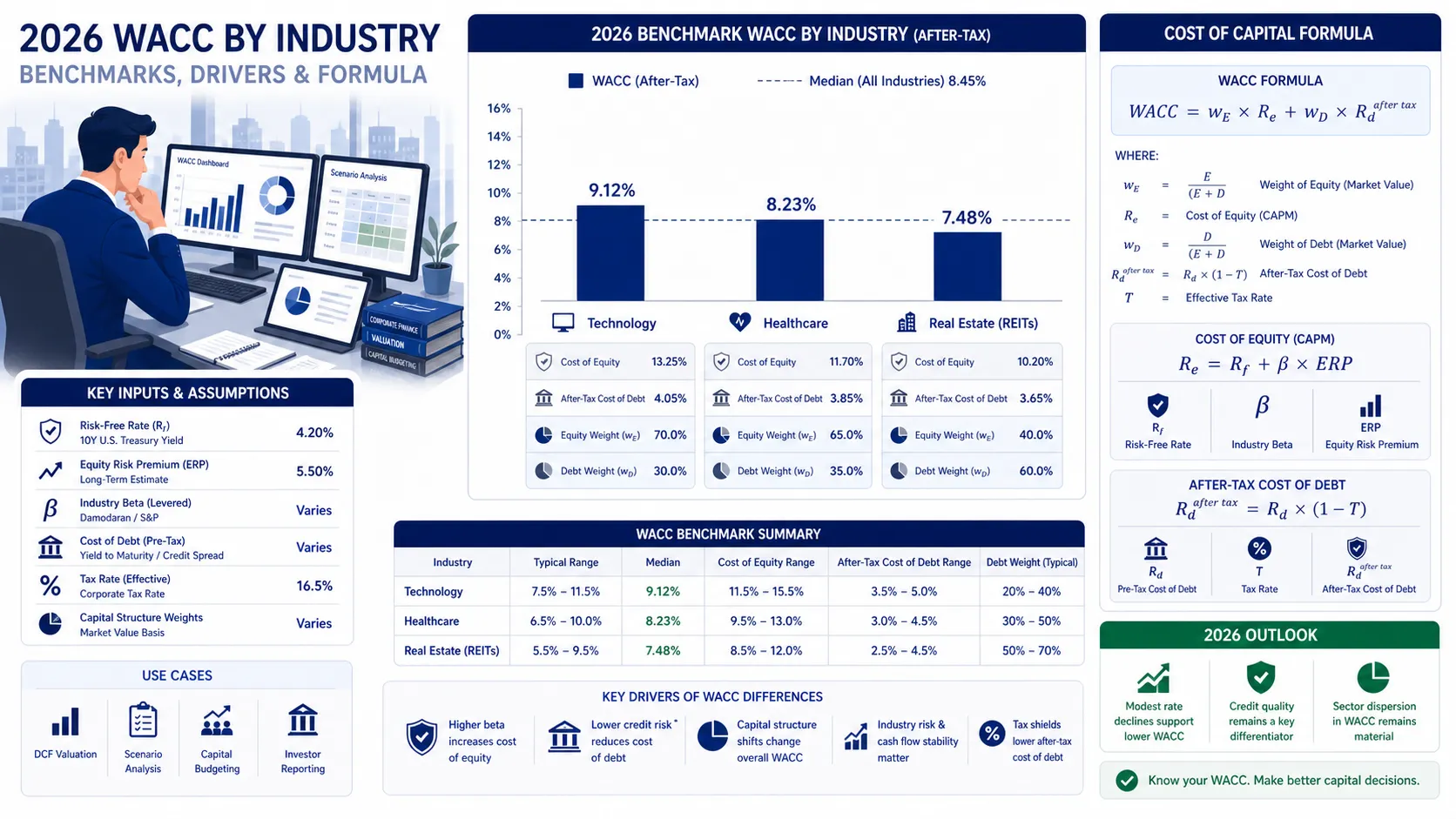
WACC by Industry: 2026 Benchmarks for Technology, Healthcare, and Real Estate
In 2026, industry WACC diverges sharply, from 5.5% for utilities to over 11.5% for software. CFOs must benchmark their discount rate against peers to ground valuations in market reality.
 Corporate Finance
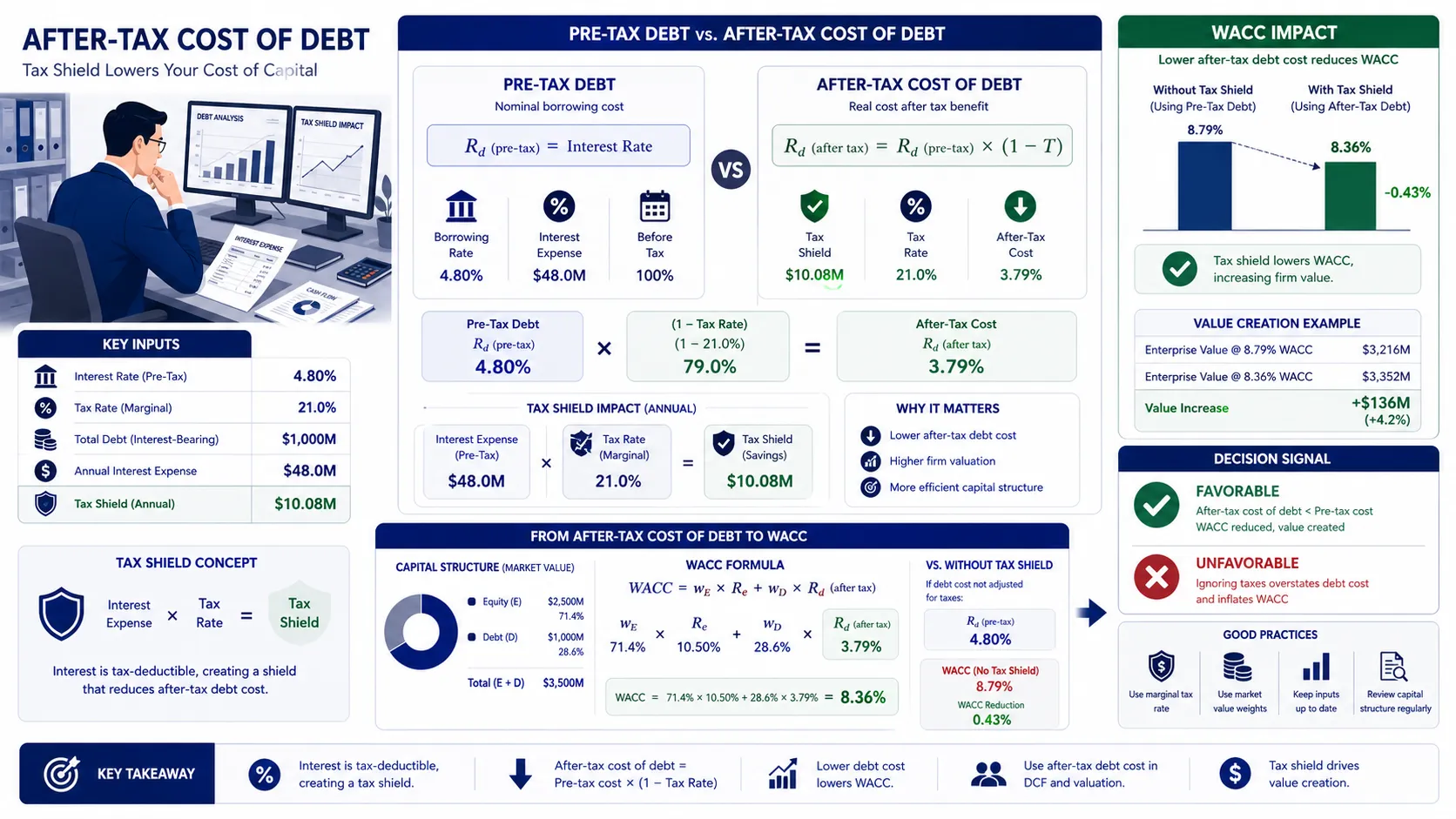
What Is After-Tax Cost of Debt and How Does It Lower WACC?
Interest payments are tax-deductible, making debt cheaper than equity and lowering your company's WACC. The after-tax cost of debt reveals this true, subsidized borrowing rate.
 Corporate Finance
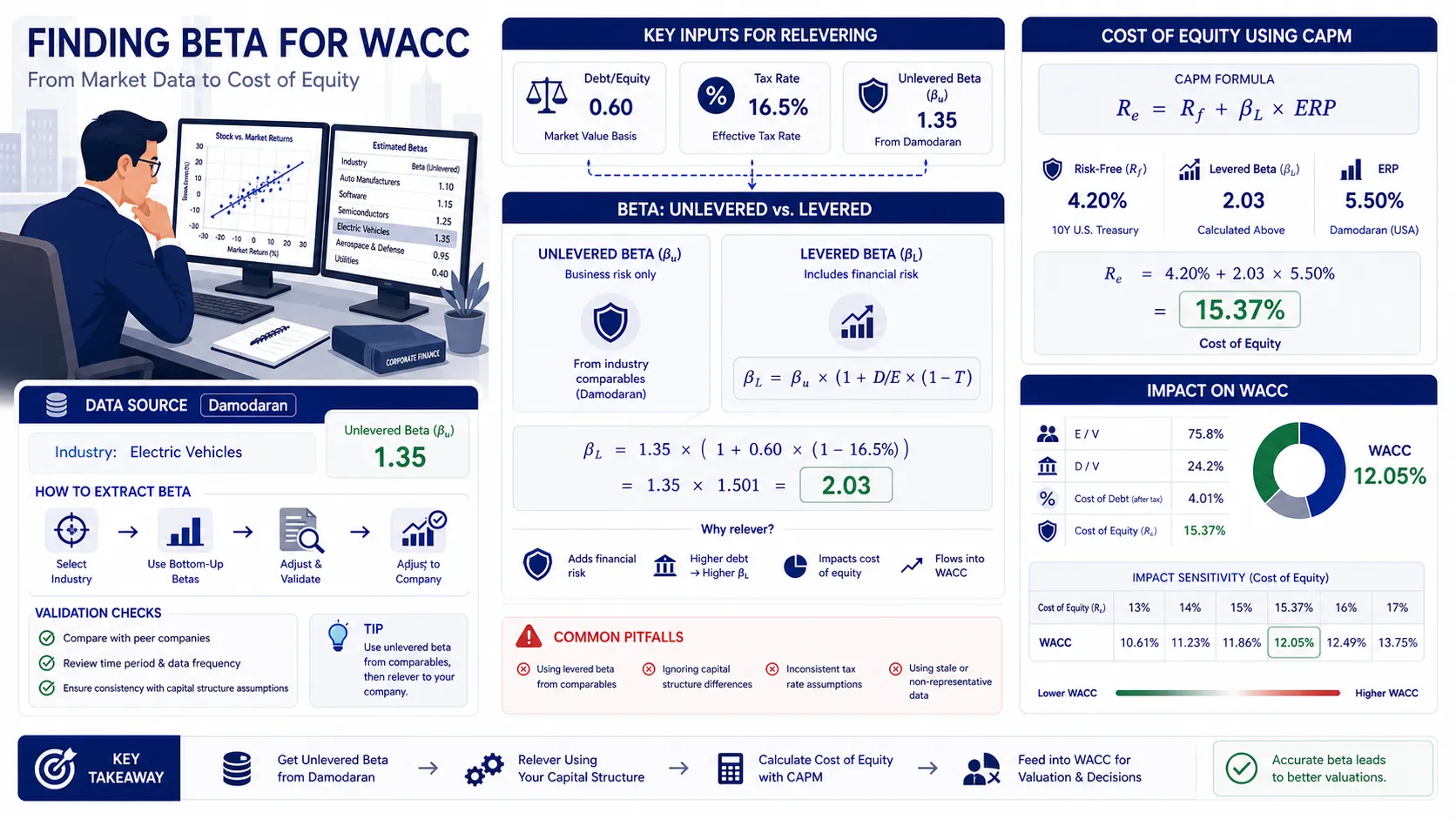
How to Find Beta for WACC: Unlevered vs Levered Beta Calculati
Unlock institutional-grade WACC by mastering bottom-up beta: unlever public peers to strip debt risk, then re-lever for your target's capital structure. This precision method solves CAPM's toughest hurdle, delivering accurate equity risk pricing for DCF models.
Frequently Asked Questions (FAQ)
What is a good quick ratio target for a private business?
How does the cash ratio differ from the quick ratio?
Why should restricted cash be deducted from the quick ratio?
The calculations, projections, and reports generated by BizToolkitPro are for educational and informational purposes only. They do not represent professional investment advice, financial planning, tax guidance, legal counsel, or formal business valuation.
Financial models and valuation formulas (including WACC, DCF, IRR, and NPV) rely on assumptions and inputs provided directly by the user. Actual financial markets and business metrics fluctuate; therefore, BizToolkitPro makes no warranties, express or implied, regarding the accuracy, completeness, or suitability of the outputs for any investment strategy or corporate decision.
Always perform your own independent diligence and consult with a licensed Financial Analyst, Certified Public Accountant (CPA), or certified valuation specialist before committing capital or executing corporate transactions.