
Current Ratio Calculator for Institutional Solvency Analysis
Welcome to the premium Current Ratio calculator, an institutional-grade solvency tool engineered to evaluate corporate liquidity safety.
This utility calculates the standard current ratio alongside adjusted current ratios that exclude restricted cash and slow-moving inventories, generating a 2D sensitivity matrix and dynamic stress scenarios.
Have a suggestion or found a calculation discrepancy? Let us know!
How to use this current ratio calculator
Inputs you need before calculating solvency
To execute a comprehensive liquidity stress test, gather the following key balance sheet records representing short-term assets and current liabilities:
- •Current Assets: Total liquid resources convertible into cash within 12 months, including cash, marketable securities, trade accounts receivable, and inventory values.
- •Current Liabilities: All obligations coming due within 1 year, including trade accounts payable, short-term debt, and accrued expenses.
- •Restricted Cash: Cash balances held in escrow or restricted by bank debt covenants, which cannot be deployed for general operations.
- •Slow-Moving Inventory: Work-in-progress or warehouse stock unlikely to clear within 90 days, which represents a liquidity drag.
- •Short-Term Debt & Accrued Liabilities: Bank overdrafts, short-term notes, and unpaid accrued operating costs (taxes, wages).
Interpreting the solvency dashboard and matrix
Once you input the metrics and click "Calculate Solvency", the client dashboard outputs three dimensions of risk:
- The Solvency Gauge: A color-coded radial meter mapping your current ratio against industry safety levels (Weak, Warning, Healthy, or Excellent).
- Adjusted Current Ratio: A conservative solvency metric that automatically strips away restricted cash and illiquid stock, highlighting the true core cash buffer.
- 2D Sensitivity Grid: An interactive matrix illustrating how the current ratio swings under 80% to 120% shifts in asset values and liabilities, letting you spot credit risks before they happen.
Current ratio formula and methodology
Mathematical Framework
The Current Ratio measures a company's ability to cover its short-term obligations with its short-term assets. It is mathematically formulated as:
To account for asset quality and restrictions, the Adjusted Current Ratio is derived by deducting restricted cash and slow-moving stock:
Net Working Capital (NWC) measures the absolute dollar buffer:
Asset quality and restricted cash adjustments
In corporate finance, not all current assets are created equal. A business might report a high current ratio on its balance sheet, but still face an imminent cash flow crunch. This discrepancy usually arises from two factors: restricted cash and slow-moving inventory.
Restricted cash is often pledged as collateral for debt covenants, construction project escrows, or letters of credit. Because it cannot be deployed to pay down immediate accounts payable or payroll, including it in standard liquidity calculations yields an overly optimistic solvency view.
Similarly, inventory carries substantial liquidation risk. Warehouse stock of outdated electronic components, seasonal garments, or work-in-progress materials cannot be converted into cash within a standard operating cycle without severe write-downs. Under stress, lenders and auditors focus on the adjusted current ratio to isolate the core working capital buffer.
By calculating the adjusted current ratio, financial underwriters strip away these illiquid layers to verify whether cash, cash equivalents, and high-velocity trade receivables alone can meet current liabilities.
Current ratio example calculation
Case Study: Mid-Market Manufacturing Firm
Let us analyze the short-term solvency profile of a mid-market manufacturing corporation. The firm reports the following balances on its quarterly balance sheet:
| Metric Description | Value (USD) |
|---|---|
| Total Current Assets | $500,000 |
| Total Current Liabilities | $250,000 |
| Restricted Cash (Escrowed) | $50,000 |
| Slow-Moving Warehouse Inventory | $30,000 |
| Target Safety Current Ratio | 2.00x |
Step-by-step arithmetic resolution
Follow this sequence of operations to solve for standard and adjusted liquidity buffers:
- Step 1: Calculate the Standard Current Ratio
Ratio = $500,000 / $250,000 = 2.00x. This meets the target ratio. - Step 2: Solve for Adjusted Current AssetsDeduct restricted assets and illiquid inventories:
Adjusted Assets = $500,000 - $50,000 - $30,000 = $420,000. - Step 3: Solve for the Adjusted Current RatioDivide adjusted assets by total current liabilities:
Adjusted Ratio = $420,000 / $250,000 = 1.68x. - Step 4: Compute the Shortfall to Target (2.00x)Required assets to reach 2.00x =
$250,000 * 2.00 = $500,000.
Adjusted shortfall =$500,000 - $420,000 = $80,000.
This audit reveals that while the standard current ratio meets the 2.00x requirement, the firm actually suffers from an $80,000 liquidity shortfall on an adjusted basis, signifying dependency on slow warehouse sales.
What your current ratio result means
Ratios above 2.0x (Sufficient)
A current ratio above 2.0x indicates a substantial liquidity buffer. The company possesses twice as many short-term resources as immediate liabilities, meaning it can easily handle sudden drop-offs in cash receipts, seasonal sales slowdowns, or delayed accounts receivable collections. However, extreme ratios (e.g., >4.0x) might indicate poor cash redeployment.
Ratios from 1.0x to 1.5x (Vulnerable)
A ratio in this range signals that the company's financial safety margin is thin. Any unexpected delay in client invoicing, raw material cost surges, or bank credit line contractions could force the business into technical default or require owner equity injections to pay payroll and suppliers.
Ratios below 1.0x (Distressed)
A current ratio below 1.0x indicates that current liabilities exceed current assets. The company suffers from negative net working capital, which represents a critical financial distress signal. Immediate restructuring, refinancing, or liquidation of long-term assets is typically required to avoid short-term insolvency.
Current ratio use cases for startups, SaaS, and private companies
SaaS & Tech Companies: The Deferred Revenue Distortion
Software-as-a-Service (SaaS) and subscription business models present a unique challenge when interpreting liquidity ratios. SaaS companies collect customer payments upfront for annual plans, which are recorded as Deferred Revenue under current liabilities.
Deferred revenue represents a performance obligation to deliver software, not a cash payout liability. Because it does not require cash outflows, it artificially deflates the standard current ratio. Financial analysts examining software companies must adjust for this non-cash liability, often recalculating an "Adjusted Tech Current Ratio" by subtracting deferred revenue from current liabilities.
Manufacturing & E-commerce: Inventory Over-Valuation
For asset-heavy sectors like e-commerce and physical manufacturing, inventory forms the largest portion of current assets. In these sectors, standard current ratios are often distorted by raw materials or goods that are obsolete or slow to clear. Lenders look past the standard ratio and focus on quick ratios to safeguard their loans.
- ✓Treating Restricted Reserves as Liquid Cash: Forgetting to exclude locked escrow cash.
- ✓Failing to Adjust for Deferred Revenue: Allowing pre-paid software subscriptions to artificially indicate insolvency risk.
- ✓Carrying Obsolete Inventory at Book Value: Overstating assets with stock that can only be sold at deep discounts.
- ✓Neglecting Accrued Liabilities: Leaving out tax provisions and accrued wages coming due at month-end.
Real-world case study: Apple Inc. (AAPL, FY 2023)
Apple Inc. metrics profile
Apple Inc., a global technology leader, is analyzed here to demonstrate the application of the current ratio. This metric is crucial for assessing a company's short-term liquidity, indicating its ability to cover its short-term obligations with its current assets.
For its fiscal year 2023, Apple Inc. reported current assets of $143.566 billion and current liabilities of $145.308 billion, resulting in a current ratio of approximately 0.99. A current ratio below 1.0 generally suggests that a company might have difficulty covering its short-term obligations, as its current assets are less than its current liabilities. However, for a financially robust company like Apple, with significant cash flow generation and strong market access, a current ratio slightly below 1.0 may not indicate immediate liquidity problems. It could reflect efficient working capital management or a strategic decision to utilize short-term financing, rather than a sign of financial distress for investors.
Related Calculators
Estimate weighted average cost of capital.
Open Tool →DCF CalculatorValue a business using discounted cash flows.
Open Tool →NPV CalculatorCompute net present value of cash flows.
Open Tool →IRR CalculatorSolve project internal rates of return.
Open Tool →Free Cash Flow CalculatorEstimate operating free cash flow.
Open Tool →Break-Even ROI CalculatorAnalyze payback thresholds and returns.
Open Tool →Related Articles & Guides
 Corporate Finance
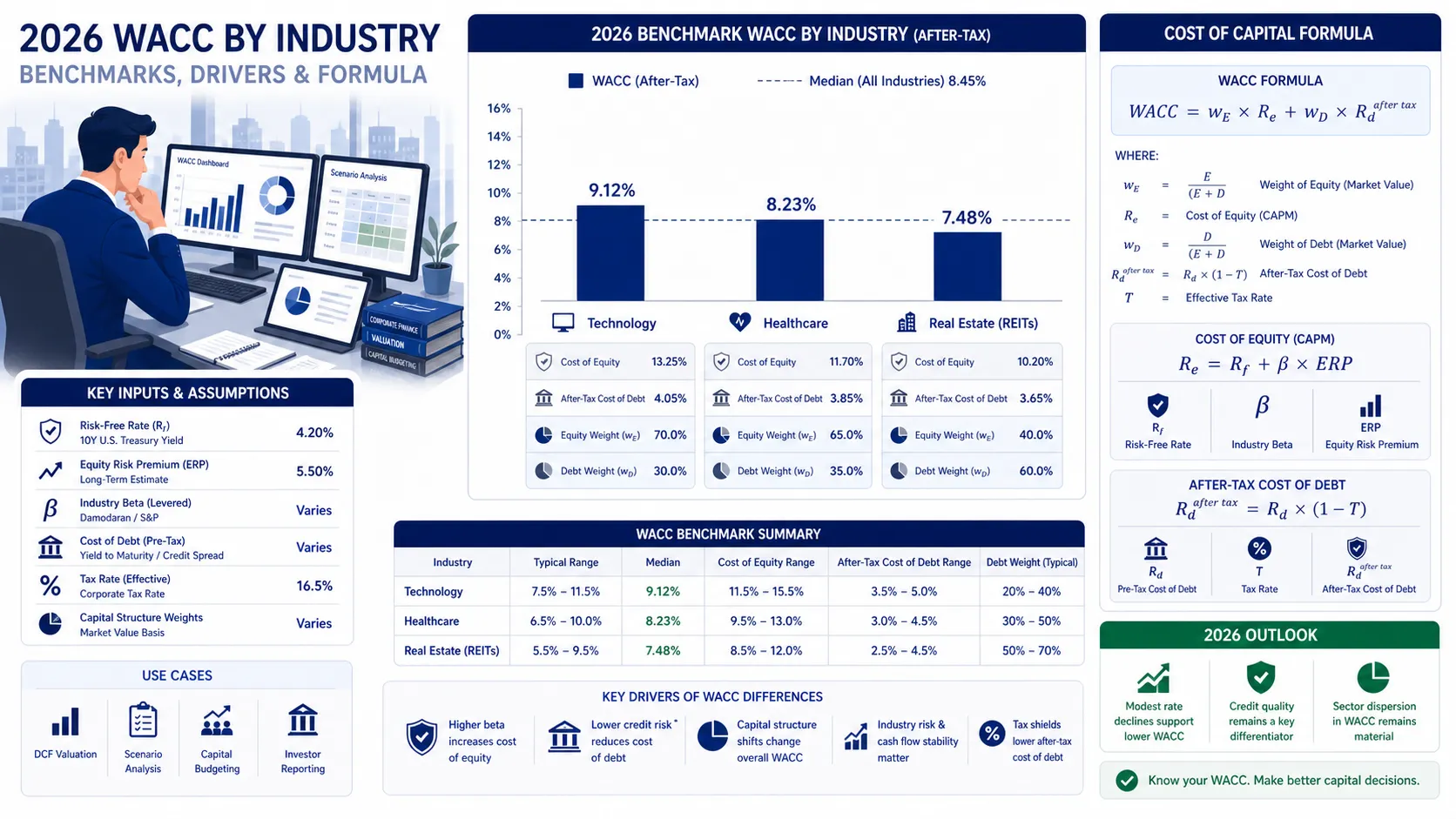
WACC by Industry: 2026 Benchmarks for Technology, Healthcare, and Real Estate
In 2026, industry WACC diverges sharply, from 5.5% for utilities to over 11.5% for software. CFOs must benchmark their discount rate against peers to ground valuations in market reality.
 Corporate Finance
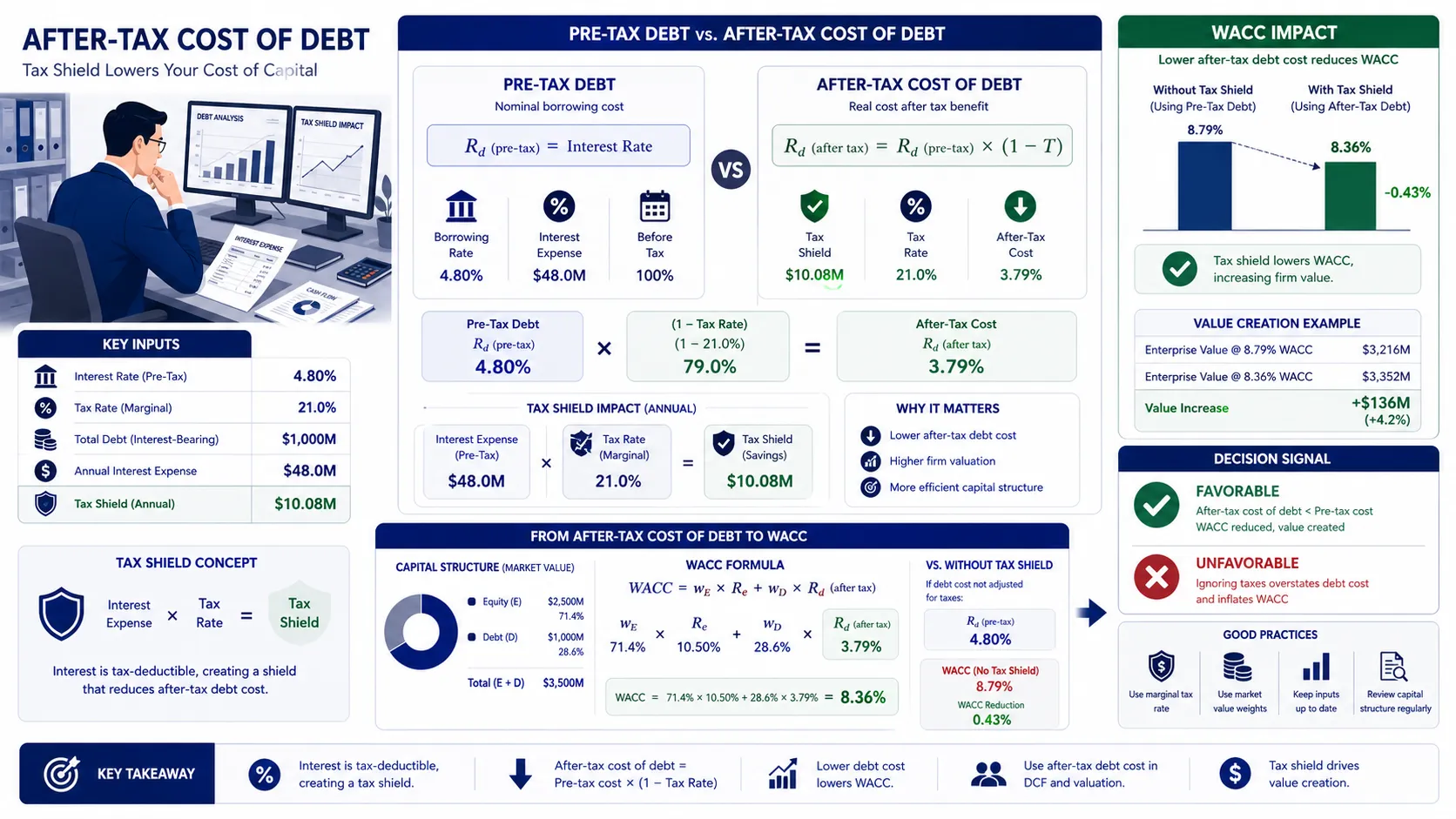
What Is After-Tax Cost of Debt and How Does It Lower WACC?
Interest payments are tax-deductible, making debt cheaper than equity and lowering your company's WACC. The after-tax cost of debt reveals this true, subsidized borrowing rate.
 Corporate Finance
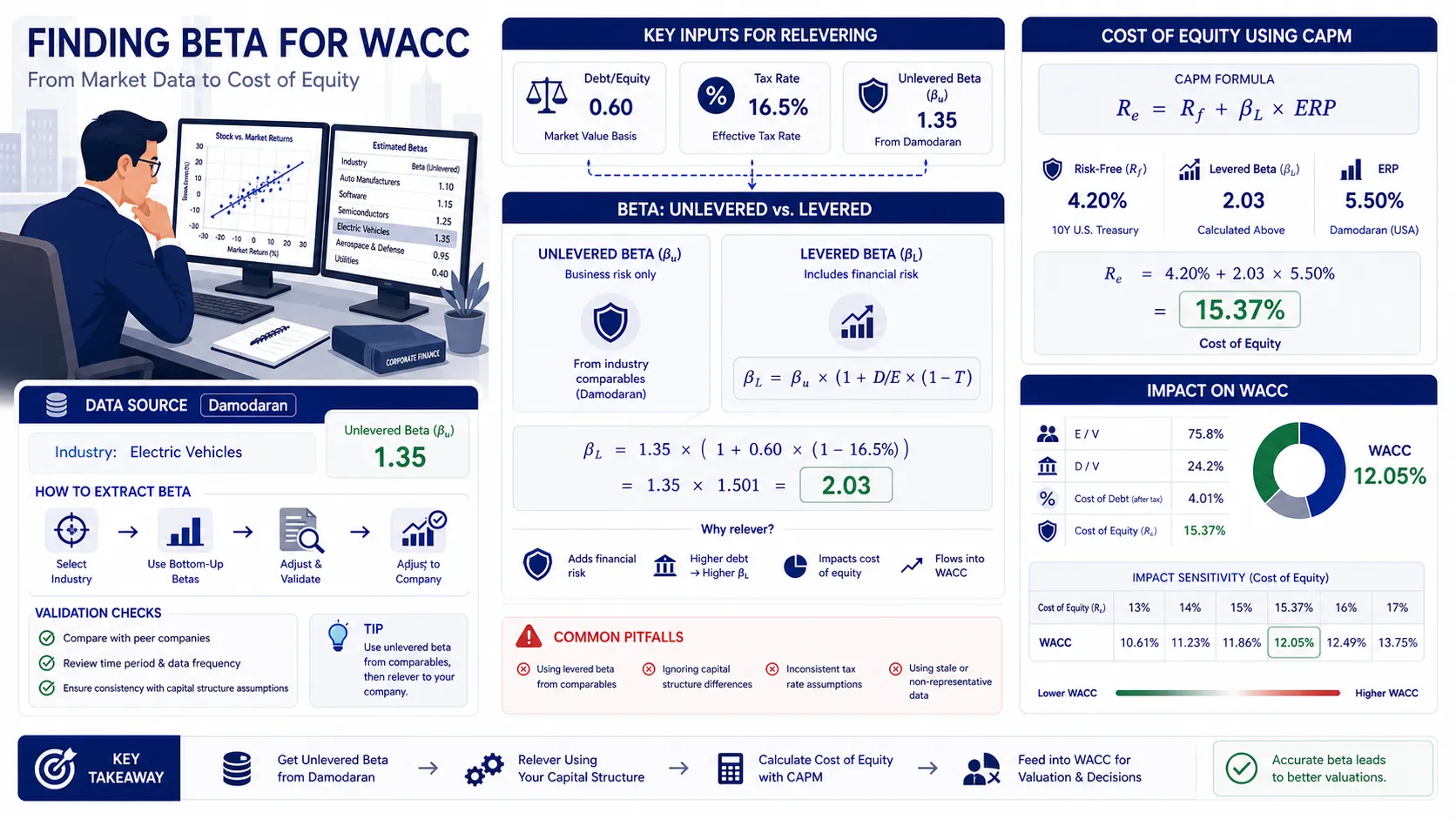
How to Find Beta for WACC: Unlevered vs Levered Beta Calculati
Unlock institutional-grade WACC by mastering bottom-up beta: unlever public peers to strip debt risk, then re-lever for your target's capital structure. This precision method solves CAPM's toughest hurdle, delivering accurate equity risk pricing for DCF models.
Frequently Asked Questions (FAQ)
What is a good current ratio target for a private business?
How does the current ratio differ from the quick ratio?
Why should restricted cash be deducted from the current ratio?
Can a company have a high current ratio but still go bankrupt?
The calculations, projections, and reports generated by BizToolkitPro are for educational and informational purposes only. They do not represent professional investment advice, financial planning, tax guidance, legal counsel, or formal business valuation.
Financial models and valuation formulas (including WACC, DCF, IRR, and NPV) rely on assumptions and inputs provided directly by the user. Actual financial markets and business metrics fluctuate; therefore, BizToolkitPro makes no warranties, express or implied, regarding the accuracy, completeness, or suitability of the outputs for any investment strategy or corporate decision.
Always perform your own independent diligence and consult with a licensed Financial Analyst, Certified Public Accountant (CPA), or certified valuation specialist before committing capital or executing corporate transactions.