
Interest Coverage Calculator for Debt Serviceability Analysis
Evaluate your corporate debt service safety margins using the Interest Coverage calculator.
Solve for Times Interest Earned (TIE) alongside EBITDA interest coverage, model earnings stress scenarios, and generate a 2D sensitivity matrix for commercial loan underwriting.
Have a suggestion or found a calculation discrepancy? Let us know!
How to use this interest coverage calculator
Inputs you need before calculating debt coverage
To run a precise Times Interest Earned (TIE) audit, collect these operational and financial metrics from your company's income statement and debt schedules:
- •Operating Income (EBIT): Earnings Before Interest and Taxes representing your core operational profit.
- •Depreciation & Amortization: Non-cash asset expenses, which are added back to EBIT to evaluate cash-based debt coverage.
- •Annual Interest Expense: Total annual interest payments on senior debt, revolving credit, and capital leases.
- •Target Safety Coverage Ratio: The safety threshold specified in your bank agreements (typically 1.5x to 3.0x).
Interpreting the debt coverage dashboard and indicators
The calculator computes standard, cash-based, and stressed interest coverage indices:
- The Coverage Gauge: An interactive radial meter assessing whether your coverage is Distressed (≤1.0x), Warning (1.0x to 2.0x), Healthy (2.0x to 4.0x), or Excellent (>4.0x).
- EBITDA Interest Coverage: Calculates coverage using cash earnings, showing your safety margin during capital investment slowdowns.
- 2D Sensitivity Grid: Mappings that illustrate how the interest coverage ratio responds to fluctuations in EBIT and interest rate expenses.
Interest coverage formula and methodology
Formula Framework
The Standard Interest Coverage Ratio (Times Interest Earned) divides operational earnings by annual interest expense:
The EBITDA Interest Coverage Ratio adds back non-cash depreciation and amortization to EBIT, providing a cash-focused safety index:
The role of D&A in cash coverage analysis
In corporate debt underwriting, lenders evaluate whether operating cash flow is sufficient to cover periodic interest payments.
Operating Income (EBIT) represents the standard operational profitability metric. However, EBIT includes non-cash expenses, primarily Depreciation of physical plant and equipment, and Amortization of intangible assets. These accounting adjustments reduce reported net income but do not represent actual cash outflows.
As a result, a company with significant capital investments may report low EBIT interest coverage, while possessing healthy cash flows. By calculating the EBITDA Interest Coverage Ratio, analysts add back these D&A adjustments to assess the true cash safety margin. Commercial bank covenants frequently specify EBITDA-based coverage ratios to ensure borrower solvency.
Interest coverage example calculation
Debt Underwriting Case Study
Let us analyze a manufacturing company seeking to evaluate its interest coverage safety. The firm reports the following quarterly and annual figures:
| Financial Register Account | Value (USD) |
|---|---|
| Operating Income (EBIT) | $300,000 |
| Depreciation & Amortization | $100,000 |
| Annual Interest Expense | $120,000 |
| Required Safety Coverage Covenant | 2.50x |
Step-by-step arithmetic resolution
Follow these steps to compute standard and cash-based coverage:
- Step 1: Calculate Standard Interest Coverage (TIE)Divide EBIT by Interest Expense:
Ratio = $300,000 / $120,000 = 2.50x. This exactly meets the covenant threshold. - Step 2: Solve for EBITDA Cash EarningsAdd back D&A:
EBITDA = $300,000 + $100,000 = $400,000. - Step 3: Solve for EBITDA Interest CoverageDivide EBITDA by Interest Expense:
EBITDA Coverage = $400,000 / $120,000 = 3.33x. - Step 4: Compute Earnings Shortfall to Target (3.00x)Required EBIT for 3.00x safety =
$120,000 * 3.00 = $360,000.
Earnings shortfall =$360,000 - $300,000 = $60,000.
What your coverage results mean
Coverage > 3.0x (Excellent)
A ratio above 3.0x indicates comfortable debt service capacity. The company generates operating income at least three times its annual interest payments. This minimal default risk makes it highly eligible for refinancing or obtaining additional credit lines.
Coverage 1.5x to 3.0x (Vulnerable)
Ratios in this range are common for moderately leveraged companies. While operations cover current interest charges, safety margins are narrow. Any decline in market demand, inflation in operating costs, or rises in variable interest rates could compromise debt serviceability.
Coverage ≤ 1.0x (Distressed)
A ratio at or below 1.0x signals that operational profit is insufficient to cover annual interest. The business operates with a coverage shortfall, relying on cash reserves or refinancing to avoid default.
Interest coverage use cases across business verticals
SaaS & Technology Startups: Venture Debt Audits
SaaS firms often report negative EBIT during growth stages due to significant sales and marketing investments. However, because software firms collect customer payments upfront for annual plans, they may maintain high cash balances. Venture lenders evaluate custom EBITDA and cash-burn coverage metrics rather than traditional TIE ratios to assess debt capacity.
Leveraged Buyouts (LBOs): Target Debt Capacity
In private equity transactions, LBO models evaluate whether target companies can service the leverage used to fund their acquisition. PE firms target companies with stable EBITDA interest coverage (typically >2.0x) to ensure the business can pay down acquisition debt over time.
- ✓Using Net Income instead of EBIT: Deducting taxes and interest before evaluating coverage, which distorts the solvency ratio.
- ✓Ignoring Variable Rate Exposures: Failing to model how variable rate debt increases interest expenses during rate hike cycles.
- ✓Omitting Capitalized Leases: Excluding capitalized lease interest from total interest obligations, understating coverage risks.
Real-world case study: Apple Inc. (AAPL, FY 2023)
Apple Inc. metrics profile
Apple Inc. (AAPL) is a global technology giant analyzed here for its interest coverage, a key financial health indicator. This case study utilizes Apple's verified financial data from its Fiscal Year 2023 to demonstrate the application of an Interest Coverage Calculator. The analysis helps in understanding the company's ability to meet its interest obligations.
For Fiscal Year 2023, Apple Inc. reported an Operating Income (EBIT) of $114,301 million and a cash paid for interest of $3,803 million, serving as a proxy for interest expense. This results in an Interest Coverage Ratio of approximately 30.05x. This exceptionally high ratio indicates Apple's strong ability to cover its interest payments comfortably, reflecting robust operational profitability relative to its debt servicing costs. Such a high ratio suggests minimal financial risk from debt obligations and considerable financial flexibility, making it an attractive prospect for lenders and a sign of stability for investors.
Related Calculators
Estimate weighted average cost of capital.
Open Tool →DCF CalculatorValue a business using discounted cash flows.
Open Tool →NPV CalculatorCompute net present value of cash flows.
Open Tool →IRR CalculatorSolve project internal rates of return.
Open Tool →Free Cash Flow CalculatorEstimate operating free cash flow.
Open Tool →Break-Even ROI CalculatorAnalyze payback thresholds and returns.
Open Tool →Related Articles & Guides
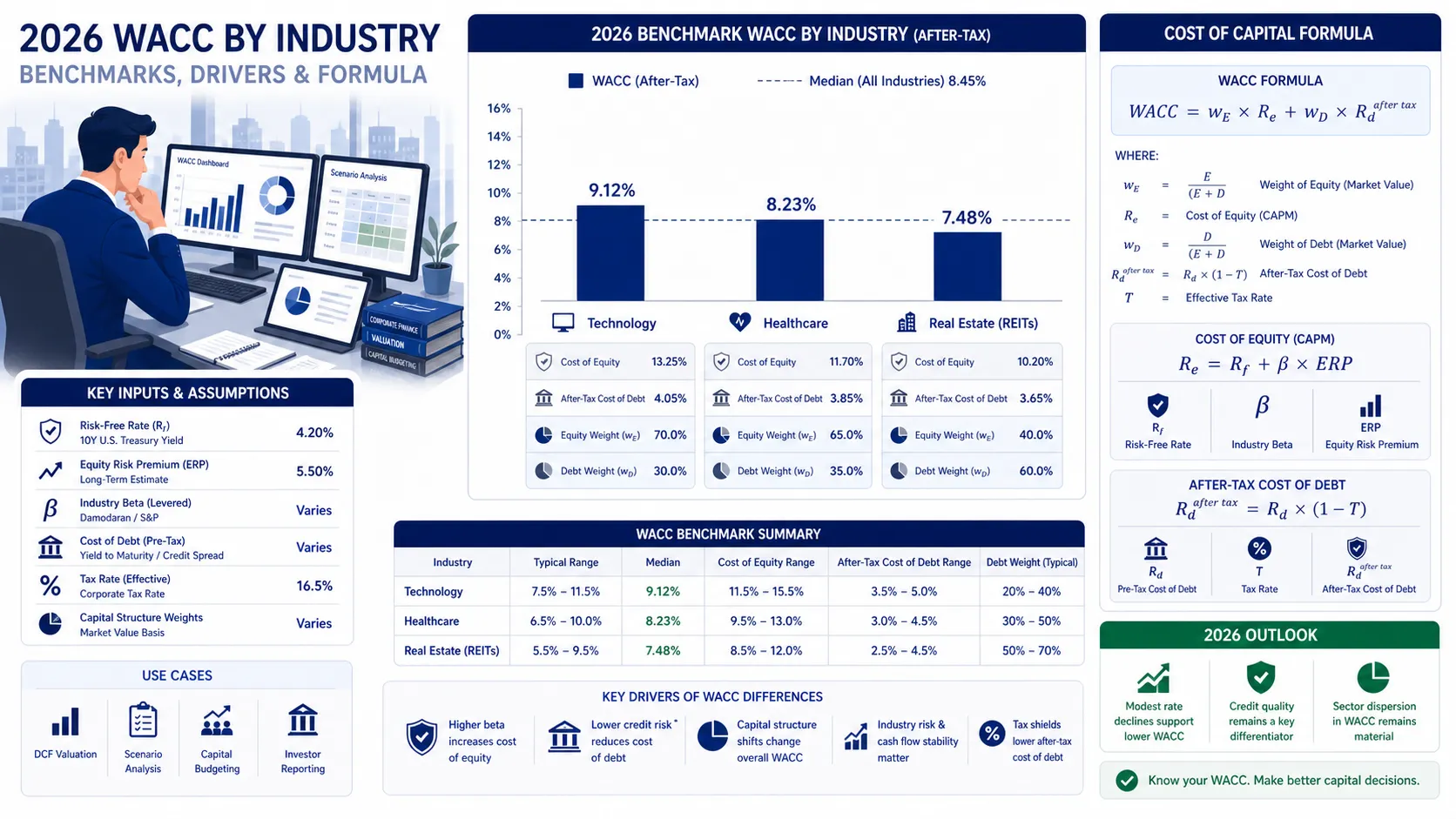 Corporate Finance
WACC by Industry: 2026 Benchmarks for Technology, Healthcare, and Real Estate
In 2026, industry WACC diverges sharply, from 5.5% for utilities to over 11.5% for software. CFOs must benchmark their discount rate against peers to ground valuations in market reality.
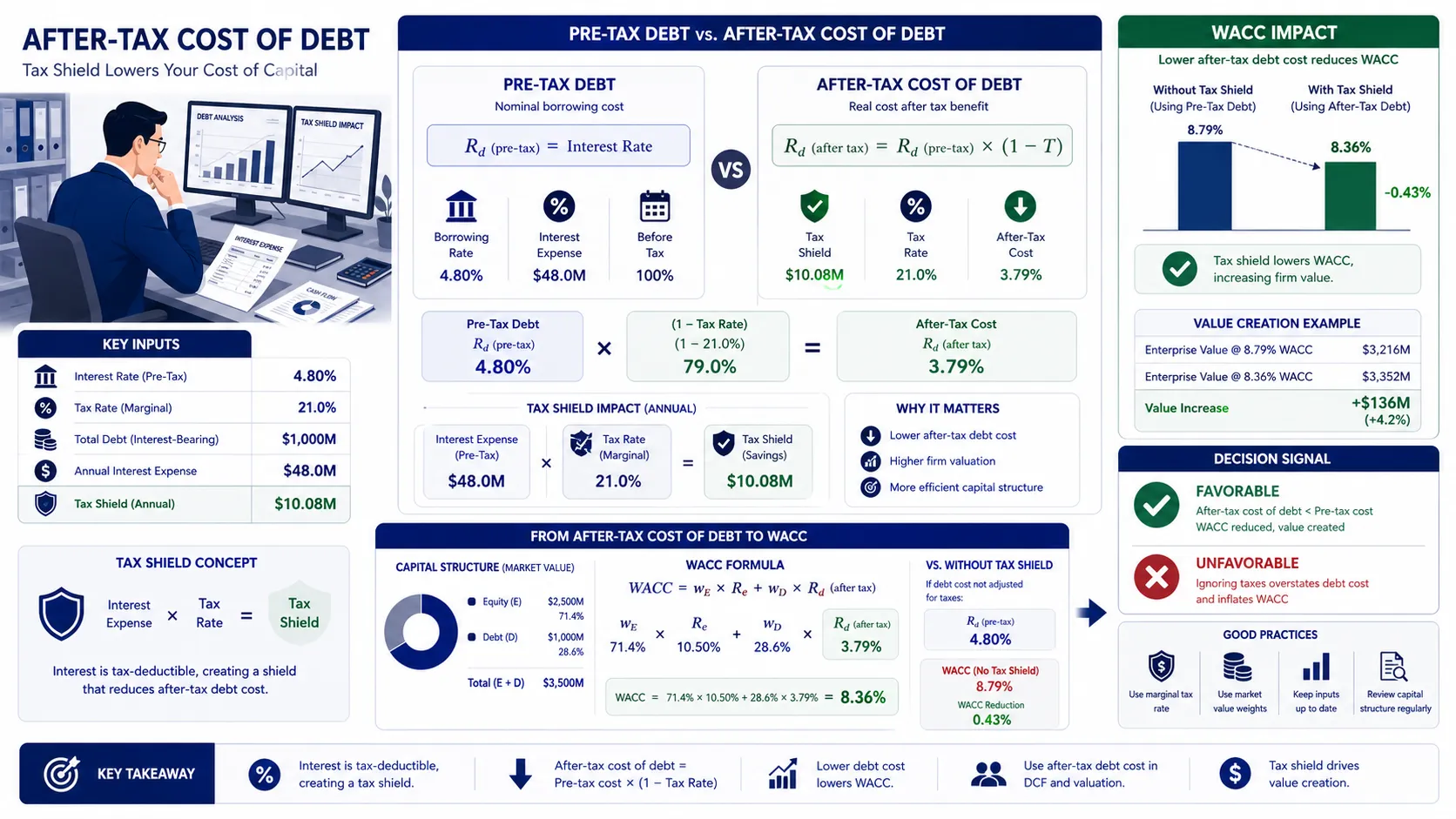 Corporate Finance
What Is After-Tax Cost of Debt and How Does It Lower WACC?
Interest payments are tax-deductible, making debt cheaper than equity and lowering your company's WACC. The after-tax cost of debt reveals this true, subsidized borrowing rate.
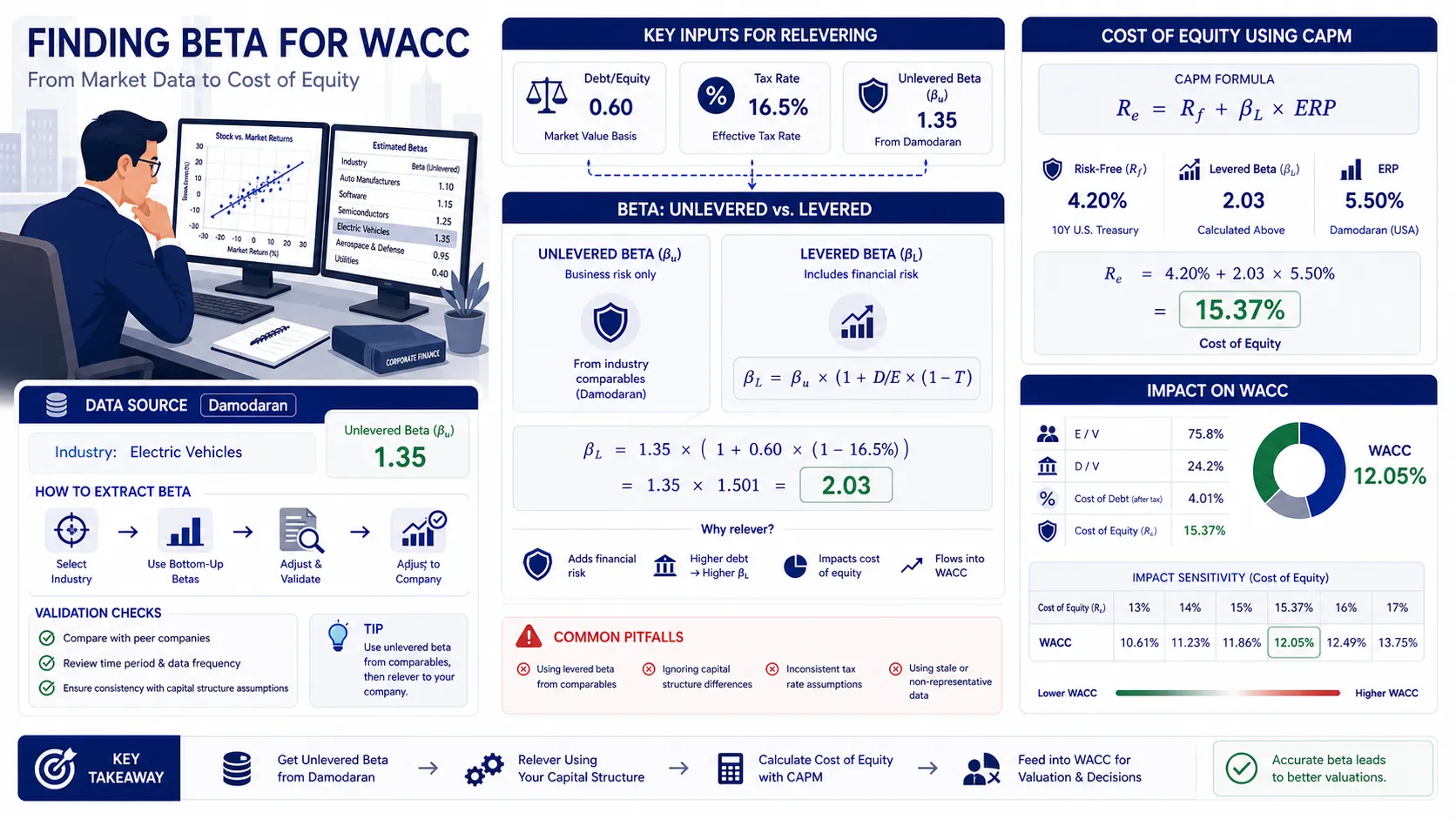 Corporate Finance
How to Find Beta for WACC: Unlevered vs Levered Beta Calculati
Unlock institutional-grade WACC by mastering bottom-up beta: unlever public peers to strip debt risk, then re-lever for your target's capital structure. This precision method solves CAPM's toughest hurdle, delivering accurate equity risk pricing for DCF models.
Frequently Asked Questions (FAQ)
What is a good interest coverage ratio target?
How does interest coverage relate to default risk?
What is the difference between EBIT and EBITDA interest coverage?
The calculations, projections, and reports generated by BizToolkitPro are for educational and informational purposes only. They do not represent professional investment advice, financial planning, tax guidance, legal counsel, or formal business valuation.
Financial models and valuation formulas (including WACC, DCF, IRR, and NPV) rely on assumptions and inputs provided directly by the user. Actual financial markets and business metrics fluctuate; therefore, BizToolkitPro makes no warranties, express or implied, regarding the accuracy, completeness, or suitability of the outputs for any investment strategy or corporate decision.
Always perform your own independent diligence and consult with a licensed Financial Analyst, Certified Public Accountant (CPA), or certified valuation specialist before committing capital or executing corporate transactions.