
Debt-to-Equity (D/E) Calculator for Corporate Solvency Analysis
Audit balance sheet gearing and financial leverage using the professional Debt-to-Equity calculator. Solve for Book vs.
Market equity benchmarks, measure net debt-to-equity ratios, and analyze debt capitalization parameters for institutional risk underwriting.
Have a suggestion or found a calculation discrepancy? Let us know!
How to use this debt-to-equity calculator
Inputs required for capital structure modeling
To run a precise gearing diagnostic, collect these metrics from your company's balance sheet and market data:
- •Short-Term Debt: Commercial paper, bank overdrafts, and current portions of long-term debt maturing within 12 months.
- •Long-Term Debt: Senior secured notes, mezzanine financing, mortgages, and obligations with maturities exceeding 1 year.
- •Cash & Equivalents: Readily available cash, treasury reserves, and liquid paper, which are deducted to solve for Net Debt.
- •Book Value of Equity: Total shareholder equity recorded on the balance sheet (retained earnings plus paid-in capital).
- •Market Value of Equity: Total market capitalization (total outstanding shares multiplied by the current stock price) for public firm modeling.
- •Preferred Equity: Hybrid shares outstanding, which are treated as debt-like buffers by institutional credit analysts.
Interpreting leverage results and ratio tables
The solver processes your inputs and compiles multiple structural diagnostics:
- The Gearing Gauge: A color-coded scale assessing whether your D/E ratio is Conservative (≤0.5x), Moderate (0.5x to 1.5x), Aggressive (1.5x to 2.5x), or Highly Leveraged (>2.5x).
- Net Debt to Equity: Accounts for your cash buffer, deducting cash reserves from debt before dividing by equity. This is a critical metric for companies holding substantial cash reserves.
- Debt Capitalization %: Represents total debt as a percentage of total corporate capital (Debt / [Debt + Equity]).
- 2D Sensitivity Matrix: Dynamically calculates resulting ratios as Total Debt and Shareholder Equity fluctuate under various operating assumptions.
Debt-to-equity formula and methodology
Formula Library
The Standard Debt-to-Equity Ratio divides total liabilities (short and long term) by shareholder equity:
To account for treasury reserves, Net Debt-to-Equity is derived as:
Where total debt and equity components are adjusted as:
Book equity vs market equity valuation bases
In financial modeling, choosing between Book Value and Market Value of Equity can completely alter the perceived risk profile of a company.
Book Value of Equity represents the historical accounting equity recorded on the company's balance sheet. It is calculated as total assets minus total liabilities, reflecting cumulative earnings and share issuances. Because it is based on historical costs, it is static and does not account for future growth potential. Creditors and commercial banks typically require book value ratios when auditing loan covenant compliance, as it reflects the conservative liquidation cushion.
Market Value of Equity (Market Capitalization) represents the current valuation assigned by public or private equity investors. It is calculated by multiplying outstanding shares by the current market share price. For high-growth industries like SaaS, technology, or pharmaceuticals, market equity is often many times larger than book equity, reflecting anticipated future cash flows. While a company may appear highly leveraged on a book value basis, it might show a highly conservative ratio when mapped against market equity. Analysts use market equity when evaluating transactional enterprise value structures and M&A pricing.
Debt-to-equity example calculation
Leverage Structuring Case Study
Let us analyze the capital structure of a growing logistics company preparing to secure additional commercial credit. The accounting registers show the following:
| Balance Sheet Account | Value (USD) |
|---|---|
| Short-Term Operating Debt | $100,000 |
| Long-Term Mortgages & Notes | $400,000 |
| Cash & Short-Term Investments | $50,000 |
| Book Value of Shareholder Equity | $300,000 |
| Preferred Shares Outstanding | $50,000 |
Mathematical step-by-step resolution
To determine standard, net, and total capital leverage indexes, complete the following calculations:
- Step 1: Solve for Total Debt
Total Debt = Short-Term + Long-Term = $100,000 + $400,000 = $500,000. - Step 2: Calculate Standard Debt-to-EquityDivide total debt by book equity:
D/E Ratio = $500,000 / $300,000 = 1.67x. - Step 3: Solve for Net Debt and Net D/EDeduct cash reserves:
Net Debt = $500,000 - $50,000 = $450,000.Net D/E = $450,000 / $300,000 = 1.50x. - Step 4: Compute Total Debt Gearing (Including Preferred Shares)Under bank covenants, preferred equity is bundled with debt:
Adjusted Debt = $500,000 + $50,000 = $550,000.Adjusted D/E = $550,000 / $300,000 = 1.83x.
What your leverage results mean
D/E ≤ 0.5x (Conservative)
A D/E ratio under 0.5x suggests a conservative capital structure. The company is primarily funded by equity, meaning it carries low interest expense obligations and minimal risk of default during economic downturns. This low risk makes it highly attractive to commercial banks offering low interest rates, although it may imply underutilized debt capacity.
D/E 0.5x to 1.5x (Moderate)
Ratios in this range are common in capital-intensive sectors like manufacturing, commercial real estate, and utilities. This indicates a balanced mix of debt and equity funding. While the firm carries notable interest expenses, they are typically covered by operations, resulting in an optimized weighted average cost of capital.
D/E > 1.5x (Aggressive)
A ratio above 1.5x indicates aggressive leverage. A significant portion of operations is funded by debt. In this scenario, any decline in cash flow or rise in interest rates could make it difficult to meet debt service obligations. Lenders will charge higher risk premiums or enforce strict covenants.
Debt-to-equity use cases across business verticals
SaaS & Technology Startups: Asset-Light Leverage Profiles
Subscription business models rarely carry traditional debt like mortgage loans. Startups are funded primarily through venture capital equity. However, when software companies scale, they frequently utilize venture debt to fund acquisitions or bridge financing. Since SaaS firms have high gross margins and predictable ARR, lenders focus on the debt-to-equity ratio as a metric for risk management.
Commercial Real Estate (CRE): Gearing Limits
In property acquisition, debt-to-equity represents the core metric for equity partners and mortgage lenders. CRE projects regularly use leverage to boost equity yields. Keeping D/E within institutional limits (typically under 2.33x, matching a 70% Loan-to-Value) is essential for securing favorable pricing.
- ✓Omitting Short-Term Credit Lines: Leaving out revolving lines of credit, which understates total leverage.
- ✓Treating Preferred Shares as Pure Equity: Ignoring the fixed dividend payout obligations of preferred equity.
- ✓Mixing Book Equity and Market Equity: Using market equity values to justify bank covenant limits that require book value accounting.
Real-world case study: Apple Inc. (AAPL, FY 2023)
Apple Inc. metrics profile
Apple Inc., a global technology giant, is analyzed here through its Debt-to-Equity ratio for Fiscal Year 2023. This ratio is a key indicator of the company's financial leverage and capital structure, revealing how much of its operations are financed by debt versus shareholder equity. Understanding this metric is essential for investors and stakeholders assessing Apple's financial health and risk profile.
Apple Inc.'s Debt-to-Equity ratio of approximately 1.79 for Fiscal Year 2023 indicates that the company utilizes a notable amount of debt relative to its equity to finance its operations and growth. For a company of Apple's size and market position, this level of leverage is often a strategic choice, allowing it to potentially amplify shareholder returns, especially given its strong cash flow generation and access to favorable borrowing rates. While a higher ratio generally implies increased financial risk, Apple's robust profitability, substantial reserves, and ability to consistently service its debt suggest a well-managed capital structure. Investors typically evaluate this ratio in conjunction with other solvency and liquidity metrics to gain a comprehensive understanding of the company's financial stability and risk management practices.
Related Calculators
Estimate weighted average cost of capital.
Open Tool →DCF CalculatorValue a business using discounted cash flows.
Open Tool →NPV CalculatorCompute net present value of cash flows.
Open Tool →IRR CalculatorSolve project internal rates of return.
Open Tool →Free Cash Flow CalculatorEstimate operating free cash flow.
Open Tool →Break-Even ROI CalculatorAnalyze payback thresholds and returns.
Open Tool →Related Articles & Guides
 Corporate Finance
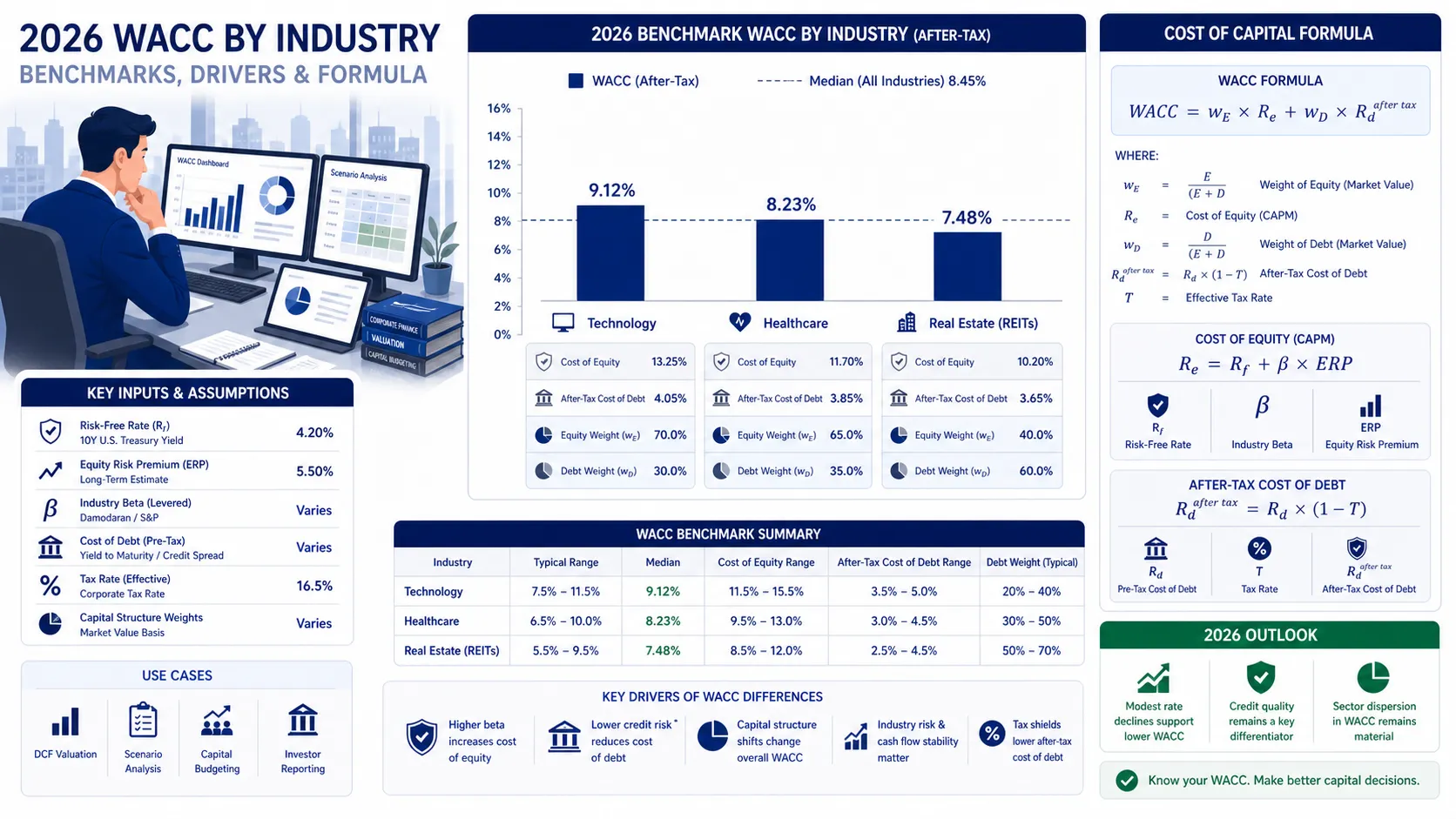
WACC by Industry: 2026 Benchmarks for Technology, Healthcare, and Real Estate
In 2026, industry WACC diverges sharply, from 5.5% for utilities to over 11.5% for software. CFOs must benchmark their discount rate against peers to ground valuations in market reality.
 Corporate Finance
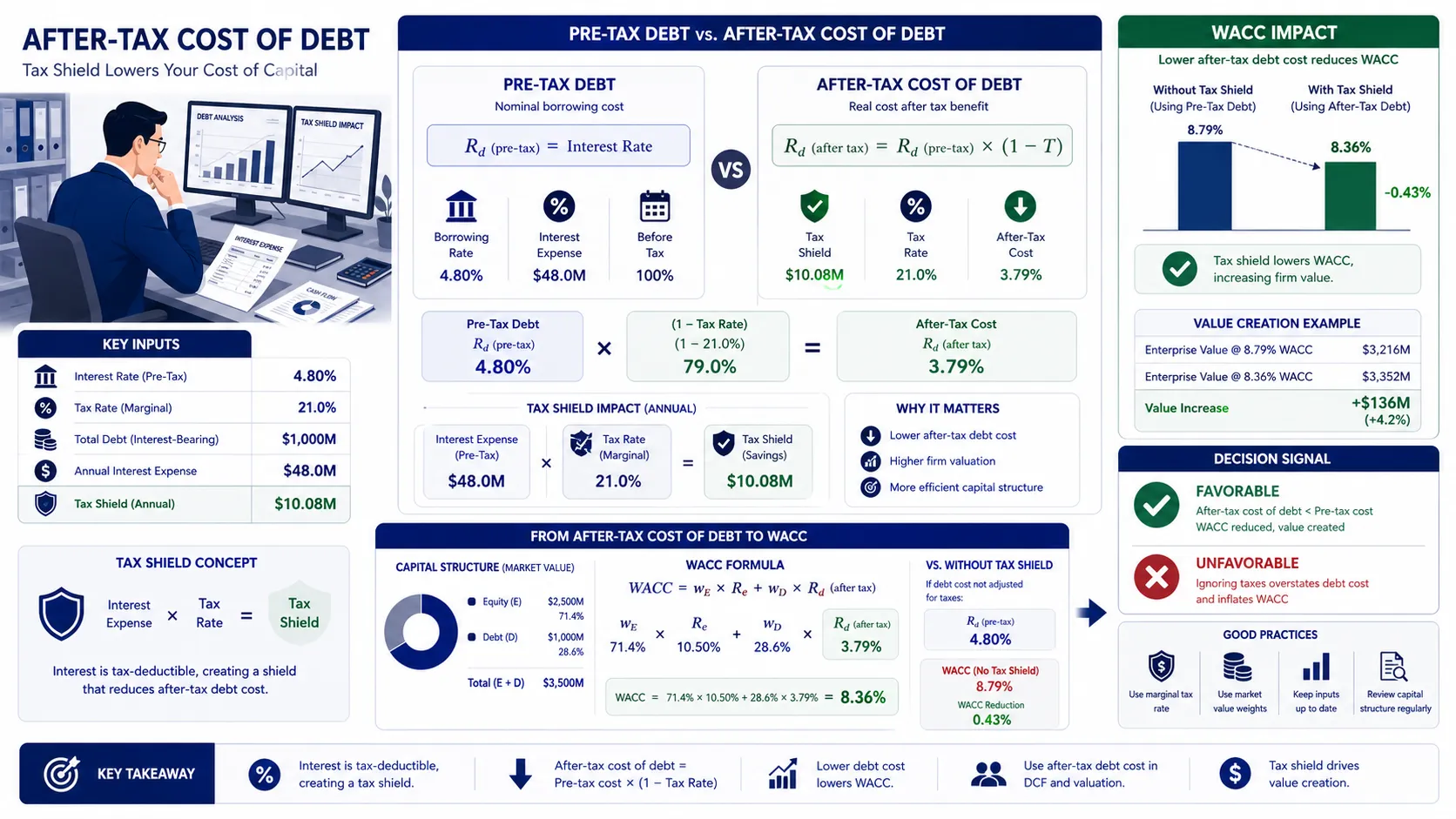
What Is After-Tax Cost of Debt and How Does It Lower WACC?
Interest payments are tax-deductible, making debt cheaper than equity and lowering your company's WACC. The after-tax cost of debt reveals this true, subsidized borrowing rate.
 Corporate Finance
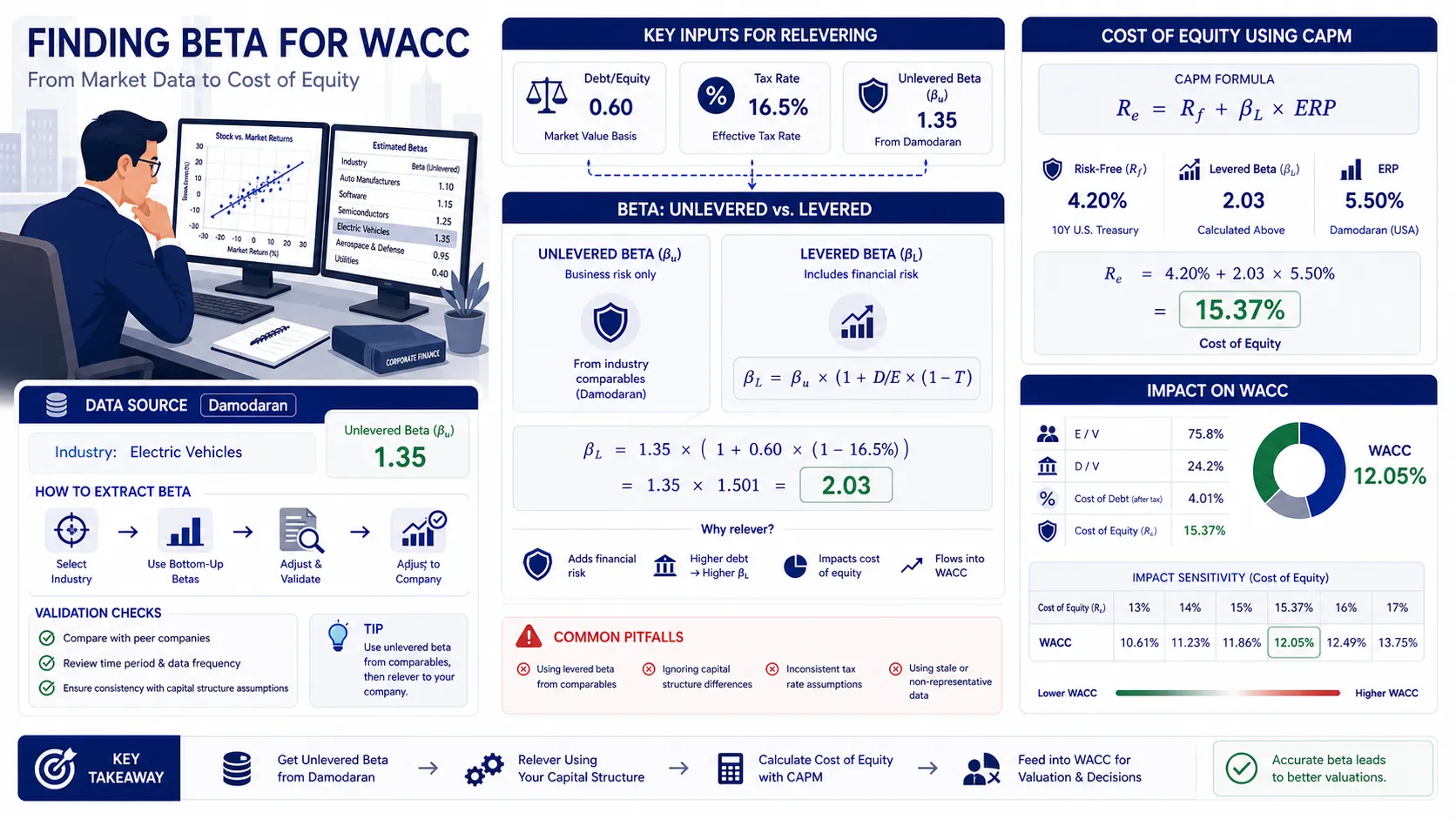
How to Find Beta for WACC: Unlevered vs Levered Beta Calculati
Unlock institutional-grade WACC by mastering bottom-up beta: unlever public peers to strip debt risk, then re-lever for your target's capital structure. This precision method solves CAPM's toughest hurdle, delivering accurate equity risk pricing for DCF models.
Frequently Asked Questions (FAQ)
What is a healthy Debt-to-Equity target for businesses?
Why do commercial lenders focus on Net D/E over standard D/E?
How does preferred equity affect my Debt-to-Equity ratio?
Is a high Debt-to-Equity ratio ever beneficial for companies?
The calculations, projections, and reports generated by BizToolkitPro are for educational and informational purposes only. They do not represent professional investment advice, financial planning, tax guidance, legal counsel, or formal business valuation.
Financial models and valuation formulas (including WACC, DCF, IRR, and NPV) rely on assumptions and inputs provided directly by the user. Actual financial markets and business metrics fluctuate; therefore, BizToolkitPro makes no warranties, express or implied, regarding the accuracy, completeness, or suitability of the outputs for any investment strategy or corporate decision.
Always perform your own independent diligence and consult with a licensed Financial Analyst, Certified Public Accountant (CPA), or certified valuation specialist before committing capital or executing corporate transactions.