
ROIC Calculator - Return on Invested Capital
Use this focused ROIC calculator, an advanced corporate finance solver designed to evaluate management capital efficiency. By comparing Net Operating Profit After Tax (NOPAT) against total Net Invested Capital, this utility solves the firm's true operating yield.
Integrate your corporate WACC hurdle rates to calculate Economic Value Added (EVA) and visualize capital value spreads.
EBIT performance and marginal tax factors.
Set capital liabilities to determine total Net Invested Capital.
Have a suggestion or found a calculation discrepancy? Let us know!
Understanding Return on Invested Capital (ROIC)
Defining NOPAT and Invested Capital base
Return on Invested Capital (ROIC) is widely considered by institutional investors and equity analysts to be the single most important metric for evaluating corporate performance. Unlike Return on Equity (ROE) or Return on Assets (ROA), which can be easily manipulated through financial leverage or accounting policies, ROIC focuses strictly on the core operating returns generated by the capital actually deployed in the business.
To solve for ROIC, we analyze two parameters:
- Net Operating Profit After Tax (NOPAT): This is the firm's operating income (EBIT) adjusted for taxes. It represents the cash earnings available to all providers of capital (both debt and equity holders).
- Net Invested Capital: This represents the total net funds deployed in the firm's active operations, computed as Total Debt plus Total Equity, minus Cash and cash equivalents.
The value creation spread (ROIC vs. WACC)
An investment creates economic value for shareholders only if its ROIC exceeds its Weighted Average Cost of Capital (WACC). This difference is known as the Value Creation Spread. If a firm's ROIC is 15% and its WACC is 10%, the firm is generating a positive spread of 5%, creating Economic Value Added (EVA).
Conversely, if a firm's ROIC falls below its WACC, it is destroying shareholder wealth, even if it reports positive accounting net profits. Deployed capital is failing to cover its opportunity cost, signaling inefficiency.
Operating efficiency indicators
By isolating operating income (EBIT) and net assets, ROIC helps analysts identify a firm's operational moat. Businesses with high product margins or rapid capital turnovers enjoy high ROIC yields, signifying a sustainable competitive advantage over peer firms.
How to use this ROIC calculator
Enter operating earnings and tax rates
Start by inputting your corporate Operating Income (EBIT) and marginal income Tax Rate (in %). If you want to compute Economic Value Added (EVA), enter your target Cost of Capital (WACC percentage) in the provided input field.
These parameters allow the calculator to find NOPAT, establishing the numerator of the ROIC efficiency ratio.
Input capital structure and solve returns
Under the "Capital Structure Base" card on the left panel, input the Total Debt, Book Value of Equity, and Cash and equivalents. Click "Run Solver" to execute the calculation.
Verify visual outputs
The outputs card will display NOPAT, Net Invested Capital, solved ROIC percentage, and EVA. Use the comparison bar chart to visualize the value creation spread. Toggle to the Sensitivity Grid to see how changing EBIT levels impact your EVA metrics across shifting parameters.
Compare ROIC capital efficiency scenarios
ROIC baseline scenario
The base scenario represents your expected operating parameters. NOPAT and capital structure are modeled under normal forecasts to establish a baseline return efficiency ratio.
ROIC upside scenario
The bull scenario models upside operational performance. Larger EBIT margins combined with optimized working capital structures generate an elevated ROIC and EVA wealth yield.
ROIC downside scenario
The bear scenario tests downside risk. Reduced sales demand combined with cost inflation on inventory capital structures depresses ROIC yields, dragging them below WACC limits.
ROIC sensitivity analysis
EBIT variance vs capital outlay matrix
The sensitivity grid maps the solved ROIC and EVA metrics against shifting EBIT levels (vertical) and total invested capital variables (horizontal). This matrix is essential for identifying cost thresholds.
Identifying spread crossover boundaries
By observing the cell values in the sensitivity matrix, you can identify the exact points where the ROIC drops below the WACC hurdle rate, flagging potential impairment.
Assessing operation Moat stability
If a firm's ROIC remains above WACC even when EBIT drops by 15%, the operational moat is deemed robust. Projects with stable spreads across parameters are highly favored.
ROIC formula and mathematical methodology
Methodology
ROIC is calculated using the following formula:
Where:
Step-by-step mathematical logic
To calculate ROIC and Economic Value Added (EVA), follow these steps:
- Compute NOPAT: Adjust EBIT for taxes by multiplying it by (1 - Tax Rate).
- Compute Net Invested Capital: Add all short-term and long-term interest-bearing debt to total shareholders' equity, and subtract cash and equivalents.
- Solve ROIC: Divide NOPAT by Net Invested Capital and multiply by 100.
- Solve EVA (if WACC is available): Multiply Net Invested Capital by the value creation spread (ROIC - WACC) divided by 100.
Example calculation of ROIC
Example parameters
Suppose a business reports an operating EBIT of $200,000. The marginal corporate tax rate is 21%. Its capital structure consists of $300,000 in total interest-bearing debt and $700,000 in book value of equity. The firm holds $100,000 in cash reserves. The WACC hurdle rate is set at 10%.
We want to calculate NOPAT, Invested Capital, ROIC, and EVA.
Step-by-step resolution
First, the NOPAT:
NOPAT = $200,000 * (1 - 0.21) = $158,000.
Second, Net Invested Capital:
Invested Capital = $300,000 + $700,000 - $100,000 = $900,000.
Third, the ROIC:
ROIC = ($158,000 / $900,000) * 100 = 17.56% (rounded).
Fourth, the Economic Value Added (EVA):
EVA = $900,000 * (17.56% - 10%) / 100 = $68,000. Since ROIC exceeds WACC by 7.56%, the company is creating $68,000 of wealth for its shareholders.
Common mistakes in ROIC calculations
Using Net Income instead of NOPAT
A common error is using net income (which is already after interest expenses) in the ROIC numerator. Interest expenses represent returns paid to debt holders. Since the denominator (Invested Capital) includes debt, the numerator must reflect earnings *before* interest payments, which is why we must use NOPAT (EBIT adjusted for taxes) instead of net income.
Failing to subtract excess cash
Another mistake is not subtracting cash and cash equivalents from the invested capital base. Excess cash is non-operating; it is typically held in interest-bearing bank accounts rather than deployed in active factory equipment or working capital. Failing to subtract cash inflates the invested capital denominator, artificially depressing your calculated ROIC ratio.
Real-world case study: Apple Inc. (AAPL, FY 2023)
Apple Inc. metrics profile
Apple Inc. is a global technology leader, and analyzing its Return on Invested Capital (ROIC) provides insights into how effectively it uses shareholder and debt capital to generate profits. For fiscal year 2023, Apple demonstrated strong capital efficiency, reflecting its robust business model and brand strength. This analysis helps understand the company's operational profitability relative to its capital base.
A high ROIC, such as Apple's for FY 2023, indicates superior management efficiency in deploying both equity and debt capital to generate profits. For investors, this suggests that the company is effectively creating significant value above the cost of the capital it employs, making it an attractive investment for long-term growth. Apple's consistent ability to achieve high ROIC underscores its competitive advantages, including strong brand loyalty, continuous innovation, and a robust ecosystem, which collectively translate into sustainable profitability and efficient capital utilization. This metric is crucial for assessing a company's fundamental performance and its potential for continued value creation, showcasing its ability to convert capital into earnings.
Related Calculators
Estimate weighted average cost of capital.
Open Tool →DCF CalculatorValue a business using discounted cash flows.
Open Tool →NPV CalculatorCompute net present value of cash flows.
Open Tool →IRR CalculatorSolve project internal rates of return.
Open Tool →Free Cash Flow CalculatorEstimate operating free cash flow.
Open Tool →Break-Even ROI CalculatorAnalyze payback thresholds and returns.
Open Tool →Related Articles & Guides
 Corporate Finance
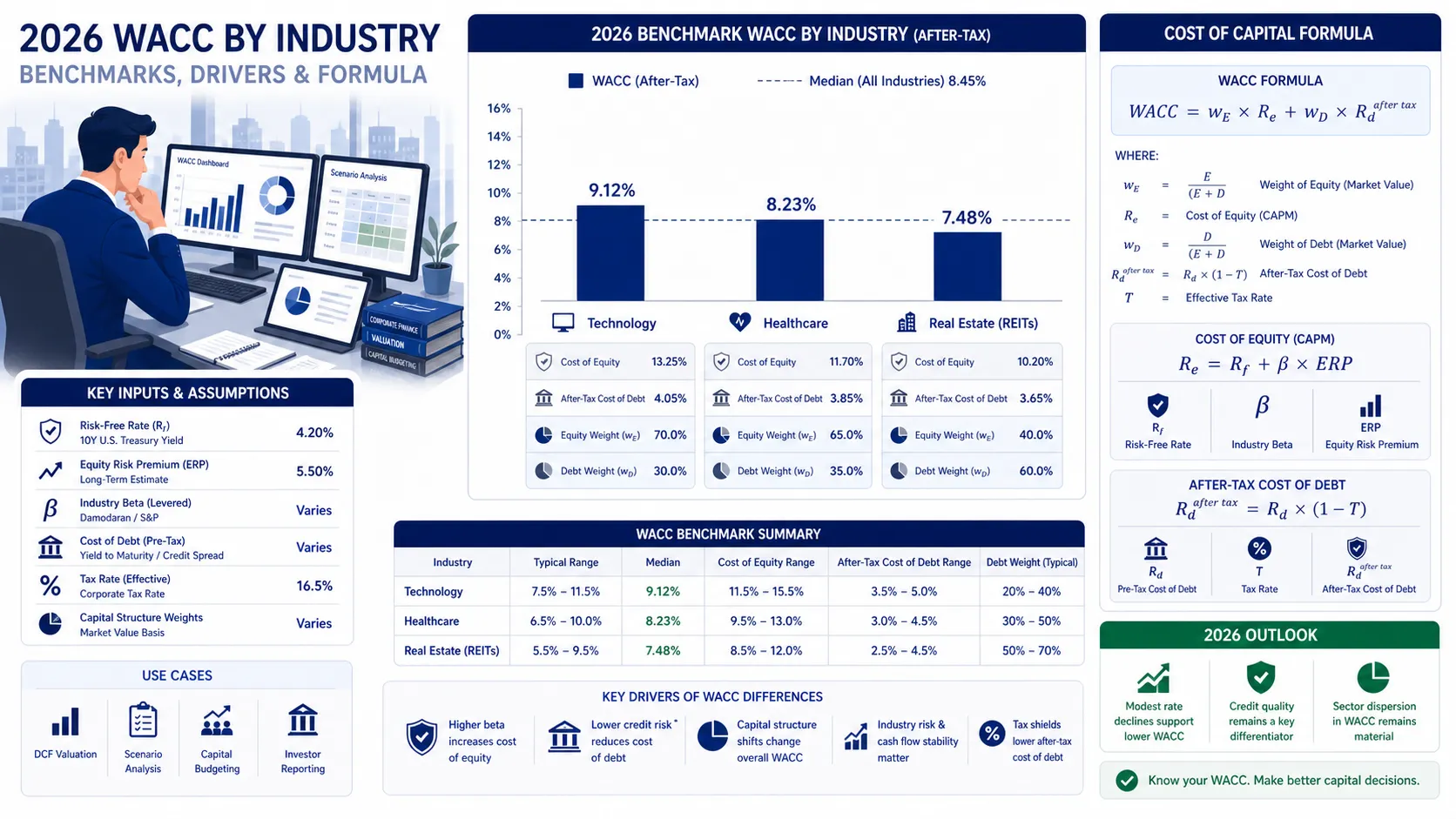
WACC by Industry: 2026 Benchmarks for Technology, Healthcare, and Real Estate
In 2026, industry WACC diverges sharply, from 5.5% for utilities to over 11.5% for software. CFOs must benchmark their discount rate against peers to ground valuations in market reality.
 Corporate Finance
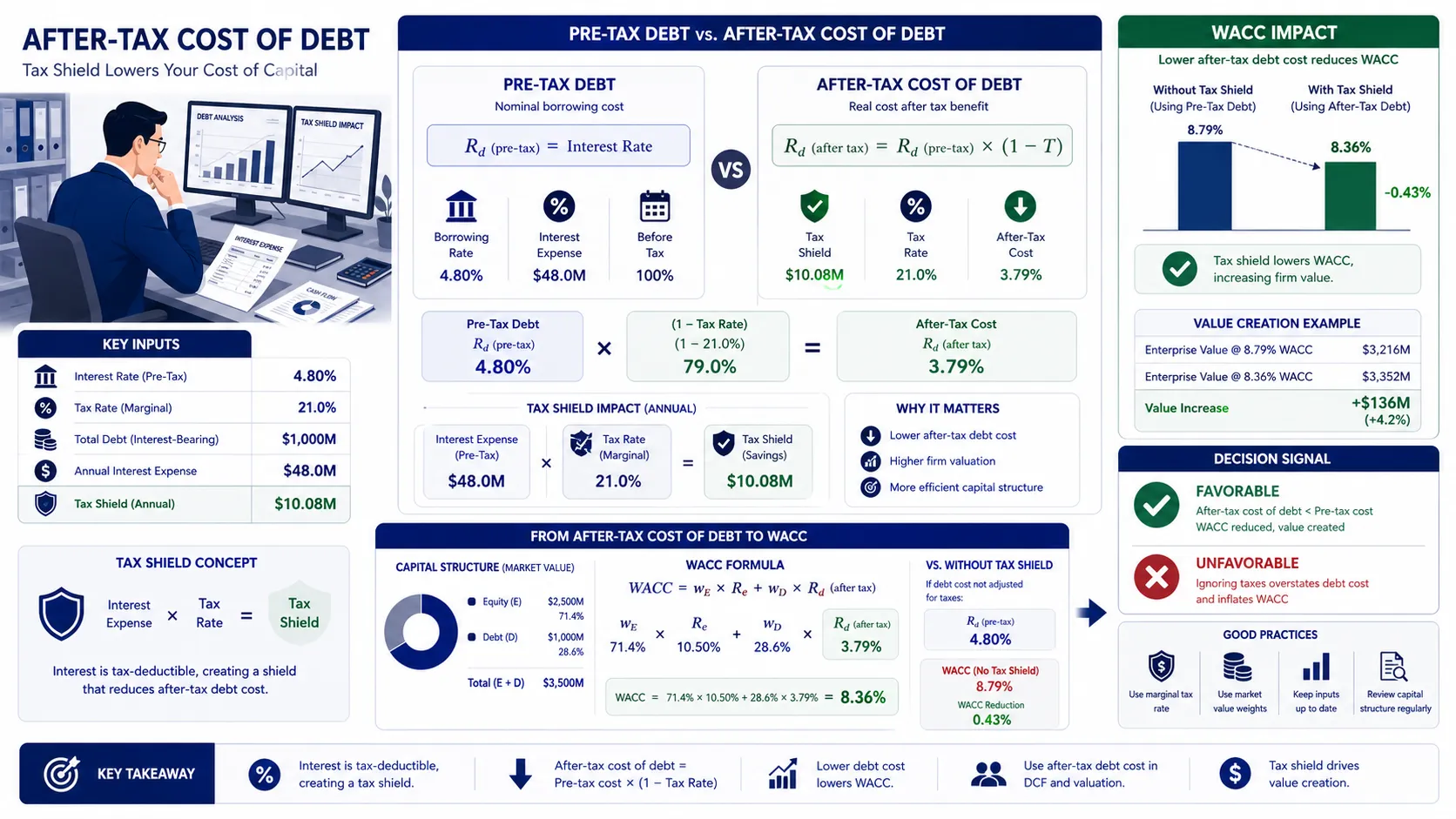
What Is After-Tax Cost of Debt and How Does It Lower WACC?
Interest payments are tax-deductible, making debt cheaper than equity and lowering your company's WACC. The after-tax cost of debt reveals this true, subsidized borrowing rate.
 Corporate Finance
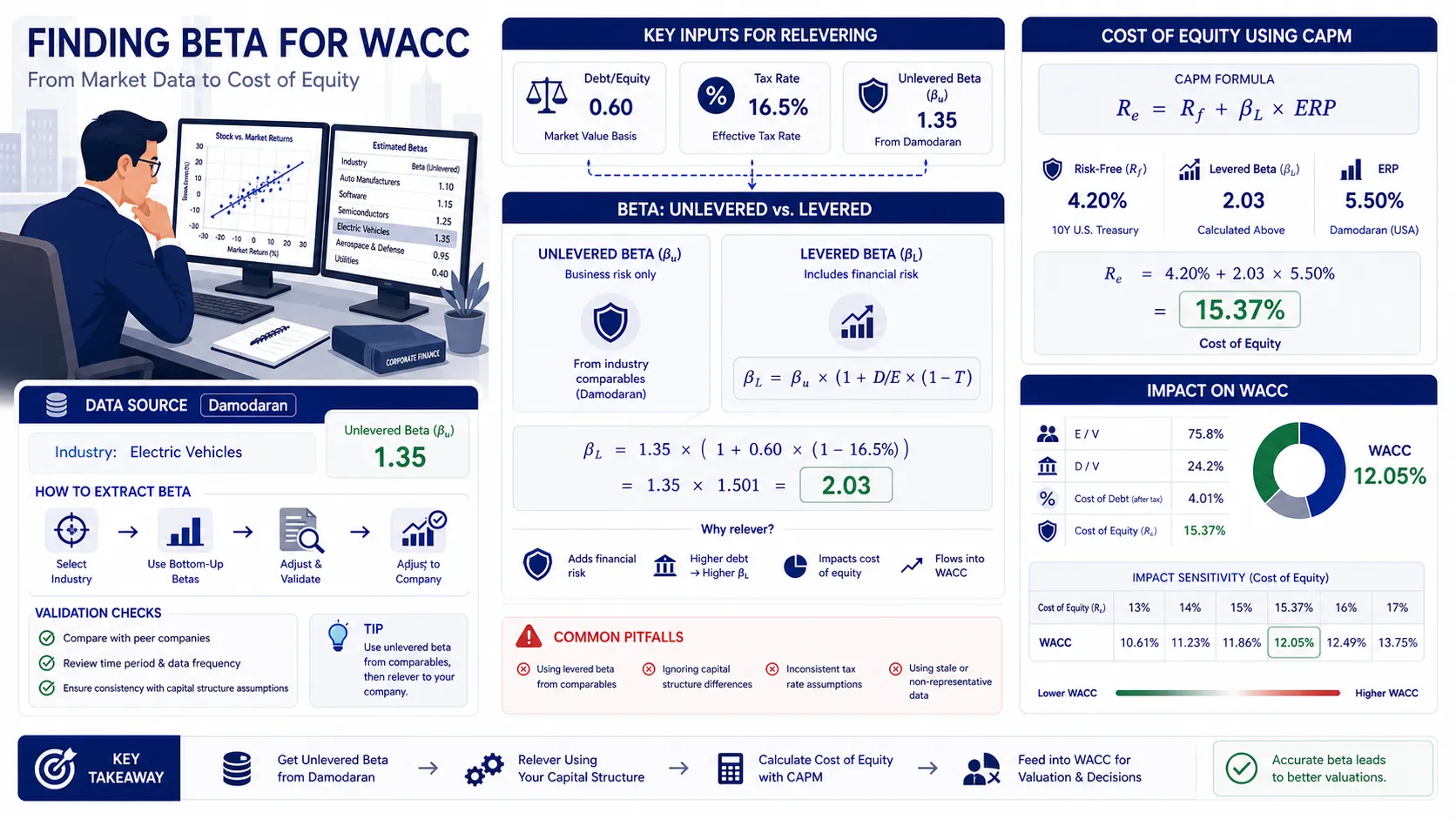
How to Find Beta for WACC: Unlevered vs Levered Beta Calculati
Unlock institutional-grade WACC by mastering bottom-up beta: unlever public peers to strip debt risk, then re-lever for your target's capital structure. This precision method solves CAPM's toughest hurdle, delivering accurate equity risk pricing for DCF models.
Frequently Asked Questions
What is a good ROIC percentage?
How does WACC influence EVA?
The calculations, projections, and reports generated by BizToolkitPro are for educational and informational purposes only. They do not represent professional investment advice, financial planning, tax guidance, legal counsel, or formal business valuation.
Financial models and valuation formulas (including WACC, DCF, IRR, and NPV) rely on assumptions and inputs provided directly by the user. Actual financial markets and business metrics fluctuate; therefore, BizToolkitPro makes no warranties, express or implied, regarding the accuracy, completeness, or suitability of the outputs for any investment strategy or corporate decision.
Always perform your own independent diligence and consult with a licensed Financial Analyst, Certified Public Accountant (CPA), or certified valuation specialist before committing capital or executing corporate transactions.