ROI Calculator - Return on Investment Yield
Use this focused ROI calculator, designed to calculate the total Return on Investment and compound annualized yields (CAGR) for your projects and corporate assets. Supporting both simple holding sales and multi-period recurring cash flows, this tool offers detailed returns profiling, scenario stress testing, and discount-spread comparisons.
Make informed asset allocation choices using premium yield modeling.
Choose Simple Asset Sale or multi-period Cash Flow analysis.
Set initial costs and yield values.
Have a suggestion or found a calculation discrepancy? Let us know!
Understanding Return on Investment (ROI) and CAGR
Defining simple ROI
Return on Investment (ROI) is one of the most widely used financial metrics globally because of its simplicity and versatility. It measures the net return generated by an investment relative to its initial capital outlay. Expressed as a percentage, it tells you the absolute growth rate of your invested capital. Whether you are purchasing commercial machinery, funding a marketing campaign, or buying real estate assets, ROI provides a quick baseline to assess raw profitability.
However, simple ROI lacks one crucial dimension: time. A 50% return on investment sounds lucrative, but it is vastly different if it takes 1 year to achieve versus 10 years. For this reason, simple ROI must be supplemented with annualized yields.
Why annualized ROI (CAGR) is essential
Annualized ROI, often referred to as the Compound Annual Growth Rate (CAGR), solves the timing issue by calculating the geometric mean of the return rate on an annual basis. It answers the question: "What steady annual rate of return would have grown our initial investment to its final value over the holding period?"
By translating total returns into annualized figures, corporate finance teams can easily compare investments of different durations side-by-side. For example, a project yielding a 100% total return over 5 years (14.87% annualized) can be compared directly to a project yielding a 30% return over 1 year (30.00% annualized).
Adjusting for inflation & funding cost
When evaluating a multi-year investment, simple nominal yields can be highly misleading. Analysts deduct the rate of inflation or compare the solved CAGR against the company's cost of capital (WACC). An investment is truly profitable only if its annualized yield exceeds the hurdle funding rate.
How to use this ROI calculator
Select calculation mode and input capital
Choose your analysis style: "Simple Mode" models basic assets where you have a single initial cost and a final payout at the end of the holding term. "Cash Flow Mode" allows you to enter varying recurring cash inflows over multiple consecutive periods.
Input the Initial Investment outlay required at the start of your investment.
Enter return parameters and resolve yields
In Simple Mode, enter the Final Value and specify the holding period in years. In Cash Flow Mode, enter the cash flow amounts for each consecutive year. Click the "Run Solver" button to generate your results.
Explore outputs and metrics
The outputs card will display the solved total net profits, simple ROI, and annualized CAGR. Use the sensitivity grid tab to stress test yields against varying capital outlays or cash flows, or inspect the scenario comparison to contrast conservative models.
Compare ROI return scenarios
ROI baseline scenario
The base scenario represents your expected operating parameters. Return cash flows are modeled under moderate, normal-state forecasts to establish a baseline return yield.
ROI upside scenario
The bull scenario models upside operational performance. Larger cash inflows combined with shorter asset holding periods generate an accelerated CAGR yield.
ROI downside scenario
The bear scenario tests downside risk. Reduced cash inflows combined with extended holding terms depress the calculated ROI and CAGR yields significantly.
ROI and CAGR sensitivity profiling
Initial outlay vs final value matrix
The sensitivity grid maps the solved CAGR yield against shifting initial outlay costs (vertical) and final asset values (horizontal). This matrix is essential for evaluating capital safety margins.
Identifying hurdle crossover points
By observing the cell values in the sensitivity matrix, you can identify the exact points where the CAGR drops below the corporate hurdle rate, serving as a warning indicator for decision-makers.
Assessing yield stability
If a small cost overrun (e.g., +5%) triggers a massive decline in CAGR, the investment carries high financial risk. Robust projects show stable yield ratios across variables.
ROI formula and mathematical methodology
Methodology
Simple ROI is solved using the absolute returns ratio:
Annualized ROI (CAGR) is solved over holding years (t):
Step-by-step mathematical logic
To calculate ROI under this methodology, follow these steps:
- Compute Net Profit: Subtract the initial cost outlay from the final value (or sum all cash inflows and subtract the cost).
- Solve Simple ROI: Divide the Net Profit by the initial cost outlay, and multiply by 100.
- Solve CAGR: Convert the simple ROI to a multiplier factor (1 + ROI/100). Raise this factor to the power of 1/t, where t is the holding term in years. Subtract 1, and multiply by 100 to get the annualized yield.
Example calculation of ROI
Simple investment assumptions
Suppose a business invests $50,000 in a commercial asset. After holding the asset for 3 years, the asset is liquidated for a final value of $75,000.
We want to calculate the total net profit, the simple ROI, and the compound annualized return.
Step-by-step resolution
First, the net profit:
Net Profit = $75,000 - $50,000 = $25,000.
Second, the simple ROI:
ROI = ($25,000 / $50,000) * 100 = 50.00%.
Third, the annualized ROI:
Annualized ROI = [ (1 + 0.50)^(1/3) - 1 ] * 100 = [ (1.50)^0.3333 - 1 ] * 100 = [ 1.1447 - 1 ] * 100 = 14.47%. This project grew at a compound annual rate of 14.47% over the 3-year term.
Common mistakes in ROI modeling
Ignoring capital holding duration
A major financial analysis mistake is comparing two simple ROI percentages while ignoring their durations. A 100% ROI achieved over 10 years (7.18% CAGR) is far less efficient than a 20% ROI achieved in 6 months (44.0% CAGR). Always look at the annualized CAGR percentage to ensure you are comparing capital deployment efficiency accurately.
Neglecting ongoing maintenance expenses
When calculating the cost of an investment, many managers only include the initial purchase price. Ongoing maintenance, transaction fees, insurance, and taxes must be factored into the outlay. Overlooking these costs inflates your calculated net profits, leading to overly optimistic ROI results that do not reflect reality.
Real-world case study: Meta Platforms (META, FY 2023)
Meta Platforms metrics profile
Meta Platforms has made significant strategic investments in its Reality Labs division, which is focused on building the metaverse, including augmented and virtual reality technologies. This case study examines the financial performance of Reality Labs for the fiscal year 2023 to understand the return on these substantial investments.
For fiscal year 2023, Meta Platforms' Reality Labs division incurred $18.01 billion in operating costs to generate $1.89 billion in revenue, resulting in a net operating loss of $16.12 billion. This yields a significant negative Return on Investment (ROI) of approximately -89.5% for the year. This indicates that while Meta is heavily investing in its long-term vision for the metaverse, the division is currently far from profitable and continues to be a major drain on company resources. The substantial losses reflect Meta's aggressive spending on product development and ecosystem scaling in AR/VR, underscoring a long-term strategic bet rather than immediate financial returns.
Related Calculators
Estimate weighted average cost of capital.
Open Tool →DCF CalculatorValue a business using discounted cash flows.
Open Tool →NPV CalculatorCompute net present value of cash flows.
Open Tool →IRR CalculatorSolve project internal rates of return.
Open Tool →Free Cash Flow CalculatorEstimate operating free cash flow.
Open Tool →Break-Even ROI CalculatorAnalyze payback thresholds and returns.
Open Tool →Related Articles & Guides
 Corporate Finance
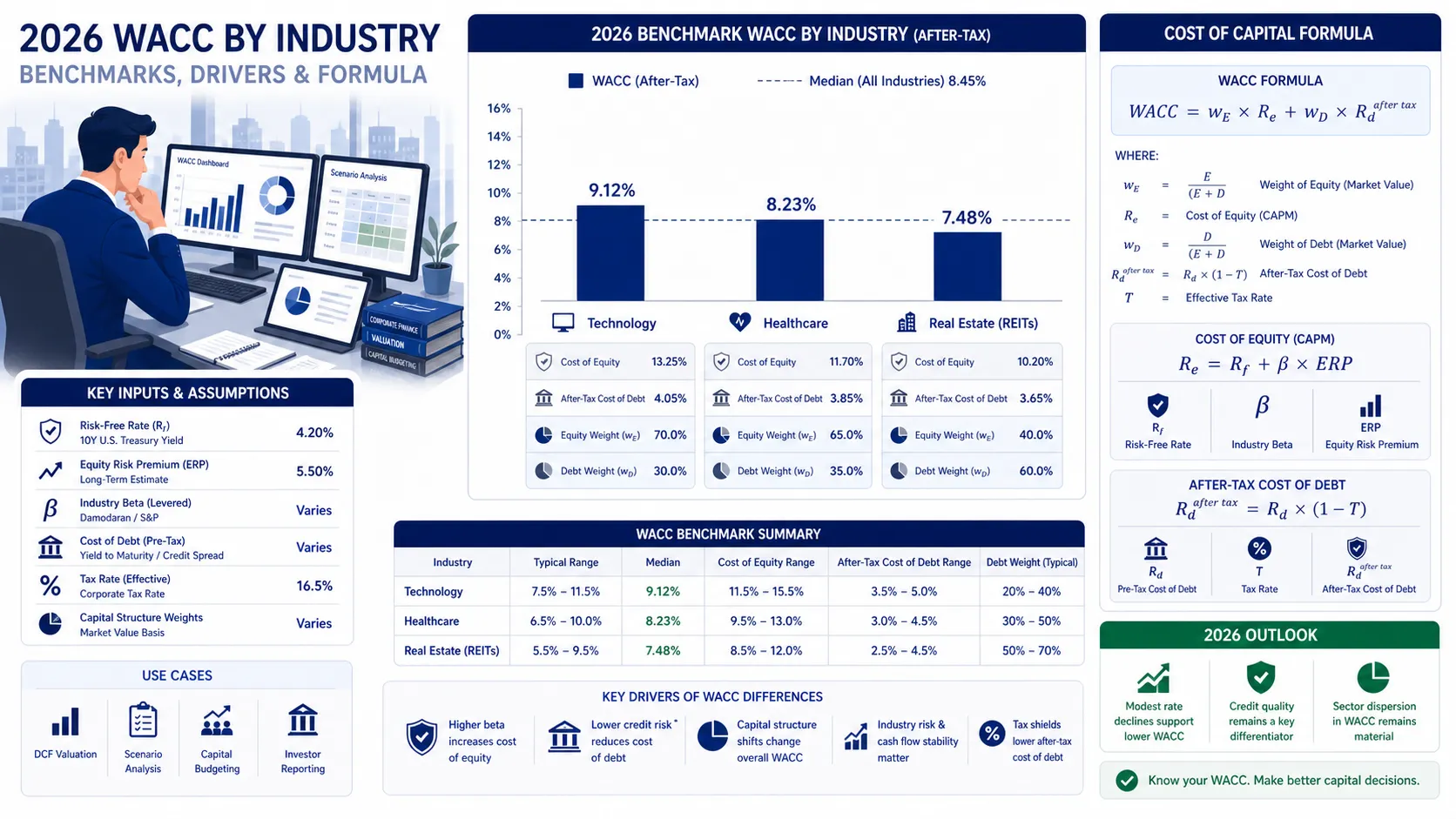
WACC by Industry: 2026 Benchmarks for Technology, Healthcare, and Real Estate
In 2026, industry WACC diverges sharply, from 5.5% for utilities to over 11.5% for software. CFOs must benchmark their discount rate against peers to ground valuations in market reality.
 Corporate Finance
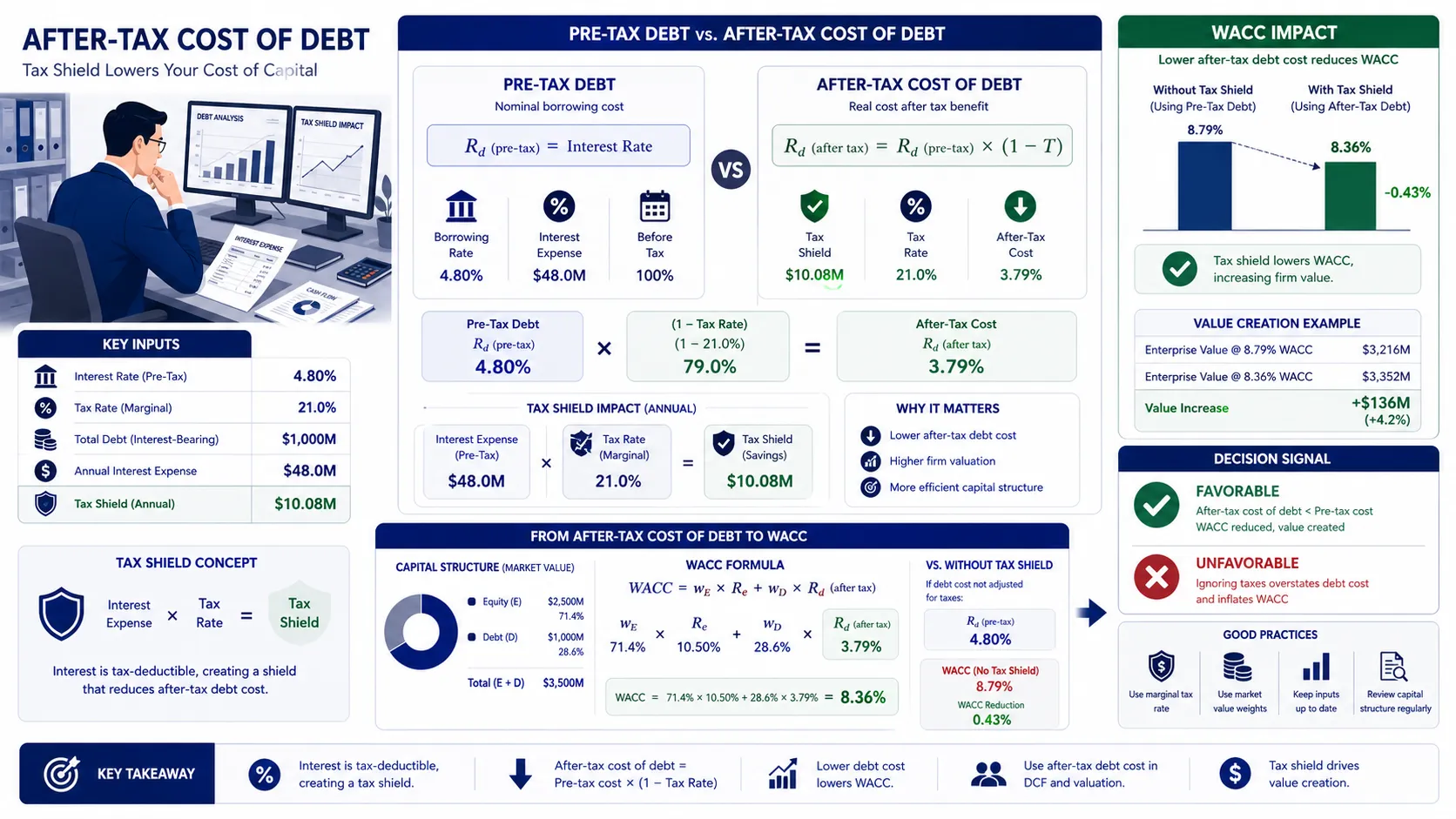
What Is After-Tax Cost of Debt and How Does It Lower WACC?
Interest payments are tax-deductible, making debt cheaper than equity and lowering your company's WACC. The after-tax cost of debt reveals this true, subsidized borrowing rate.
 Corporate Finance
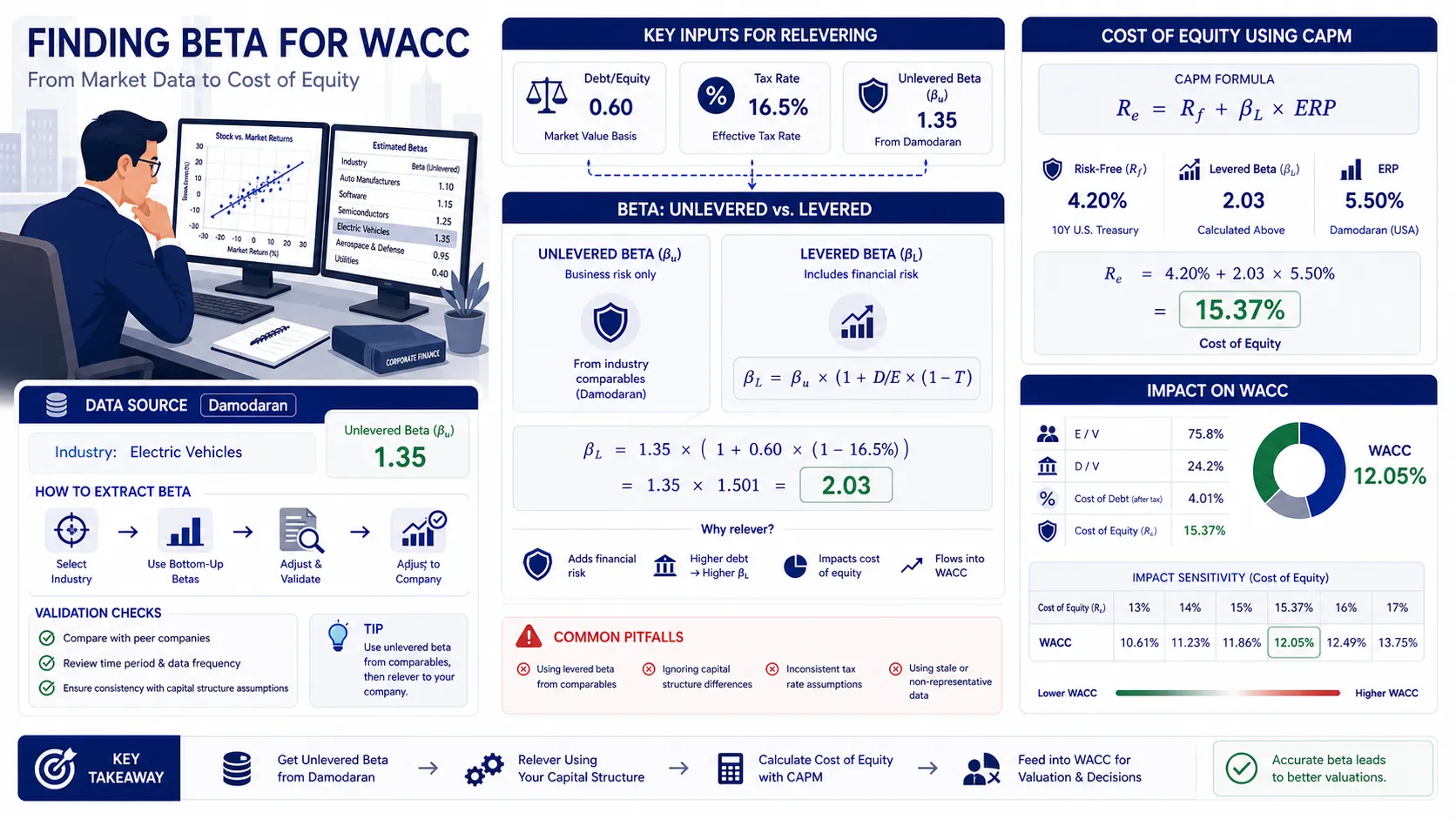
How to Find Beta for WACC: Unlevered vs Levered Beta Calculati
Unlock institutional-grade WACC by mastering bottom-up beta: unlever public peers to strip debt risk, then re-lever for your target's capital structure. This precision method solves CAPM's toughest hurdle, delivering accurate equity risk pricing for DCF models.
Frequently Asked Questions
What is Compound Annual Growth Rate (CAGR)?
Why is simple ROI misleading for long holding terms?
The calculations, projections, and reports generated by BizToolkitPro are for educational and informational purposes only. They do not represent professional investment advice, financial planning, tax guidance, legal counsel, or formal business valuation.
Financial models and valuation formulas (including WACC, DCF, IRR, and NPV) rely on assumptions and inputs provided directly by the user. Actual financial markets and business metrics fluctuate; therefore, BizToolkitPro makes no warranties, express or implied, regarding the accuracy, completeness, or suitability of the outputs for any investment strategy or corporate decision.
Always perform your own independent diligence and consult with a licensed Financial Analyst, Certified Public Accountant (CPA), or certified valuation specialist before committing capital or executing corporate transactions.