
Profitability Index Calculator - Capital Efficiency Ratio
Use this focused profitability index calculator, an analytical solver designed to determine the capital efficiency ratio of your projects. By comparing the present value of future cash inflows against the initial outlay, this tool measures the value created per unit of investment.
Optimize your capital budget and make accept-or-reject decisions backed by present-value metrics.
Set initial costs and compounding hurdle rate.
Enter expected recurring inflows from year 1.
Have a suggestion or found a calculation discrepancy? Let us know!
Understanding profitability index in capital budgeting
Defining the capital efficiency ratio
The Profitability Index (PI), also referred to as the Profit Inflation Ratio or Value Investment Ratio, is a capital budgeting tool used to evaluate the relationship between a project's costs and its future cash benefits. Unlike Net Present Value (NPV), which measures the absolute wealth added by a project, PI measures the relative efficiency of value creation. It answers a vital corporate question: "How much present value do we create for every single dollar we invest?"
This ratio is particularly useful in capital rationing situations, where a firm has a fixed capital budget and must select from a variety of independent positive-NPV projects. Ranking projects by PI ensures the company maximizes the total value generated from its limited resources.
PI decision guidelines (Accept vs. Reject)
The profitability index has clear decision rules for capital allocations:
- PI > 1.0: The present value of future inflows exceeds the initial investment cost. The project is profitable, creates value, and should be accepted.
- PI = 1.0: The present value of future inflows exactly equals the investment cost. The project breaks even in present-value terms; the firm is indifferent.
- PI < 1.0: The present value of cash inflows is less than the outlay. The project destroys value and must be rejected.
The role of capital rationing
Under capital rationing, a company cannot fund all positive-NPV projects due to cash constraints. Simple NPV sorting might lead to picking a single massive project that consumes the entire budget, while a combination of smaller projects with slightly lower individual NPVs but higher relative PIs could yield a far higher total NPV. Using PI as a ranking tool helps executives identify the most efficient project mix.
How to use this profitability index calculator
Set investment outlay and discount parameters
Begin by entering the Initial Outlay Cost required to launch the project at Period 0. Next, specify the Discount Rate (representing the company's hurdle rate or cost of capital). This rate will be used to discount each year's inflow back to Year 0.
Populate the expected cash inflows list for each forecast period. You can add more rows for longer-duration projects or remove rows to truncate the timeline.
Interpret solver decisions
Click "Run Solver" to execute the calculation. The results panel will display the solved PI ratio, present value of inflows, and Net Present Value. The gauge chart visually highlights whether the project lands in the green accepted zone (PI >= 1.0) or red rejected zone.
Explore sensitivity matrices
You can toggle to the Sensitivity Grid to inspect how changes in discount rates or initial outlays shift the PI ratio, helping you perform robust stress testing across varying macro cost environments.
Compare profitability index scenarios
Profitability Index baseline scenario
The base scenario represents your expected operating parameters. Cash inflows and discount rates are modeled under moderate, normal-state forecasts to establish a baseline present-value recovery timeline.
Profitability Index upside scenario
The bull scenario models upside operational performance. Larger cash inflows and lower market discount rates accelerate the present-value compounding, resulting in a significantly higher profitability index.
Profitability Index downside scenario
The bear scenario tests downside risk. Reduced cash inflows combined with higher financing discount rates delay cost recovery, dropping the profitability index below the 1.0 hurdle threshold limit.
Profitability index sensitivity analysis
Hurdle rate vs outlay cost variables
The sensitivity grid maps the solved profitability index against shifting hurdle rates (vertical) and initial outlay costs (horizontal). This matrix is essential for identifying risk thresholds.
Identifying index crossover boundaries
By observing the cell values in the sensitivity matrix, you can identify where the PI ratio drops below 1.0. This crossover point serves as a warning indicator for decision-makers.
Evaluating project robustness
If a project's PI remains above 1.0 even when the discount rate rises by 3%, the project is deemed robust. If a slight rate shift triggers a decline in PI below 1.0, the project carries high financial risk.
PI formula and mathematical methodology
Mathematical Equation
The Profitability Index (PI) is calculated using the following formula:
Where the PV of Inflows is:
Step-by-step mathematical logic
To calculate the PI ratio under standard financial methodology, follow these steps:
- Discount each year's cash inflow (CF_t) back to present value using the discount rate (r). For example, Year 1 is divided by (1+r)^1, Year 2 by (1+r)^2, and so on.
- Sum all of these discounted present values to calculate the total Present Value of Inflows.
- Divide the total Present Value of Inflows by the absolute value of the Initial Outlay.
The resulting decimal ratio indicates the relative profitability of the project. Note that PI is mathematically related to NPV: if NPV is positive, PI will always be greater than 1.0.
Example calculation of Profitability Index
Investment assumptions
Let's look at a capital investment requiring an initial outlay of $100,000. The projected inflows are Year 1 = $40,000, Year 2 = $50,000, and Year 3 = $40,000. The discount rate (WACC) is set at 10%.
We want to calculate the Present Value of Inflows and solve for the PI ratio.
Solving step-by-step
First, we discount each year's inflow to Year 0:
- Year 1 PV: $40,000 / 1.10^1 = $36,363.64
- Year 2 PV: $50,000 / 1.10^2 = $41,322.31
- Year 3 PV: $40,000 / 1.10^3 = $30,052.59
Total Present Value of Inflows = $36,363.64 + $41,322.31 + $30,052.59 = $107,738.54.
Next, we apply the PI formula:
PI = $107,738.54 / $100,000 = 1.08 (rounded). Since PI is 1.08 (which is greater than 1.0), the investment decision is to ACCEPT the project. This project generates $1.08 of present value for every $1.00 invested. The Net Present Value is: $107,738.54 - $100,000 = $7,738.54.
Common mistakes in profitability index modeling
Neglecting the scale of the investment
A major strategic mistake is preferring a higher PI ratio over a higher absolute NPV when comparing mutually exclusive projects of differing scales. For example, Project A requires an outlay of $10,000 and creates $20,000 in PV (PI = 2.0, NPV = $10,000). Project B requires $100,000 and creates $150,000 in PV (PI = 1.5, NPV = $50,000). While Project A has a higher PI ratio, Project B creates far more absolute wealth ($50,000 vs. $10,000) and should be preferred if budget permits.
Applying incorrect discount rates
Since the profitability index depends heavily on the present value of inflows, choosing an incorrect discount rate will distort the results. Using a discount rate that is too low understates the cost of capital, artificially inflating the PI ratio and leading to risky project choices. Conversely, using a discount rate that is too high destroys viable investment projects. Always align your discount rate with the firm's actual WACC.
Real-world case study: Taiwan Semiconductor Manufacturing Company (TSMC) (TSM, FY 2025 (Projected))
Taiwan Semiconductor Manufacturing Company (TSMC) metrics profile
TSMC, a global leader in semiconductor manufacturing, consistently undertakes substantial capital expenditures to expand its production capacity and maintain technological leadership. This case study analyzes a hypothetical fab expansion project for TSMC, based on their projected capital spending for FY 2025, to illustrate the application of the Profitability Index in capital budgeting decisions. The analysis uses realistic estimates for cash flows and TSMC's reported cost of capital.
For this hypothetical fab expansion, TSMC's estimated Profitability Index of 1.13 indicates that the present value of the project's expected future cash flows exceeds its initial investment. This suggests that the project would be considered financially attractive, as it is expected to generate $1.13 in present value for every dollar invested. A PI greater than 1.0 is generally favorable, aligning with TSMC's strategic imperative to invest heavily in advanced manufacturing to meet robust demand, particularly in AI-related segments. This metric helps guide management in allocating capital efficiently to projects that promise to enhance shareholder value.
Related Calculators
Estimate weighted average cost of capital.
Open Tool →DCF CalculatorValue a business using discounted cash flows.
Open Tool →NPV CalculatorCompute net present value of cash flows.
Open Tool →IRR CalculatorSolve project internal rates of return.
Open Tool →Free Cash Flow CalculatorEstimate operating free cash flow.
Open Tool →Break-Even ROI CalculatorAnalyze payback thresholds and returns.
Open Tool →Related Articles & Guides
 Corporate Finance
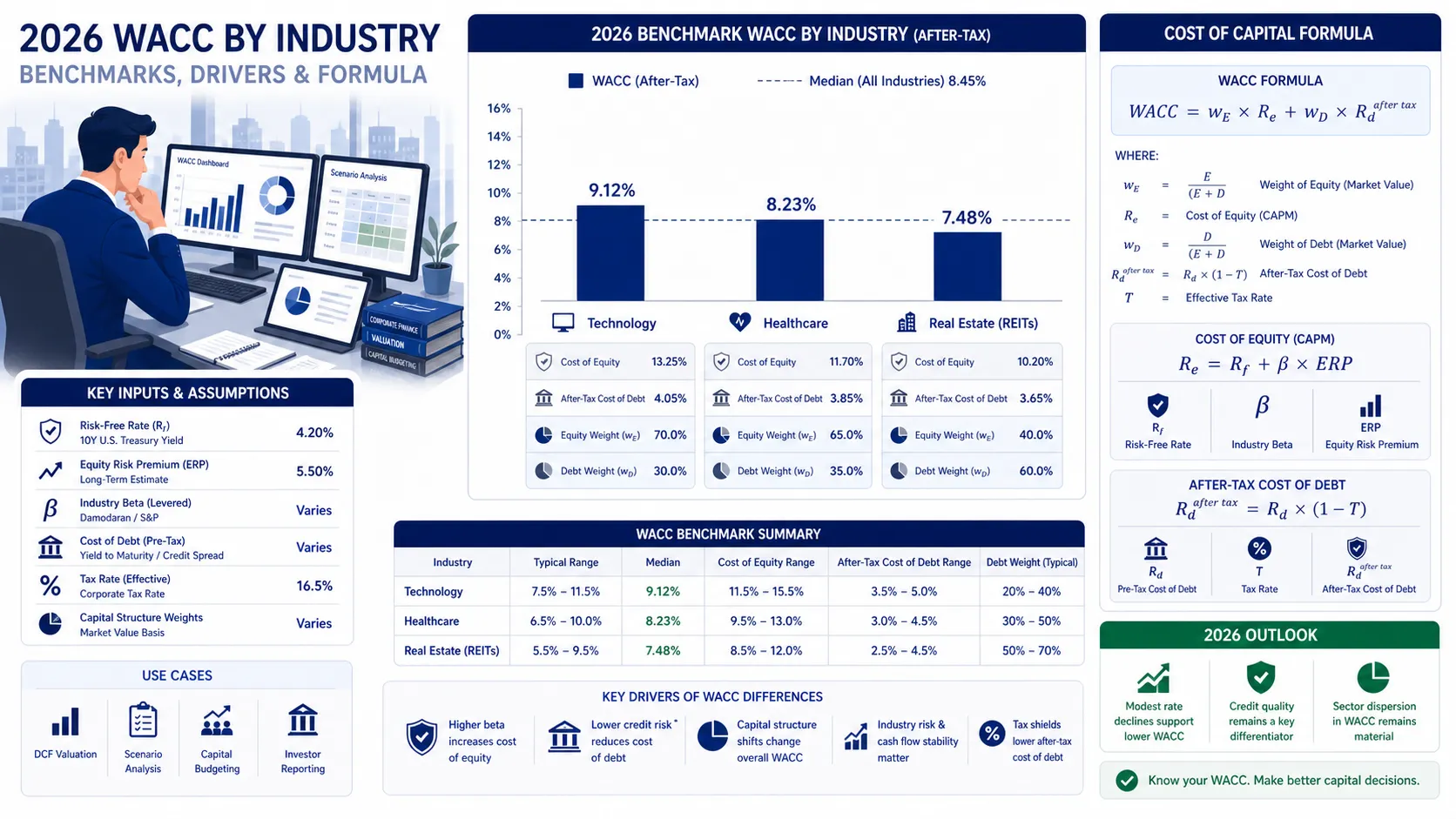
WACC by Industry: 2026 Benchmarks for Technology, Healthcare, and Real Estate
In 2026, industry WACC diverges sharply, from 5.5% for utilities to over 11.5% for software. CFOs must benchmark their discount rate against peers to ground valuations in market reality.
 Corporate Finance
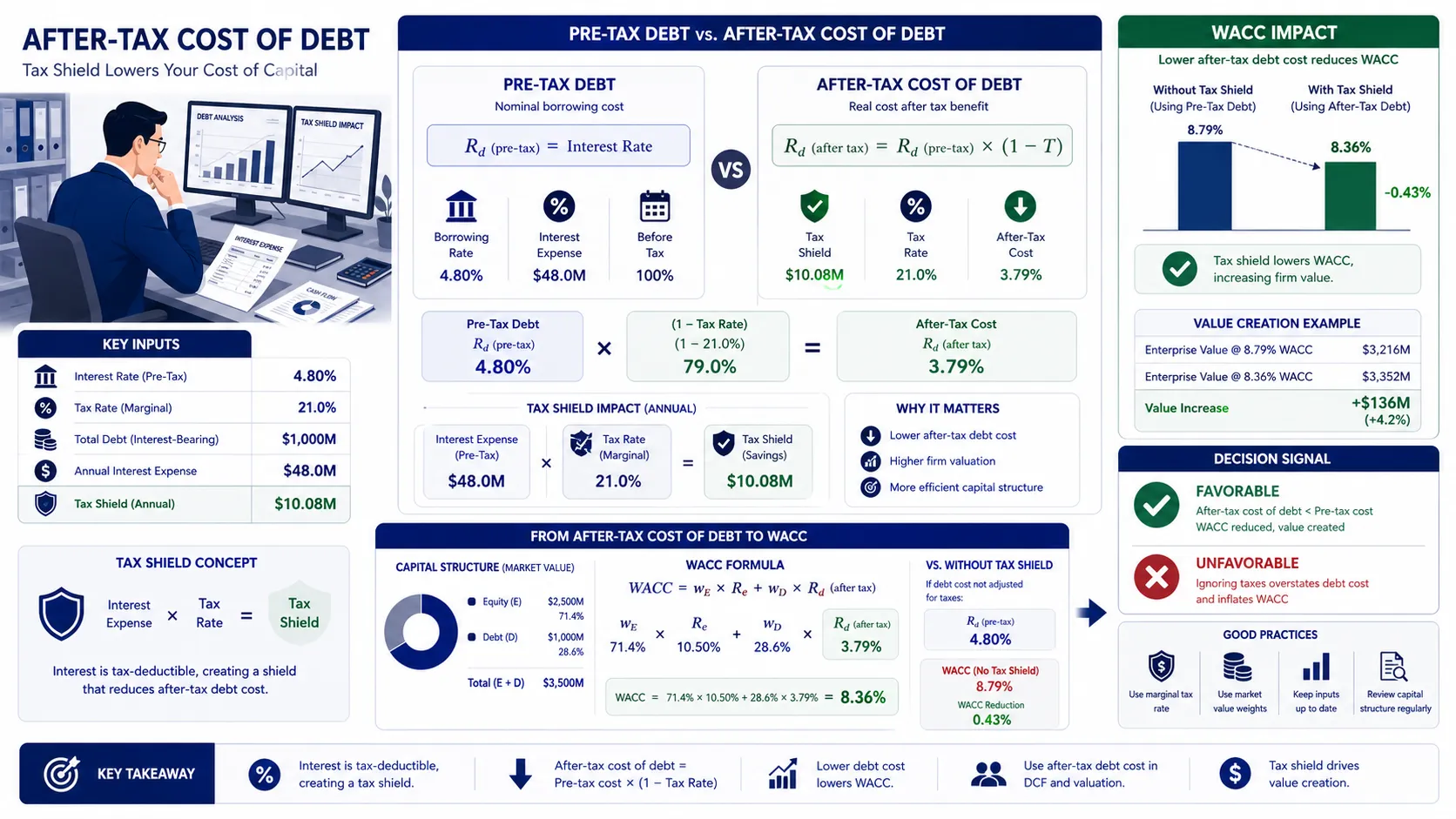
What Is After-Tax Cost of Debt and How Does It Lower WACC?
Interest payments are tax-deductible, making debt cheaper than equity and lowering your company's WACC. The after-tax cost of debt reveals this true, subsidized borrowing rate.
 Corporate Finance
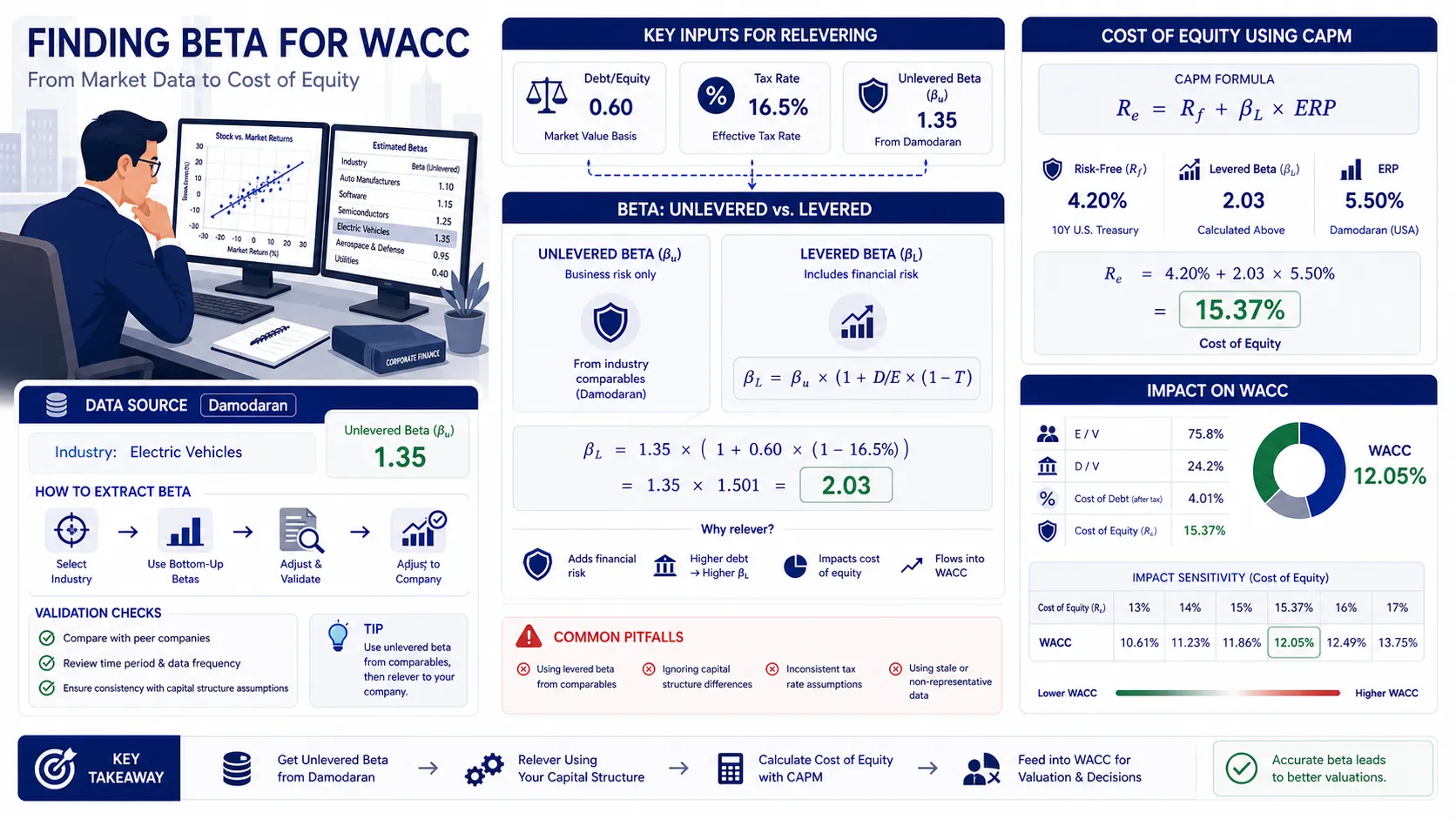
How to Find Beta for WACC: Unlevered vs Levered Beta Calculati
Unlock institutional-grade WACC by mastering bottom-up beta: unlever public peers to strip debt risk, then re-lever for your target's capital structure. This precision method solves CAPM's toughest hurdle, delivering accurate equity risk pricing for DCF models.
Frequently Asked Questions
What is the main advantage of Profitability Index over NPV?
Can profitability index be negative?
The calculations, projections, and reports generated by BizToolkitPro are for educational and informational purposes only. They do not represent professional investment advice, financial planning, tax guidance, legal counsel, or formal business valuation.
Financial models and valuation formulas (including WACC, DCF, IRR, and NPV) rely on assumptions and inputs provided directly by the user. Actual financial markets and business metrics fluctuate; therefore, BizToolkitPro makes no warranties, express or implied, regarding the accuracy, completeness, or suitability of the outputs for any investment strategy or corporate decision.
Always perform your own independent diligence and consult with a licensed Financial Analyst, Certified Public Accountant (CPA), or certified valuation specialist before committing capital or executing corporate transactions.