
Payback Period Calculator - Investment Breakeven
Use this focused payback period calculator, designed to compute the exact period required to recoup your initial capital outlay. Determining the breakeven timeline of projects is a critical step in corporate budgeting, liquidity planning, and risk mitigation.
This utility solves simple payback periods, charts cumulative flows, and contrasts scenarios to help you assess project risks before committing capital.
Set initial cost outlay for the project at Time 0.
Enter expected recurring inflows from year 1 onwards.
Have a suggestion or found a calculation discrepancy? Let us know!
Understanding payback period in capital budgeting
Role as a liquidity screening tool
The payback period is highly valued by corporate finance managers because it indicates how long a company's cash remains tied up in an investment. In volatile economic climates or fast-paced industries (such as software development or retail), projects that return cash quickly are highly favored. A short payback period decreases the liquidity risk of the firm and frees up capital for subsequent investment opportunities.
By establishing a maximum acceptable payback threshold (for example, requiring all projects to break even within 3 years), businesses can easily filter out high-risk long-term capital programs that might drain cash resources during economic downturns.
Limitations compared to Net Present Value
While simple to calculate and easy to communicate, the simple payback period has two major theoretical drawbacks: it completely ignores the time value of money, and it overlooks any cash flows that occur after the payback year. For instance, a project that breaks even in 2 years but generates zero cash afterward would be selected over a project that breaks even in 3 years but generates millions in Year 4 and 5.
To overcome these limits, financial analysts treat the payback period as an initial screening tool rather than the sole decision metric. It should always be paired with Net Present Value (NPV) or internal yields to ensure the firm maximizes absolute wealth creation.
Evaluating investment risk bounds
By focusing on cash recovery time, the payback method acts as a natural proxy for risk screening. The further out a cash flow is projected, the more uncertain it is. By preferring projects with rapid payback cycles, companies can insulate their capital structures from long-term macroeconomic volatility, credit market shifts, and technology obsolescence.
How to use this payback period calculator
Enter capital cost and cash inflows
Begin by entering your Initial Investment cost (entered as a positive value). This represents the capital outlay required at Period 0 to start the project. After that, add expected cash inflows for each consecutive forecast period (Year 1, Year 2, etc.) using the cash inflows input list.
You can easily adjust the number of periods in your model by clicking the "Add Flow row" or "Remove" buttons to match the exact duration of your project's projections.
Analyze the breakeven chart
Once you have populated your inputs, click "Run Solver." The cumulative cash flows chart will render, visually mapping out the path of your investment as it recovers. The red indicator shows the exact breakeven crossover point on the zero baseline.
Inspect scenario variations
Use the tab navigation panel on the right card to toggle between the Sensitivity Grid, which models payback changes against outlay variables, and Scenarios comparing expected vs. pessimistic cases. This multi-dimensional mapping provides a solid basis for final risk reports.
Compare payback timing scenarios
Payback Period baseline scenario
The base scenario represents your expected operating parameters. The cash inflows are modeled under standard market expansion rates. This acts as the baseline forecast for calculating standard cost recovery timelines.
Payback Period upside scenario
The bull scenario models upside operational performance. It assumes faster sales cycle times, lower variable costs, and higher pricing power, yielding larger cash inflows that accelerate the breakeven timeline.
Payback Period downside scenario
The bear scenario tests downside resiliency. It assumes delayed customer acquisitions and inflation on cost outlays, resulting in diminished inflows that extend the recovery timeline significantly.
Payback period sensitivity profiling
Initial outlay vs annual flows matrix
The sensitivity grid maps the solved payback period against shifting initial outlay costs (vertical) and annual cash flow variables (horizontal). This matrix is essential for assessing capital risk bounds.
Identifying capital overrun thresholds
By inspecting different cost-increase scenarios, managers can see the exact point where a 10% capital overrun pushes the payback timeline beyond the company's maximum risk tolerance limit.
Evaluating cash flow volatility
If a slight decline in annual cash flow (e.g., -5%) triggers a massive delay in cost recovery, the project carries high operational risk. Projects with stable payback timelines across variables are favored.
Payback formula and mathematical methodology
Breakeven Equation
The payback period is solved by tracking cumulative cash flows:
Step-by-step payback calculation logic
To calculate simple payback, follow this structured process:
- Create a table tracking the cumulative cash flows, starting at Year 0 with the negative investment cost.
- Add the inflow of Year 1 to the negative balance. Keep adding each year's inflow until the cumulative total turns positive.
- Identify the year (t) right before the crossover occurs (where the balance is still negative).
- Calculate the fractional portion by dividing the remaining negative deficit at year t by the total inflow expected during the next year (t+1).
This fractional result is added to the year t to yield the exact decimal payback time.
Example calculation of payback period
Project cash flows list
Let's analyze a capital project requiring an initial outlay of $100,000. The subsequent annual cash inflows are: Year 1 = $30,000, Year 2 = $40,000, Year 3 = $50,000, and Year 4 = $30,000.
We want to calculate how many years it takes for the cumulative inflows to equal $100,000.
Solving for breakeven years
Let's compile the cumulative balance:
- Year 0: -$100,000
- Year 1: -$100,000 + $30,000 = -$70,000
- Year 2: -$70,000 + $40,000 = -$30,000
- Year 3: -$30,000 + $50,000 = +$20,000 (crossover year)
At the end of Year 2, we are still short by $30,000. In Year 3, we expect an inflow of $50,000. Assuming cash flows occur evenly throughout the year, the payback period is: 2 + ($30,000 / $50,000) = 2.60 years.
Common mistakes in payback period modeling
Ignoring post-payback cash flows
A major strategic mistake is choosing projects based solely on the fastest payback. Some projects recover costs rapidly but stop generating income shortly after, whereas others take longer to break even but yield substantial cash flows for decades. Always verify total NPV to prevent picking short-term projects that limit long-term corporate growth.
Treating all periods as equal value
Simple payback period models treat cash flows in Year 5 exactly same as cash flows in Year 1. Because of inflation and capital opportunity costs, a dollar received today is worth more than a dollar tomorrow. Neglecting the discount factor leads to optimistic assessments. Make sure to double check your findings against discounted payback solvers.
Real-world case study: HubSpot (HUBS, Q1 2024)
HubSpot metrics profile
HubSpot, a leading SaaS provider, demonstrated robust growth and efficient customer acquisition in the first quarter of 2024. An analysis of its key financial and operational metrics, such as Customer Acquisition Cost (CAC) and average customer revenue, allows for the calculation of its CAC Payback Period.
HubSpot's CAC Payback Period of approximately 7.8 months in Q1 2024 is highly efficient for a SaaS company. This indicates that HubSpot recoups its investment in acquiring a new customer in less than eight months, a strong indicator of healthy unit economics and effective sales and marketing strategies. For investors, a short payback period signifies quick returns on customer acquisition investments, potentially freeing up capital for further growth or other strategic initiatives. It reflects well on the company's operational efficiency and ability to scale profitably.
Related Calculators
Estimate weighted average cost of capital.
Open Tool →DCF CalculatorValue a business using discounted cash flows.
Open Tool →NPV CalculatorCompute net present value of cash flows.
Open Tool →IRR CalculatorSolve project internal rates of return.
Open Tool →Free Cash Flow CalculatorEstimate operating free cash flow.
Open Tool →Break-Even ROI CalculatorAnalyze payback thresholds and returns.
Open Tool →Related Articles & Guides
 Corporate Finance
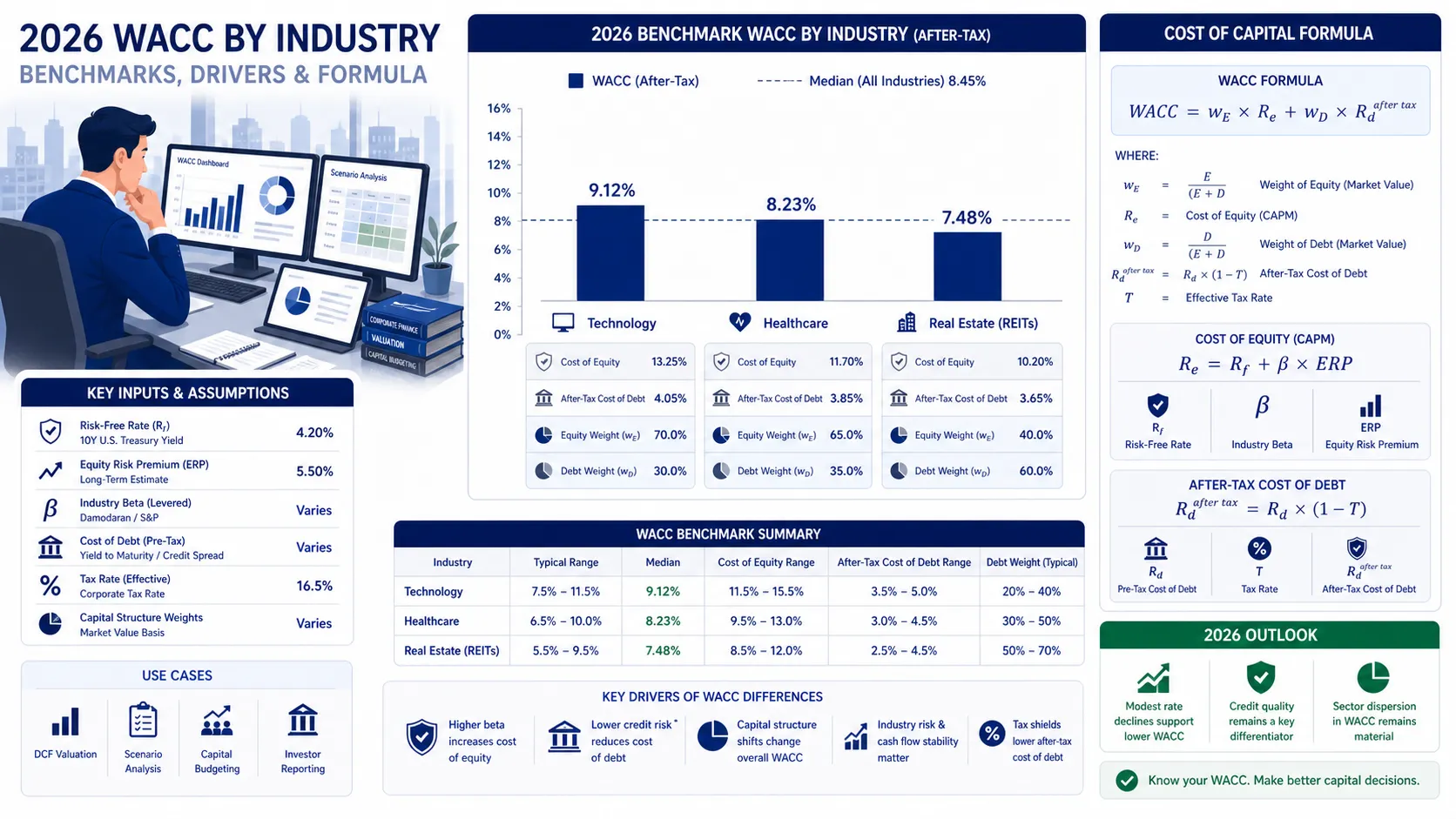
WACC by Industry: 2026 Benchmarks for Technology, Healthcare, and Real Estate
In 2026, industry WACC diverges sharply, from 5.5% for utilities to over 11.5% for software. CFOs must benchmark their discount rate against peers to ground valuations in market reality.
 Corporate Finance
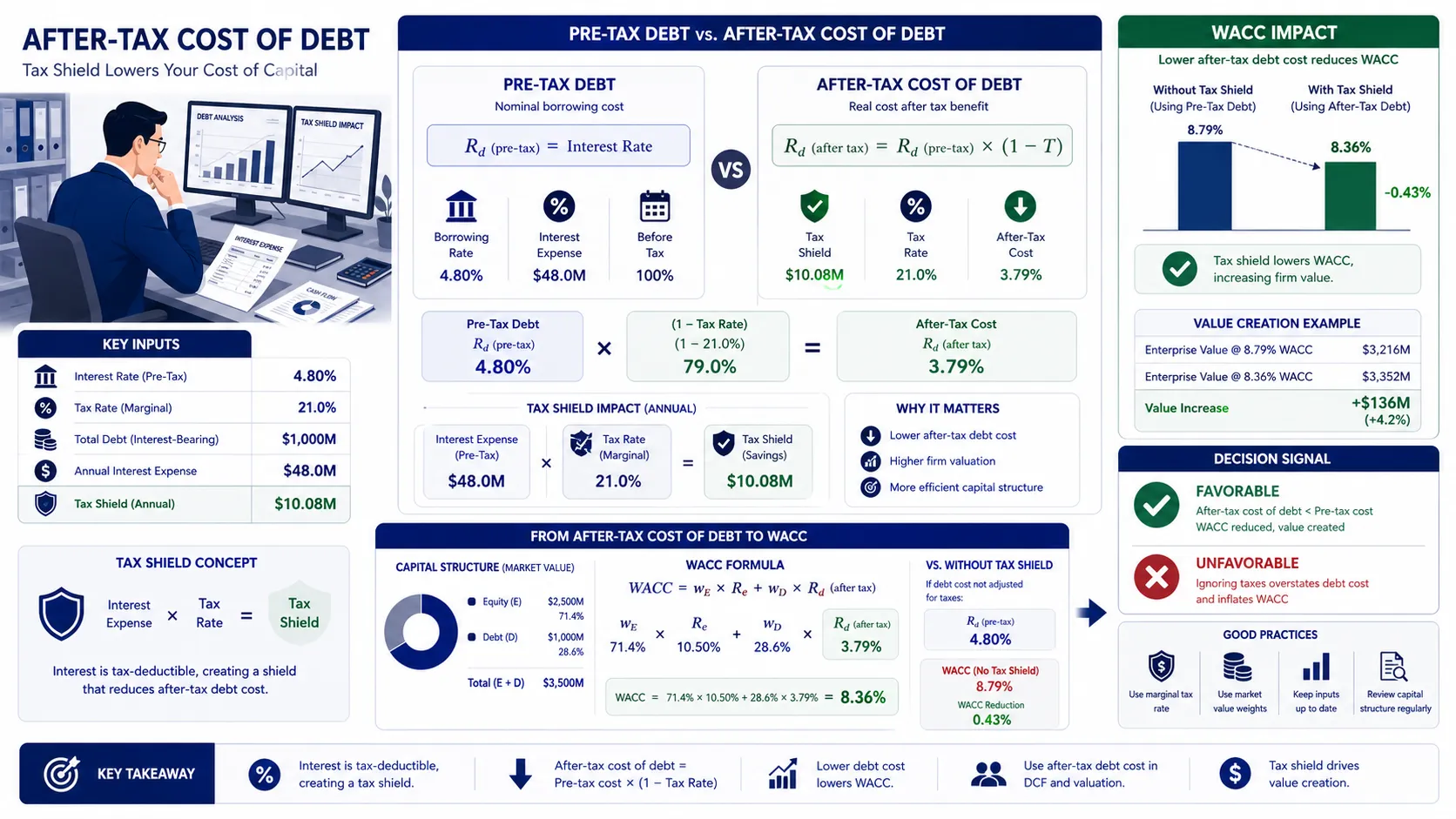
What Is After-Tax Cost of Debt and How Does It Lower WACC?
Interest payments are tax-deductible, making debt cheaper than equity and lowering your company's WACC. The after-tax cost of debt reveals this true, subsidized borrowing rate.
 Corporate Finance
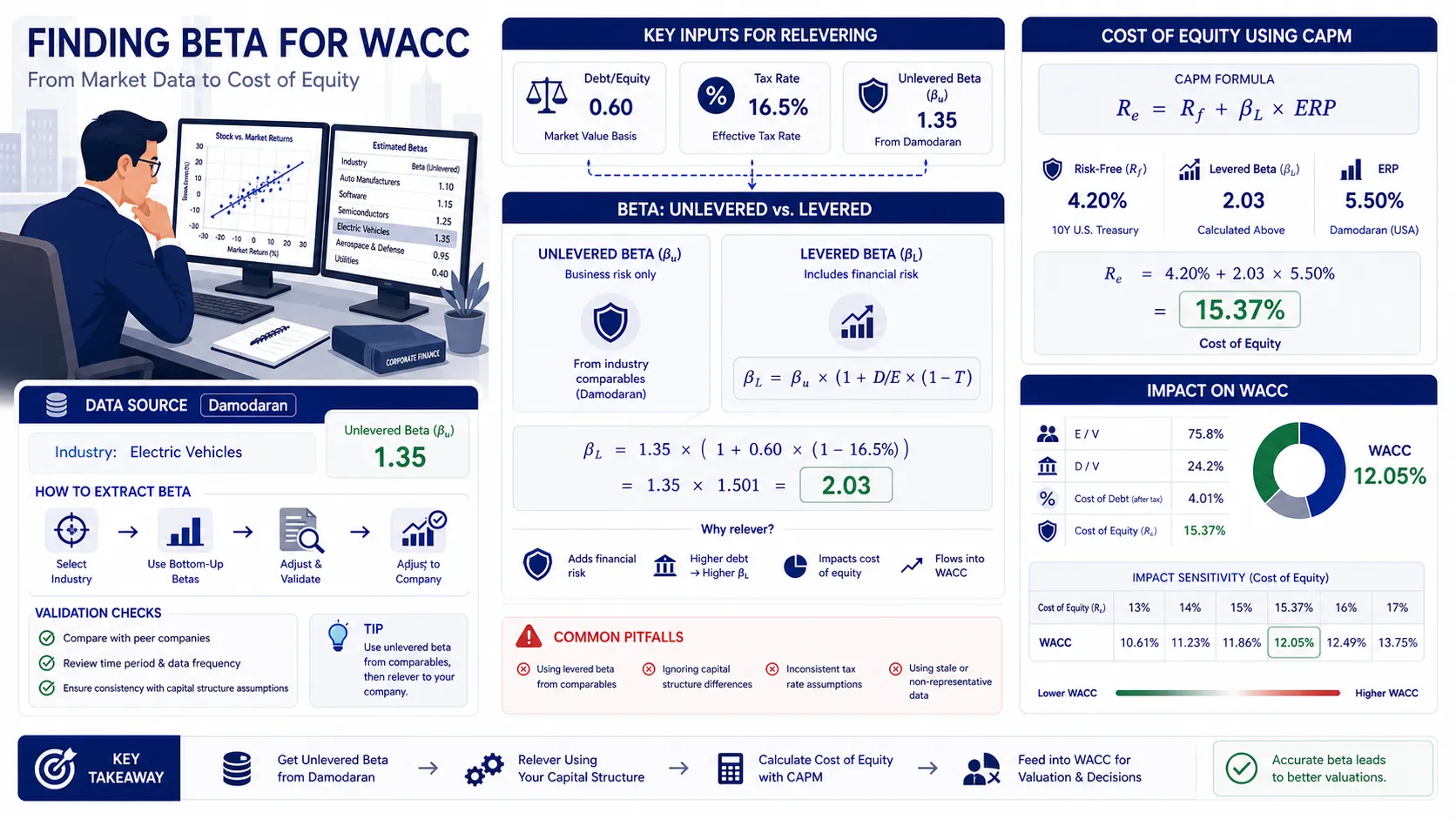
How to Find Beta for WACC: Unlevered vs Levered Beta Calculati
Unlock institutional-grade WACC by mastering bottom-up beta: unlever public peers to strip debt risk, then re-lever for your target's capital structure. This precision method solves CAPM's toughest hurdle, delivering accurate equity risk pricing for DCF models.
Frequently Asked Questions
What is a good payback period?
Does simple payback account for inflation?
What happens if the project never breaks even?
The calculations, projections, and reports generated by BizToolkitPro are for educational and informational purposes only. They do not represent professional investment advice, financial planning, tax guidance, legal counsel, or formal business valuation.
Financial models and valuation formulas (including WACC, DCF, IRR, and NPV) rely on assumptions and inputs provided directly by the user. Actual financial markets and business metrics fluctuate; therefore, BizToolkitPro makes no warranties, express or implied, regarding the accuracy, completeness, or suitability of the outputs for any investment strategy or corporate decision.
Always perform your own independent diligence and consult with a licensed Financial Analyst, Certified Public Accountant (CPA), or certified valuation specialist before committing capital or executing corporate transactions.