
MIRR Calculator - Modified Internal Rate of Return
Use this focused MIRR calculator, a premium corporate finance solver designed to compute the Modified Internal Rate of Return. When assessing long-term investment projects, financial analysts often find that standard IRR assumes unrealistic reinvestment rates.
This utility lets you configure distinct financing and reinvestment rates, avoiding multiple-root traps and yielding highly accurate cost recovery projections. Compare periodic yields side-by-side to make sound capital allocation choices.
Set rates for financing outflows and reinvesting inflows.
Define cash timeline. Time 0 is usually negative (investment outlay).
Have a suggestion or found a calculation discrepancy? Let us know!
Why Modified IRR is superior to standard IRR
The reinvestment rate assumption flaw
Traditional Internal Rate of Return (IRR) has a fundamental flaw: it mathematically assumes that all positive cash inflows generated by a project are immediately reinvested at the same high IRR rate. For example, if a project has an IRR of 55%, this implies the company can immediately reinvest intermediate cash flows to earn 55%. In reality, businesses typically reinvest at their standard cost of capital or standard market rates, making the regular IRR highly optimistic and misleading for decision-makers.
By utilizing the Modified Internal Rate of Return (MIRR), analysts can resolve this reinvestment rate anomaly. The MIRR allows you to input a separate reinvestment rate that reflects the actual rate the firm can earn on cash flows returned from the project. Typically, this reinvestment rate is equal to the firm's Weighted Average Cost of Capital (WACC), which represents a far more conservative and realistic assumption.
Elimination of multiple root anomalies
When projects have non-normal cash flows (meaning outflows occur both at the start and during later years of the timeline), standard IRR equations can produce multiple mathematical roots. This occurs because the equation is a polynomial of degree n, and sign changes in the cash flow sequence can yield multiple discount rates that drive the Net Present Value (NPV) to zero.
MIRR resolves this issue completely. It does so by converting all negative cash flows into a present value at Year 0 using the financing rate, and compounding all positive cash flows to a terminal value at Year n using the reinvestment rate. Since there is only one positive terminal value at Year n and one negative present value at Year 0, the equation is solved for a single, unique rate. This guarantees a safe and reliable calculation under any cash flow structure.
Reinvestment efficiency adjustments
By decoupling funding cost and reinvestment rate, MIRR becomes an excellent tool for project risk appraisal. For cash-constrained firms, the financing rate can be set high (reflecting high bank debt margins), while the reinvestment rate can be set lower (reflecting conservative liquid treasury yields). This dual-rate modeling provides a dynamic hurdle assessment that standard single-rate IRR can never match.
How to use this MIRR calculator
Input financing and reinvestment parameters
Begin by entering your cost of capital or financing rate. This represents the interest rate you pay on borrowed funds or the hurdle rate for capital investment outflows. After that, enter the reinvestment rate, which represents the interest rate you expect to earn when positive intermediate cash inflows are returned and put back into the corporate treasury.
Configuring these two rates is the core benefit of the MIRR solver, ensuring that financing costs and reinvestment yields are separately modeled according to your actual corporate policies.
Define cash flows timeline and run solver
List your cash flows year-by-year. Period 0 should reflect the initial cash outflow, which must be entered as a negative number. Add subsequent cash flows for each forecasted period. You can easily add new years or delete unnecessary rows using the interactive buttons on the left panel.
Once your flows are entered, click the "Run Solver" button. The results panel will immediately refresh to display the solved MIRR, standard IRR, NPV, and a sensitivity matrix plotting varying rates.
Compare results and options
After executing the solver, inspect the "Allocation Summary" to review the solved rate. Navigate to the "Greedy Comparison" or "Sensitivity Grid" to see how the MIRR shifts under different reinvestment rate scenarios (typically +/- 2%). You can also save multiple scenario runs to compare portfolio yields across different macro cost structures.
Compare MIRR reinvestment scenarios
Base scenario modeling
The base scenario represents your expected operating parameters. The cash flows are modeled under moderate sales assumptions, and the discount/reinvestment rates reflect the company's current WACC. This serves as the primary benchmark for investment screening.
Bull (upside) scenario testing
The bull scenario models upside operational performance. It assumes faster product adoption, higher revenues, and lower working capital requirements, yielding larger cash inflows. Additionally, reinvestment rates might be adjusted higher to reflect optimistic market yields.
Bear (downside) scenario testing
The bear scenario tests downside resiliency. It assumes reduced market demand, high inflation on operational costs, and delays in product launch. Financing rates are often adjusted higher in the bear scenario to model increased borrowing costs during credit crunches.
MIRR sensitivity analysis
Reinvestment rate vs financing rate matrix
The sensitivity grid maps the solved MIRR against shifting reinvestment rates (horizontal) and financing rates (vertical). This grid is vital for financial planning because it highlights how sensitive the project's yield is to macroeconomic interest rate adjustments.
Identifying hurdle crossover boundaries
By observing the cell colors in the sensitivity matrix, you can instantly identify where the MIRR falls below the corporate hurdle rate. This boundary helps project sponsors determine the exact borrowing cost limit the project can support before becoming value-destructive.
Impairment risk mitigation
If a project's MIRR remains stable even when the reinvestment rate drops by 3%, the project is deemed robust. If a slight rate shift triggers a massive decline in yield, the project carries high financial risk, requiring a larger safety margin.
Formula and mathematical methodology
Mathematical Equation
The Modified Internal Rate of Return (MIRR) formula is expressed as:
Step-by-step MIRR calculation logic
To calculate the MIRR under this methodology, we follow a three-step mathematical process:
- Discount all negative cash flows: Find the present value of all cash outflows using the financing rate (f) as the discount factor. Sum these values to get the total PV of Outflows.
- Compound all positive cash flows: Find the future value of all positive cash inflows at the terminal year (n) using the reinvestment rate (r). Sum these values to get the total FV of Inflows.
- Compute the rate: Divide the total FV of Inflows by the absolute value of the total PV of Outflows. Raise the ratio to the power of 1/n, and subtract 1 to get the final MIRR percentage.
This structured methodology removes the mathematical ambiguity of traditional IRR, yielding a clear percentage return that corporate finance teams can rely upon for capital budgeting.
Example calculation of MIRR
Project cash flows and rates
Let's consider an investment with a 4-year life. The initial cost at Year 0 is -$1,000. The subsequent annual inflows are: Year 1 = $300, Year 2 = $400, Year 3 = $400, and Year 4 = $450. The finance rate is set at 8%, and the reinvestment rate is set at 10%.
We will calculate the present value of outflows and the future value of inflows to solve for MIRR.
Solving step-by-step
The only outflow occurs at Year 0, so the PV of Outflows is exactly -$1,000.
Next, we compound the inflows to Year 4 at the 10% reinvestment rate:
- Year 1 flow ($300) compounded for 3 years: $300 * (1.10)^3 = $399.30
- Year 2 flow ($400) compounded for 2 years: $400 * (1.10)^2 = $484.00
- Year 3 flow ($400) compounded for 1 year: $400 * (1.10)^1 = $440.00
- Year 4 flow ($450) at Year 4: $450.00
Total Future Value of Inflows = $399.30 + $484.00 + $440.00 + $450.00 = $1,773.30.
Using the formula: MIRR = ($1,773.30 / $1,000)^(1/4) - 1 = (1.7733)^0.25 - 1 = 15.40%. The traditional IRR for this same project is 19.53%. The MIRR provides a more conservative estimate because it assumes inflows are reinvested at 10% rather than 19.53%.
What your MIRR result means
Corporate yield interpretation
A solved MIRR provides a realistic percentage yield of the project portfolio. Unlike standard IRR, which can artificially inflate returns, MIRR reflects the actual return that will be added to the corporate treasury, allowing executives to set hurdles accurately.
Ranking mutually exclusive projects
When deciding between two mutually exclusive projects, the project with the higher MIRR should generally be selected. Because MIRR uses a consistent reinvestment rate (usually WACC) for both projects, it provides a fair, apples-to-apples yield comparison.
Alignment with Net Present Value (NPV)
A major benefit of MIRR is that it resolves conflicts between standard IRR rankings and NPV rankings. When projects differ in size, duration, or cash flow timing, MIRR decisions align perfectly with NPV, ensuring you maximize absolute shareholder wealth.
Common mistakes in MIRR calculations
Confusing financing and reinvestment rates
A frequent error is mixing up the financing rate and the reinvestment rate. The financing rate applies only to cash outflows (negative values), reflecting the cost of capital or interest paid to fund deficits. The reinvestment rate applies only to cash inflows (positive values), representing the yield at which returned cash is compounded. Interchanging these rates leads to incorrect decision metrics.
Incorrect period counting
Another common mistake is miscounting the periods (n) when raising the ratio to the power of 1/n. Remember that n is the number of compounding years, not the total number of cash flow entries. If you have cash flows from Year 0 to Year 4, the number of periods n is 4, even though there are 5 cash flow entries in the list. Miscalculating n leads to significant distortion of annualized yields.
Real-world case study: Utility-Scale Solar Project (Industry Benchmark) (2024 Standard)
Utility-Scale Solar Project (Industry Benchmark) metrics profile
This case study examines the Modified Internal Rate of Return (MIRR) for a hypothetical 100 MW utility-scale solar farm project, representing an industry benchmark for capital-intensive renewable energy investments. MIRR is a crucial metric for evaluating the attractiveness of such long-term projects, considering both the cost of financing and the rate at which positive cash flows can be reinvested. The analysis utilizes recent industry data and benchmarks for capital expenditures, operational costs, revenue generation, and typical discount rates for renewable energy infrastructure.
The calculated MIRR of 4.36% for this hypothetical utility-scale solar project indicates the project's profitability when considering a realistic financing cost and a conservative reinvestment rate for generated cash flows. For investors in the renewable energy sector, this metric provides a more reliable assessment than traditional IRR, as it mitigates the assumption of reinvesting cash flows at the project's own high internal rate of return. A MIRR above the financing rate suggests the project is value-accretive, although investors typically seek higher returns (often 8-15% IRR for utility-scale projects) to compensate for long-term capital commitment and inherent project risks. The lower MIRR in this benchmark case highlights the capital-intensive nature and often lower-risk, lower-return profile of mature utility-scale infrastructure, necessitating careful capital allocation and long-term financial planning.
Related Calculators
Estimate weighted average cost of capital.
Open Tool →DCF CalculatorValue a business using discounted cash flows.
Open Tool →NPV CalculatorCompute net present value of cash flows.
Open Tool →IRR CalculatorSolve project internal rates of return.
Open Tool →Free Cash Flow CalculatorEstimate operating free cash flow.
Open Tool →Break-Even ROI CalculatorAnalyze payback thresholds and returns.
Open Tool →Related Articles & Guides
 Corporate Finance
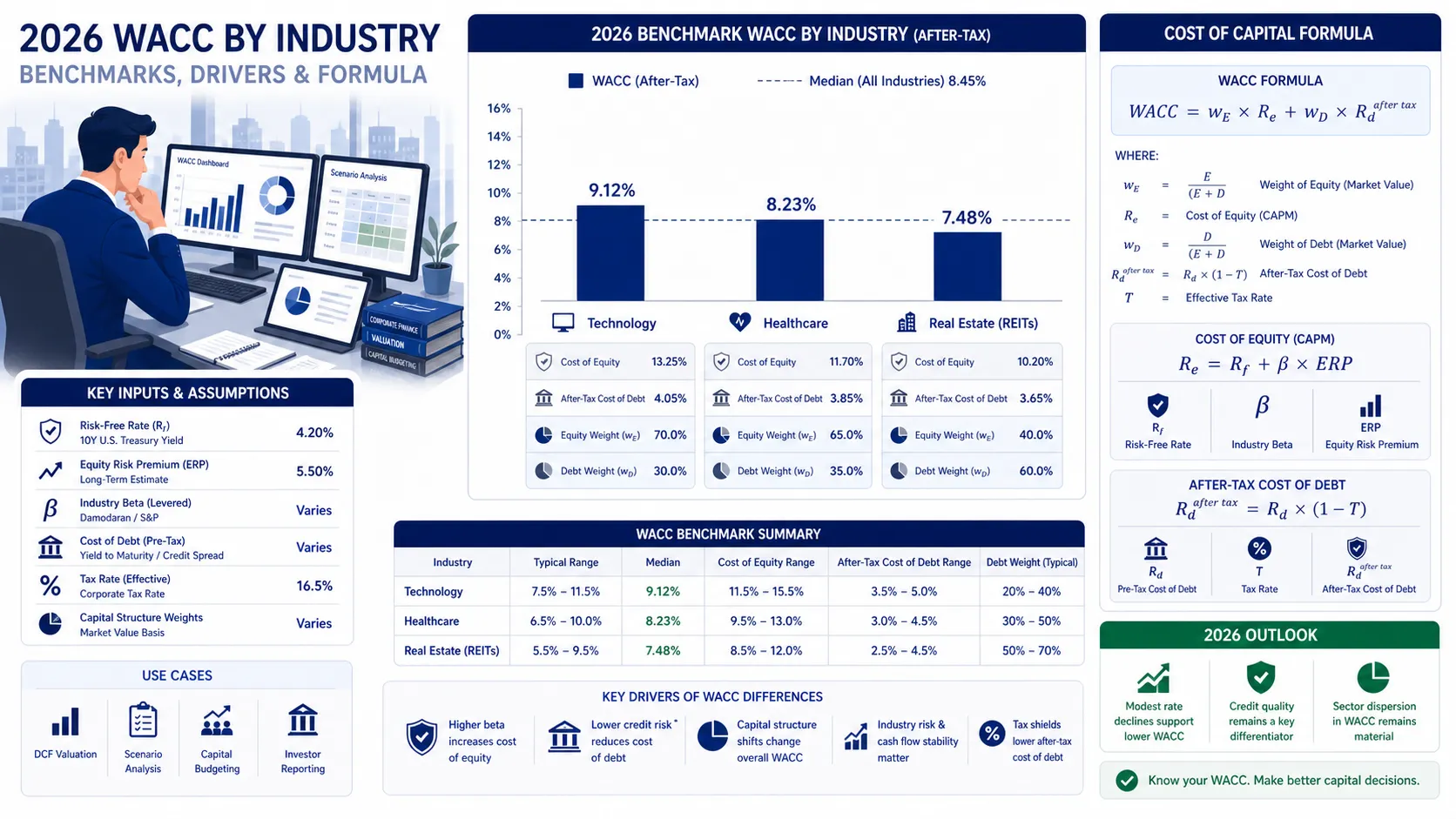
WACC by Industry: 2026 Benchmarks for Technology, Healthcare, and Real Estate
In 2026, industry WACC diverges sharply, from 5.5% for utilities to over 11.5% for software. CFOs must benchmark their discount rate against peers to ground valuations in market reality.
 Corporate Finance
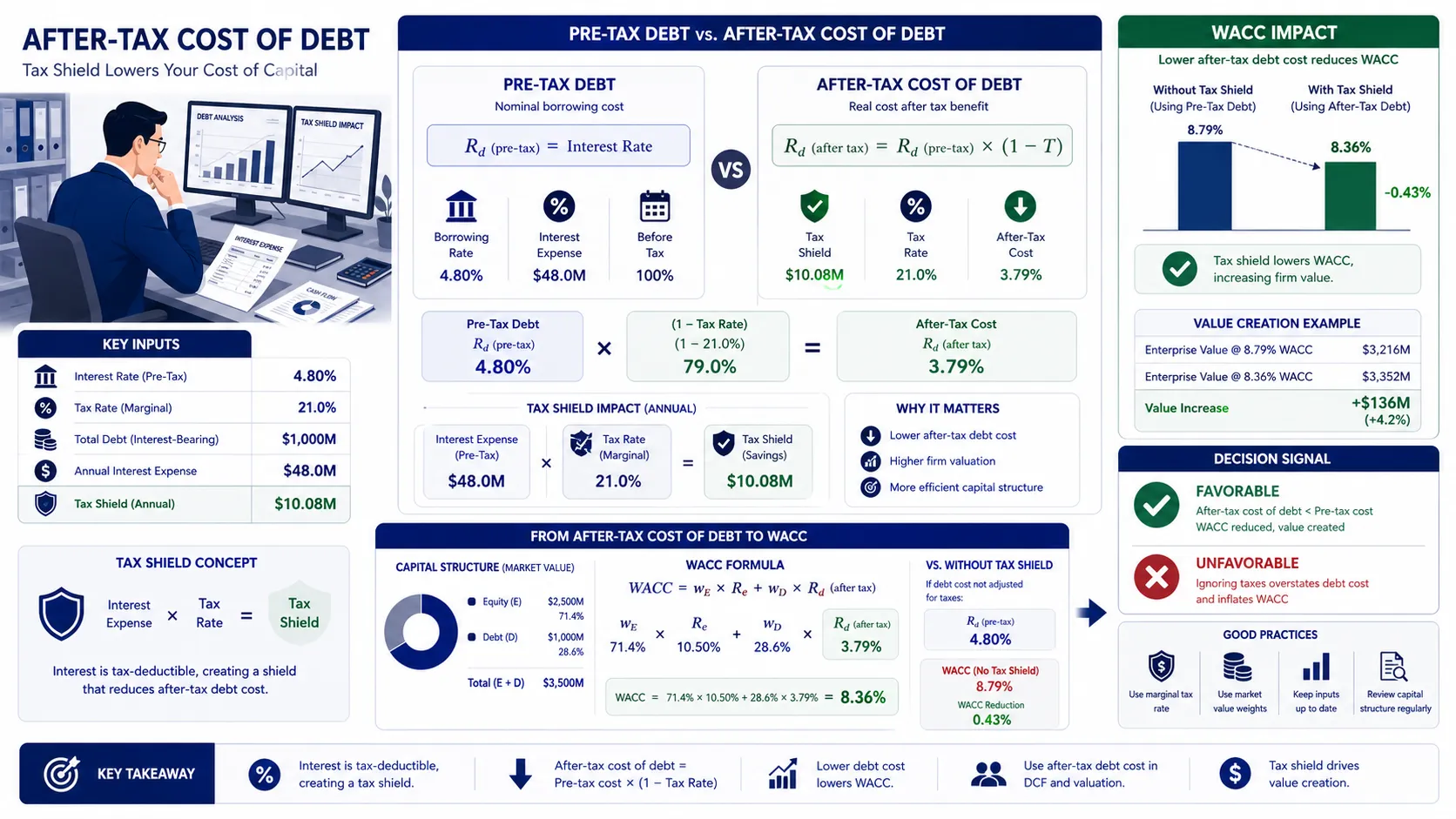
What Is After-Tax Cost of Debt and How Does It Lower WACC?
Interest payments are tax-deductible, making debt cheaper than equity and lowering your company's WACC. The after-tax cost of debt reveals this true, subsidized borrowing rate.
 Corporate Finance
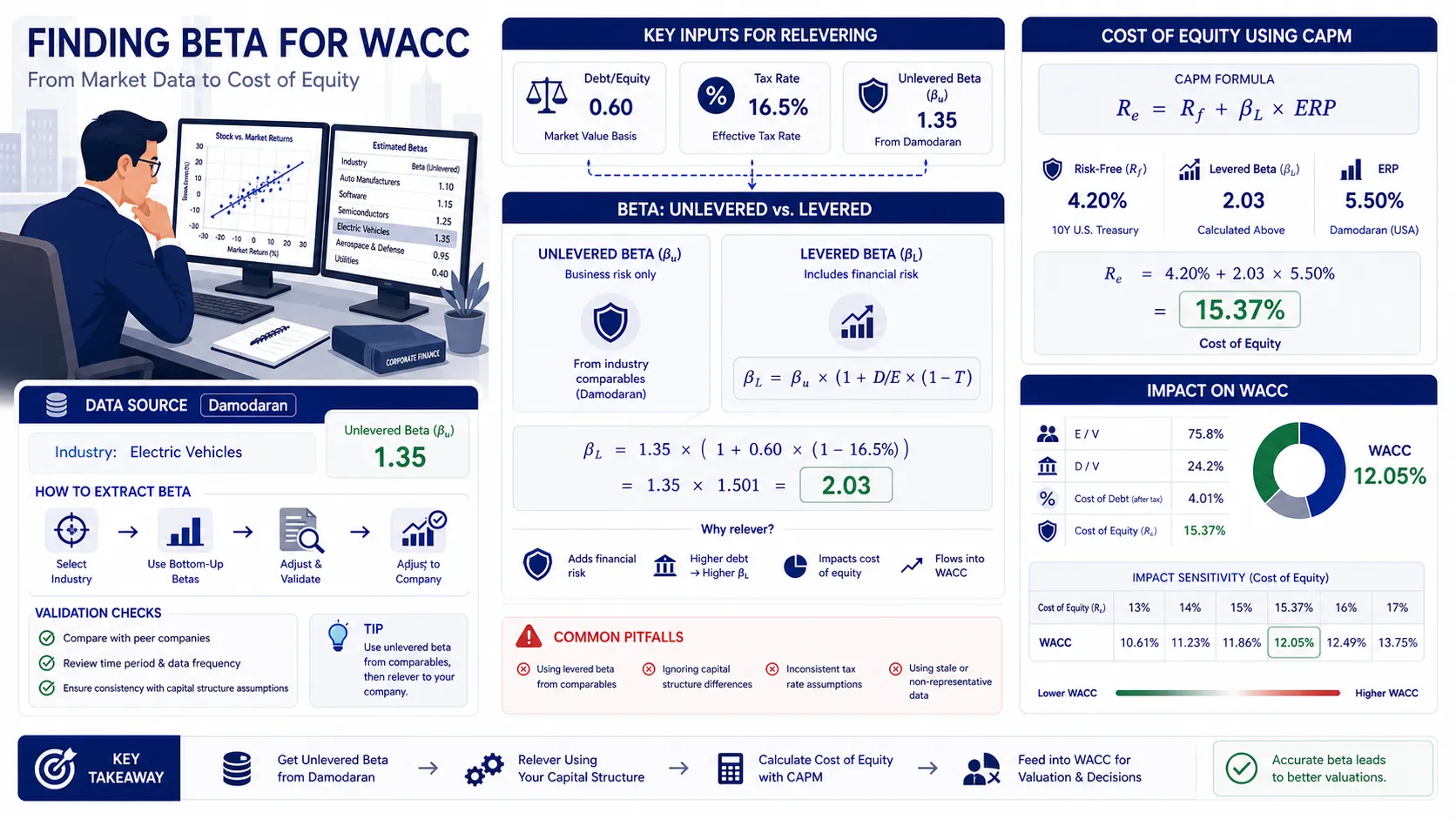
How to Find Beta for WACC: Unlevered vs Levered Beta Calculati
Unlock institutional-grade WACC by mastering bottom-up beta: unlever public peers to strip debt risk, then re-lever for your target's capital structure. This precision method solves CAPM's toughest hurdle, delivering accurate equity risk pricing for DCF models.
Frequently Asked Questions
What parameters does MIRR require?
Why is MIRR usually lower than IRR?
Can MIRR handle multiple investment outlays?
The calculations, projections, and reports generated by BizToolkitPro are for educational and informational purposes only. They do not represent professional investment advice, financial planning, tax guidance, legal counsel, or formal business valuation.
Financial models and valuation formulas (including WACC, DCF, IRR, and NPV) rely on assumptions and inputs provided directly by the user. Actual financial markets and business metrics fluctuate; therefore, BizToolkitPro makes no warranties, express or implied, regarding the accuracy, completeness, or suitability of the outputs for any investment strategy or corporate decision.
Always perform your own independent diligence and consult with a licensed Financial Analyst, Certified Public Accountant (CPA), or certified valuation specialist before committing capital or executing corporate transactions.