
Discounted Payback Calculator - Present Value Breakeven
Use this focused discounted payback calculator, designed to solve the exact period required to recover your investment capital on a present-value basis.
By discounting each cash inflow using your cost of capital (WACC) or discount rate, this tool offers a realistic, inflation-adjusted breakeven timeline, addressing the primary limitation of simple payback period models.
Set initial costs and hurdle rates.
Enter expected nominal cash inflows from Year 1.
Have a suggestion or found a calculation discrepancy? Let us know!
Understanding discounted payback in capital budgeting
Simple vs. discounted payback comparison
The simple payback period model has a massive flaw: it treats a dollar received in Year 5 exactly the same as a dollar received in Year 1. Because of inflation and opportunity costs, receiving cash later is less valuable than receiving it today. Simple payback can lead corporate managers to accept projects that break even quickly in nominal terms but actually destroy present value when adjusted for capital costs.
Discounted payback resolves this by discounting each future inflow using the cost of capital (r). Because discounted cash flows are smaller than nominal cash flows, the discounted payback period is always longer than the simple payback period. It provides a more conservative, risk-adjusted timeline that aligns with net present value principles.
Why discounted payback is vital for risk mitigation
In capital budgeting, the discounted payback period acts as a liquidity screening limit. High-risk projects or investments in changing technology markets require rapid cash recovery. By factoring in the cost of debt or equity, firms ensure that they are not only getting their nominal cash back, but also earning enough to cover their cost of funding during the recovery phase.
If a project's discounted payback period exceeds its useful life, or is longer than the company's maximum risk tolerance limit, it should be rejected. This is equivalent to having a negative NPV.
Factoring in capital opportunity costs
Every dollar invested in a project represents an opportunity cost. If those funds were left in alternative market assets, they would generate a baseline compound return. Discounted payback incorporates this opportunity cost explicitly into the timeline, protecting corporate cash structures from value-destructive investments.
How to use this discounted payback calculator
Set investment outlay and hurdle rates
Begin by entering the Initial Investment outlay required at Year 0. Then, input the corporate Discount Rate (hurdle rate, in %). This discount rate should reflect your company's Weighted Average Cost of Capital (WACC) or the cost of debt/equity funding the project.
Next, populate the list of expected annual cash inflows. You can add more forecast years or remove unnecessary ones to match your project's schedule.
Examine present-value recovery trends
Once you click "Run Solver," the outputs will refresh. The dual line chart compares the simple recovery timeline against the discounted recovery path. This visual comparison highlights the impact of the cost of capital over the project's life.
Explore sensitivity matrices
You can toggle to the Sensitivity Grid to see how changing cost of capital rates or flows variance impacts your recovery timeline, or view the scenario panel to compare conservative downside models.
Compare discounted payback timing scenarios
Discounted Payback baseline scenario
The base scenario represents your expected operating parameters. Cash inflows and discount rates are modeled under moderate, normal-state forecasts to establish a baseline present-value recovery timeline.
Discounted Payback upside scenario
The bull scenario models upside operational performance. Larger cash inflows and lower market discount rates accelerate the present-value compounding, resulting in a significantly shorter recovery timeline.
Discounted Payback downside scenario
The bear scenario tests downside risk. Reduced cash inflows combined with higher financing discount rates delay cost recovery, often flagging the project as "Not Recovered" within the expected lifecycle.
Discounted payback sensitivity analysis
Discount rate vs cash inflows variables
The sensitivity grid maps the solved discounted payback period against shifting discount hurdle rates (vertical) and cash flow variables (horizontal). This matrix is essential for identifying risk thresholds.
Identifying WACC threshold limits
By observing the cell values in the sensitivity matrix, you can identify the exact discount rate limit where the project's recovery timeline exceeds its useful life, serving as a warning indicator.
Assessing cash flow stability
If a small cost increase (e.g., +5%) triggers a massive delay in present-value recovery, the project carries high financial risk. Robust projects show stable recovery timelines across parameters.
Discounted payback formula and methodology
Methodology
First, discount each period's cash inflow:
Then, calculate the recovery year:
Step-by-step discounted payback logic
First, translate each expected nominal cash flow into present value using the discount rate (r). Second, build a cumulative present value timeline starting with the negative outlay. Add each discounted flow to the balance until it crosses from negative to positive. Identify the year (t) right before the crossover year. Finally, calculate the decimal fraction by dividing the absolute value of the remaining negative present value at year t by the present value of inflows in period t+1.
Example calculation of discounted payback
Project cash flows and discount parameters
Let's analyze a project with an outlay of $100,000. It returns cash inflows of $40,000 per year for 4 years. The company requires a hurdle return of 10%. We want to find the discounted payback period.
First, we discount each inflow:
- Year 1 PV: $40,000 / 1.10 = $36,363.64
- Year 2 PV: $40,000 / 1.10^2 = $33,057.85
- Year 3 PV: $40,000 / 1.10^3 = $30,052.59
- Year 4 PV: $40,000 / 1.10^4 = $27,320.54
Crossover analysis and solution
Let's aggregate cumulative present values:
- Year 0: -$100,000
- Year 1: -$100,000 + $36,363.64 = -$63,636.36
- Year 2: -$63,636.36 + $33,057.85 = -$30,578.51
- Year 3: -$30,578.51 + $30,052.59 = -$525.92
- Year 4: -$525.92 + $27,320.54 = +$26,794.62
Crossover happens in Year 4. At Year 3, the unrecovered present value is $525.92. The Year 4 discounted inflow is $27,320.54. The discounted payback period is: 3 + ($525.92 / $27,320.54) = 3.02 years. Note that the simple payback period for this project would be exactly 2.50 years. The 10% discount rate adds 0.52 years to the breakeven timeline.
Common mistakes in discounted payback calculations
Applying incorrect discount factors
A frequent mathematical mistake is using simple interest discounting rather than compound interest discounting. The discount factor must increase exponentially with each period: (1+r)^t. Using linear discounting (e.g. dividing by 1 + r*t) understates the cost of capital over longer horizons, leading to prematurely short payback outputs.
Disregarding cash flows beyond payback
Just like the simple payback method, the discounted payback period still ignores all cash flows generated after the project breaks even. An investment that pays back in 3 years and then shuts down is ranked higher than one that pays back in 3.5 years but yields high returns for another decade. Always run an NPV comparison to check total wealth creation.
Real-world case study: Industrial Manufacturing Sector Benchmark (2025 Industry Standard)
Industrial Manufacturing Sector Benchmark metrics profile
This case study examines a hypothetical industrial manufacturing company undertaking a significant capital project, such as a plant upgrade or new production line. The Discounted Payback Calculator is applied to evaluate the project's financial viability by determining how long it takes for the investment's discounted cash flows to recover the initial outlay, providing insights into liquidity and project risk.
The calculated discounted payback period of approximately 4.3 years for this industrial project indicates a reasonable time frame for recouping the initial investment, adjusted for the time value of money. This metric is crucial for capital budgeting decisions, as it provides management with a clear understanding of the project's liquidity risk and how quickly capital is freed up for other ventures. A weighted average cost of capital (WACC) of 10% is consistent with benchmarks for the industrial manufacturing sector. While a shorter payback period is often preferred, this duration suggests a balanced approach to risk and return, especially if the project's economic life extends significantly beyond the payback period, generating substantial long-term value.
Related Calculators
Estimate weighted average cost of capital.
Open Tool →DCF CalculatorValue a business using discounted cash flows.
Open Tool →NPV CalculatorCompute net present value of cash flows.
Open Tool →IRR CalculatorSolve project internal rates of return.
Open Tool →Free Cash Flow CalculatorEstimate operating free cash flow.
Open Tool →Break-Even ROI CalculatorAnalyze payback thresholds and returns.
Open Tool →Related Articles & Guides
 Corporate Finance
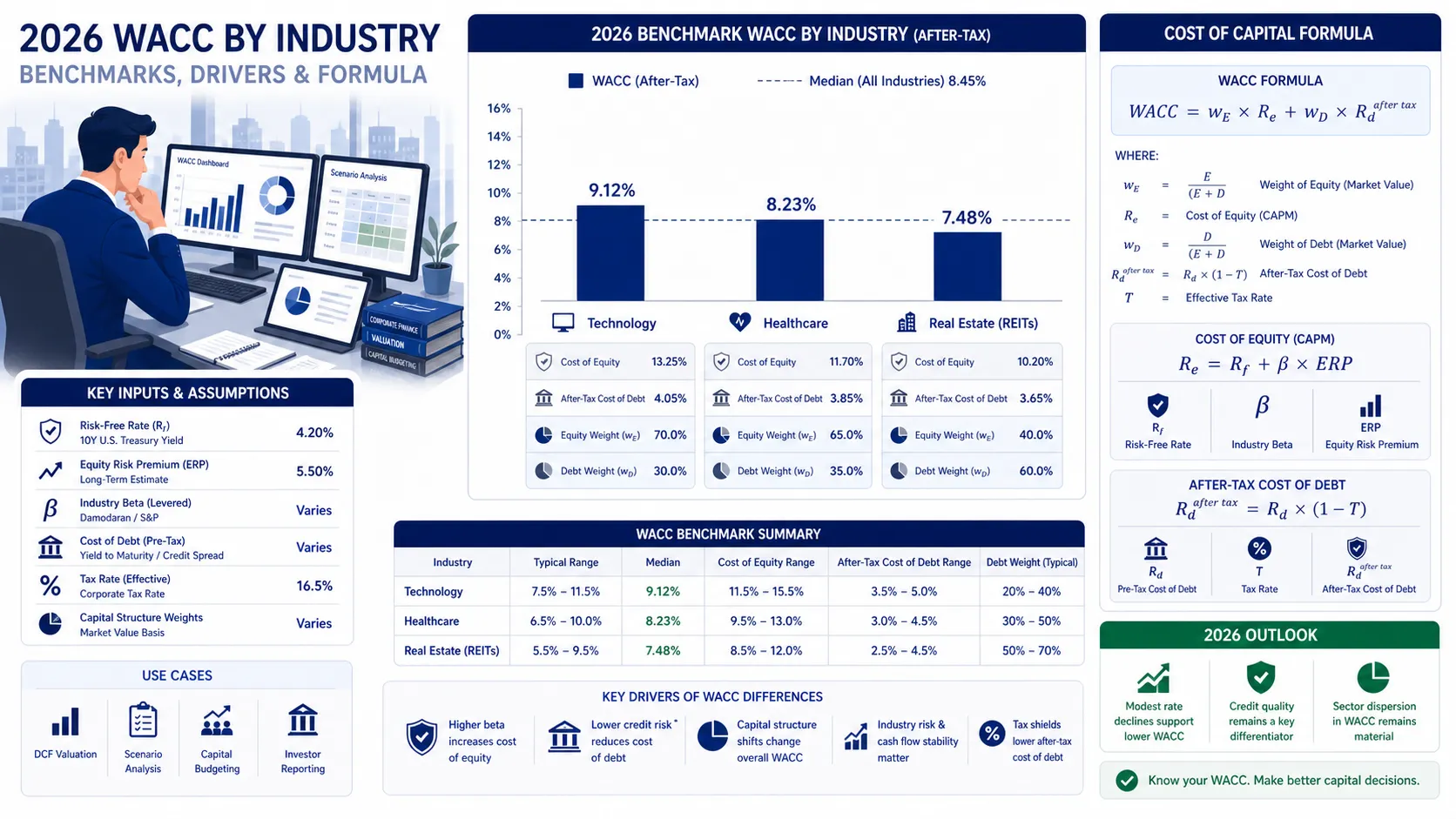
WACC by Industry: 2026 Benchmarks for Technology, Healthcare, and Real Estate
In 2026, industry WACC diverges sharply, from 5.5% for utilities to over 11.5% for software. CFOs must benchmark their discount rate against peers to ground valuations in market reality.
 Corporate Finance
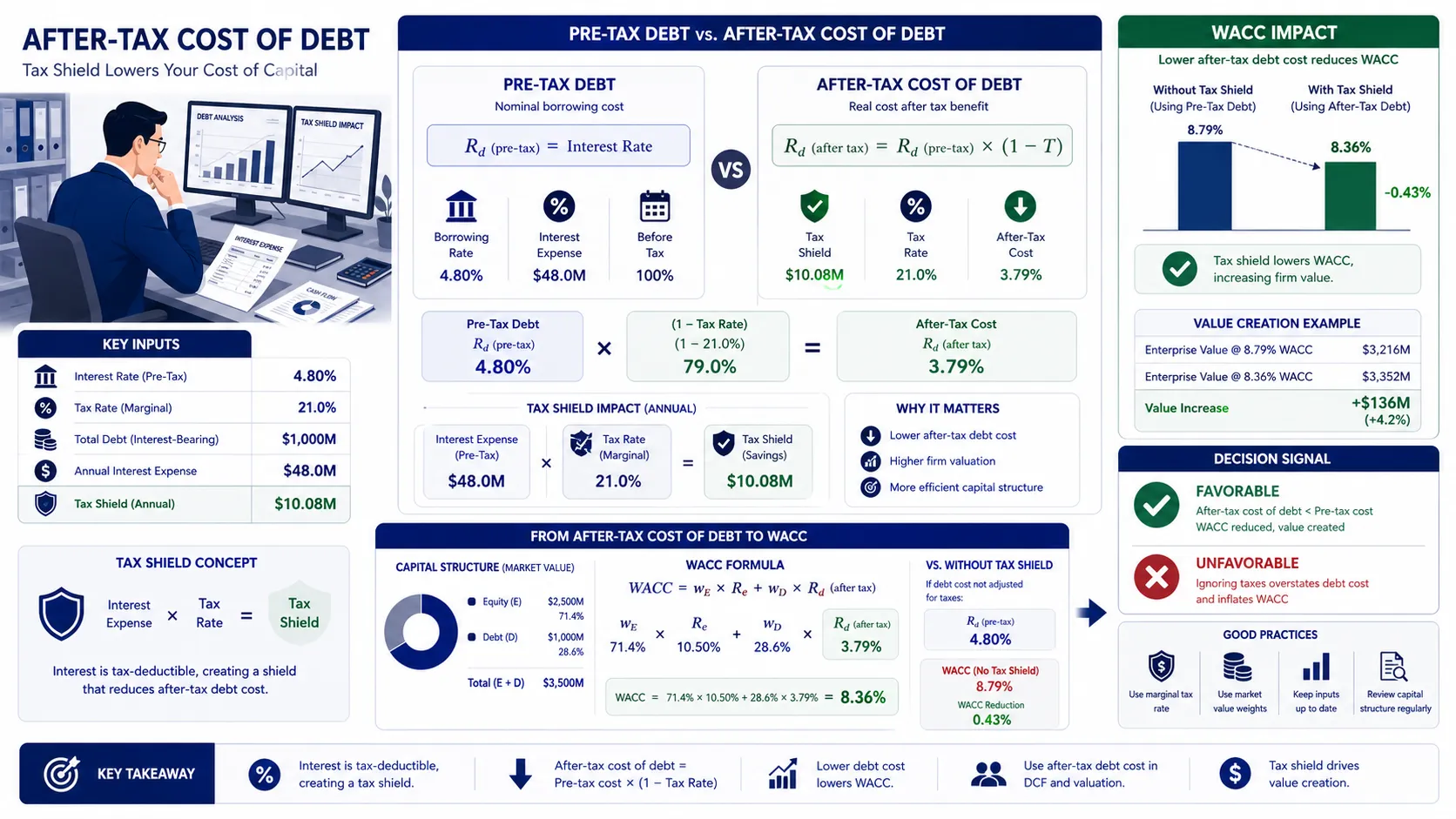
What Is After-Tax Cost of Debt and How Does It Lower WACC?
Interest payments are tax-deductible, making debt cheaper than equity and lowering your company's WACC. The after-tax cost of debt reveals this true, subsidized borrowing rate.
 Corporate Finance
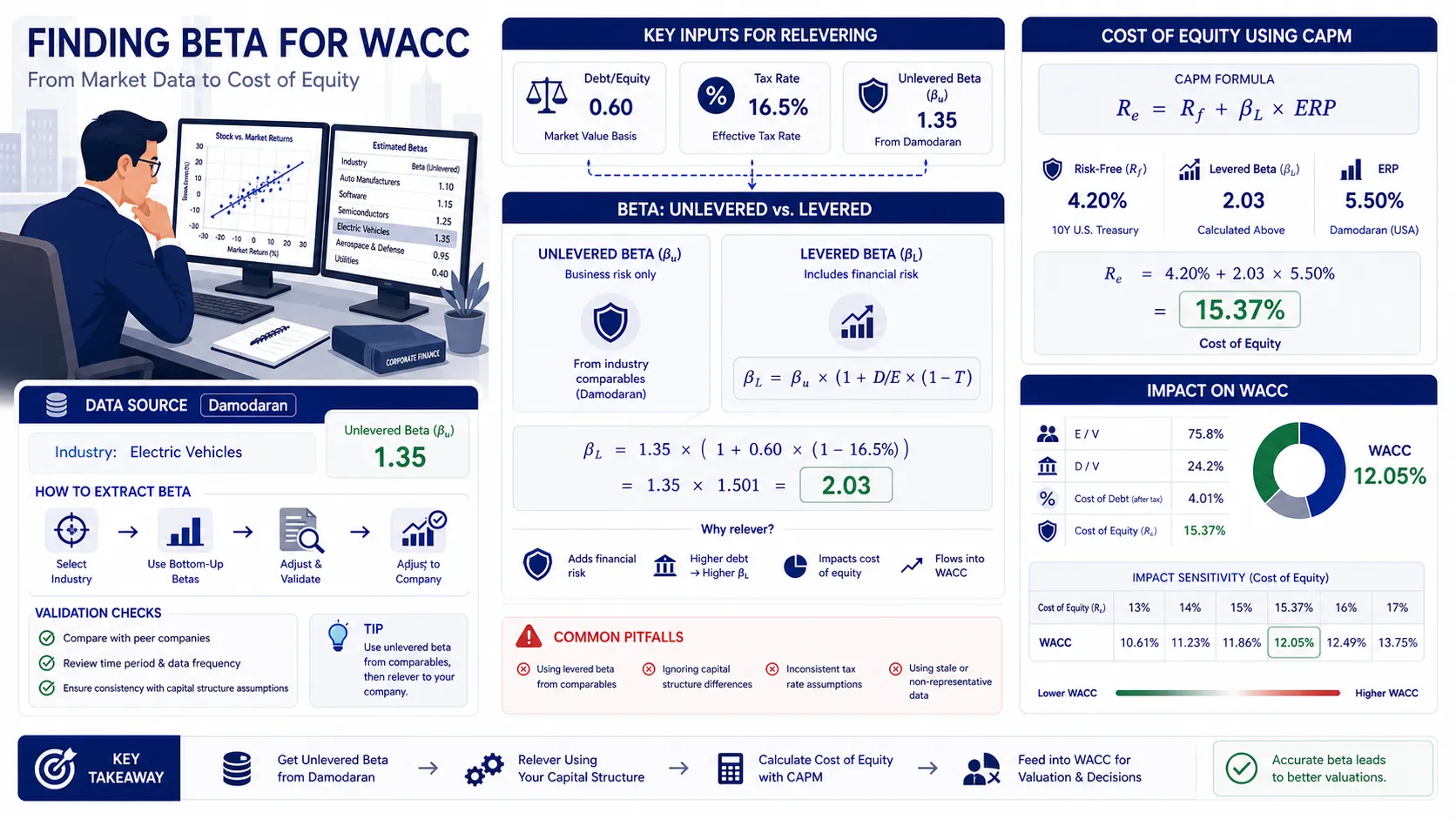
How to Find Beta for WACC: Unlevered vs Levered Beta Calculati
Unlock institutional-grade WACC by mastering bottom-up beta: unlever public peers to strip debt risk, then re-lever for your target's capital structure. This precision method solves CAPM's toughest hurdle, delivering accurate equity risk pricing for DCF models.
Frequently Asked Questions
Why is the discounted payback period always longer?
What happens if the project never pays back?
The calculations, projections, and reports generated by BizToolkitPro are for educational and informational purposes only. They do not represent professional investment advice, financial planning, tax guidance, legal counsel, or formal business valuation.
Financial models and valuation formulas (including WACC, DCF, IRR, and NPV) rely on assumptions and inputs provided directly by the user. Actual financial markets and business metrics fluctuate; therefore, BizToolkitPro makes no warranties, express or implied, regarding the accuracy, completeness, or suitability of the outputs for any investment strategy or corporate decision.
Always perform your own independent diligence and consult with a licensed Financial Analyst, Certified Public Accountant (CPA), or certified valuation specialist before committing capital or executing corporate transactions.