
Capital Allocation Calculator - Optimal Portfolio Selection
Use this focused capital allocation calculator, a premium corporate finance utility designed to solve the optimal subset of investment candidates under strict budget constraints. Corporate executives and financial planners frequently face situations where they must prioritize projects to maximize overall returns while working within a fixed capital budget.
This calculator goes beyond simple heuristics, implementing a mathematical binary knapsack solver that identifies the absolute best combination of projects. Compare the optimal allocation model against simple Profitability Index ranking, inspect multi-dimensional cost sensitivity grids, and export professional advisory memos.
Define capital threshold limit to constrain project selection.
Input capital requirement cost and projected Net Present Value (NPV).
Have a suggestion or found a calculation discrepancy? Let us know!
How to use this capital allocation calculator
Defining project costs and cash inflows (NPV)
To begin modeling your capital budget, you must first define the candidate projects. In the left panel, add rows for each project under consideration. For each project, input a unique project name (or identifier) along with two critical financial metrics:
- Outlay Cost: The initial capital expenditure (CAPEX) required to launch and execute the project. This cost is treated as a hard subtraction from the overall budget pool.
- Project NPV: The estimated Net Present Value that the project is expected to generate. This value represents the present value of future cash inflows discounted at your hurdle rate, minus the outlay.
Ensure all values are stated in consistent currency units to maintain structural calculation integrity.
Setting your portfolio budget constraints
Once you have populated your candidate list, set the Capital Budget Cap. This represents the total amount of investment funding available for allocation during the budget period.
After defining the budget limit and the projects, click the "Solve Portfolio" button. The results panel will automatically refresh to display the optimal subset of selected projects, the maximum cumulative NPV created, the total cost outlay, and the remaining unallocated cash. You can toggle tabs on the results card to inspect the sensitivity grid and compare the results to greedy PI heuristics.
Capital allocation decision-making framework (optimal vs greedy)
Why simple PI ranking leads to sub-optimal subsets
A common approach to capital allocation is the "Greedy" method, where projects are ranked in descending order of their Profitability Index (PI = NPV / Cost). Analysts fund the highest-ranked projects one by one until the budget runs out. While intuitive, this approach often yields sub-optimal results in the presence of indivisible projects and tight budgets.
For example, if the budget is $100,000, and we have Project X (Cost $60,000, NPV $45,000, PI 0.75), Project Y (Cost $50,000, NPV $35,000, PI 0.70), and Project Z (Cost $50,000, NPV $35,000, PI 0.70). The greedy method selects Project X first because of its higher PI. However, this leaves only $40,000 in the budget, which is not enough to fund either Project Y or Z. The total NPV created is $45,000, with $40,000 left uninvested.
The economic value of mathematical optimization (knapsack solver)
A mathematical solver looks at the entire combination of projects to find the optimal solution. In the example above, a binary knapsack solver recognizes that by bypassing Project X, it can select *both* Project Y and Project Z.
This combination costs exactly $100,000 (utilizing the budget fully) and generates a total NPV of $70,000 ($35,000 + $35,000). By employing the optimal model instead of the greedy ranking, the firm generates an extra $25,000 of wealth from the same $100,000 budget cap.
This is the essence of capital optimization: maximizing the yield of capital resources by analyzing the full combinatorics of candidates.
Mathematical modeling of portfolio selection (the binary knapsack problem)
The Knapsack Problem Formulation
Capital allocation can be mathematically modeled as a 0-1 Knapsack Problem, where each project (i) can either be selected (x_i = 1) or rejected (x_i = 0):
Algorithm choice: dynamic programming vs bitmask search
To solve this optimization problem, two primary algorithmic approaches can be utilized depending on the scale and nature of the inputs:
- Dynamic Programming (DP): Builds a lookup table to solve sub-problems based on integer budget values. While highly efficient for small, integer-based budgets, it scales poorly (pseudo-polynomial time complexity) when budget limits or costs are large decimal numbers, leading to massive memory consumption.
- Bitmask Search (Exact Iterative Solver):For portfolios with a moderate number of projects (N ≤ 16), our engine uses a bitmask search. By testing all 2^N possible project combinations (e.g., 65,536 combinations for N = 16), this algorithm identifies the absolute global maximum with complete floating-point precision, bypassing the scaling and rounding errors associated with DP.
Formula & methodology for capital allocation efficiency
Measuring total NPV yield and allocated budget ratios
To evaluate the efficiency of your capital program, the calculator computes the Allocation Efficiency Ratio:
Allocation Efficiency = ( Total Cost of Selected Projects / Total Budget Cap ) * 100
This ratio measures how much of the available funding is actively deployed. A higher ratio indicates that the solver successfully identified a combination of projects that utilizes the available capital, minimizing uninvested cash reserves that drag down overall returns.
Understanding the profitability index threshold limit
The Profitability Index (PI) serves as the primary efficiency metric for individual projects. It measures the value generated per dollar of capital outlay:
Profitability Index (PI) = Net Present Value (NPV) / Initial Cost
A project is value-creative only if its PI is greater than 0. Projects with a negative NPV (PI < 0) should be excluded from candidate lists entirely. While the solver does not rely on simple PI rankings to select projects, it uses PI values to verify that every funded candidate generates returns exceeding its initial cost.
Example calculation of capital portfolio allocation
Sample projects and budget constraint inputs
Let's walk through an illustrative allocation scenario for a business with a capital budget cap of $300,000. The company has four investment candidates:
- Project A: Cost = $100,000, NPV = $20,000 (PI = 0.20)
- Project B: Cost = $150,000, NPV = $35,000 (PI = 0.23)
- Project C: Cost = $200,000, NPV = $45,000 (PI = 0.225)
- Project D: Cost = $80,000, NPV = $15,000 (PI = 0.187)
Comparing optimal solver vs greedy PI ranking step-by-step
Let's analyze how both methods allocate the $300,000 budget:
1. Greedy PI Ranking Method:
- Sort by PI: Project B (0.233) → Project C (0.225) → Project A (0.20) → Project D (0.187).
- Select B (Cost $150k, NPV $35k). Remaining Budget = $150k.
- Try to select C (Cost $200k) → Exceeds budget. Skip.
- Select A (Cost $100k, NPV $20k). Remaining Budget = $50k.
- Try to select D (Cost $80k) → Exceeds budget. Skip.
- Greedy Outcome: Select A & B. Total Cost = $250,000. Total NPV = $55,000. Leftover Cash = $50,000.
2. Optimal Binary Knapsack Solver:
- Evaluates all combinations. Identifies that selecting Project B and Project C costs exactly $350,000 (exceeds budget), but selecting Project A and Project C costs exactly $300,000.
- Optimal Outcome: Select A & C. Total Cost = $300,000. Total NPV = $65,000 ($20k + $45k). Leftover Cash = $0.
The optimal solver generates an extra $10,000 in NPV wealth (an 18.18% return increase) by utilizing the budget fully, illustrating the advantage of mathematical portfolio modeling over simple heuristics.
What the optimal portfolio allocation results mean
Capital efficiency ratio and leftover budget allocation
A high allocation efficiency ratio indicates that your portfolio utilizes the available funding. However, if the optimal solver outputs significant leftover budget, it suggests a capital mismatch.
In such cases, the company can deploy the remaining cash to secondary liquid assets (like treasury bills) or reassess minor projects that require less capital outlay. Alternatively, the remaining funds can be returned to the corporate treasury to support subsequent funding cycles, ensuring capital is not left idle.
Hurdle rate sensitivity and costs fluctuation impact
Valuation estimates are highly sensitive to market fluctuations. If material costs rise or supply chain constraints increase project costs, the optimal combination can shift.
The Sensitivity Matrix addresses this risk by displaying the resulting total NPV across varying budget limits (columns) and cost multiplier adjustments (rows). Inspecting this matrix helps financial planning teams identify "robust" projects that remain selected even under adverse cost-overrun scenarios, providing a margin of safety for investment decisions.
Industry use cases for capital allocation
Venture capital and product portfolios
Venture capital partners and startup product leads use capital allocation models to prioritize product expansions. When selecting which software features or product lines to develop under a fixed engineering budget, team leads treat engineering sprints as cost constraints and projected user revenues as the NPV target, optimizing developer resources.
Corporate budgeting and infrastructure
Corporate finance teams and municipal agencies prioritize capital improvement plans (CIP) using allocation models. Public agencies must select which roads, parks, or utility networks to fund under tax revenue constraints, maximizing social benefit (or present value) while adhering to strict budget limitations.
SaaS marketing channels & LTV selection
Growth marketers allocate marketing budgets across multiple customer acquisition channels. By treating the customer acquisition cost (CAC) as the outlay and the customer lifetime value (LTV) as the return, teams solve the optimal acquisition portfolio to maximize MRR growth under a monthly marketing budget.
Common mistakes in capital budgeting and project prioritization
Relying solely on raw NPV size without cost constraints
A frequent capital prioritization mistake is funding projects based entirely on their absolute NPV size. For instance, a firm might select a massive project that generates $100,000 in NPV but costs $500,000 to execute.
By ignoring cost efficiency, the company consumes its entire capital pool on a single project. The same $500,000 could have funded five smaller projects costing $100,000 each and generating $30,000 in NPV each (totaling $150,000 in NPV). Always assess NPV relative to capital cost to ensure efficient allocation.
Using greedy heuristics for highly constrained capital structures
As illustrated in our decision-making comparison, ranking projects by Profitability Index and funding them sequentially is a heuristic, not an optimization. When budgets are tight and projects require large, indivisible outlays, greedy methods leave significant cash unallocated, depressing overall portfolio yields. Mathematical binary programming solvers are required to avoid this yield leak.
Neglecting project dependencies and timelines
Traditional knapsack models assume that candidate projects are completely independent. In the real world, projects often feature technical dependencies (e.g., Project B cannot be executed unless Project A is funded first) or cash flow interactions over time.
When avoiding capital budgeting mistakes, consider:
- Model Dependencies: Link dependent projects together in your candidate list by combining their costs and NPVs into a single portfolio choice.
- Account for Timing: Verify that the projected cash flows of selected projects align with your company's liquidity requirements across multiple fiscal periods.
- Verify Non-Financial constraints: Ensure the organization has the management bandwidth and engineering resources to execute all selected projects simultaneously.
Real-world case study: Apple Inc. (AAPL, FY 2023)
Apple Inc. metrics profile
Apple Inc., a global technology leader, consistently employs a multi-faceted capital allocation strategy, balancing reinvestment in its business with substantial returns to shareholders. For fiscal year 2023, the company demonstrated its commitment to both growth and shareholder value through significant expenditures in R&D, capital improvements, share repurchases, and dividends.
For Fiscal Year 2023, Apple Inc. allocated a total of $133.449 billion towards strategic investments and shareholder returns, exceeding its free cash flow of $99.584 billion. This indicates that Apple financed a portion of its capital allocation through existing cash reserves or other financing activities, beyond just the free cash flow generated in the year. The substantial share repurchases of $77.55 billion highlight the company's focus on returning capital to shareholders and managing its share count. Significant investments in R&D, totaling $29.915 billion, underscore Apple's commitment to innovation and maintaining its competitive edge. The consistent payment of $15.025 billion in dividends further reinforces its appeal to income-focused investors, demonstrating a balanced approach to capital stewardship and value creation.
Related Calculators
Estimate weighted average cost of capital.
Open Tool →DCF CalculatorValue a business using discounted cash flows.
Open Tool →NPV CalculatorCompute net present value of cash flows.
Open Tool →IRR CalculatorSolve project internal rates of return.
Open Tool →Free Cash Flow CalculatorEstimate operating free cash flow.
Open Tool →Break-Even ROI CalculatorAnalyze payback thresholds and returns.
Open Tool →Related Articles & Guides
 Corporate Finance
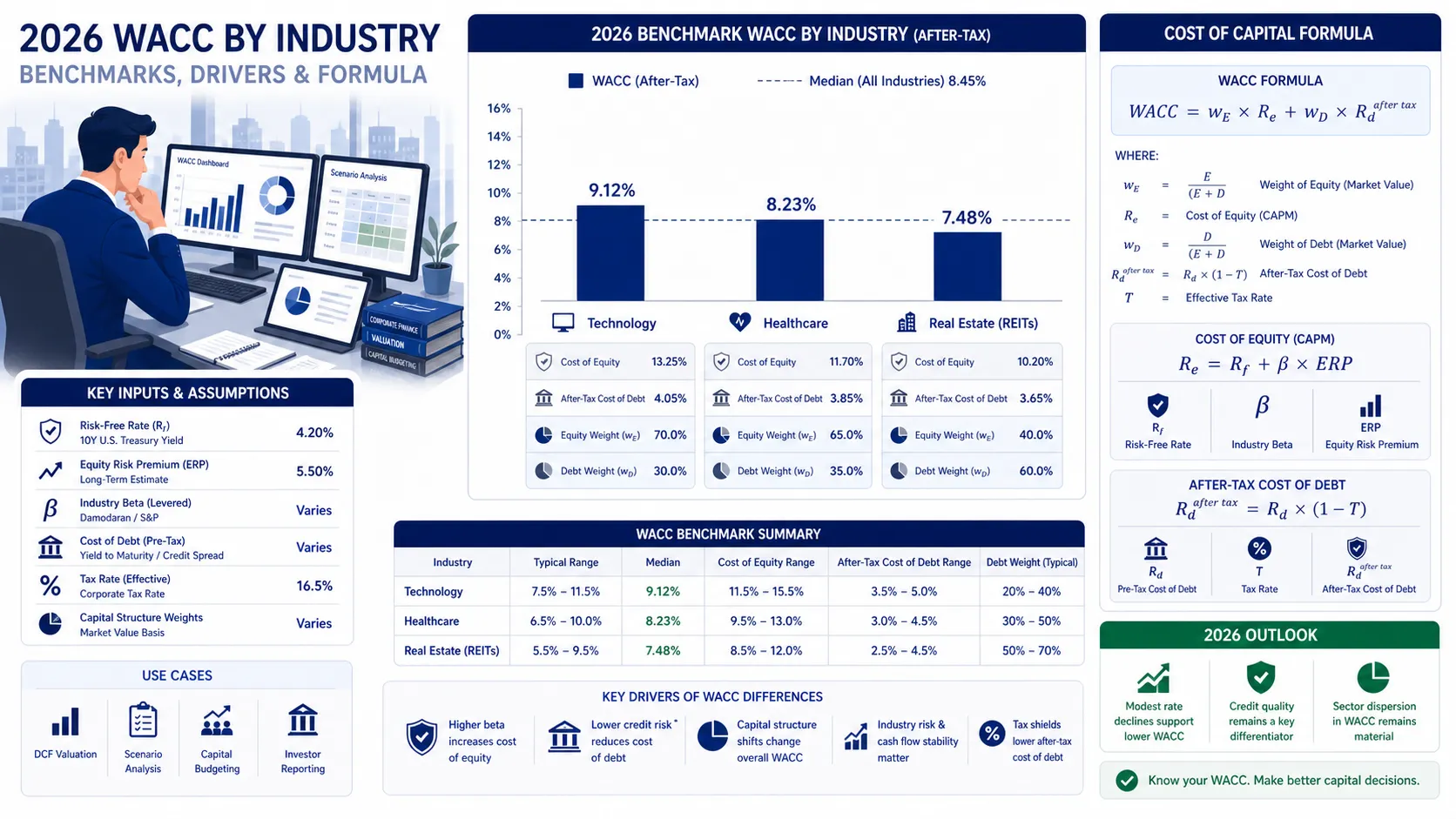
WACC by Industry: 2026 Benchmarks for Technology, Healthcare, and Real Estate
In 2026, industry WACC diverges sharply, from 5.5% for utilities to over 11.5% for software. CFOs must benchmark their discount rate against peers to ground valuations in market reality.
 Corporate Finance
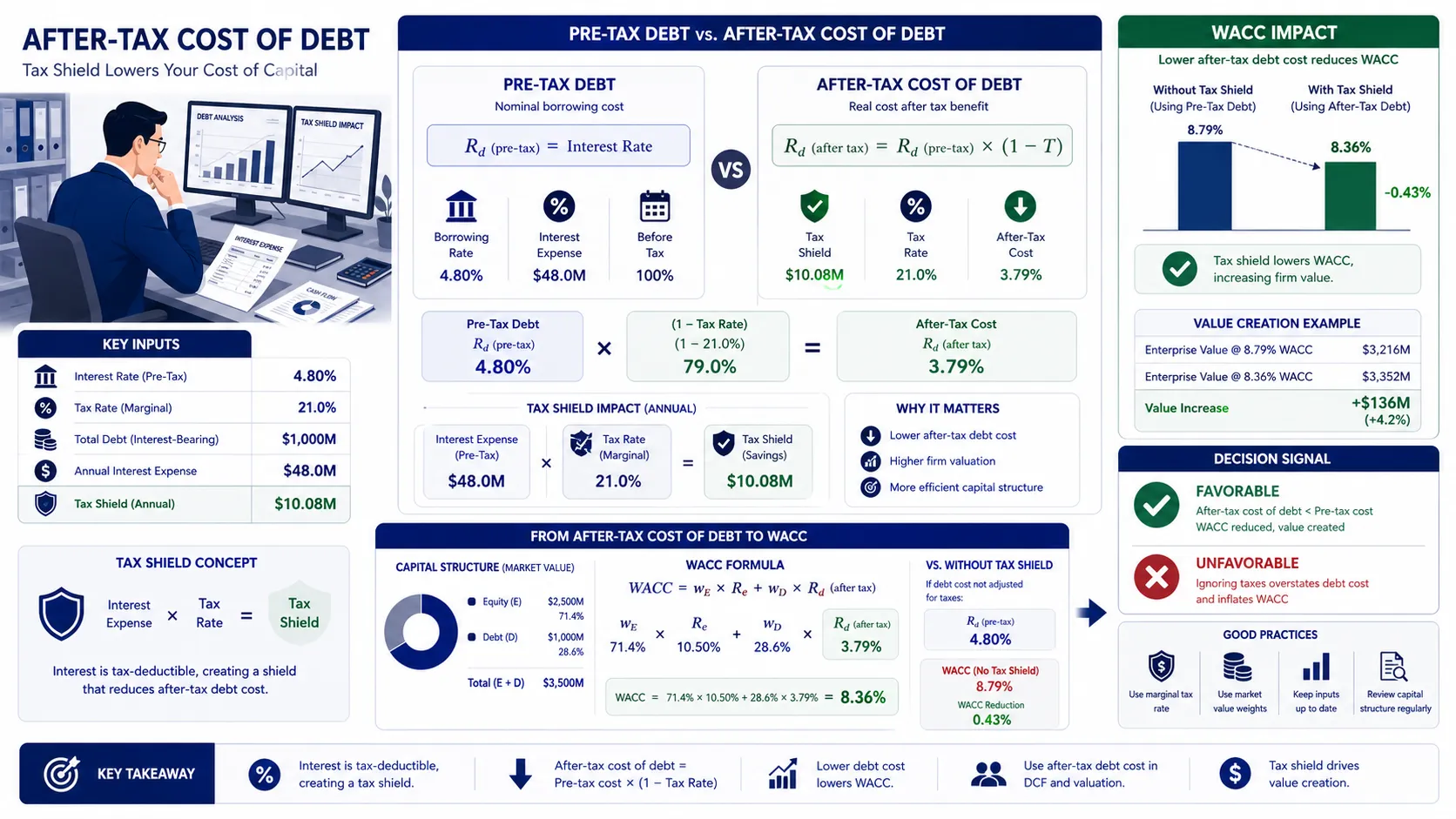
What Is After-Tax Cost of Debt and How Does It Lower WACC?
Interest payments are tax-deductible, making debt cheaper than equity and lowering your company's WACC. The after-tax cost of debt reveals this true, subsidized borrowing rate.
 Corporate Finance
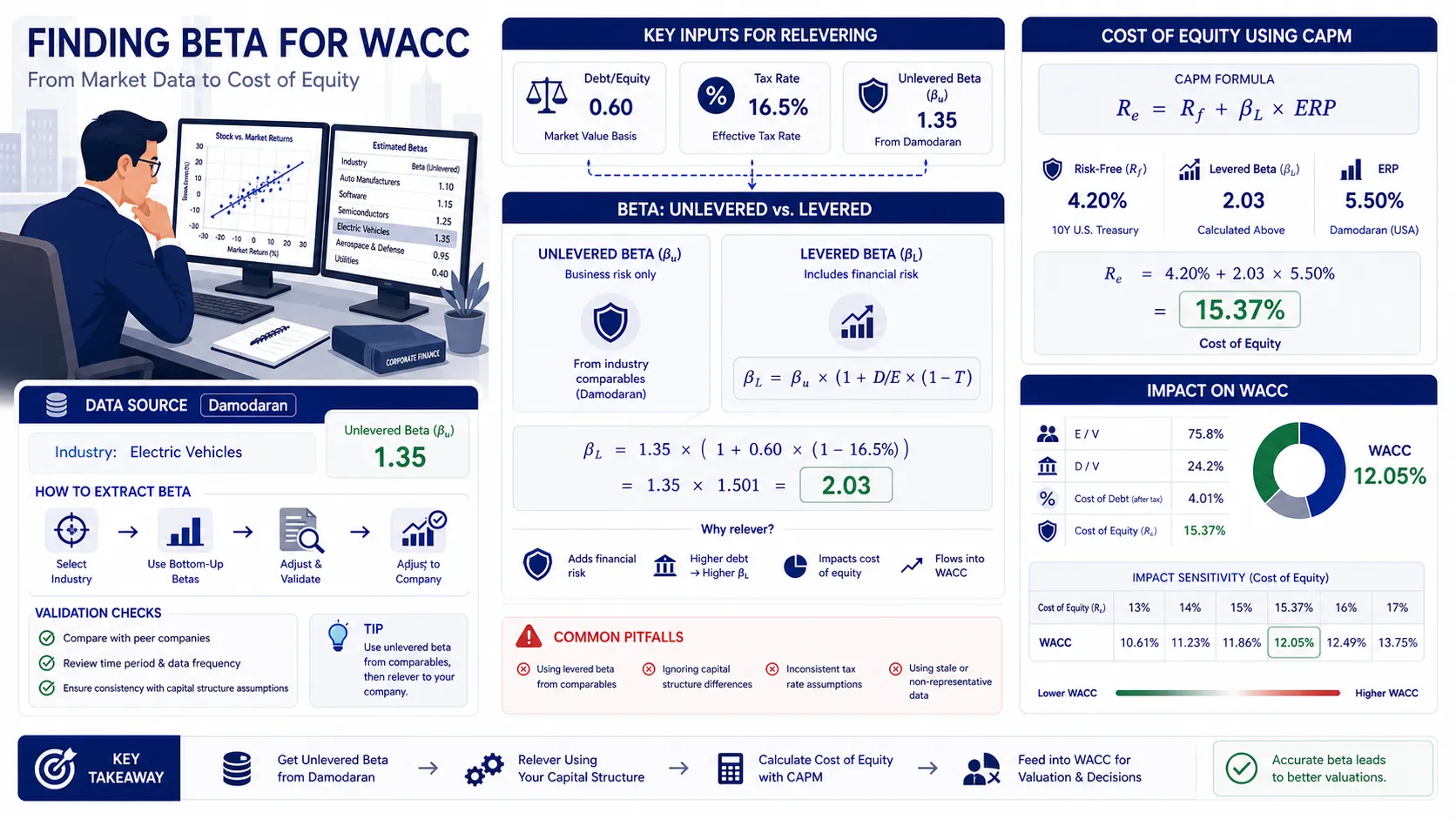
How to Find Beta for WACC: Unlevered vs Levered Beta Calculati
Unlock institutional-grade WACC by mastering bottom-up beta: unlever public peers to strip debt risk, then re-lever for your target's capital structure. This precision method solves CAPM's toughest hurdle, delivering accurate equity risk pricing for DCF models.
Frequently Asked Questions
What is the knapsack problem in capital allocation?
Why is dynamic programming sometimes used for portfolio selection?
How does cost sensitivity impact the optimal project selection?
Can I model project dependencies with this calculator?
The calculations, projections, and reports generated by BizToolkitPro are for educational and informational purposes only. They do not represent professional investment advice, financial planning, tax guidance, legal counsel, or formal business valuation.
Financial models and valuation formulas (including WACC, DCF, IRR, and NPV) rely on assumptions and inputs provided directly by the user. Actual financial markets and business metrics fluctuate; therefore, BizToolkitPro makes no warranties, express or implied, regarding the accuracy, completeness, or suitability of the outputs for any investment strategy or corporate decision.
Always perform your own independent diligence and consult with a licensed Financial Analyst, Certified Public Accountant (CPA), or certified valuation specialist before committing capital or executing corporate transactions.